Today’s mix of sunshine and rain left me in a melancholy mood which was not alleviated by the hotel’s awful spa.
I woke up to a horrible dream which put me on edge. And, typical: I’d left my mosquito repellant with Kelsey to offload some weight and now, in the night, they had assaulted me. It was my own fault – it was a balmy evening and I’d left the window open to hear the cicadas.
I received news from Stefano and Donatella that Oliver’s memory was returning and shortly after he sent me a Whatsapp message. Thank God.
The aftershocks of yesterday’s drama were still hitting me.
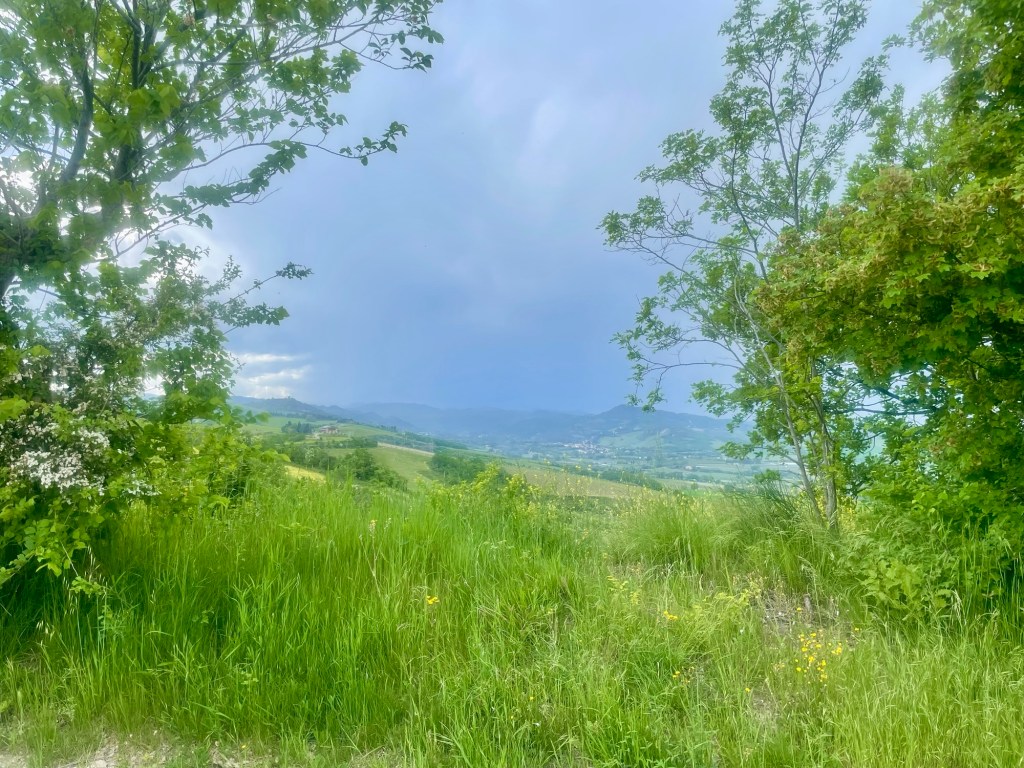
The rain fell lightly on the vineyards surrounding the agriturismo, la Sabbiona, which had a swimming pool and children’s play area for the summer. There was a bench made of wooden crates from which you could enjoy them, though something like a large football net obscured the view.
Over breakfast, I got chatting to Chris and Carey, a retired American engineer and teacher couple from Colorado who were vacationing in the region. We discussed Trump and their plans to keep travelling until his four-year reign was over. I thought of the schismatics and sewers of civil discord in Dante’s Inferno who are punished by having their body parts mutilated.
‘Who, even with untrammeled words and many
attempts at telling, ever could recount
in full the blood and wounds that I now saw?…And then, were one to show his limb pierced through
and one his limb hacked off, that would not match
the hideousness of the ninth abyss.No barrel, even though it’s lost a hoop
or end— piece, ever gapes as one whom I
saw ripped right from his chin to where we fart:his bowels hung between his legs, one saw
his vitals and the miserable sack
that makes of what we swallow excrement.’
The prophet Mohemmed shows his entrails to Dante and Virgil while on the left stands his son Ali, his head cleft from chin to forelock. Some other souls have their heads on backwards. That might be more suitable for Trump, I thought.
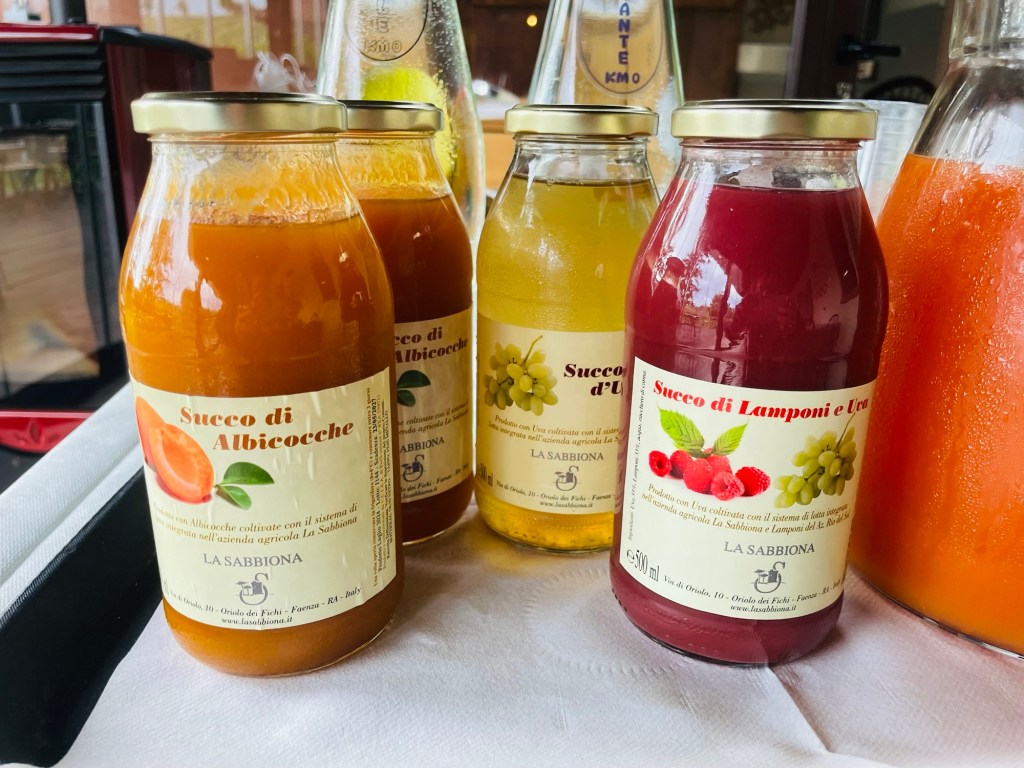
Breakfast consisted of homemade juices – I chose raspberry and grape – that came in plastic cups (Italians really like their plastic cups) and a range of home-baked pastries. There were some pretty flowers in a little boxes set out on the table in a line. Perhaps there would be a wedding. I realized as this thought transpired that I was thinking in Italian – un matrimonio.
I was eager to get back on the cammino after a couple of days of not walking but I was also tired. Yesterday had taken it out of me, even if I had slept all night. I had a headache and my stomach was playing up, so I took some paracetamol.
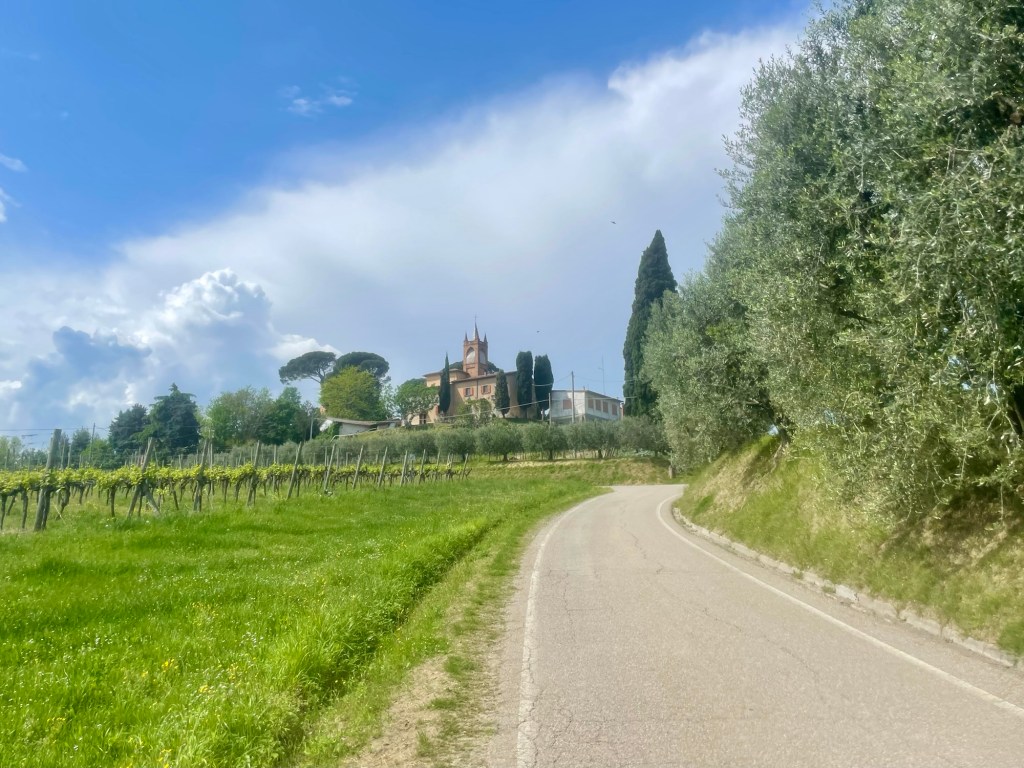
As I set off, I was rewarded with the familiar sight of olive, rosemary and fruit trees. When I passed guard dogs, now I greeted them familiarly, converted by my experience in Forlí.
The lizards were back and the thistles, poppies and sticky weed. Some wild verbena sprouted on the roadside.
A sign announced that we were in the land of ‘flavours and wine’.
Once I’d passed the little church of Sant’Apollinare, which had been reconstructed in 1946 after bombardments in World War Two, I passed onto a dirt road where poems had been pinned upon the tree barks and lamposts. One called ‘crickets’ by Nino da Oriolo read:
‘In the red of evening
The crickets serenade the moon
In a row with elms they stand on top of the hill,
They greet my day of work.
I feel them close,
They live in my land,
They live in my sun,
They feel my wind,
We enjoy the pleasure of living.
In silence they accompany me on my way.
I am not alone, we are not alone.’
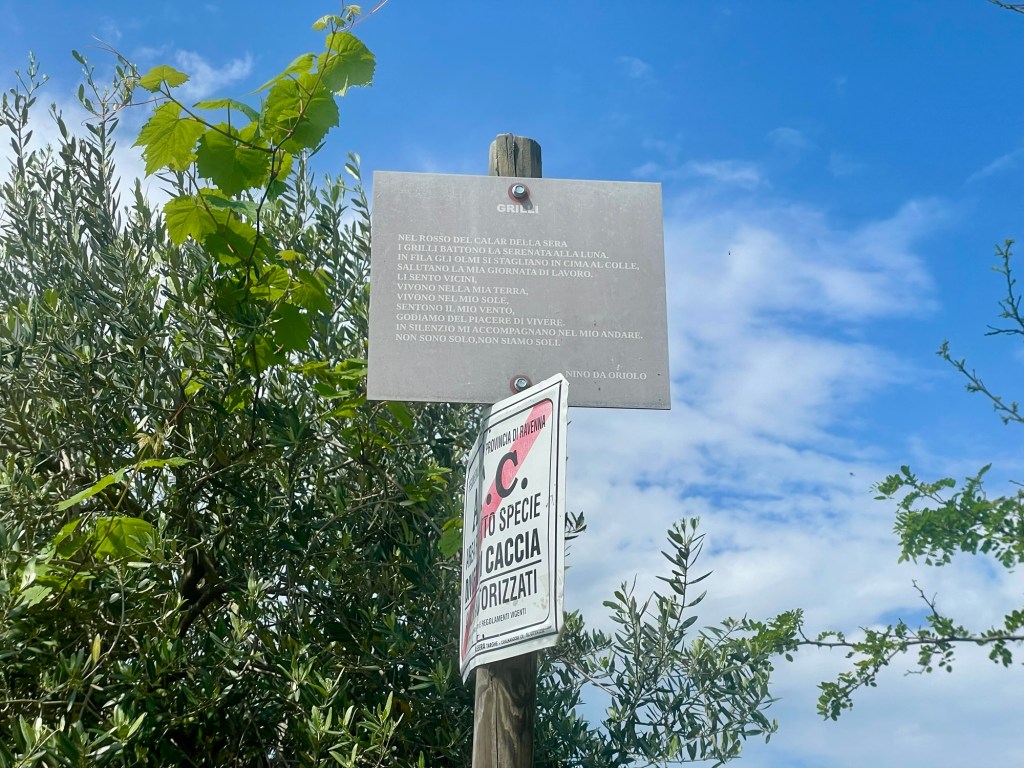
I felt alone today, though now I had met Giordano, Marcello and Oliver, the guardians of the trail, I had a new appreciation for every marker on a tree or lamppost to which they had put their generous hands. I recalled how Giordano and his son both had strong, thick fingers like tree branches.
I tried to religiously keep my feet dry as I navigated the mud which was embroidered with tractor tracks here and there.
Marco, who I had met at Fattoria Chiocce Romagnole, who had set off on the cammino from Ravenna, had written to warn me about the roads which were muddy and diverted in several places, and today, as I walked along, knocking over the daisies with the tip of my boot, I felt some comfort knowing that they had walked before me here.
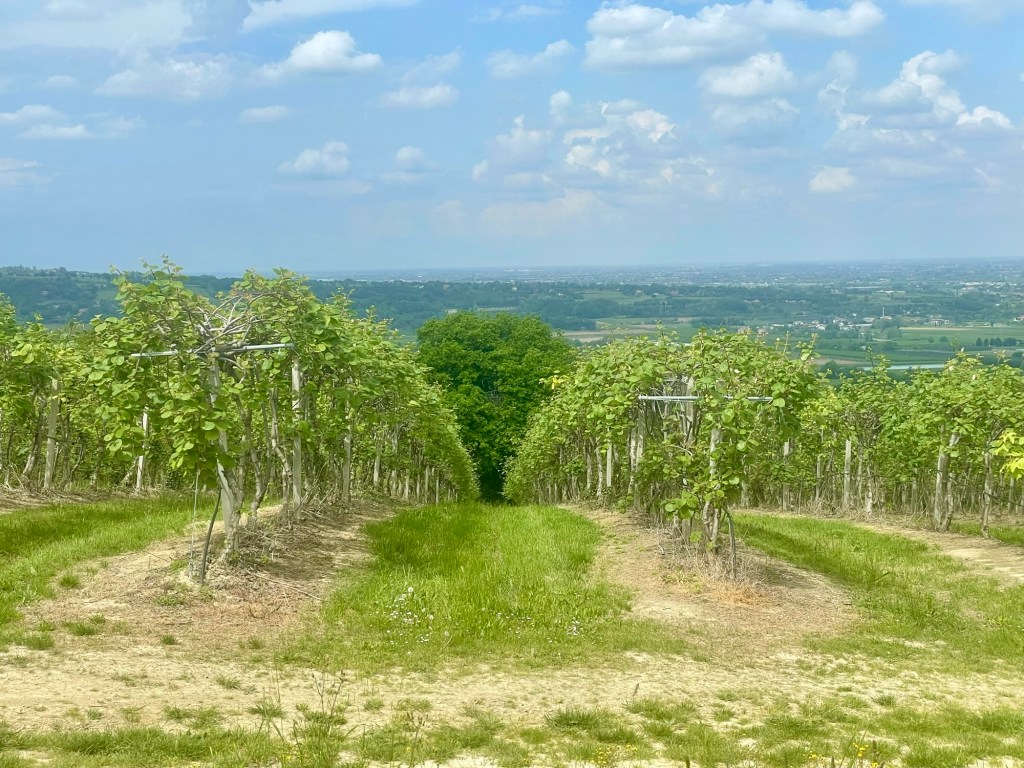
The path weaved in and out of the vines. A butterfly decorated some dog excrement and a man ate a brioche on a stationary tractor by the side of the road. The sun was strong up in the sky.
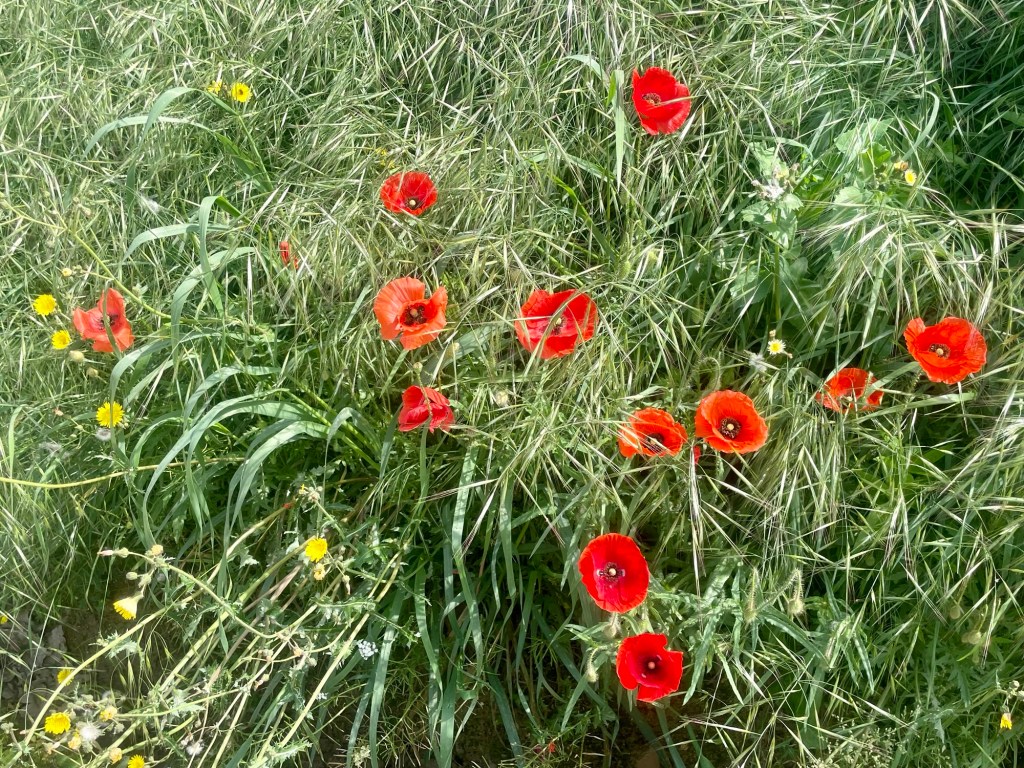
An explosion of poppies lined the margins of the path making me think back to the schismatics and of war.
My feet felt surprisingly OK. My shoes had fully dried out and I’d applied blister plasters preemptively before setting off. The wounds on the top of my toes had hardened into scabs.
It seemed like the world and his wife were mowing their lawns today in Oriolo. From everywhere emanated the smell of freshly cut grass.
A message from Kelsey arrived to say that the UN Lesbian March she had been organizing for this coming Saturday had been cancelled because some 250,000 people, including Trump, were expected to descend on Rome for Pope Frances’ funeral. Even from the grave it seemed he had it in for the gays.
I missed Kelsey.
Back on the tarmac, there appeared a pretty terracotta farmhouse to my right the colour of my bathroom and huge thistles the size of small children lined the road.
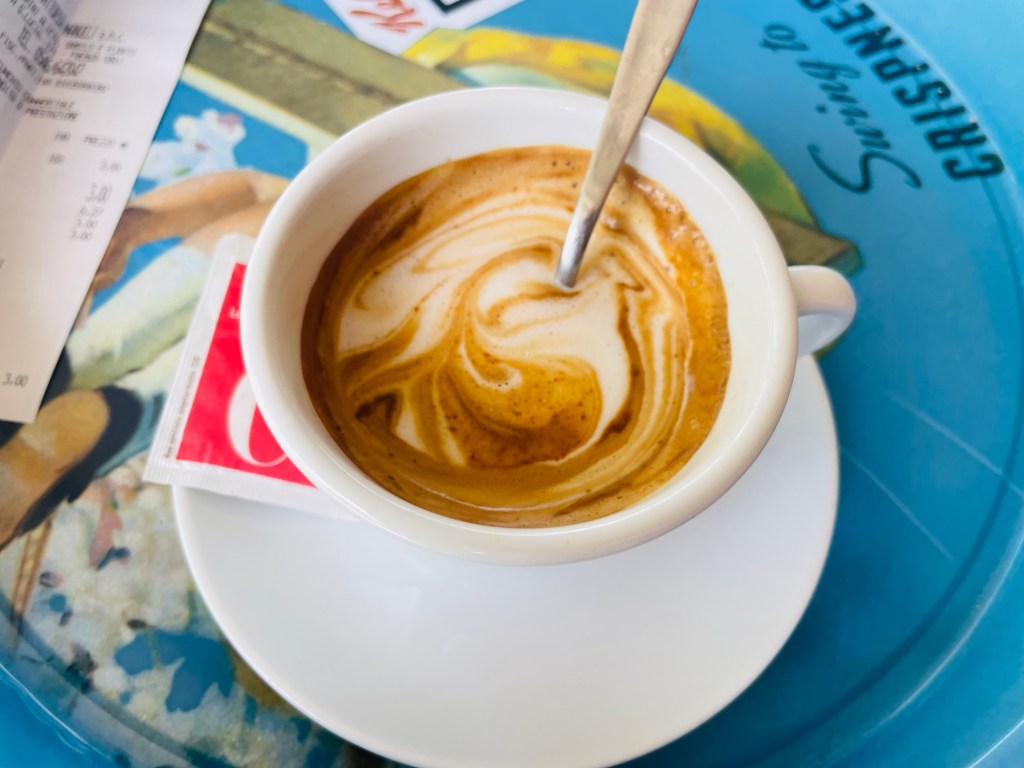
After an hour, I stopped for a caffé macchiato at Manueli restaurant which featured pretty frescos on the walls. My back was already sweating into my t-shirt. I contemplated stopping to write awhile but decided to continue on. Writing and walking had come to be, for me, one and the same.
I crossed the river Manogue and spied a lizard that had been run over. Its skin and guts were spilled out onto the pavement. It was an iridescent hue, green and blue, like an oil spill.
A dusty blue Fiat Panda sped past and a lady in a straw hat who was cultivating romagnole artichokes wished me a buon cammino.
Everything in this region is ‘Romagnole’ – there’s a deep sense of pride.
A peacock strutted across the road next to a tractor as I passed over another river following the Via della Uccellina – the path of the little bird.
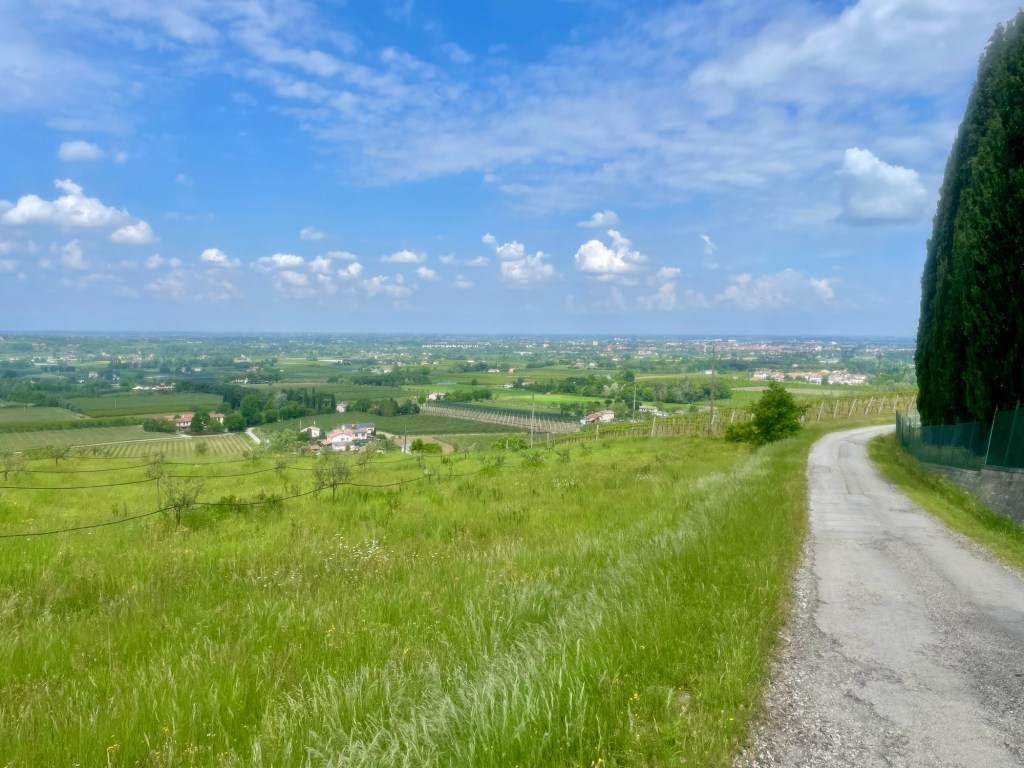
I looked back at the city of Faenza from where puffs of industrial smoke rose into the sky, merging with the clouds which were pooling grey and white. I’d visited Faenza with my Reading Dante with Refugees class and remembered vividly Sahra dancing on the stage of the spectacular theatre. I pinged her a message to see how she was getting on.
It was relatively flat on the path though I was surrounded by undulating hills. The landscape reminded me somewhat of Le Marche where I had spent several summers at my friend Harriet’s house enjoying quality time with University friends.
I listened to some gentle Indie rock as I sweated under the midday sun.
A big white car pulled out of physiotherapist’s office which I found odd to be located in the middle of the countryside.
The livid poppies made it look like the hill was aflame.
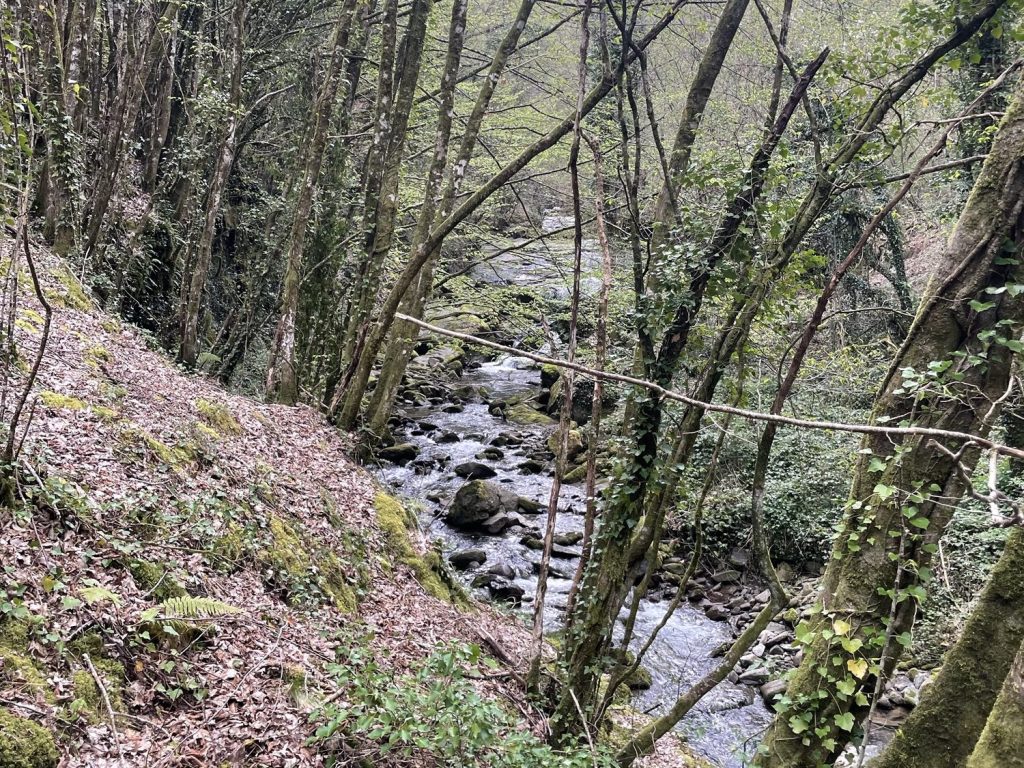
The trees were embracing one another on either side of the path to make a tunnel.
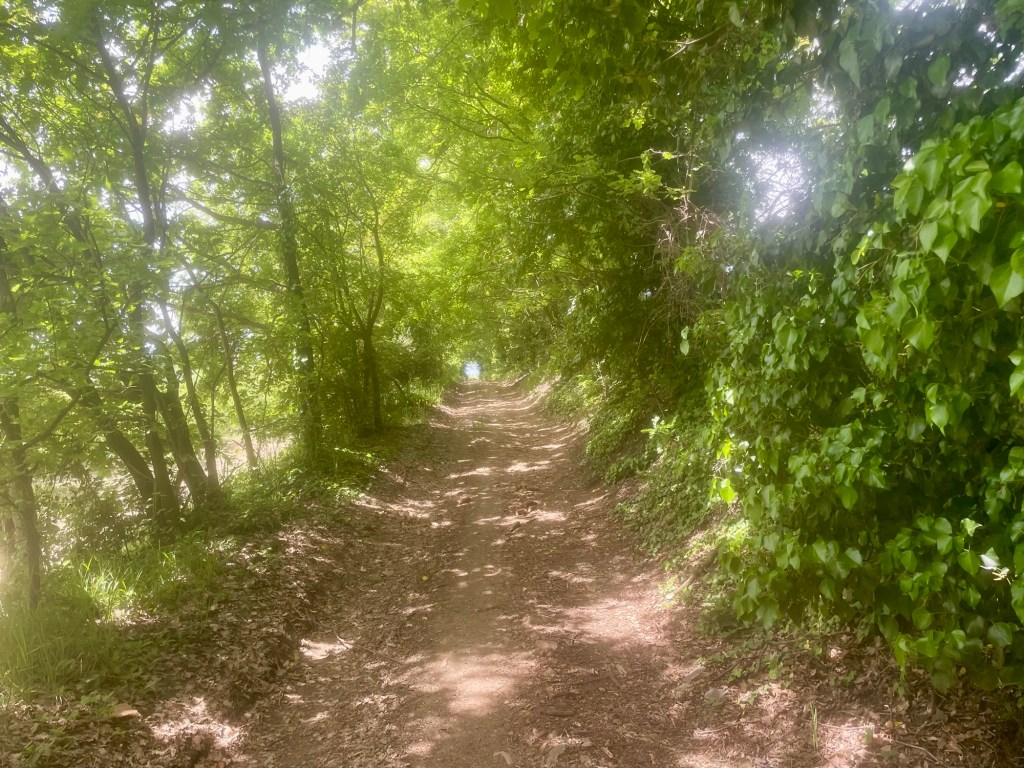
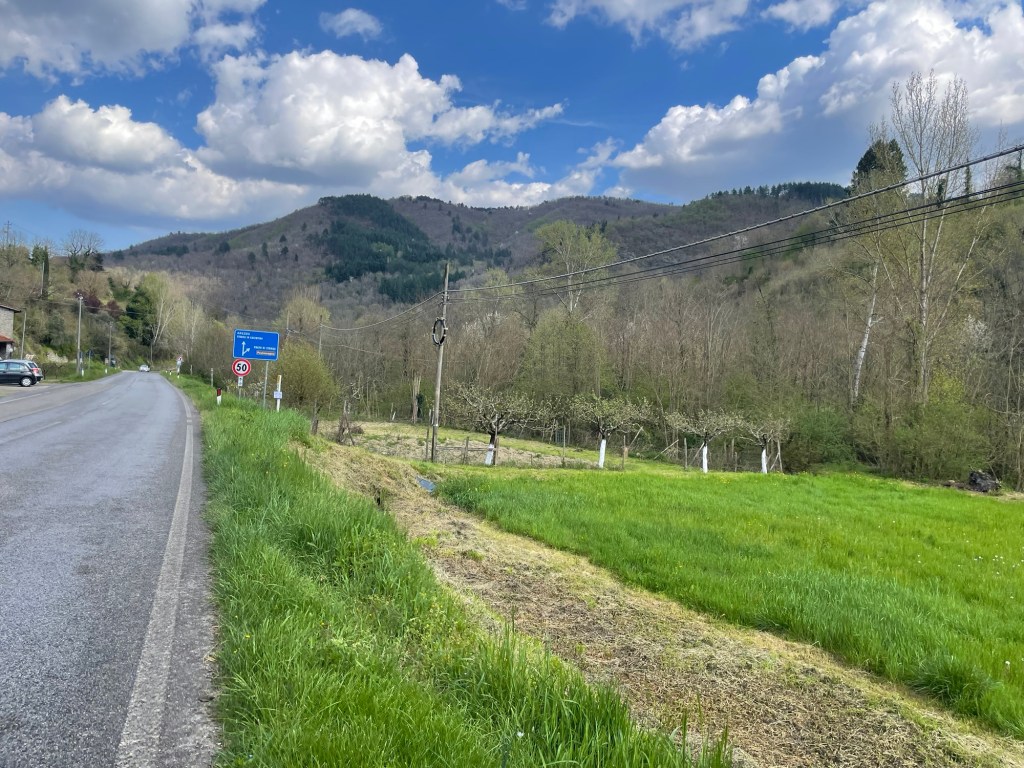
As Brisighella came into view before me, there were quite a few cars on the road.
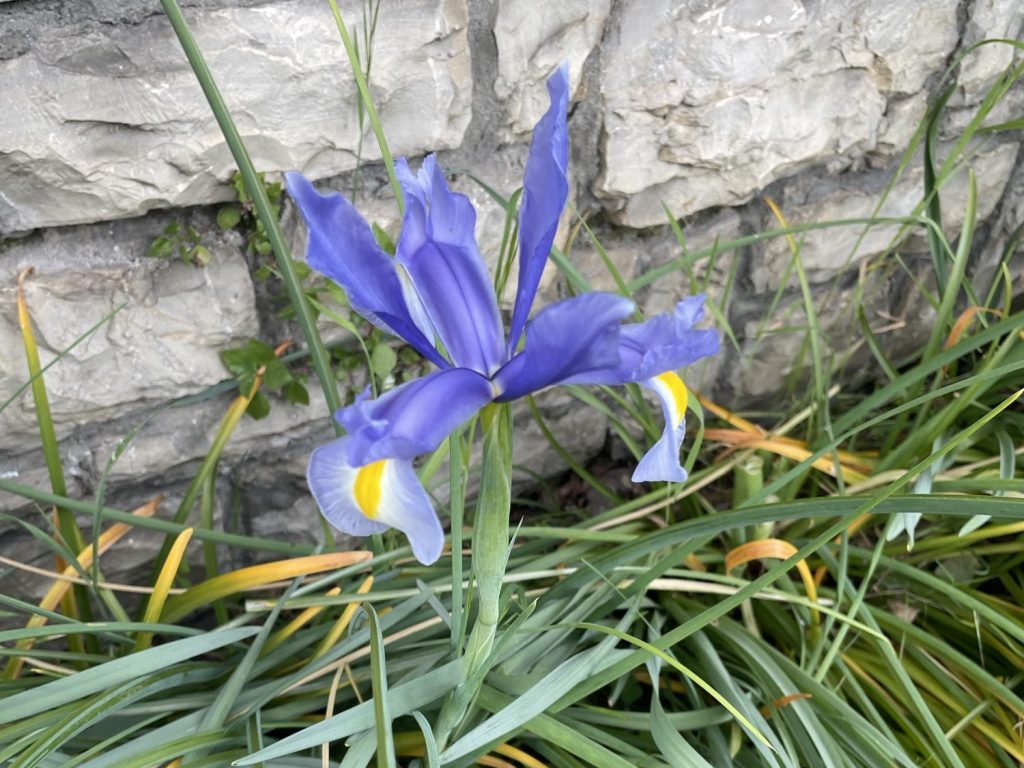
Pink, yellow and purple irises bloomed from a garden to my right. I felt the rub of the end of my second toes inside my boots.
Throughout history, different cultures have attached meaning to the length of toes, including the second toe. The Greeks, known for their appreciation of beauty and mathematical harmony, considered a longer second toe, also known as Morton’s toe, as an aesthetic ideal. Greek sculptures, such as the Venus de Milo, often depicted figures with Morton’s toe, further perpetuating its cultural significance. French sculptor Frédéric Auguste Bartholdi studied Greek and Roman sculptures, which resulted in the Statue of Liberty’s longer second toe.
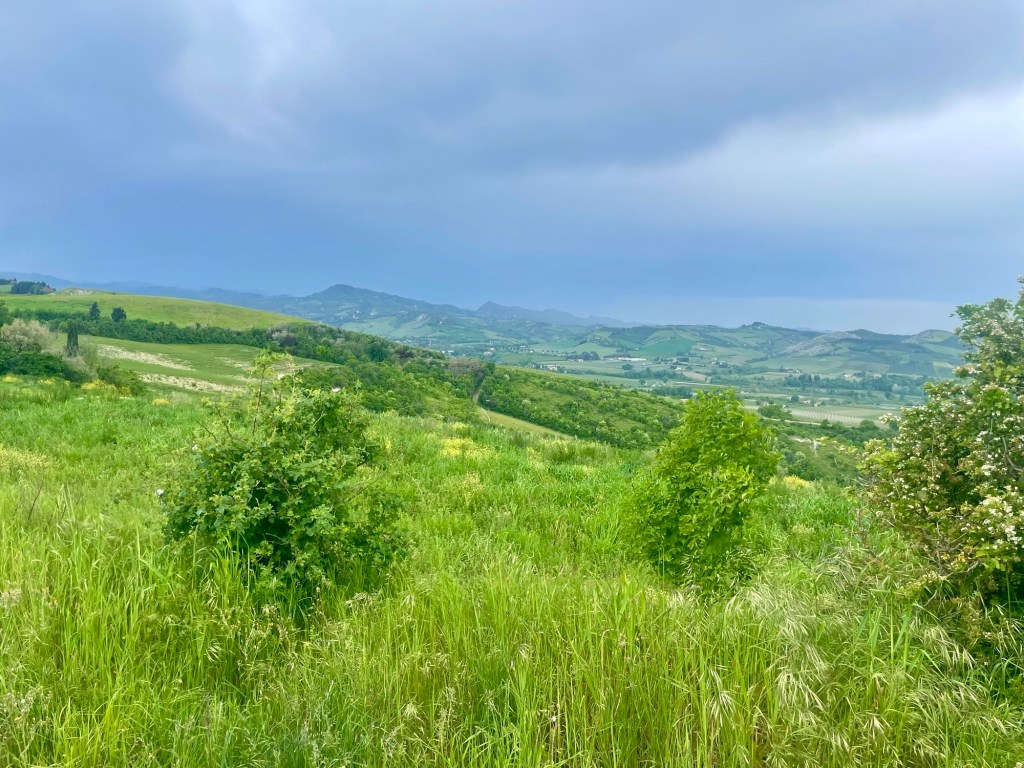
As the mountains came into view beneath a purple sky which was heavy with rain, I thought again of items I could get rid of before the climb ahead. My hoody perhaps? Or my deodorant?
Olive trees marked the perimeter of the vineyard and a familiar cuckoo sounded out.
I stubbed my swollen toes on a crack in the road and stopped for lunch, looking back over Faenza and forward towards the towering peaks. I bit into a blood orange which burst in an ecstasy of sugar in my mouth. I was tired and I wanted to take a nap but the rain was coming, so on I went. The sky was divided in two: here in front it was dark and brooding, the colour of a whale; there behind me it was light, the colour of delphiniums.
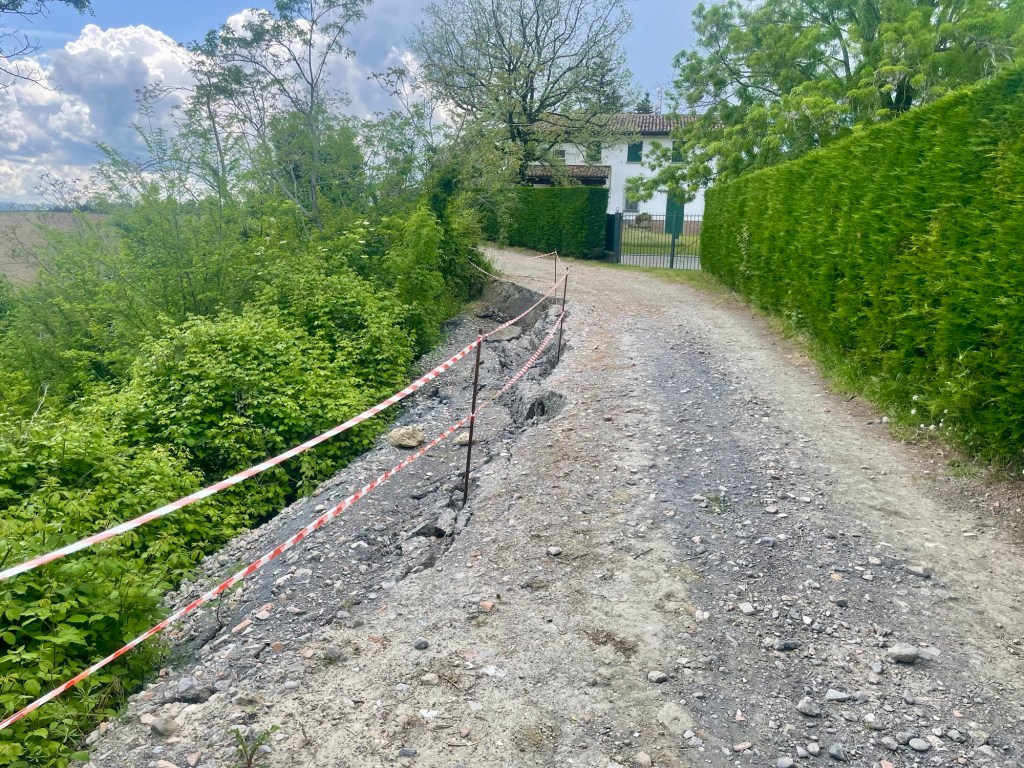
As I continued, the road collapsed down to the left. The hills were cut with ridges and valleys like slices of an apple.
A blackbird sang out and the leaves on the trees began to rustle in the light wind.
I had come to recognize the smell of oncoming rain. The butterflies had disappeared and, was that thunder I heard in the distance?
The overcast sky made the hillside look emerald green rather than the more vibrant pea green of earlier in the day. A ruined brick house emerged from among the foliage.
After about ten minutes of walking downhill, I realized I had missed a turning but I decided to proceed down the road along via Carla. I would pick up the trail later on.
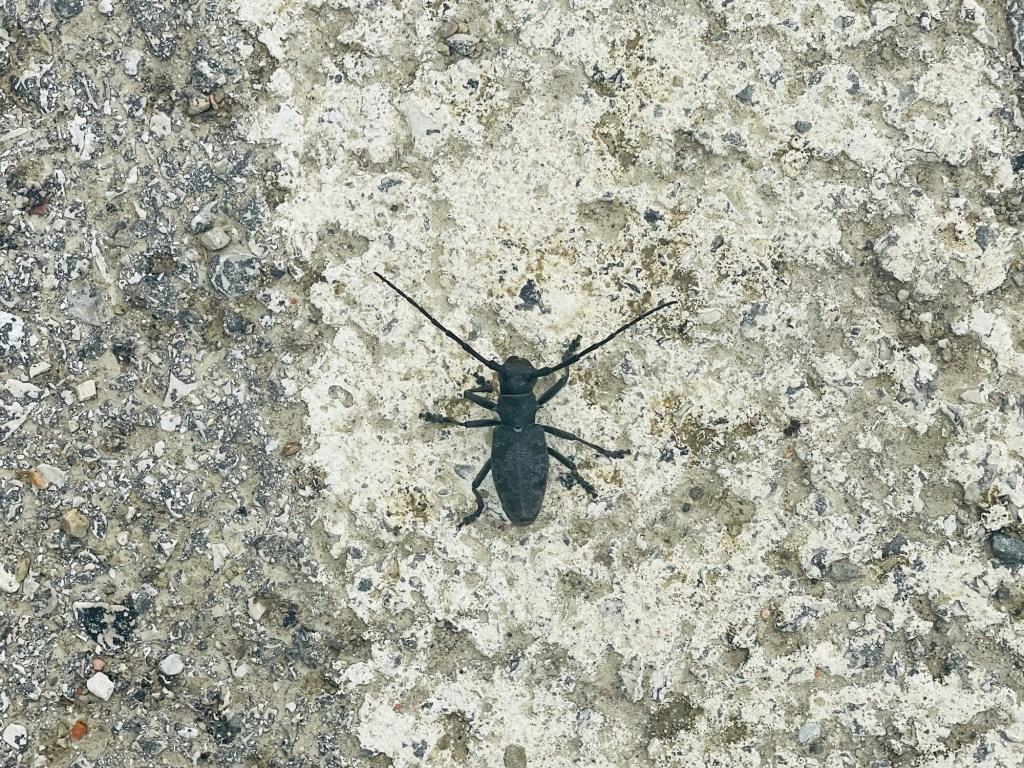
I stopped to cover my backpack at the touch of the first drops of rain, outside a house with peppermint green shutters. A huge beetle crossed in front of me and my phone pinged with the offer of a discount from a takeaway back home.
At a junction where there was a Cammino de Dante sign, I stopped briefly to converse with a woman called Stefania who was pruning her roses. She greeted me warmly and I petted her dog, Pepe. She said I was the first person she’d seen pass this year. A man in overalls asked me if I’d come from England to salute the Pope.
‘I’ll let you go before the rain comes down any stronger,’ she said, ‘do you need anything, water?’
She was particularly impressed that I was tackling the cammino alone as a woman.
‘You must have strong legs and a strong will!’ she said.
A bonfire in a farm to the right reminded me of one of my favourite Italian books, La luna e i Falò (The Moon and the Bonfires) by Cesare Pavese.
‘We all need a homeland,’ reads one line, ‘if only for the pleasure to leave it.’
A tractor on the right was mowing in between the vines and the rain was starting to hit hard. I was rushing, trying to arrive at my destination, which was suitably called Modus Acquae, for a four o’clock zoom meeting.
An impressive railway bridge on the right marked my entry into the city along with some tennis courts and recycling bins.
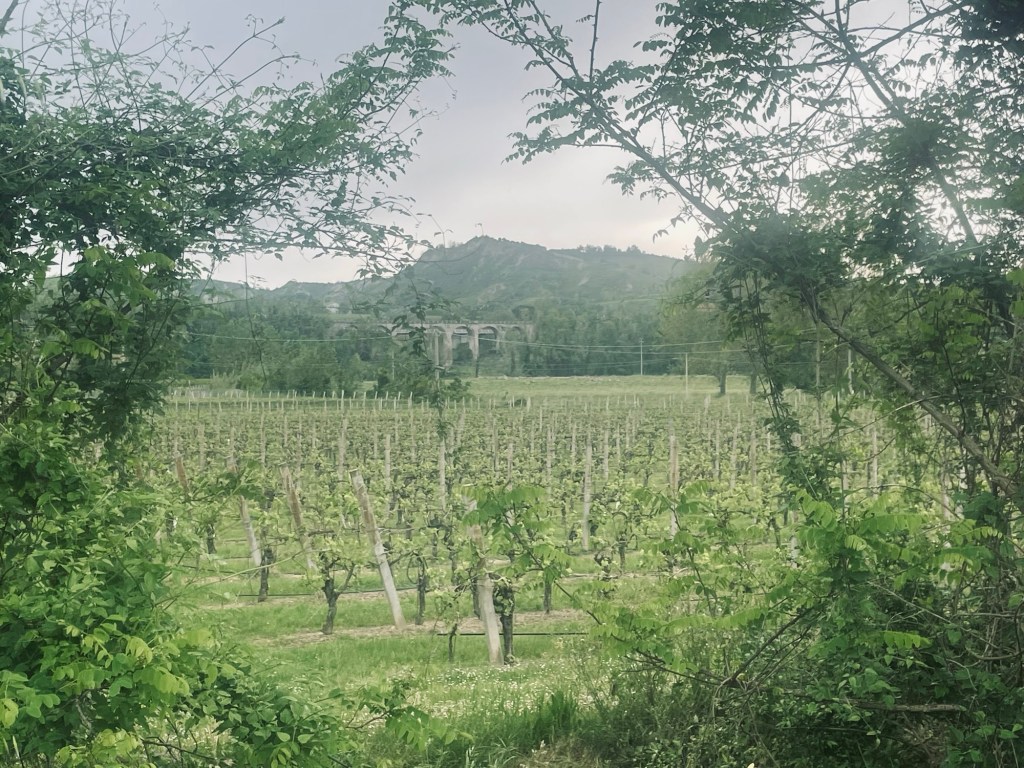
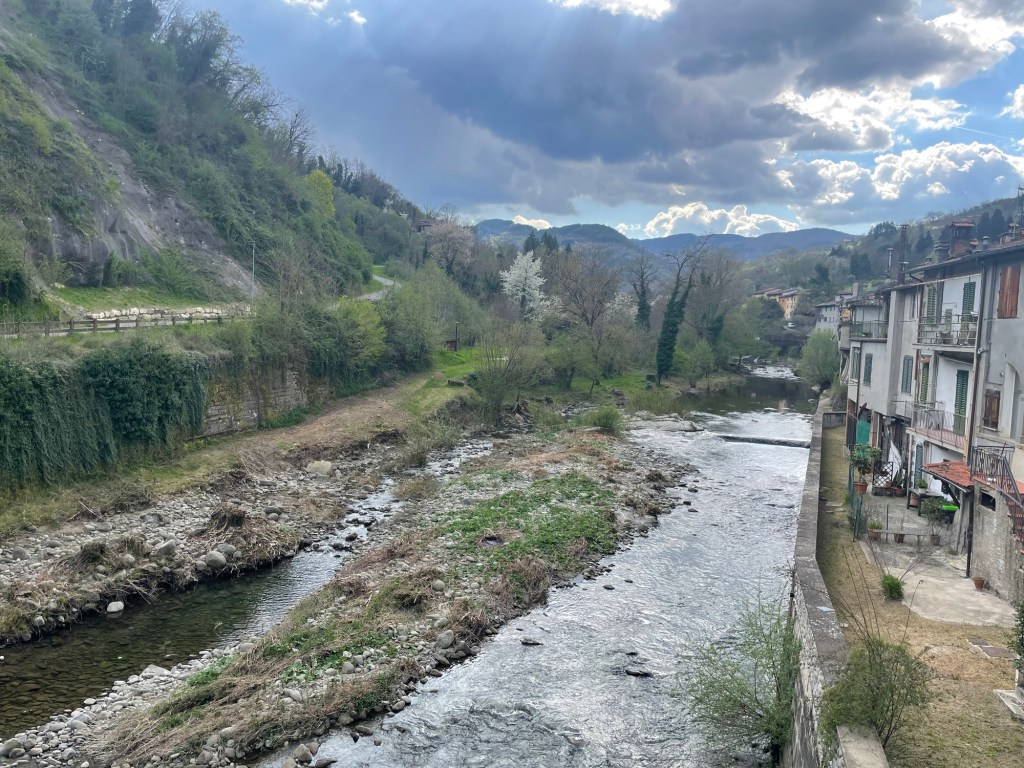
The river Lamone was opaque and surprisingly low given recent rainfall.
I passed beneath the railway bridge and by some apartments with pretty flowers on the balcony and decorative windmills spinning in the breeze.
A billboard advertised a pork festival, another steel sign announced that I’d arrived in the city of olive oil. The town sat in a nest of hills.
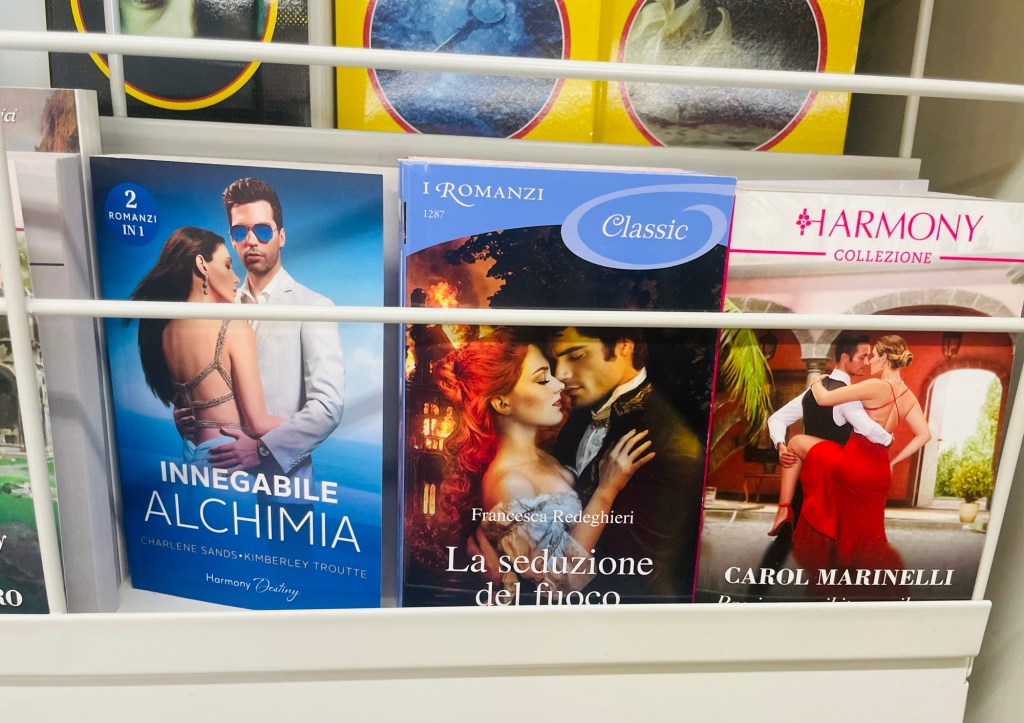
I popped into a big Conrad supermarket to stock up on dinner and lunch for tomorrow and giggled at the significant section of Italian Mills and Boon novels which had titles including ‘The Seduction of Fire’ and ‘Undeniable Alchemy’. I treated myself to some smoked salmon, strawberries and dark chocolate.
I made it just in time for my meeting with five minutes spare to untie my braids for a more formal look. It was about the presentation of some research on asylum appeals to the English judiciary. As part of the project, I’d observed 100 asylum appeals – an experience that had left me with a profound sense of moral injury at the injustice of it all.
After the meeting, I visited the hotel’s spa which had nothing on my blissful experience at the Hotel Granduca in Campigna. In fact, it was pretty awful. The view encompassed some orange tape, a ping-pong table and some camper vans that were stationed in the car park. The sauna was tepid at best and only one of the three jacuzzi functions worked.
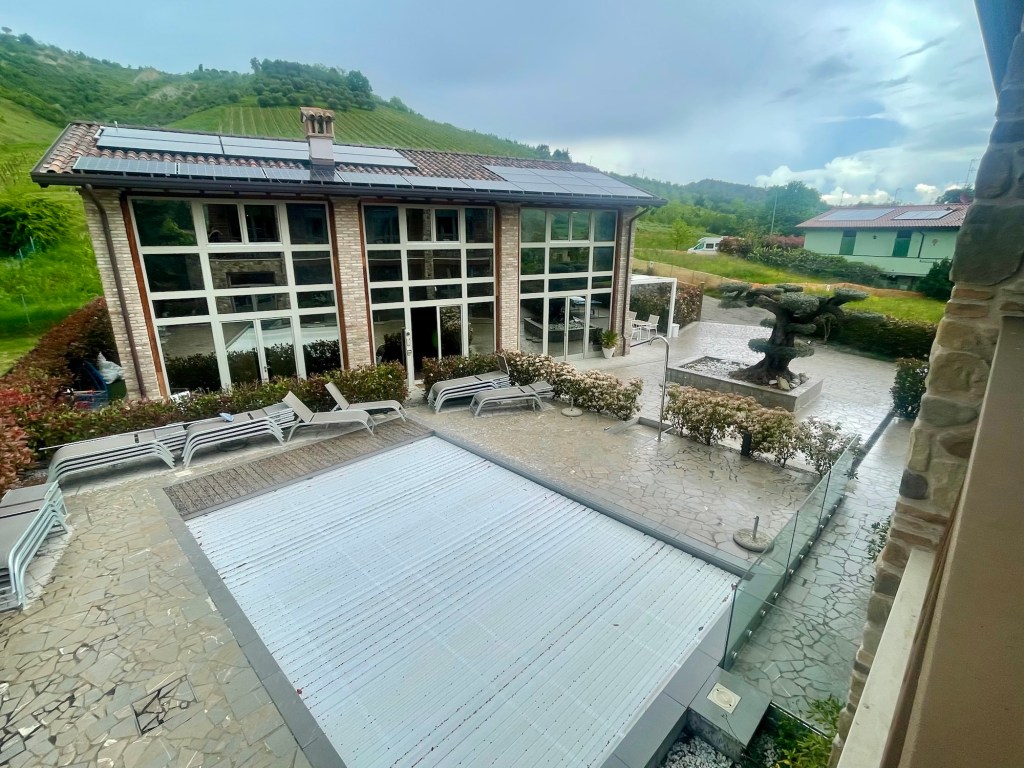
Back in my room, I peeled the blister plasters off my socks into which they had unhelpfully melted and took a Coke Zero from the mini bar. There was no question about it, I was going to lose my second toenails from the rub, rub, rub of my boots.
The rain bounced off the cover of the swimming pool and an ant scurried across my balcony to find shelter. I would have to email my local book group to let them know I would miss tomorrow’s session on Americanah by Chimamanda Ngozi Adichie, a migratory novel that I’d loved.
I felt a bit lonely as the rain stopped and the evening sunlight poured into my room. I looked out into the courtyard at an abandoned skateboard and starkly pruned tree. A Spanish girl in a princess crown was showing another how to ride a bike,
‘Go, Maria, go!’
I checked my phone to see a message from Alina and another from Oliver. Alina’s news was bad: her mother’s house in Ukraine had been hit by shelling. The news from Oliver was good: he had been discharged from hospital and was finally home.