Tag: tuscany

  • Broken Toes and Tasteful Tiles: From San Godenzo to Dicomano

    I got lost four times and made the stupid decision to scale a towering fence. 
    Marcella, the owner of the Agriturismo Tenuta Mazzini where I had spent the night, came to greet me in the morning. She was on her way to work as a primary school teacher. I didn’t hesitate in exuding my passion for her place.

    ‘It’s a marvel,’ I said.

    I always felt a slight anxiety when I had not walked for a day, but I had slept amazingly in the comfy bed, and I felt well rested as I heaved on my backpack and set off down the road to Dicomano.

    It was 10.20am and the sun was shining brightly. The air was fresh. Two cows greeted me from an ample field. 

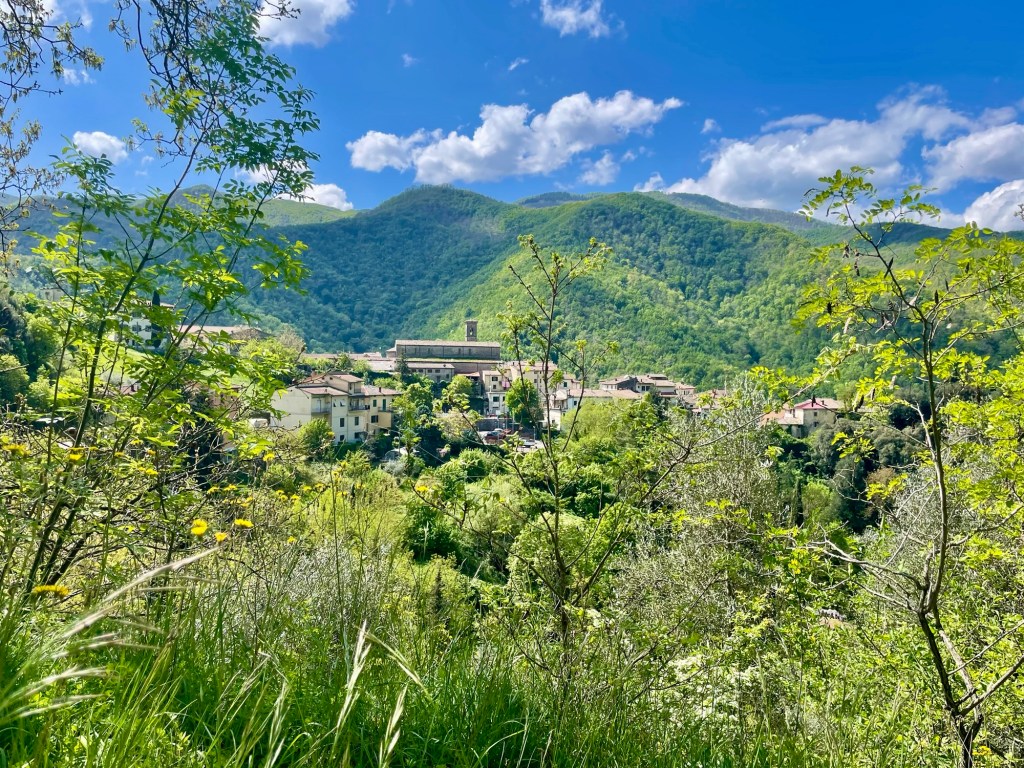
    The day’s walk began with the descent back to Dicomano where Dante was summoned for a political meeting during his exile from Florence. I’d been spending a lot of time with Dante the poet and so it was interesting to spend time with Dante the politician. It was here that he had sought to forge alliances between the Ghibellines and the White Guelfs of whom he was a member. Like many refugees, Dante had been multiply displaced. His brief stay in Bologna had been interrupted when the White Guelfs were barred from the city.

    I passed an excavator that was digging up the Earth as I wound down the road and stopped momentarily to pet a ginger tom cat.

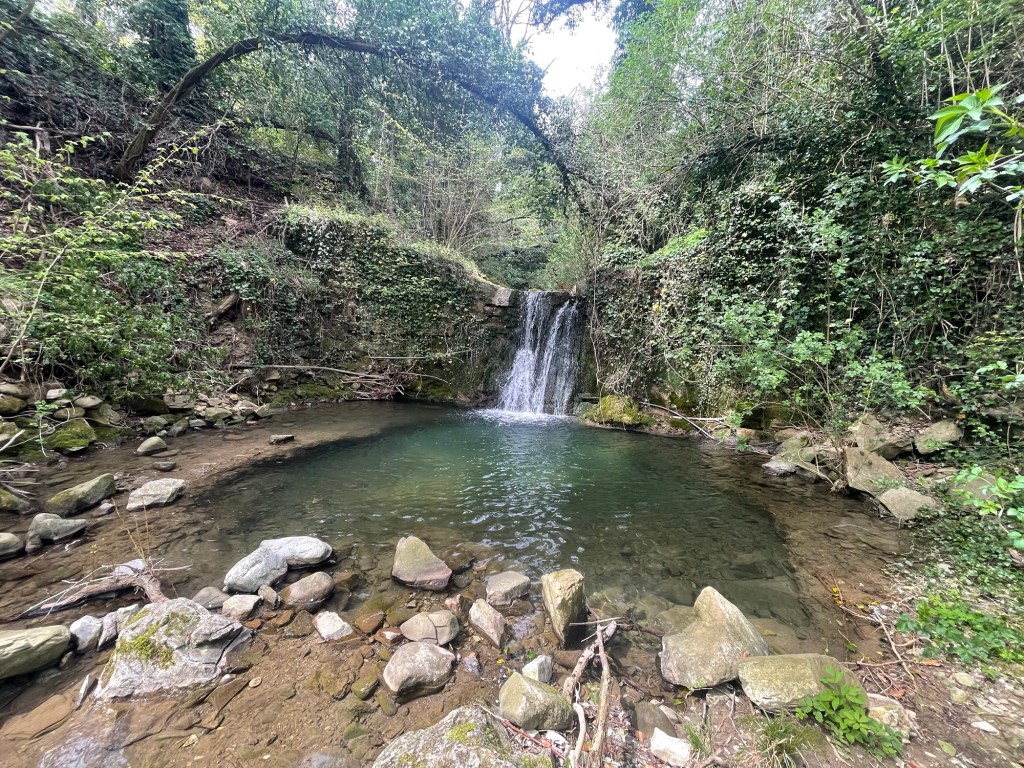
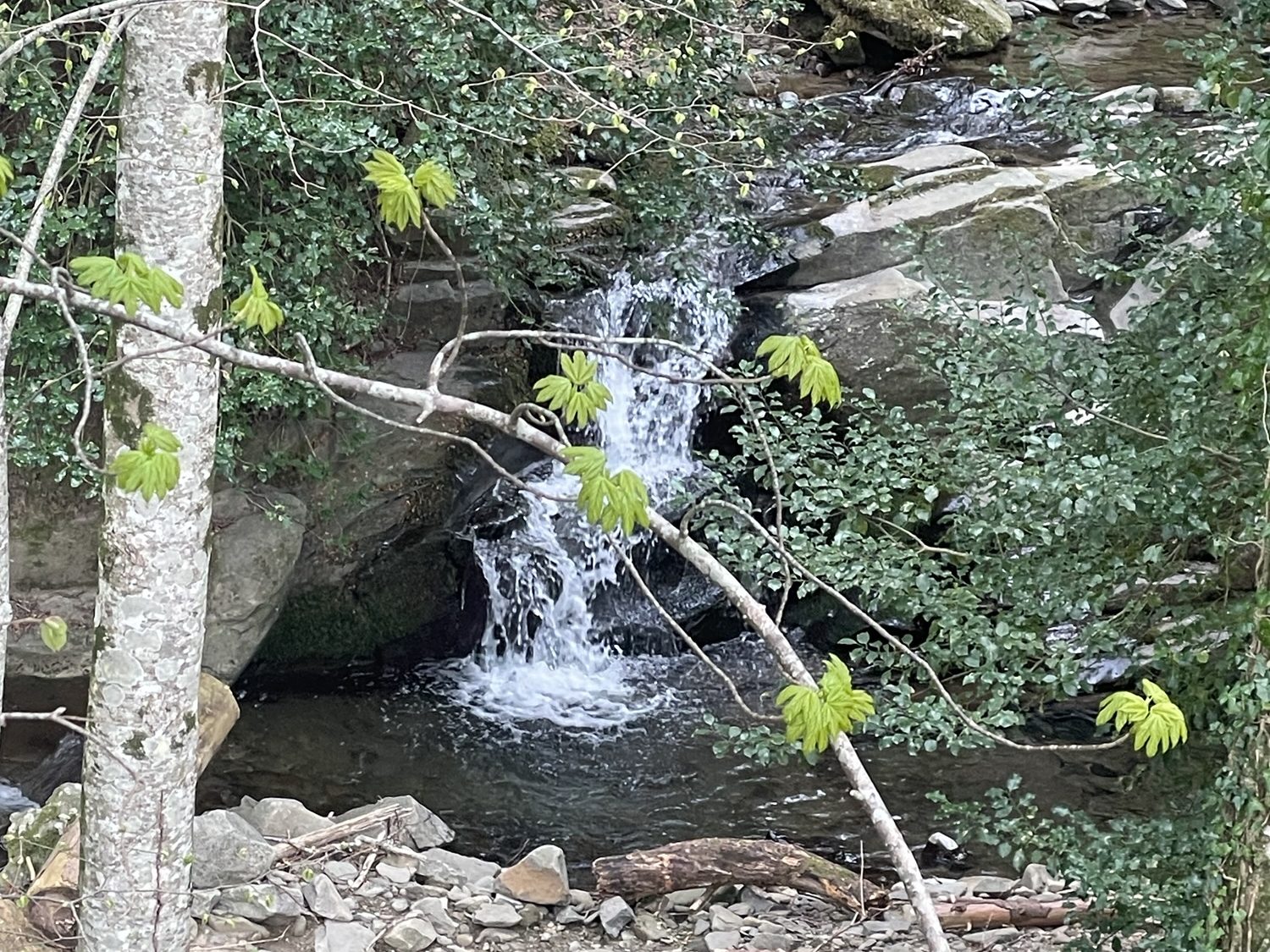
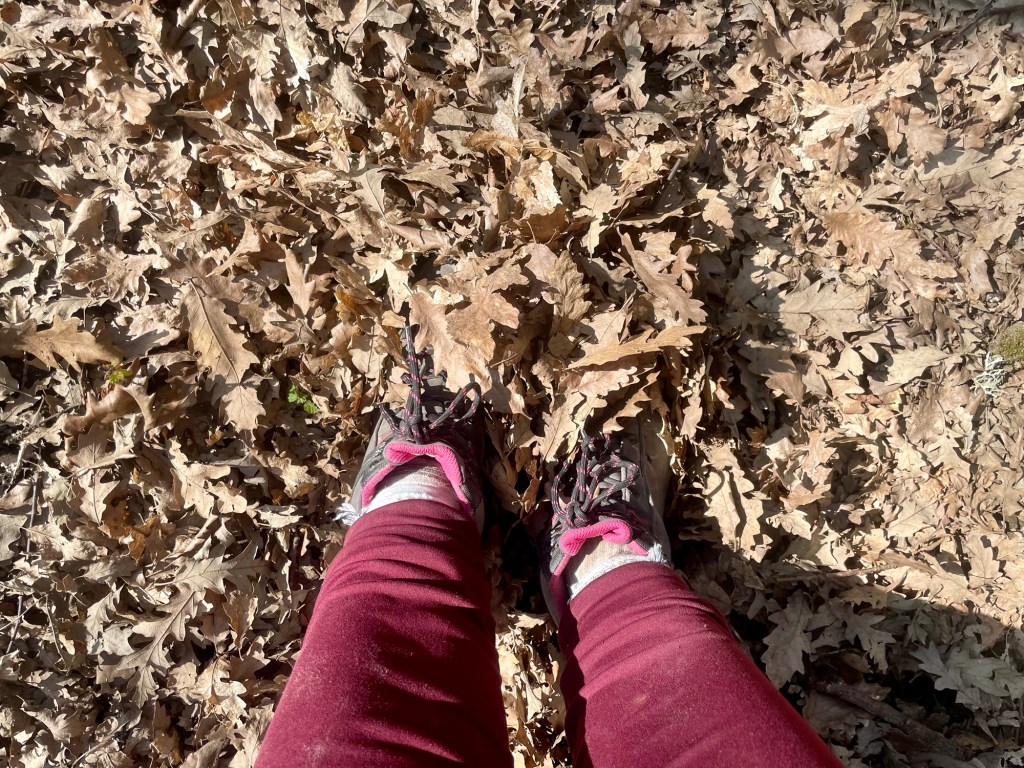
    I followed a Dante trail sign off down a small, steep woodland path to the right and was soon kicking up the leaves again. I crossed a small, gurgling waterfall where the path split in two.
    I went left, which would transpire to be the wrong choice. 

    Conscious of not walking with my phone attached to my hand, I had tucked it into my sports bra so that it was fifteen minutes before I realized that I was very much off the beaten path. I was glad I was wearing trousers and not shorts as the brambles and trees assaulted me, leaving bloody snags on my arms and hands. I held onto the tree branches to heave myself up the bank towards the road. I’d thought about going back to where I’d lost the straight path but decided to carry on. The map suggested that in a few metres I would re-reach the road from which I could proceed my descent into the medieval town.
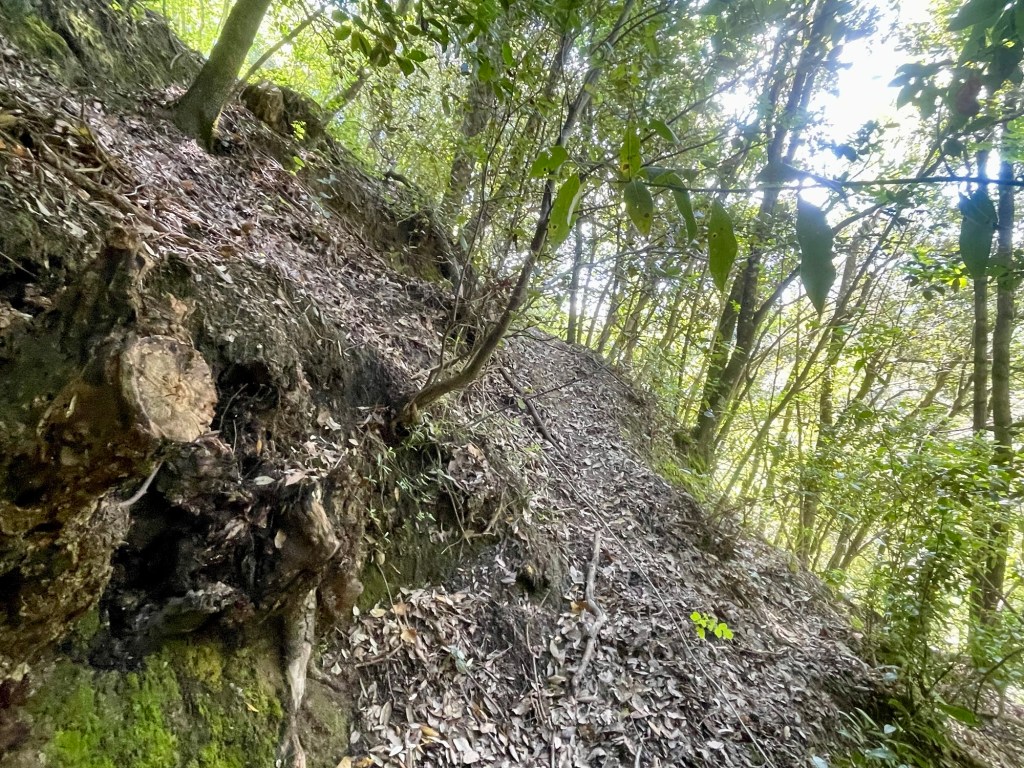
    Climbing up on my hands and knees, the mud collected beneath my fingernails. Nettles attacked my ankles and, as I passed a network of two waterfalls, my weight dislodged a huge chunk of earth from the ground.

    I assumed I had made the usual mistake of following an animal track. I passed through two olive fields and there was the road ahead of me, just a short way down from where I’d strayed. 

    I had basically done a 45-minute loop of the forest for absolutely no reason. If I had stuck to the path, I’d be eating pizza for breakfast by now but instead I was weary, thirsty and had no idea from whence I’d come. I paused for some water and let the blood dry in a thick smear on my hand. My knees were filthy from the climb.

    I passed through an open gate and exited onto a hill from where I could see the town before me. I had no idea what to do. The end was in sight and so I just kept climbing, trying to reach the road, my knees and knuckles deep in the foliage as if I were massaging the Earth. I wished I could just jump or fly over to the car park.
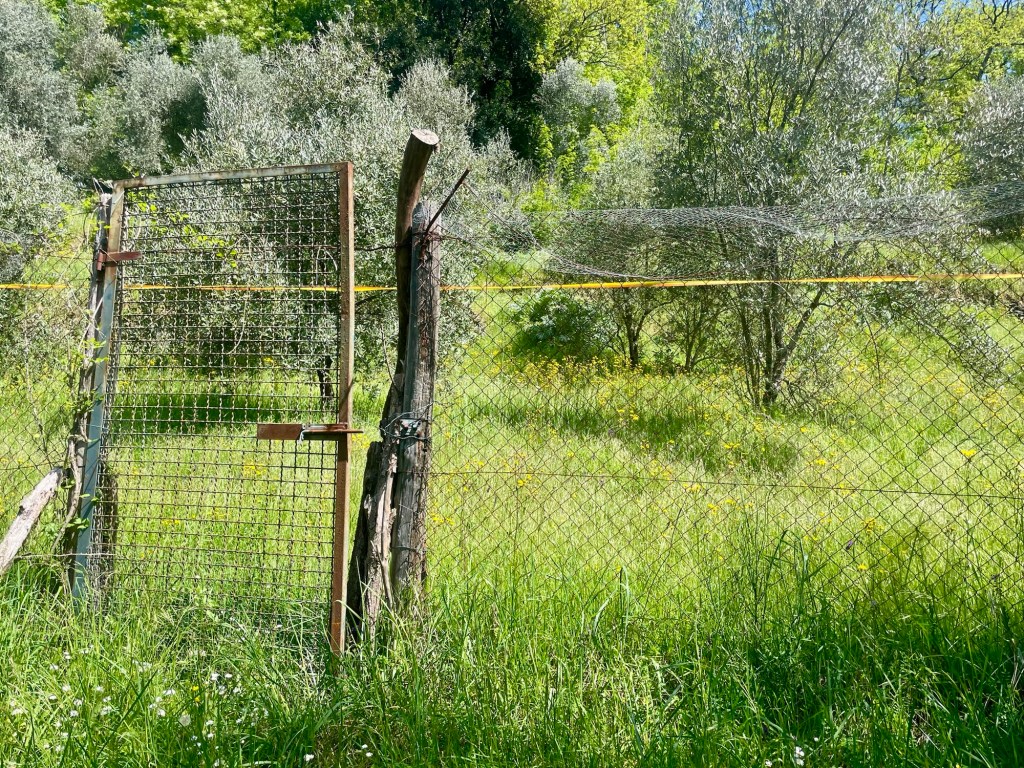
    Now all that stood before me and an espresso macchiato and pizza slice was a massive metal fence which was decorated, at the top, with a thick mesh of vertical barbed wire. 

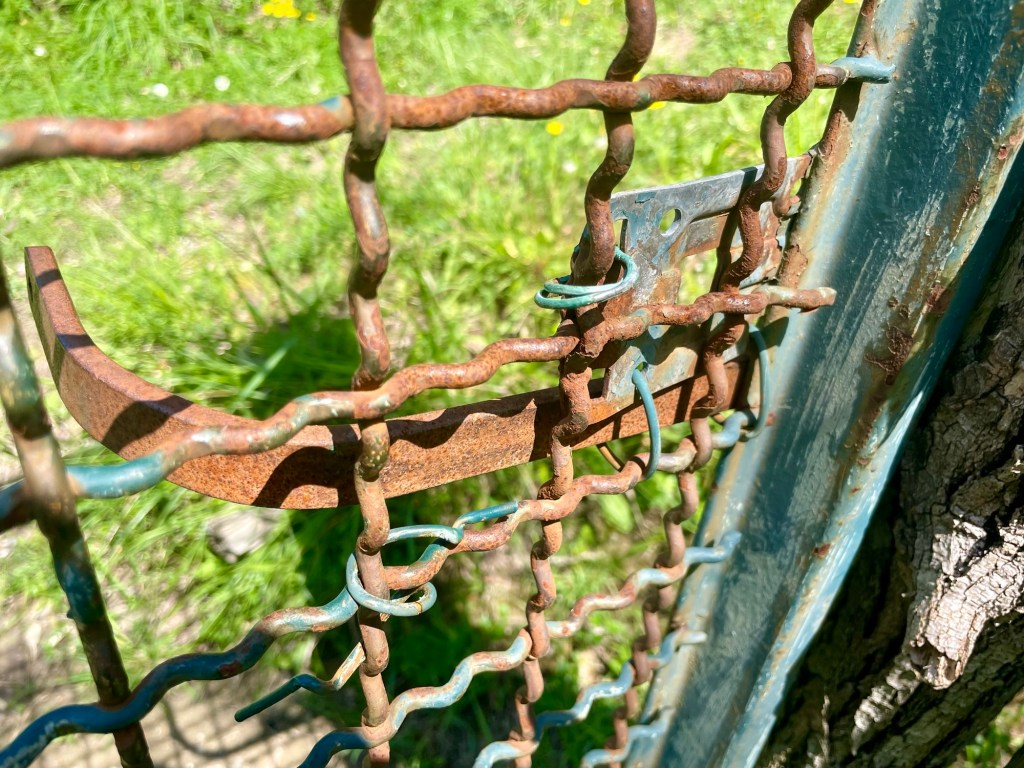
    The road was right there, but as I stumbled around the fence’s parameter, I couldn’t find a way to cross. Two metal gates were tightly fastened with thick wire which I tried in vain to unpick, clumsily sliding my fingers between the holes in the gate. There was nothing for it, I couldn’t go through or under it: I would have to go over it.

    As I climbed up onto a wooden ballast, my bag pulled me back and so I threw my weight forwards, held tight to the fence and swung my leg over. The second one followed and I jumped down, only to land on the roadside with a thud, the full force of which shot up into my left foot. 

    The familiar pain immediately hit me and I knew I’d broken something. Luckily, from the quick survey of the discomfort, I deduced I had just damaged a toe or two. This was nothing like the agony of when I’d broken my metatarsal in Guatemala when headed out on a hike to locate the national bird, the resplendent quetzal. I took some Ibroprofen for the pain and carried on into the town centre where I’d spent some time yesterday in Dante’s footsteps. My hands were covered in a cocktail of mud and blood.
    It was 12 o’clock which meant I had spent almost an hour and a half scrambling around in the woods including 15 minutes trying to unpick the lock and 15 minutes working out how to get over the fence. I’d bruised my knee and cut my trousers on the barbed wire but I had made it back onto the road. A smartly dressed lady was walking past with her dog. 

    ‘Are you OK?’ She said.

    ‘Yes,’ I replied, though I wasn’t. ‘I just got a little lost.’

    I sat on the verge and ate an apple. Next time, I’ll take the road. I could have been well on my way to Dicomano by now, but as it was, I hadn’t even reached the starting point and the steep climb meant I’d exhausted at least half of my supply of water.

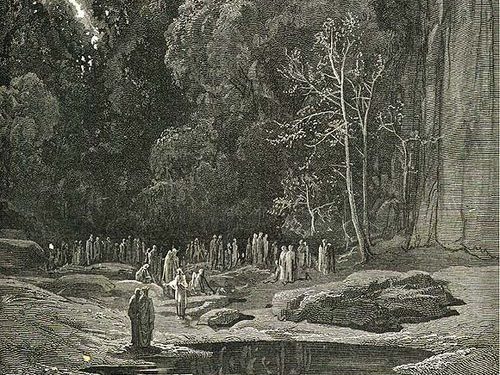
    And that was how in the middle of the journey of my life, I found myself in a caged olive grove for the straight path was lost. 

    I hobbled to a bar and ordered the much craved for coffee and pizza. I removed my shoe and tried to wiggle my left middle toe. No, it wasn’t moving. The sellotape Alina had left me finally came in use. I used it to attach my broken toe to the ones beside it. We had evolved from three toes creatures after all: the three middle toes already moved as one. 

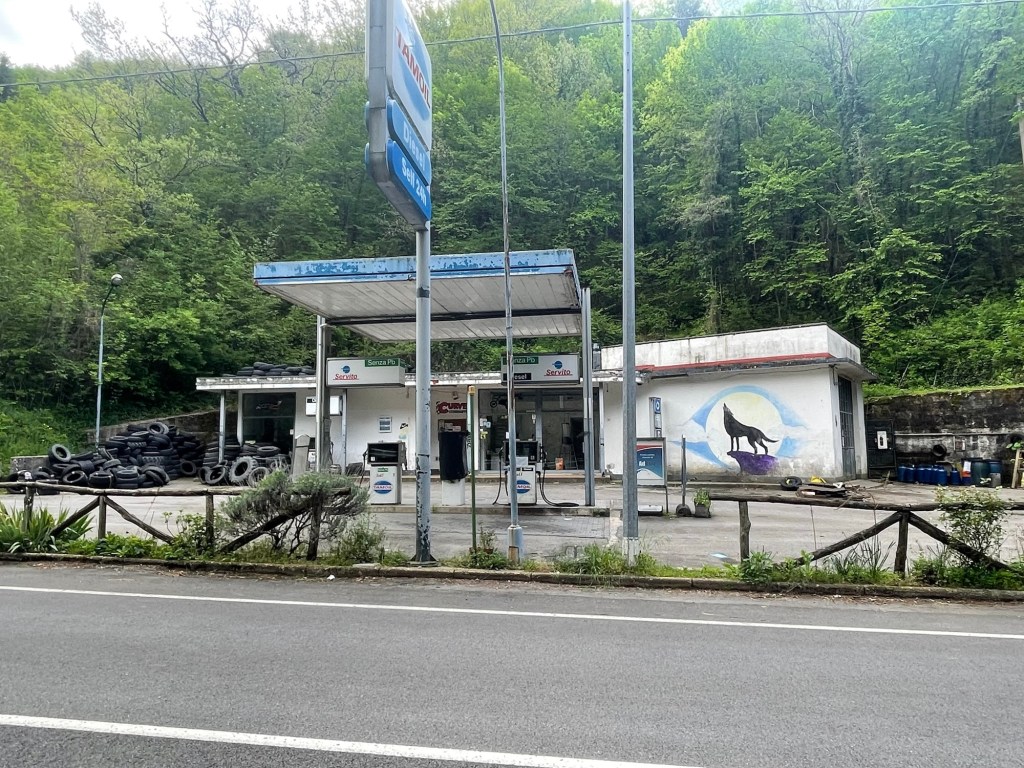
    I noted a urinal built into the cliff face next to a busy garage which had a wolf mural painted on the wall. 
    Five men were drinking beer in the café.  

    ‘Ok, let’s start again,’ I thought. It was 12.30pm.

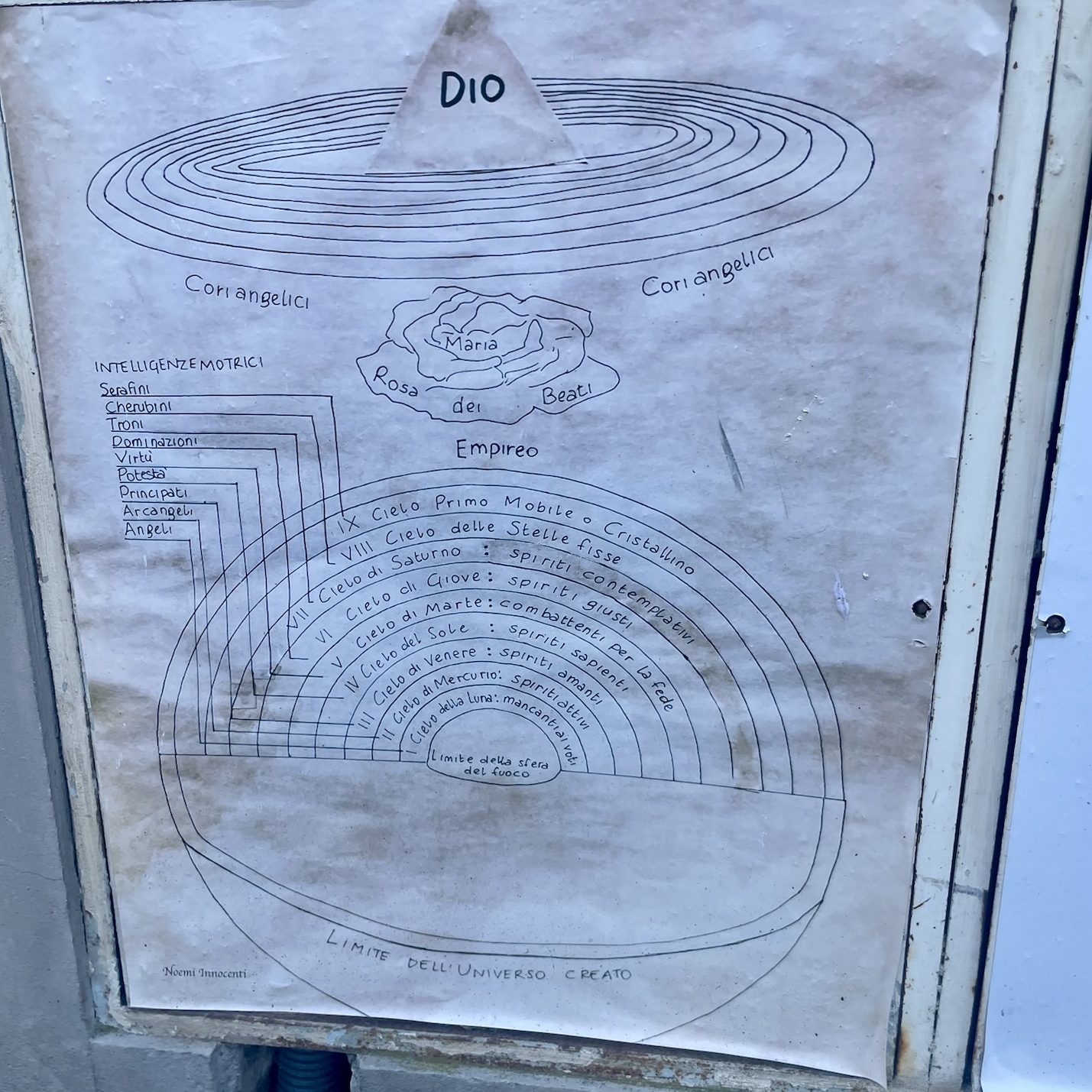
    On the surrounding streets were quotes from Dante’s Paradiso that had been plastered to the wall and here was a map of the heavenly realms as he had understood them. One quote read:

    ‘The handsome image those united souls,
    happy within their blessedness, were shaping,
    appeared before me now with open wings.

    Each soul seemed like a ruby—one in which
    a ray of sun burned so, that in my eyes,
    it was the total sun that seemed reflected.’

    In the Divine Comedy, Paradise is depicted as a series of concentric spheres surrounding the Earth, consisting of the Moon, Mercury, Venus, the Sun, Mars, Jupiter, Saturn, the Fixed Stars, the Primum Mobile and finally, the Empyrean.
    Back on the path, I passed a balcony on which stood a lady watering Calla lilies beside a hyper vigilant black cat. She smiled and wished me a ‘buon viaggio.’

    As I left the town, there was a cemetery on the left, sweeping trees to the right and, of course, the village football field.

    I followed the signage, making sure to check directions on my phone every five minutes now, and made my way up a steep concrete road. From a garage there emerged some antique porcelain sinks and toilets.

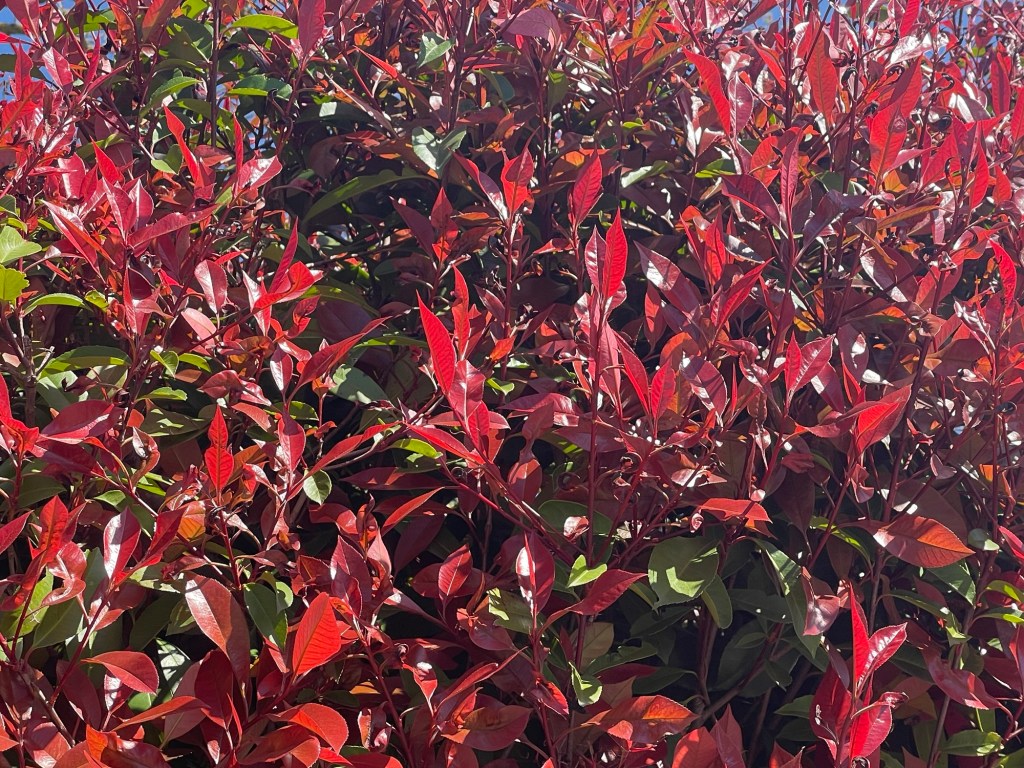
    I moved in and out of shadows, enjoying the litter of red leaves on the pavement that were the colour of Alina’s hair. Tom had told me yesterday that you could eat dandelion flowers and so I folded one into my hungry mouth. The entire plant is edible, from the flowers to the roots. It tasted bitter.
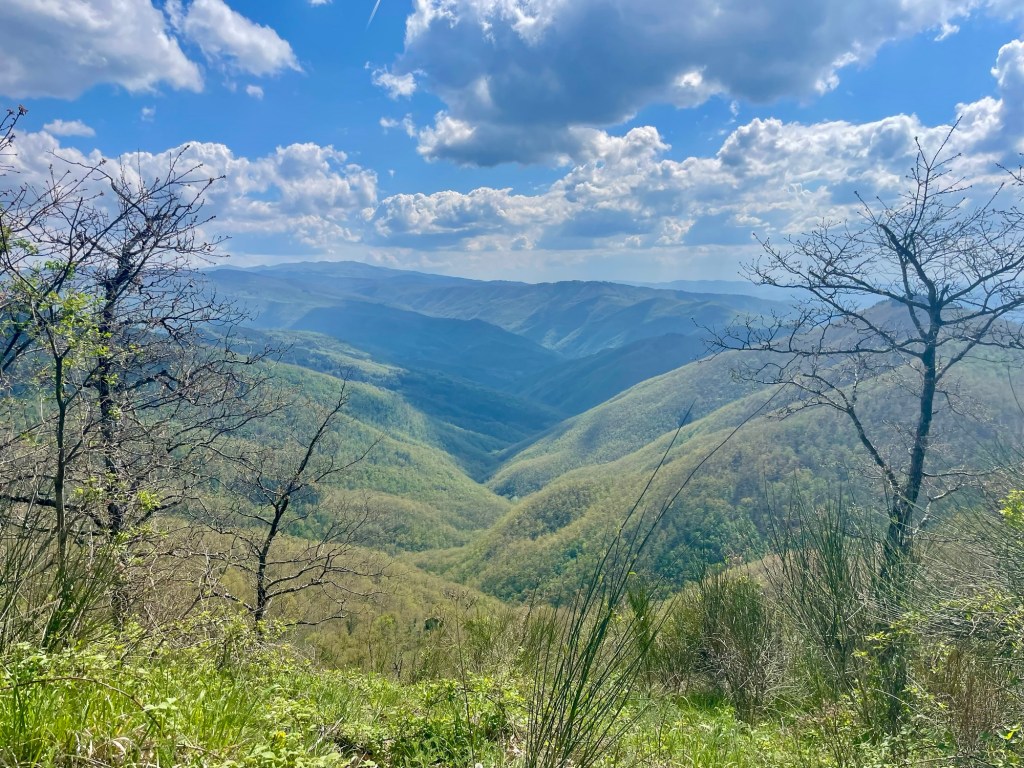
    I proceeded past a field of goats that came with a ‘beware of the goats’ sign and an agriturismo which was decorated at the front by a beacon of lemon trees. 

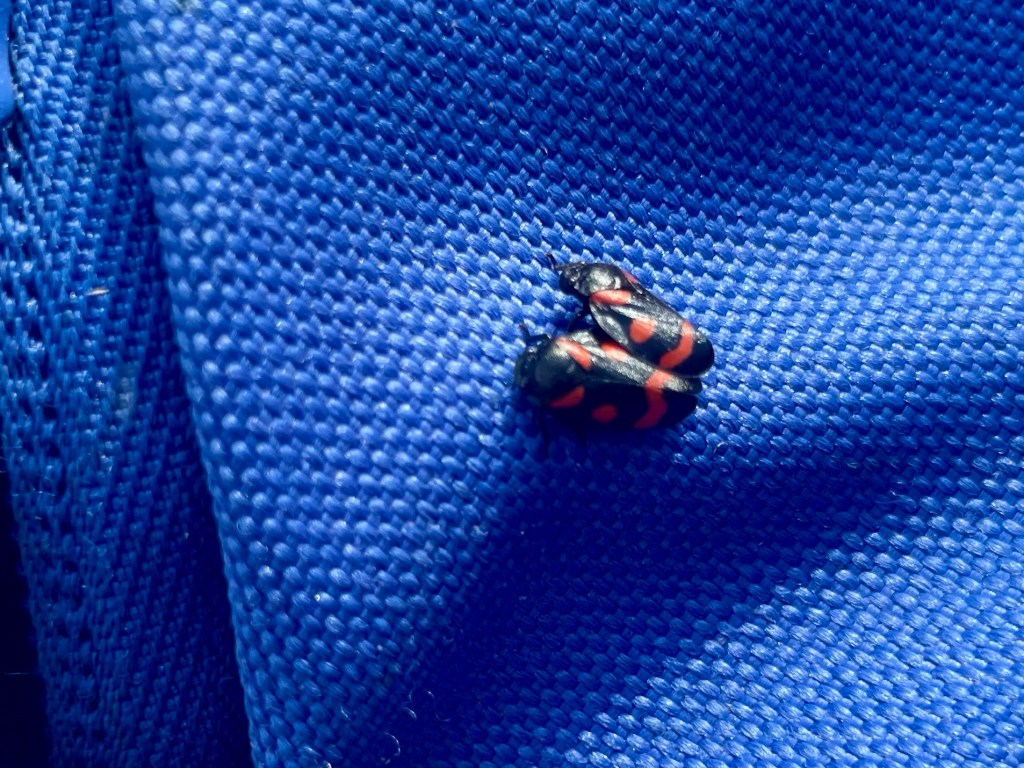
    The path had expanded out into a beautiful hobbit like landscape. I sat on a rock and drank some more water beside a prairie and a tinkling stream. A white butterfly with orange tips fluttered past, then a yellow one. Two black beetles were mating on my backpack. They were covered in red spots like inverse ladybirds. I noted that I was developing callouses on my hand from the rub of my hiking poles.
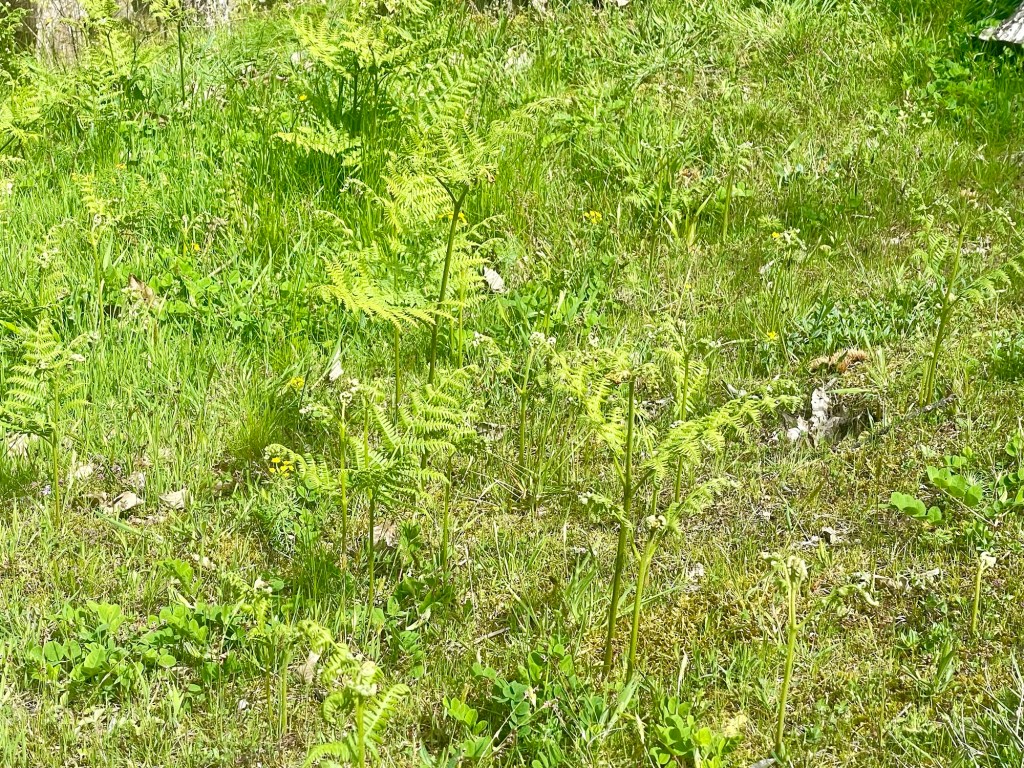
    I could see back down to the town in all its majesty. There was a house built into a tree which was surrounded by a cluster of bracken. The simple way to tell bracken apart from ferns is that bracken has a stem, and will come up singly. Ferns, on the other hand, generally don’t have a stem but rather always have multiple fronds coming up from one central point.
    I realized I was lost again and there followed an agonizing half hour hike up a steep bank that was littered with spiky horse chestnut seeds. I had somehow managed to drink all of my water and kept stopping to catch my breath. At one point, my cap was disturbed by an overhanging branch and I had to retrace my steps downwards some ten metres to retrieve it. It was a chalky blue and read, ‘Stay wild and free, protect our sea.’ I had purchased it from a Royal National Lifeboat Institute giftshop in Wales the previous summer.

    I thought of Will and Jo’s non-wedding wedding that I would be attending that weekend back in London. Their party theme was ‘under the sea’ and my friends at home had been feverishly making costumes, including one for me. 

    I stopped to pull out some horse chestnut spikes from my hands and finally re-found the path. It was 3pm and I’d only hiked some 12 kilometres and climbed nearly 120 floors but I was only about 6 kilometres along today’s 17 kilometre stretch of the cammino. My arms looked like I’d had a fight with the cat. I flicked an ant off my leg. 
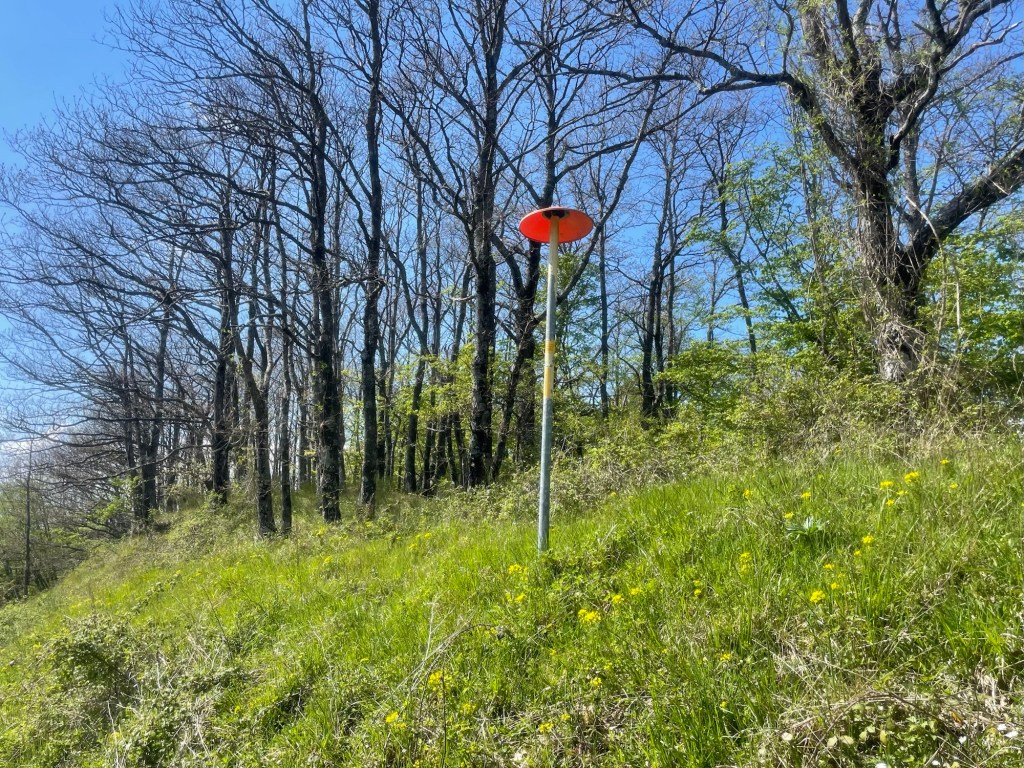
    The path followed an ancient Etruscan way which was dotted with sign posts with orange cones on the top which resembled Asian hats. I trotted downhill now, my bag chafing under my armpits, enjoying the spectacular view to the right of the mountains in the sun. They were striped in shadow and light. 

    Two lizards were wrestling beside the bushes and the trees were squeaking in the light breath of the breeze. I really wanted some water. 

    Then I realized that in my stupor I had gone wrong yet again. It was a fifteen minute hike back uphill. Today was not my day. 
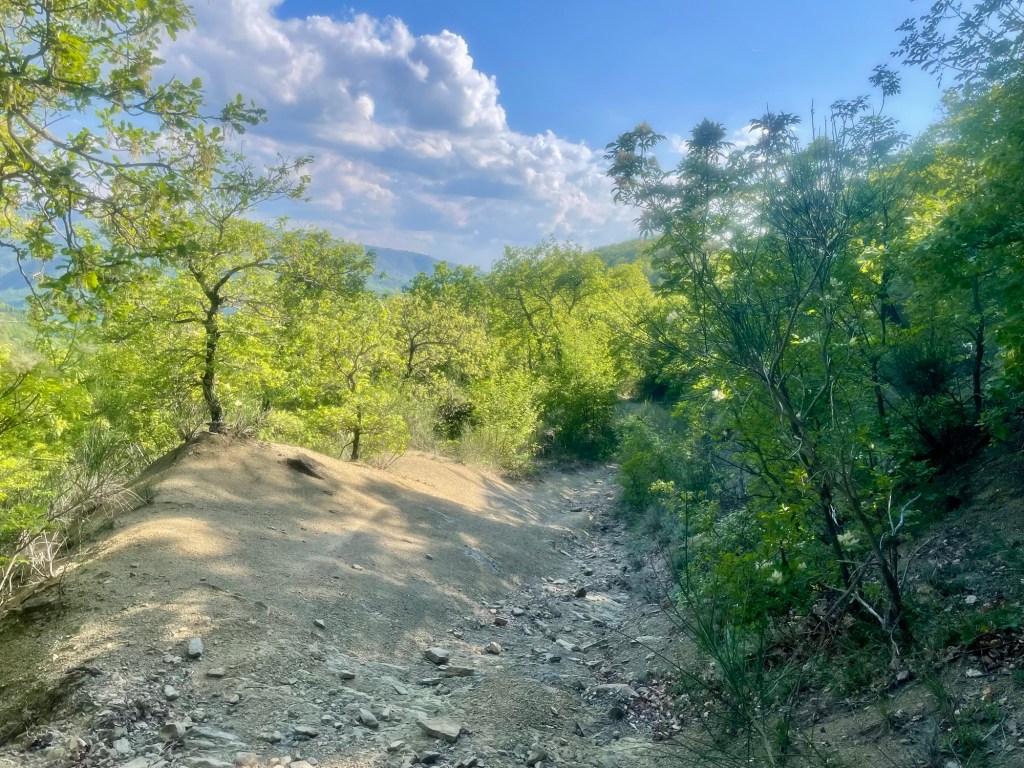
    It was tough on my knees and broken toes hiking downhill, but I was thankful to have finished the climb and grateful once more to Franco in Marradi for fixing my right hiking pole. A farm appeared to my left with goats and a horse. 

    I got lost for the fourth and final time, climbing nearly all the way up a really steep hill covered in scree only to backtrack. A cock crowed somewhere in the distance. It was 5pm.  

    An aloe vera plant emerged from someone’s garden and I was so thirsty I contemplated ripping off a leaf, opening it out and licking the sweet sap. The irises that decorated this lawn were purple and pink in hue.

    I ate some berries from my trail mix thinking they might have some moisture inside. The sun was beating down and I had my eyes peeled for an outdoor tap.

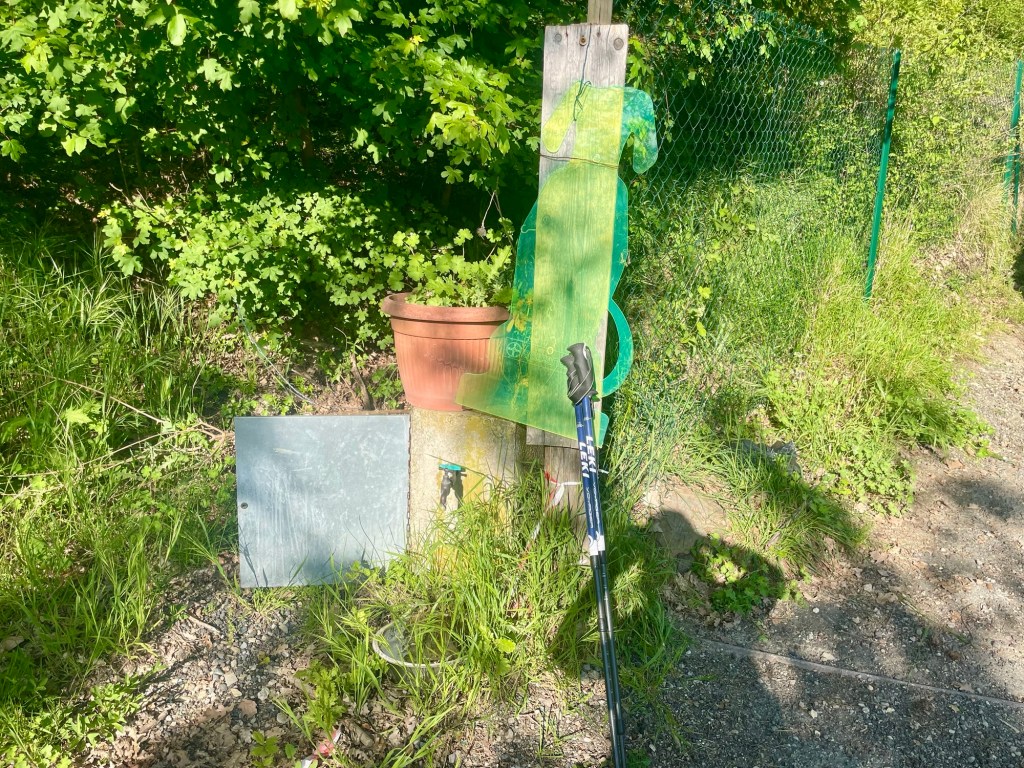
    Then, just as quickly as the thought arrived, such a tap appeared. It was accompanied by the outline of a dog and dog bowl but, water was water. I guzzled from the font and refilled my pouch. I held the water in a precious sphere in my mouth before I swallowed it. 
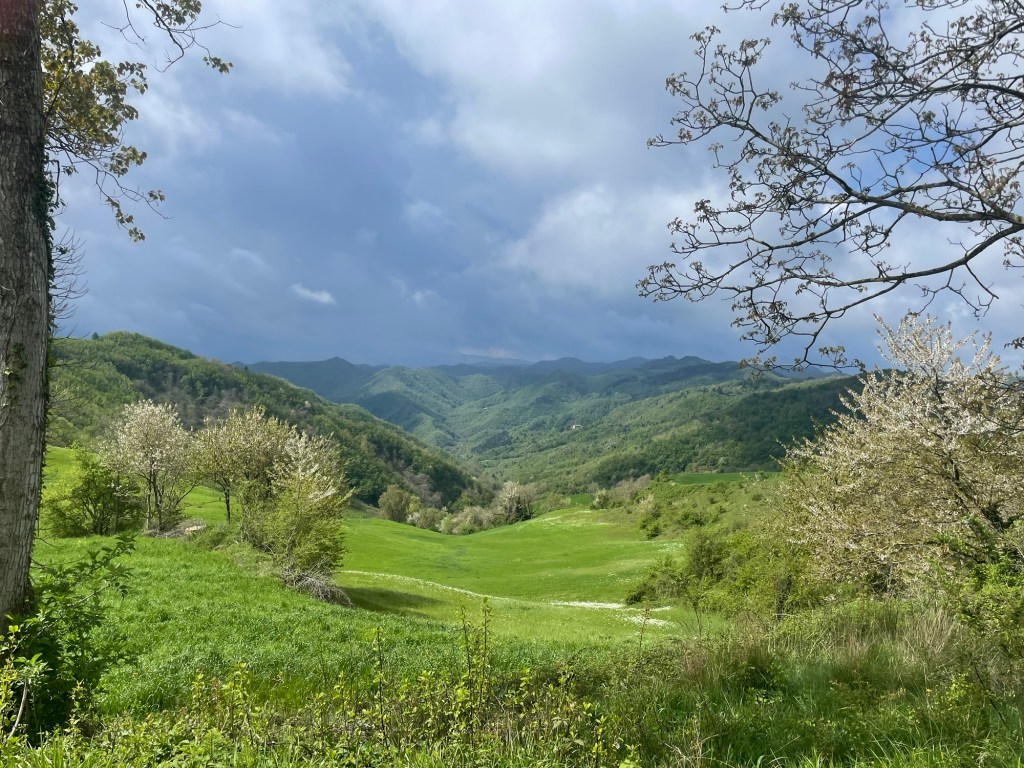
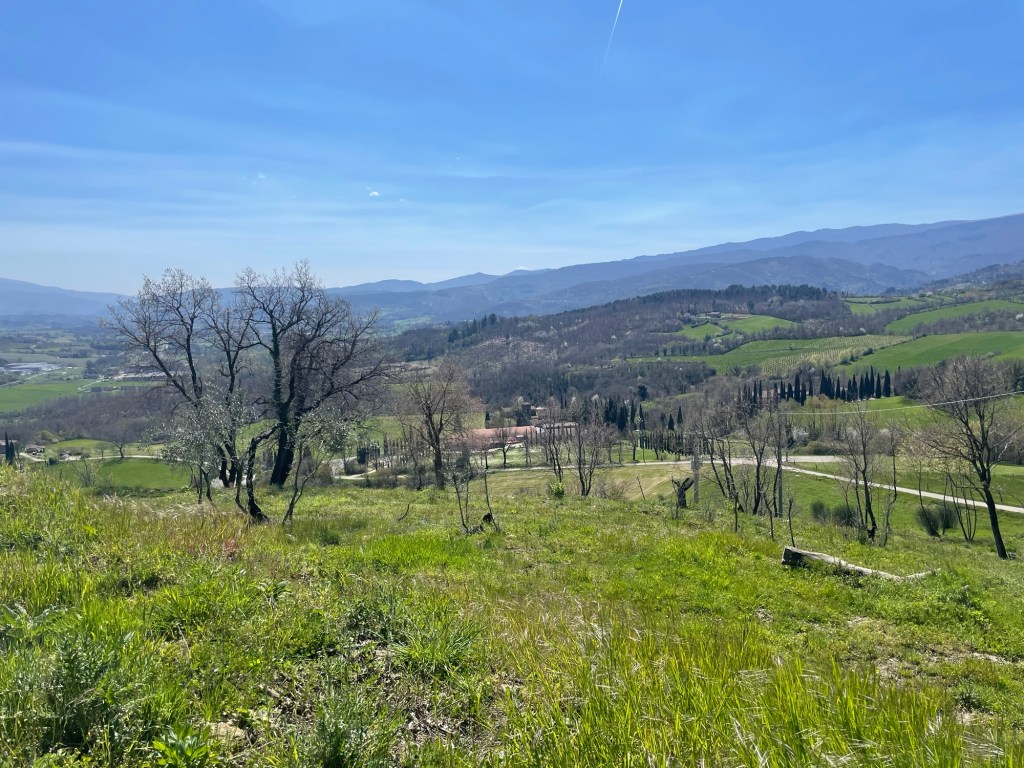
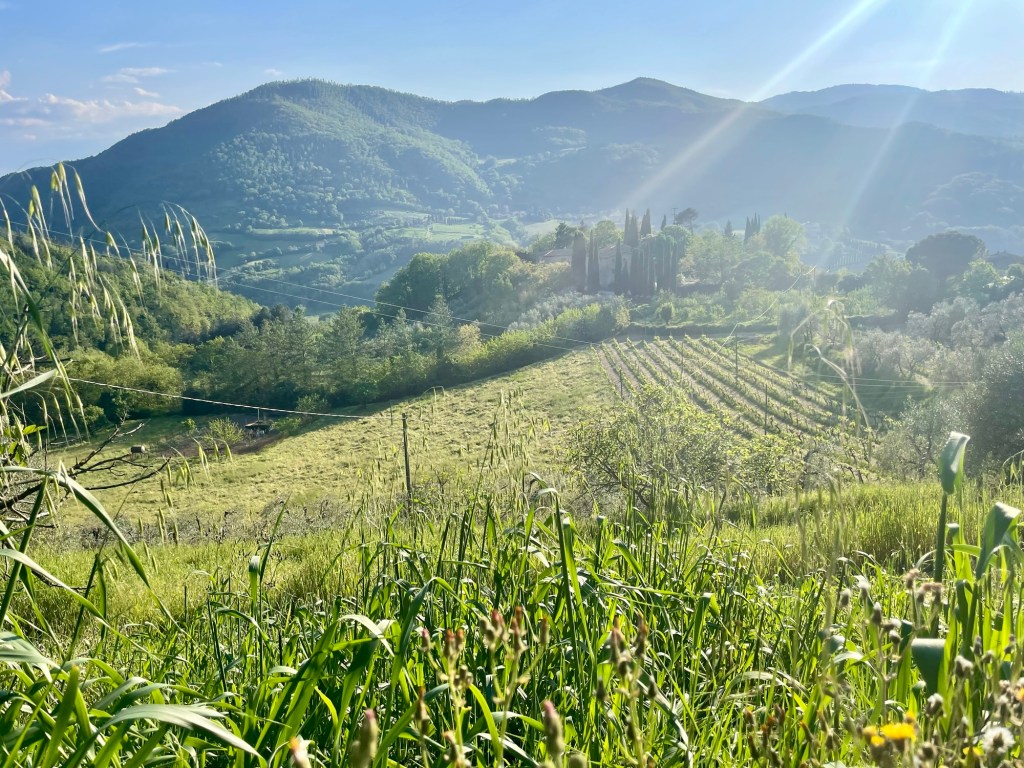
    I could feel that I was back in Tuscany because of the rolling hills, the soft golden light and the way the olive leaves seemed to glitter in the evening sun. The approaching dusk made the hills look matt and hazy.

    A bird sounded out like a car alarm. It was suddenly so tranquil. I recalled the words of William Blake from his poem Auguries of Innocence

    ‘To see a world in a grain of sand

    And a heaven in a wild flower,

    Hold infinity in the palm of your hand

    And eternity in an hour.’
    I watched a plane soar through the sky and was once again reminded that, this time next week, I’d be finished with walking and back to normal life. I wondered how normal my life could ever be after this adventure. 

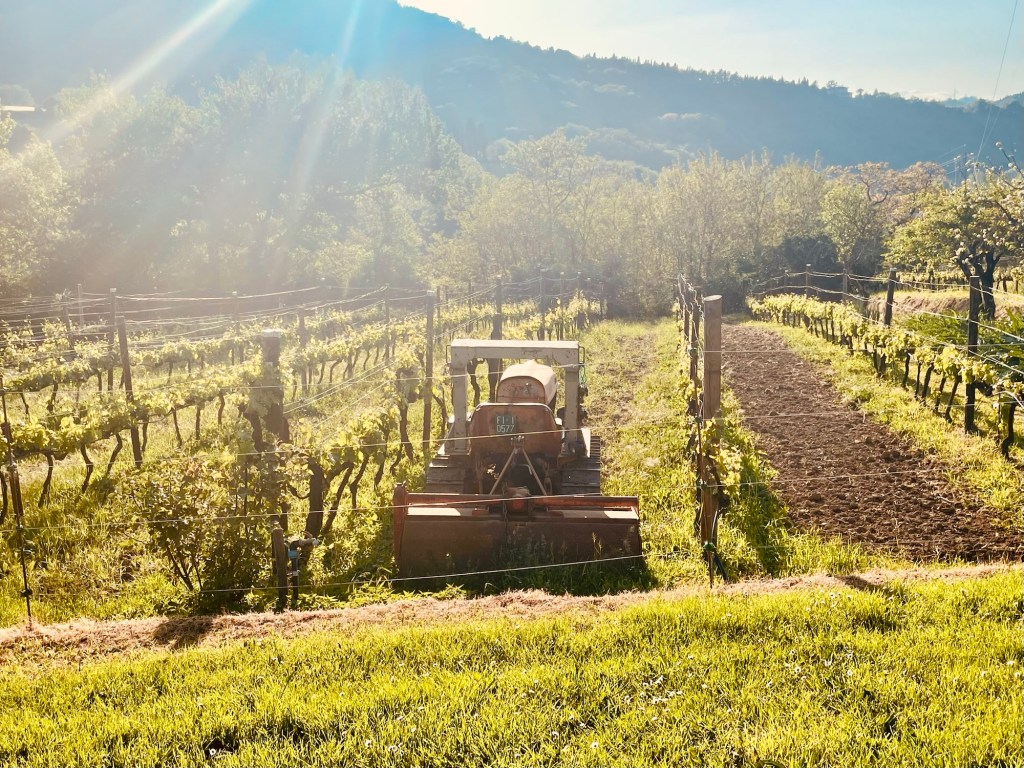
    A tractor drove past, and I collapsed in the grass awhile. I was 20 minutes from my destination but my toes ached and I was exhausted from all the extra energy I had expended on getting lost today. I had been told by my French host Beatrice that there would be pesto pasta for dinner and I was sure that it would be delicious. 

    The final descent into Dicomano was stunning. Poppies once again lined the hedgerows coupled with thick clumps of thistles. A chorus of sheep bleated out in unison. 

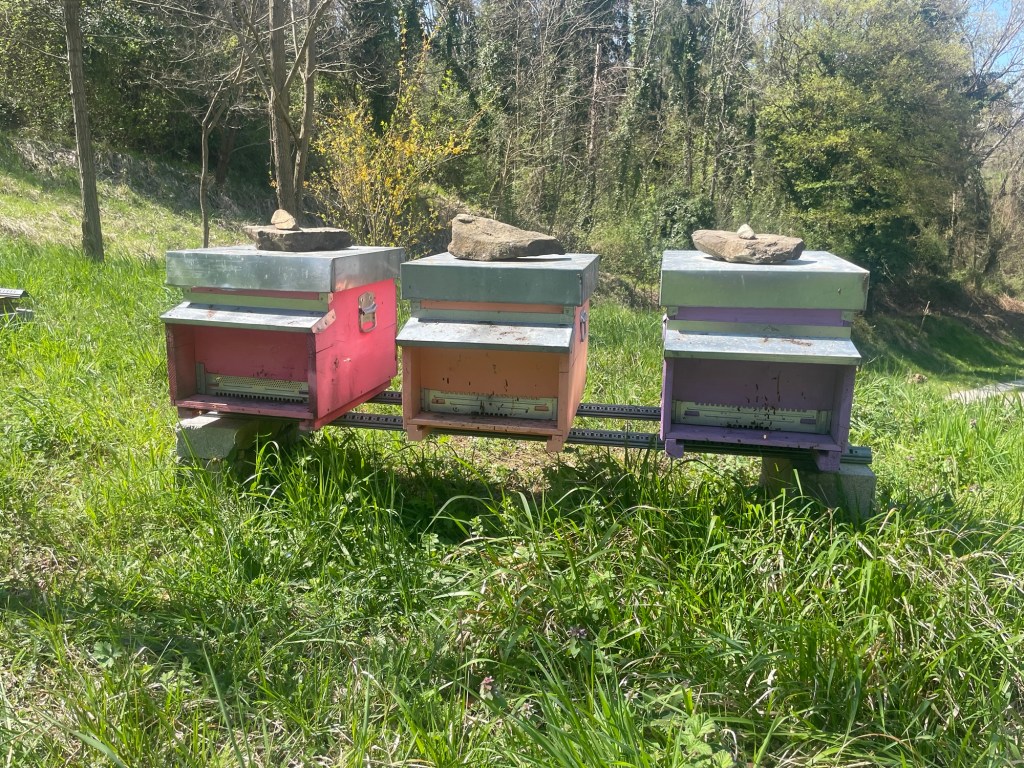
    There was a horse medallion on someone’s house and statues of little angels and a chicken rendered in bronze. There was plenty of space for both me and the cars on the road. A chain of colourful beehives lined the hill like a Lego brick house under construction.

    Three men who were tending to a cement mixer said hello as I passed them and, embarrassed, I realized I’d been singing to myself the nursery rhyme The Grand Old Duke of York. Today had certainly seen me march to the top of the hill and march back down again. 

    Then came the familiar sweet waft of black locust or white robinia. A plough was stationed in the middle of a field, retired from the toils of the day. An elderly voice was shouting to a young child something about a horse and dirty trousers. 
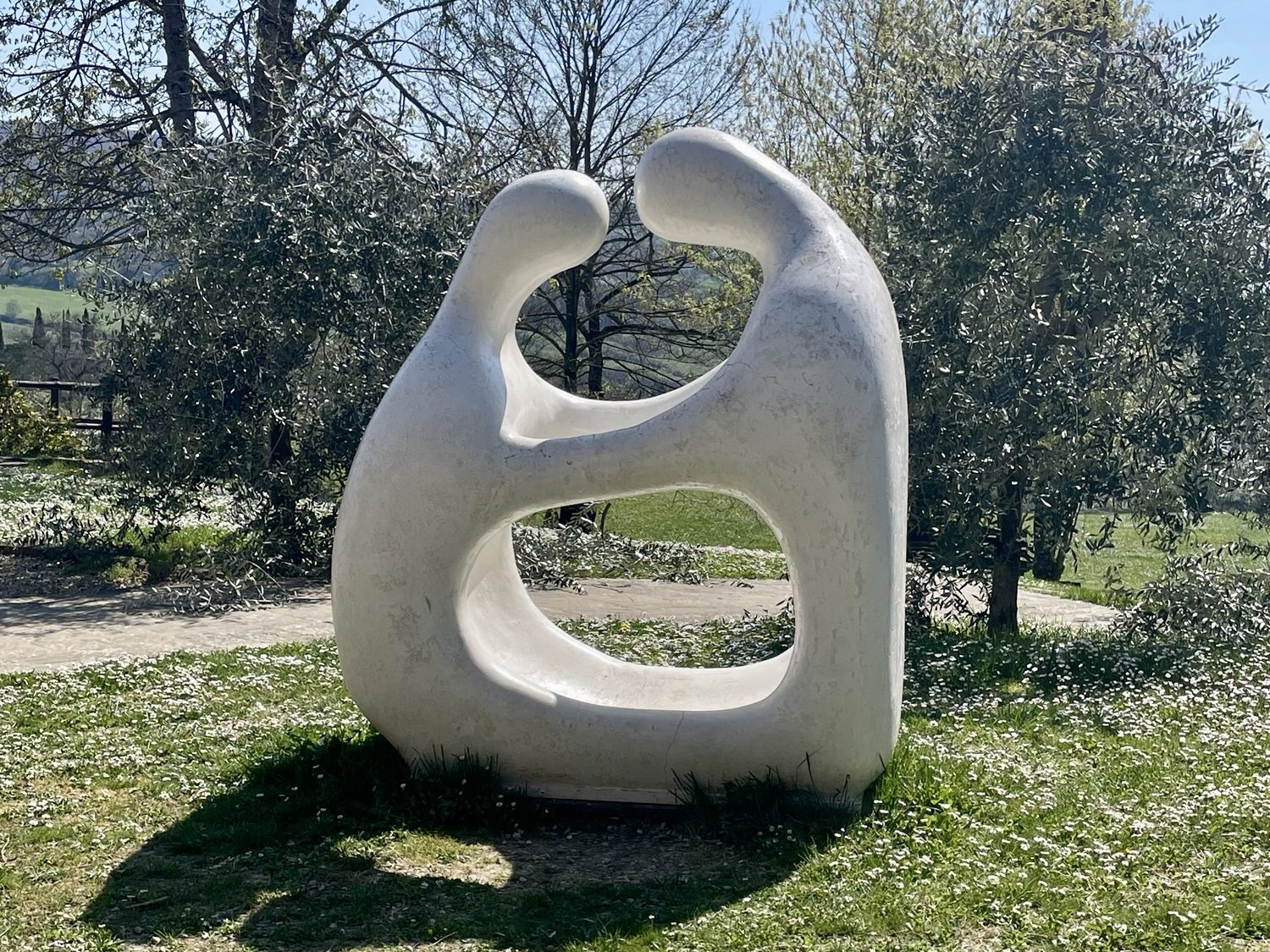
    I was greeted by my host, Ivan, who called me ‘bambina’ and complemented me on my pigtails – they were cute but also practical hiking wear. Their bed and breakfast, Pino del Capitano sat in a beautiful Mediterranean garden that was decorated with colourful Portuguese tiles and sinuous sculptures. 

    That night, I dined on a delicious fare with a man working in construction from Udine who was also staying with Ivan and Beatrice. Unlike me, he was here for business, not pleasure.

    Ivan brought me some plasters and I lanced my toes together more forcefully. He was sympathetic since his own daughter was a hiker who had recently completed 45 days of the Camino de Santiago. He was 74 but seemed much younger for his friendly and exuberant demeanor. 
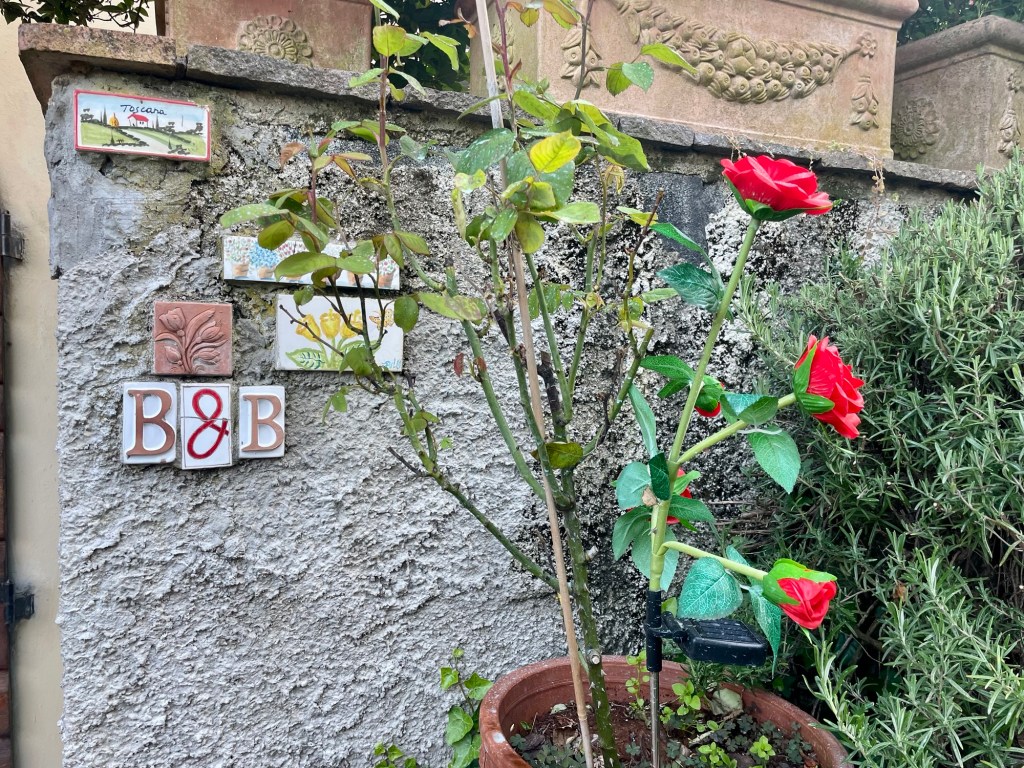
    Every stone you see, every flower, that’s the work of my hands in the garden,’ he proudly explained.

    It had taken him 25 years to get it just right. 

    We must ‘cultivate our garden’ counsels the French writer Voltaire at the end of his satirical quest, Candide. After the day I’d had I enjoyed the peace. Too true, I thought, too true. 
  • The Art of Exile: From San Benedetto in Alpe to San Godenzo 

    I had an easy day, retracing Dante’s footsteps as a political exile who had a tumultuous relationship with his native Florence.

    My sleep was disturbed and, as I was sharing the dorm with an Italian couple from Bologna, Giuliana and Vittorio who had arrived late the night before, I finally made use of my pink EarPods to listen to some sleep hypnosis meditations.

    I had fevered dreams and was reminded of Dante who in canto 27 of Purgatorio passes through the wall of flames to Paradise, only to collapse with sleep with his guides, Virgil and Statius at his side:

    ‘Before one color came to occupy
    that sky in all of its immensity
    and night was free to summon all its darkness,

    each of us made one of those stairs his bed:
    the nature of the mountain had so weakened
    our power and desire to climb ahead…

    From there, one saw but little of the sky,
    but in that little, I could see the stars
    brighter and larger than they usually are.

    But while I watched the stars, in reverie,
    sleep overcame me—sleep, which often sees,
    before it happens, what is yet to be.’

    But as Dante wakes eager for the journey ahead, writing, 

    ‘my will on will to climb above was such
    that at each step I took I felt the force
    within my wings was growing for the flight’

    I, on the other hand, was exhausted.

    Because of a landslide, I would have to retrace yesterday’s steps and take a longer improvised route round to San Godenzo. 

    Over a breakfast of sweet pastries, the hostel owner Gian Luca suggested I miss the first part and start back on the trail from after the landslide. 

    I didn’t need much convincing, so when Vittorio offered to take me halfway in their car, I agreed. 

    It would give me more time to catch up with work, specifically, a funding application I was developing to read Tagore with refugees in India. In one of his most beautiful poems in the collection Gitanjali, he describes a world undivided by borders:

    ‘Where the mind is without fear and the head is held high;

    Where knowledge is free;

    Where the world has not been broken up into fragments by narrow domestic walls;

     Where words come out from the depth of truth;

     Where tireless striving stretches its arms towards perfection;

     Where the clear stream of reason has not lost its way into the dreary desert sand of dead habit;

    Where the mind is led forward by thee into ever-widening thought and action

    Into that heaven of freedom, my Father, let my country awake.’

    It would be fascinating to see what refugees made of the world of this cosmopolitan Nobel Prize winning author. After Dante, Tagore was one of my favourite poets. 

    ‘Many people take public transport as they don’t manage after yesterday’, said Gian Luca reassuringly before he headed to the kitchen to make pasta for that day’s meal.  

    In the car, Giuliana and Vittorio told me a little of their work in music and events. 

    Soon we had arrived at Passo da Muraglione where Gian Luca had indicated to them to drop me but it turned out it was the wrong spot and I was completely off the Dante trail. I couldn’t ask the couple to drive me back another 30 minutes, and so I graciously accepted their offer to drop me directly in San Godenzo where they were passing through instead. From there it would be a three kilmetre walk up to the Agriturismo I had booked. I’d get a few steps in but the day would be my own to rest and recuperate.

    The car sounded out gospel tunes and many motorcyclists sped past on the road.

    ‘It’s the Spotify algorithm’ explained Vittorio. He’d liked one hymn and now the internet had decided he was religious. 

    In San Godenzo, I invited my hosts for a coffee and I had a slice of pizza, unsatisfied, once more, with my sweet breakfast. It was 10.30am. 

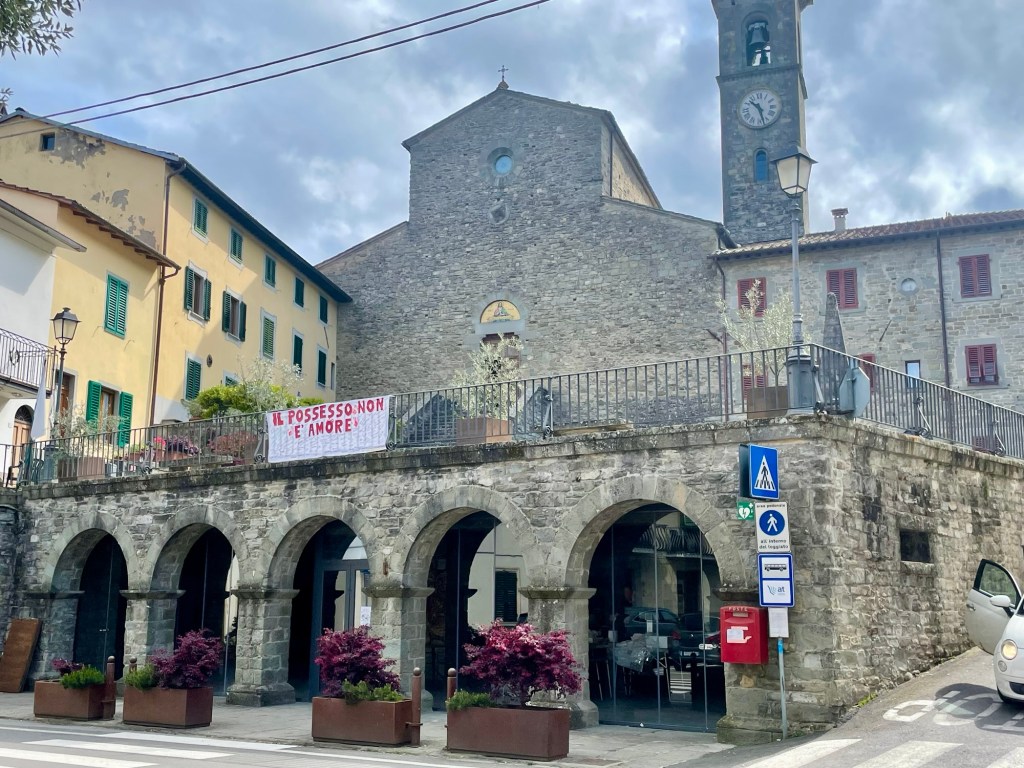
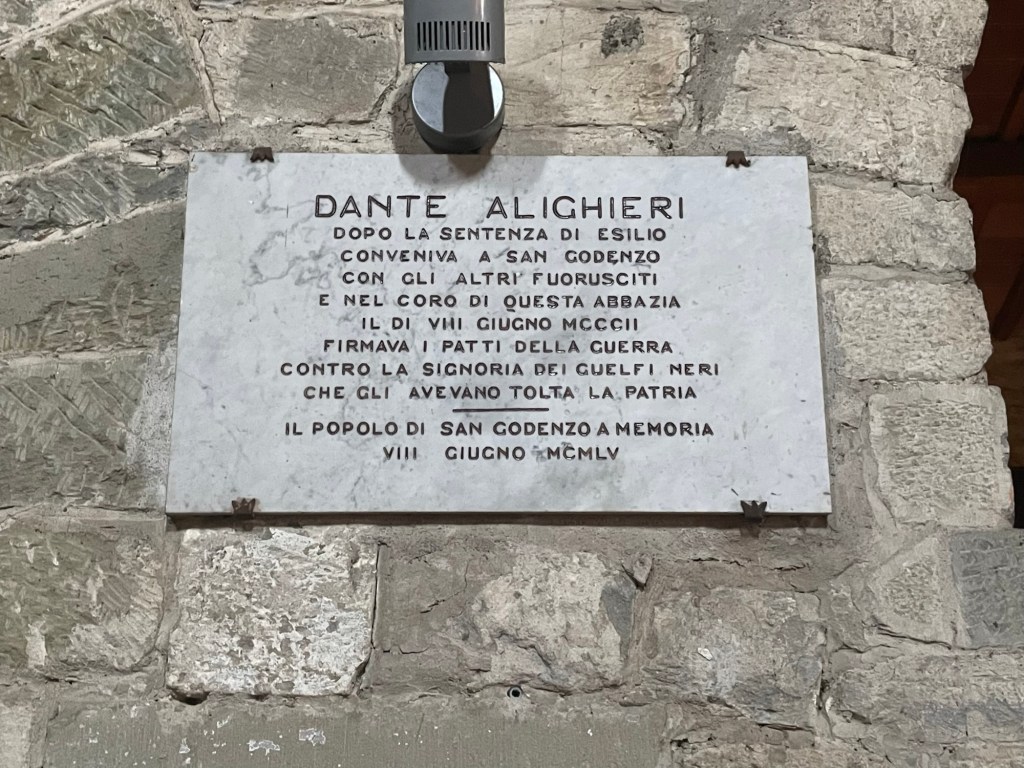
    I saluted the friendly couple and made my way to the abbey of San Godenzo in Piazza Dante Alighieri where the poet-politician had met with Ghibellines and White Guelfs in his first months of exile in June 1302 to try to forge an alliance against the Black Guelfs who had expelled him from the city.

    The convention brought together the noble families who were expelled from Florence and wanted to plan their return to the city by meditating on revenge. Dante’s name is signed in the attendance list.

    Walking around the abbey, I felt Dante’s political presence. I thought of all the refugees I knew who were committed to activism across borders. My friend Javid campaigned for women’s education in Afghanistan while an Albanian youth group I had worked with had started a campaign against blood feuds. 

    Although the 1302 convention did not lead to action, for more than 30 years, San Godenzo has commemorated this event during the ‘Dante Ghibellino’ festival, with a historical procession through the town streets. The celebrations culminate in awarding the homonymous prize to citizens who, during the year, have distinguished themselves for their civic commitment to San Godenzo, its territory and its community.

    As a political exile, Dante was excluded from a Florentine pardon in 1311, but another amnesty in 1315 would have allowed him to return. Unwilling to comply with the terms of the offer—admission of guilt and payment of a fine—Dante was again sentenced to death, this time by beheading rather than fire, the penalty now also applying to his sons, Pietro and Jacopo. 

    An additional provision stated that anyone had permission ‘to harm them in property and person, freely and with impunity.’ 

    Dante’s refusal reflected not only his great pride but also his better living conditions. While the first years of his exile had been brutal, by 1316 he was now residing in Verona as a guest of the Ghibelline ruler Cangrande della Scala. Having cut ties with his native city, he declared himself ‘Florentine by birth, not by disposition.’ Dante had learned how bread outside Florence ‘tastes of salt,’ but such bread was also not lacking as he sought out more abundant hospitality towards the end of his life. 

    Dante’s ‘overswollen pride’ is reflected in the significant time he spends with the proud in Hell and on the terrace of the proud in Purgatorio. Indeed, Dante presents pride as the foundation of sin by situating it at the base of Mount Purgatory. 

    In Purgatory, he walks alongside the proud souls who are forced to carry heavy loads:

    ‘I, completely hunched, walked on with them….for such pride, here one pays the penalty’

    Dante then reflects on the fleetingness of reputation and fame:

    ‘O empty glory of the powers of humans!
     How briefly green endures upon the peak-
     unless an age of dullness follows it…

     Worldly renown is nothing other than
     a breath of wind that blows now here, now there,
     and changes name when it has changed its course.’

    There is an irony here, since Dante is also explicit about his desire to bolster his reputation through the written word. 

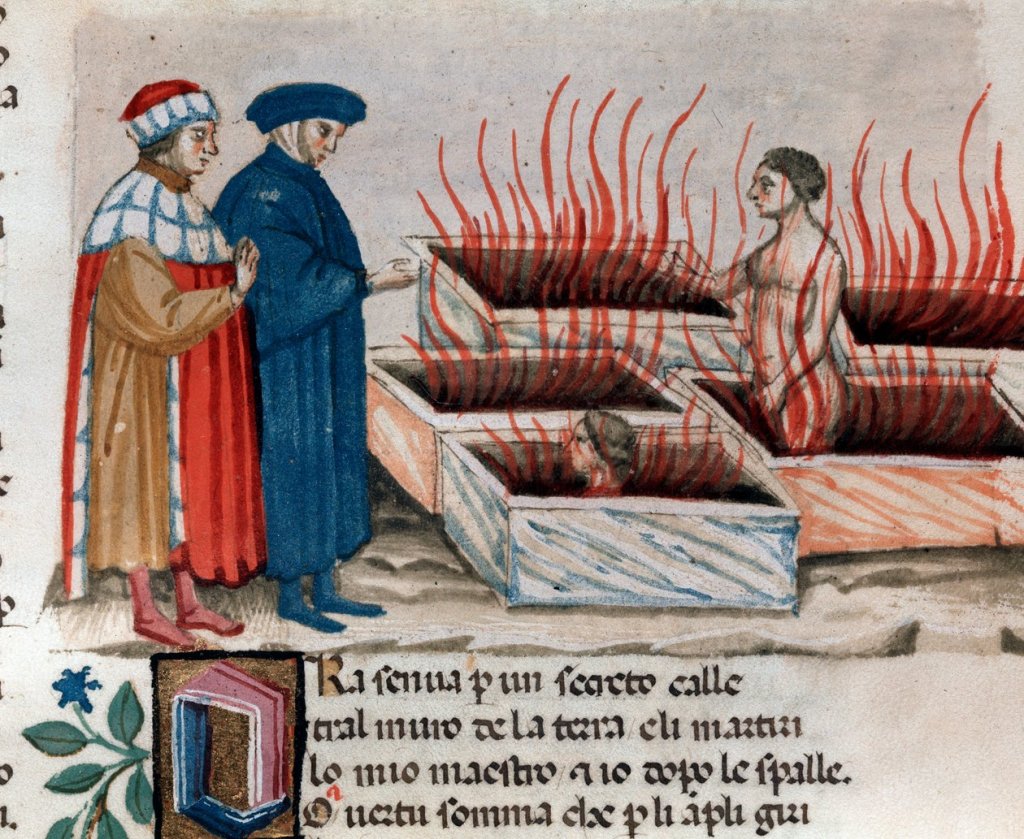
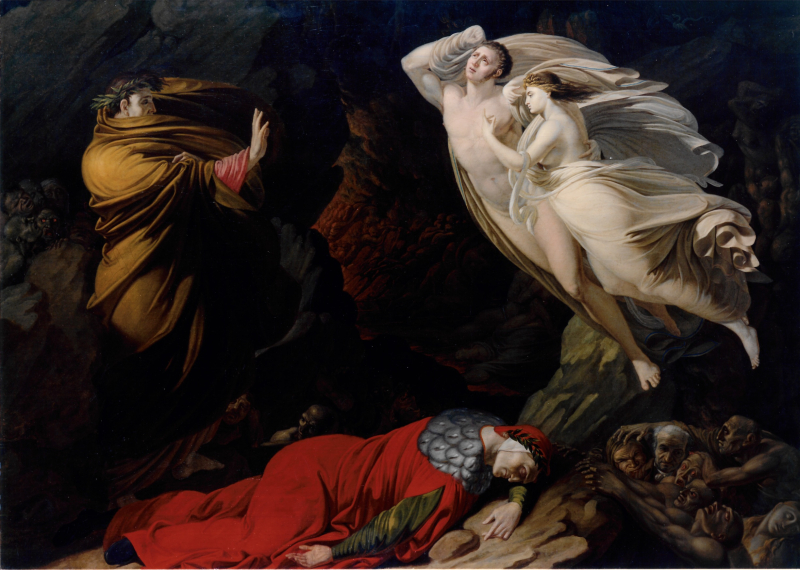
    In Inferno, meanwhile, one of the most realistic conversational exchanges occurs between Dante and Farinata degli Uberti, the great Ghibelline leader in the battle of Montaperti, who died the year before Dante’s birth. Farinata is depicted in ‘the cemetery of Epicurus and his followers, all those who say the soul dies with the body.’ However, he is also guilty of the sin of pride, something we see through his rising out of a burning coffin, stubborn and defiant.

    ‘My eyes already were intent on his;
    and up he rose—his forehead and his chest-
    as if he had tremendous scorn for Hell.’

    Dante uses the meeting to discuss Florentine politics, engaging in vocal sparring. Farinata immediately recognizes Dante as a Florentine citizen from his accent: 

    ‘Your accent makes it clear that you belong
    among the natives of the noble city
    I may have dealt with too vindictively.’

    He then goes on to explain how he was responsible for the exile of many of Dante’s ancestors`:

    ‘When I’d drawn closer to his sepulcher,
    he glanced at me, and as if in disdain,
    he asked of me: “Who were your ancestors?”

    Because I wanted so to be compliant,
    I hid no thing from him: I told him all.
    At this he lifted up his brows a bit,

    then said: “They were ferocious enemies
    of mine and of my parents and my party,
    so that I had to scatter them twice over.”’

    While there is certainly no love lost between Dante and Farinata, there is a measure of respect. Farinata, called magnanimo, ‘great-hearted’, put Florence above politics when he stood up to his victorious colleagues and argued against destroying the city completely.

    ‘But where I was alone was there where all
    the rest would have annihilated Florence,
    had I not interceded forcefully’

    As the literary critic Auerbach has noted, Dante’s realistic and somewhat flattering depiction of Farinata shows his willingness to admire and work alongside his adversaries, something he did by uniting with the Ghibellines during the 1302 convention in San Godenzo. 

    Dante rebuffs Farinata’s insults by boasting that on both occasions when his ancestors were exiled, they returned:

    ‘“If they were driven out,” I answered him,
    “they still returned, both times, from every quarter;
    but yours were never quick to learn that art.”’

    The art referred to here is the art of exile. As Barolini explains, the above conversation references four cataclysmic events in Florentine politics of the thirteenth century, as Florence oscillated between Guelph and Ghibelline control until the ultimate defeat of Farinata and the Ghibellines at the battle of Benevento of 1266. 

    In effect, the dialogue lays out two sets of factional routes and returns. The first set of route and return comprises the 1248 defeat of the Guelphs by the Ghibellines, with the help of Emperor Frederic II, followed by the return of the Guelphs in 1251, after the death of the Emperor.

    The second set comprises the 1260 defeat of the Guelphs by the Ghibellines at the battle of Montaperti, where Farinata led the Ghibellines to victory with the help of the Sienese and Manfredi, Frederic’s successor, and then the subsequent defeat of the Ghibellines and return of the Guelphs following the battle of Benevento and the death of Manfredi in 1266.

    The abbey where Dante convened with Ghibellines of his own day featured a plaque to honour him and some stunning mosaics that had been added some time after he had congregated there.

    Outside the church someone had hung a banner saying, ‘possesion isn’t love.’

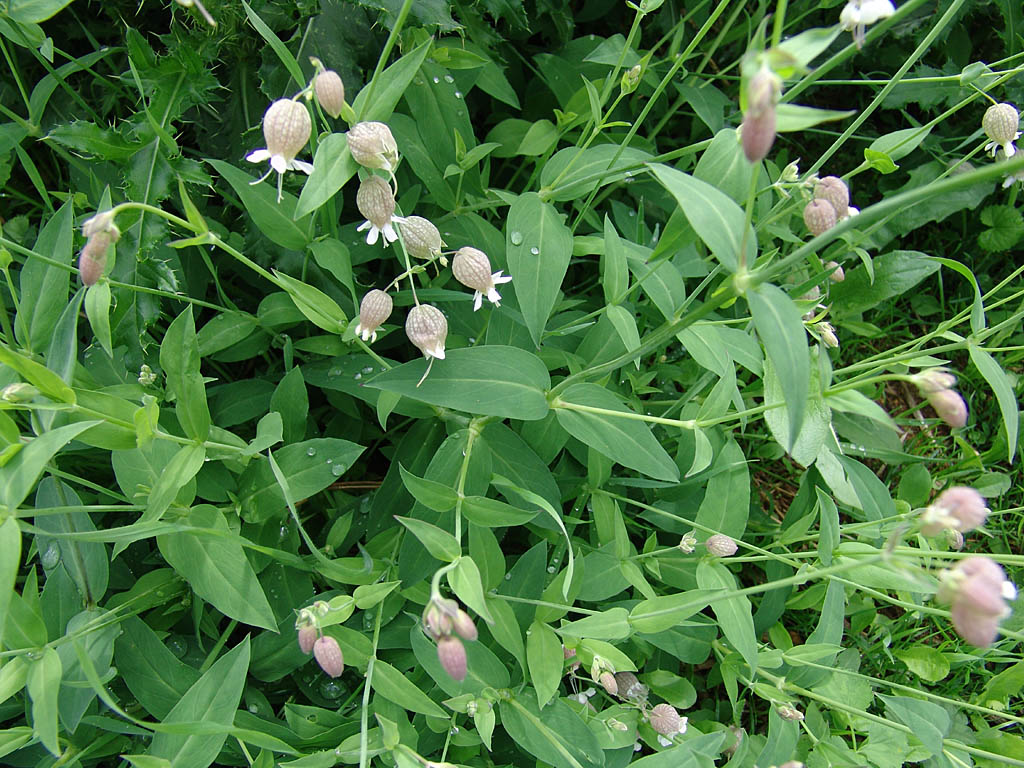
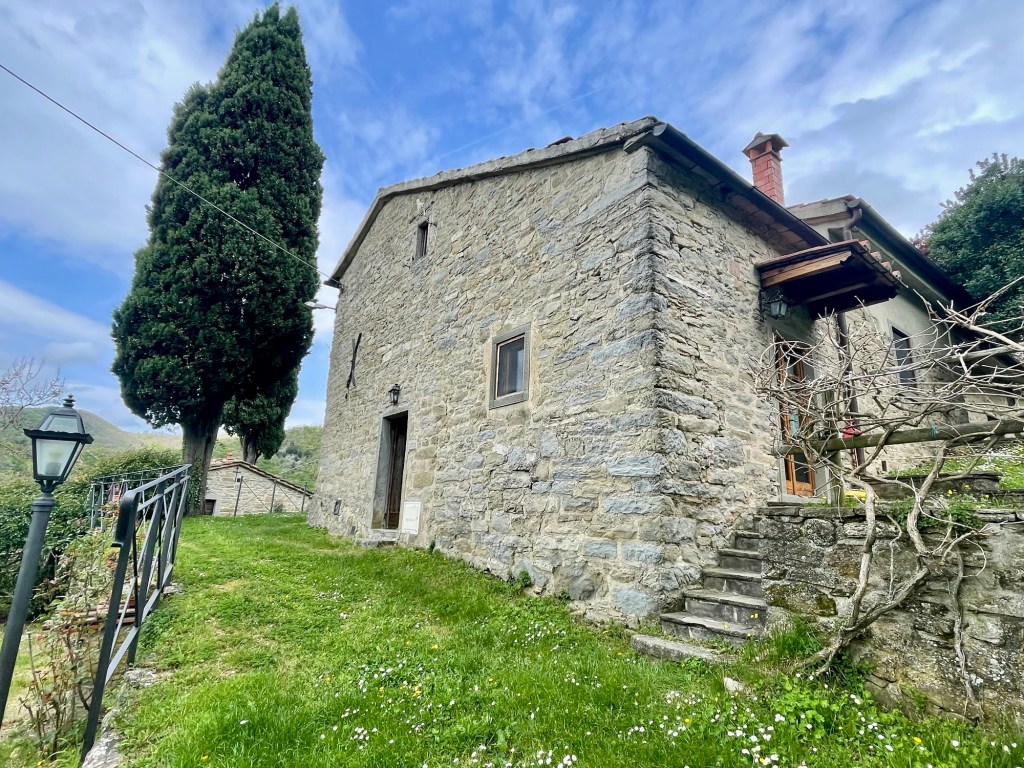
    I walked for half an hour up a hill to the Agriturismo Tenuta Mazzini where I was met by Filippo, the son of the owners who was out foraging for strigoli. He was walking alongside a woman carrying a wicker basket. Strigoli, or stridoli, are a spontaneous grass typical of the Tuscan-Romagna territory. The name comes from the screeches that two leaves emit if rubbed together. It is edible and often used in risotto or salads. It’s especially tender at this time of year, explained Filippo.

    There was a sign forbidding people from collecting mushrooms and chestnuts between the 1st of September and 31st of October but there was no mention of harvesting grasses. What’s more, the seasonal ban had yet to come into force.

    Filippo showed me where there was a local restaurant that served lunch, but the owners had provided spaghetti, tuna and tomato sauce so I made myself a meal that would serve as both lunch and dinner.

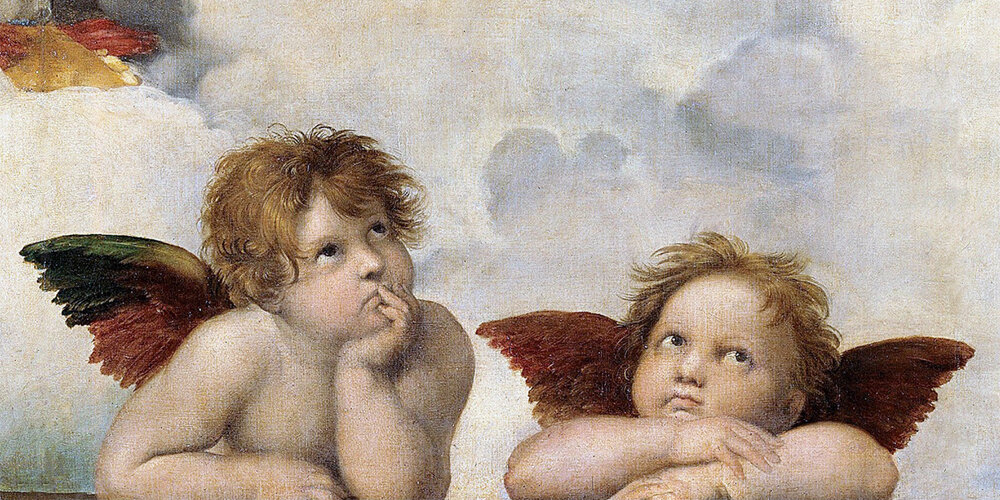
    The apartment was spacious with a comfy double bed, quite a welcome contrast from yesterday’s basic amenities and a total bargain at just 45 Euros a night. There was a poster by Matisse and a copy of The Two Cherubs by Rafael from 1513. The latter is part of a bigger painting that features the Madonna holding the Christ Child, flanked by two saints. The figures are placed among the clouds, suggesting that it is a scene from heaven. At the base of the painting are the two winged cherubs, looking up at the scene from below.

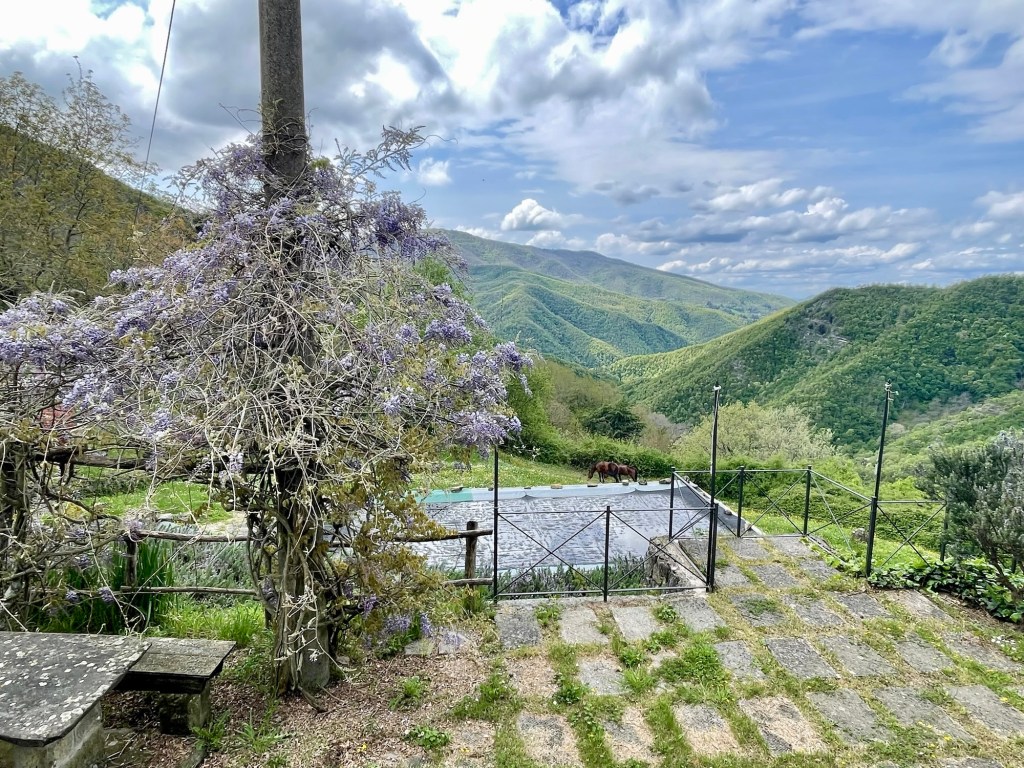
    Outside there was a swimming pool that was overhung with wisteria. It boasted a view of the rolling hills. I watched as a nuthatch flitted from branch to branch then disappeared into the distance. 

    A lady staying in the flat next door, Cristina, had brought six cats with her and took them each out for a wonder on a lead. Milu was among the friendliest and we shared caresses on the grass.

    As I caught up on work, including meeting online with my PhD student Olivia who was doing research on asylum seekers’ reception in UK hotels, I recalled Dante’s words about how writing is a way to ‘make oneself immortal.’

  • Over the Misty Mountains: From Marradi to San Benedetto in Alpe

    I said goodbye to Pope Francis, was humbled by the kindness of strangers, and struggled over the staggering mountains.

    It’s common that Italian bars and restaurants have TV’s on in the background, so over a breakfast of a croissant and cake I watched as the news anchor looked back on Pope Francis’ life. There was no doubt about it, he had been an incredible man. 

    Although I’m not a Catholic, for all intents and purposes it seemed he had been a good Pope too.

    I recalled how struck I had been when he’d blessed arriving migrant ships in Lampedusa and washed the feet of refugees. The news reported that migrants, along with homeless people and individuals in prison, had been among those invited to his funeral. Pope Francis had also spoken out about climate change. He would be sorely missed.

    500,000 pilgrims had descended on Rome to pay their respects. Kelsey, who lived there in an apartment by the Colosseum, said that the atmosphere was electric.

    I reflected that Prince William looked handsome with a beard and wondered how the encounter between Trump and Zelensky would go down. I had watched the entire video of his ritual humiliation at the hands of Trump and Vance at the Whitehouse and was left with the feeling that I had witnessed an act of bulling and extreme abuse occur upon the screen.

    11,000 police and security officers had been mobilized by the Italian state. 

    I watched Starmer greet Meloni with a kiss on the cheek and was reminded of the cruel recent UN approval for offshore processing centres for asylum seekers, a policy the UK had borrowed from Italy. 

    Franco appeared from between two baby chairs.

    ‘Buongiorno!’ he saluted me. He was wearing shorts and looked almost German with his fair hair and skinny legs. 

    ‘Buongiorno,’ I replied. 

    ‘Ah yes, the Pope of the people, he was,’ reflected Franco.

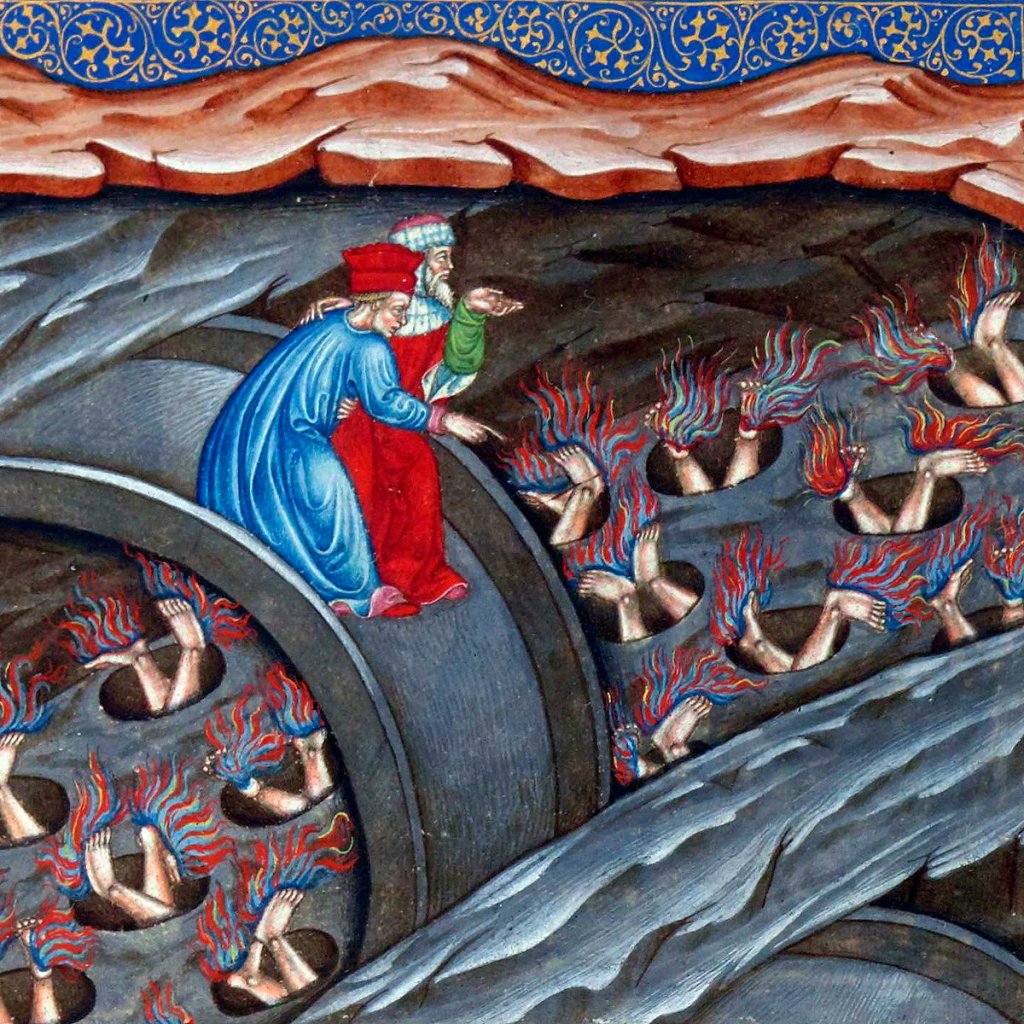
    I thought of Dante’s tumultuous relationship with the Popes, many of whom he’d put in Hell where they were buried in the ground headfirst with their feet on fire.

    ‘O Simon Magus! O his sad disciples!
    Rapacious ones, who take the things of God,
    that ought to be the brides of Righteousness,

    and make them fornicate for gold and silver!
    The time has come to let the trumpet sound
    for you; your place is here in this third pouch.’

    In this canto, Inferno 19, the prostituting of the Church-bride by her Pope-bridegroom picks up and metaphorises the sexualized language of previous parts of the Inferno. This canto is the first of several indictments of the Church in the Divine Comedy. Indeed, it picks up on some earlier indications that Dante links the clerical establishment with the sin of avarice. In Inferno 7 he says that he sees cardinals and popes among the misers in the fourth circle:

    ‘ These to the left—their heads bereft of hair—

    were clergymen, and popes and cardinals,

    within whom avarice works its excess.’

    I was captivated by the news but I had to get moving. Today was a long one and starting at 9 was already a bit ambitious, Franco warned me.

    He noted that one of my hiking poles was broken and I followed his gaze.

    ‘I don’t suppose you have any glue or something to fix it,’ I asked.

    His face lit up. 

    ‘I have just the thing’, he said.

    My host disappeared into a back room with the broken pole and reemerged ten minutes later. He had completely fixed it. It was sturdy as the mast of a ship.

    ‘But how did you manage that?’ I questioned.

    ‘Ah, it’s a secret,’ came his reply. ‘A bit of magic and good will.’

    I was beyond grateful. I was also grateful that after I’d finished my third espresso macchiato Franco handed me a fruit juice bottled filled with espresso.

    ‘You’ll need this,’ he said, ‘it’s for the road.’ 

    One of the passes I would cross today was named ‘Hell’s Hill.’

    I tucked it into my bag, delighted.

    I carefully removed a tick from my stomach as I watched a lady place flowers in boxes outside her store from the window. I realized I’d left my glasses and moisturizer at a previous hotel and was grateful for my contact lenses and Vaseline which I applied to my chapped face instead. 

    And with that, I set off back into the mountains. I saluted Franco. He left me his number in case I needed anything. He had been another ‘trail angel,’ as Kelsey called them.

    Though I had enjoyed by brief interlude from the 24-hour news cycle during my cammino, now I listened to the BBC World Service as I ascended out of the town. The Pope’s funeral was about to start and I was curious about how it would be covered. 

    It was a sunny but fresh day and I’d known better than to wear shorts. It would be cold up in the mountains and so I’d put on my trousers.

    There was no two ways about it, the ascent out of the city was steep. My back and shoulders hurt today as well as my feet. Today was going be a beast. I could feel my calf muscles twinging to life. I’d done some gentle stretching the night before but this was a burn.

    The sweat dripped off my nose and my hands slid, sweaty, on my poles. I had only been going for 20 minutes!

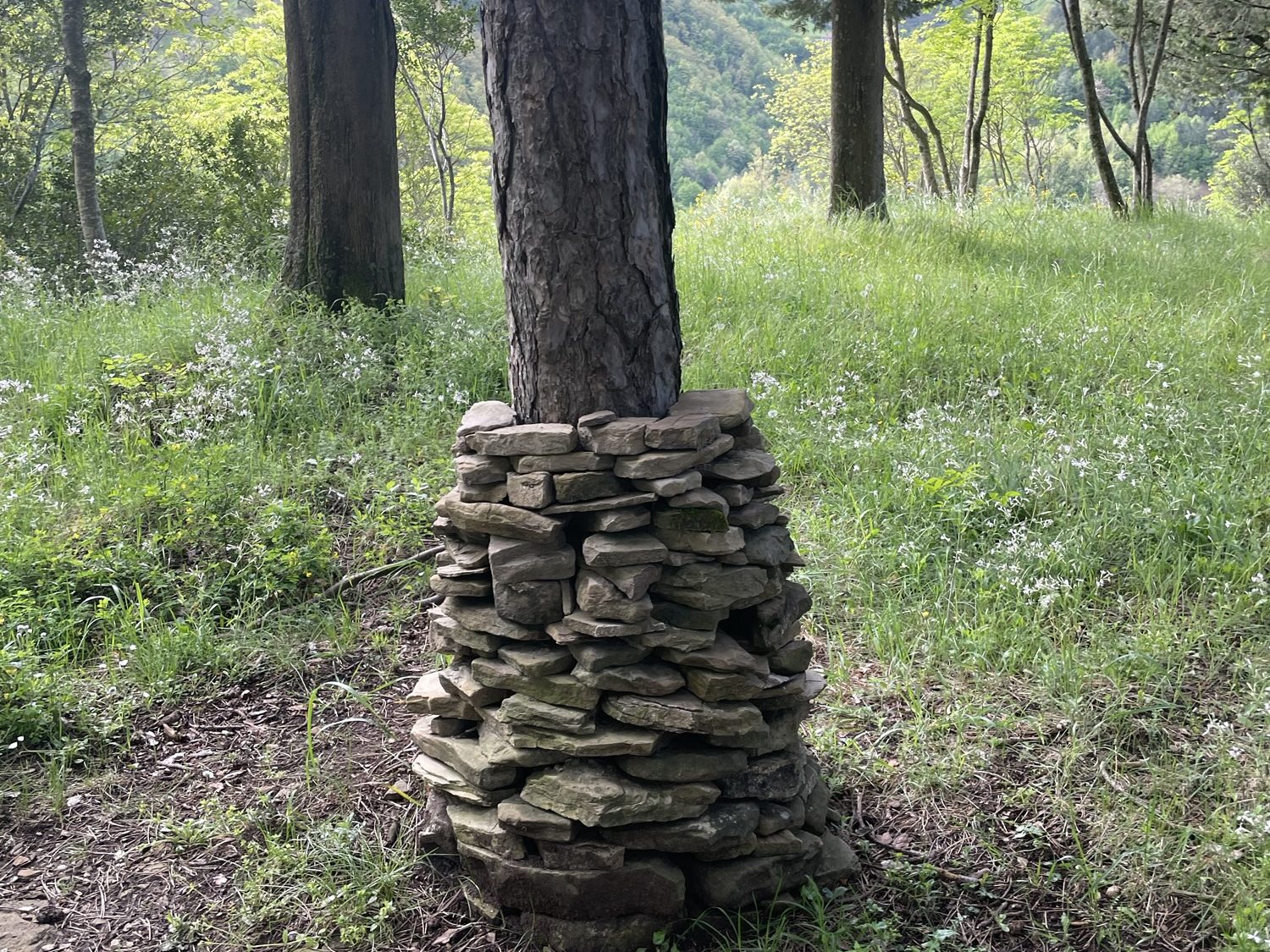
    A few mountain bikers past who I saluted – it was a sport I’d never tried. Someone had laid stones at the bottom of a line of trees like a familiar cairn. 

    I’d felt on the edge of tears for the last few days. Maybe today would be the day.

    I drank water liberally since I was counting on stopping at the Hermitage to restock on the way.

    I was religiously checking directions. I really didn’t want to add time to what would already be a super long day.

    The radio informed me that there had been a bishop in Rome for over 2000 years and that there were 1.4 billion Catholics in the world. Pope Francis had spoken out against the wars in Ukraine and Gaza. He had said that ‘a pastor should never lose the smell of his flock.’

    50 heads of state and ten monarchs were in attendance. 40,000 celebrants filled St Peter’s Square and 100,000 more were crowded before large screens on the Italian side of the border. The Vatican was, after all, its own city state.

    Someone said that the Argentinian Pope had even been able to do the impossible, make Brazilians forget their football rivalry and connect across the border. He had been a champion of interfaith dialogue.
    Then came the 10am news bulletin. Trump’s administration had deported a two-year-old to Honduras in breach of due process. Of course he had. This is what I hadn’t missed about listening to the news. I felt sick at the thought to it and recalled the poem:

    ‘First they came for the socialists, and I did not speak out—
         Because I was not a socialist.

    Then they came for the trade unionists, and I did not speak out—
         Because I was not a trade unionist.

    Then they came for the Jews, and I did not speak out—
         Because I was not a Jew.

    Then they came for me—and there was no one left to speak for me.’

    I followed the first of two detours that had been designed to avoid landslides, adding about two kilometres to my route. I dodged another group of mountain bikers, one of whom was topless. 
    It was very muddy on the path and I was immensely grateful for my poles to help me avoid a slip. Franco, you angel!

    There emerged a big rain cloud and the wind picked up.

    The radio continued with its commentary of Pope Francis’ funeral. 130 delegations were in attendance. Putin was not. He would have been arrested by international warrant if he’d set foot on Italian soil.

    Pontiff, I leaned, means ‘bridge builder’.

    In other news, North Korea had launched a new missile ship. What a world.

    A group of scouts came hiking towards me in the opposite direction. They saluted me cheerfully. Their backpacks suggested they were campers. I hoped for them as well as for myself that the rain would hold.

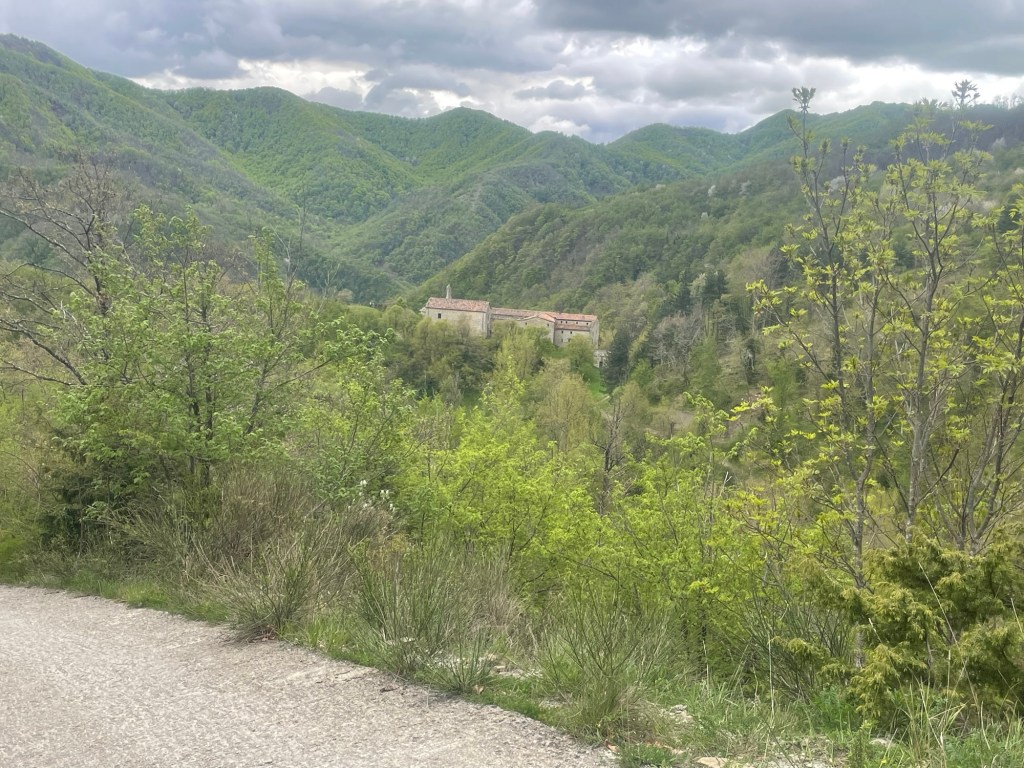
    I lost signal as I approached the Hermitage of Gamogna where an order of sisters lived and prayed. I passed two such nuns, one of whom was wearing a wooly hat, and they invited me to enjoy the church. The complex, a sign informed me, had been founded in 1053.

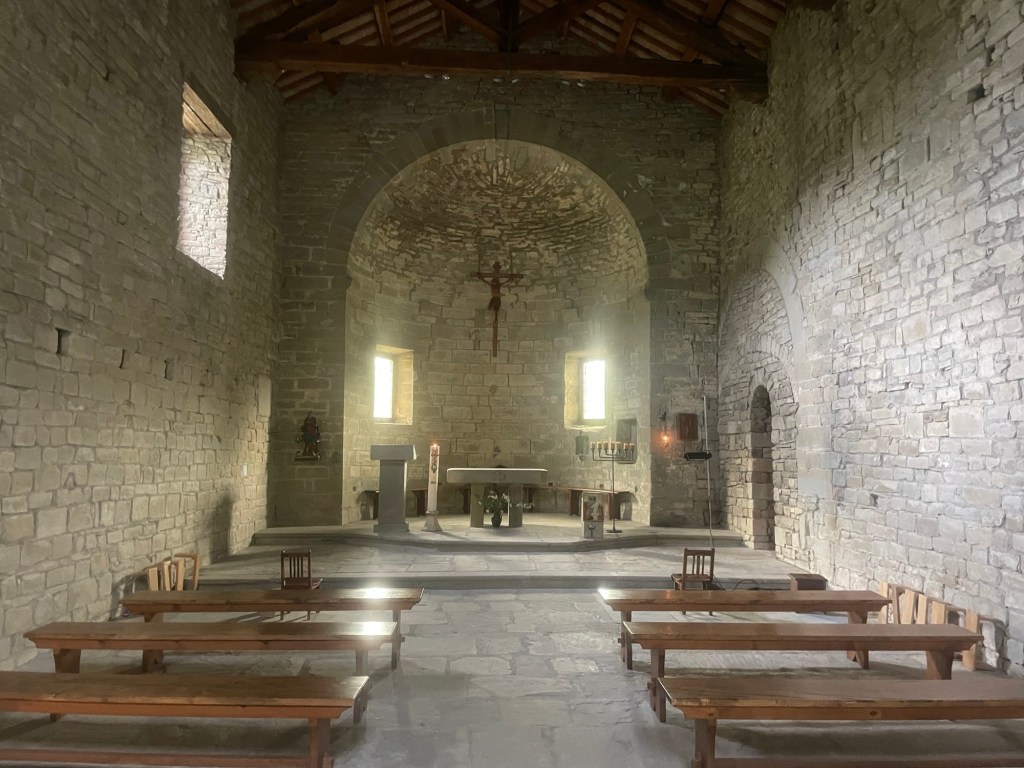
    I took off my cap as I entered the simple stone building and took awhile to sit on a pew and rest. It was incredibly tranquil. Before I left, I signed the prayer book.

    ‘With the wish of peace to all refugees and that I may complete this cammino,’ I wrote.

    I ate half of my controversial tuna and cheese sandwich in the pretty courtyard and refilled my water tank from an outside tap by which there was an abanonded toothbrush. I also drank half of the coffee that Franco had so kindly prepared for me. 

    Yum.

    A French couple were having a picnic and a couple of other hikers were making their way up to the church.

    It was 12.30pm. I followed the. prominent Cammino di Dante signs up to a field that was cordoned off with barbed wire – that’s not very nun-like, I thought. Then I crawled under it. My anorak was snagged. Would I regret this?

    I looked back at Oliver’s messages and texted him, waiting for his advice. There were footprints; somebody had come before.

    The woodland I entered was dotted with little wildflowers that looked like miniature violet pansies, and here was the familiar sprinkle of primroses.

    I exited the patch of woodland through another barbed wire fence, but this one, I noted, had a gate mechanism you could cross through and a sign that clearly indicated that livestock were grazing. I must have missed the gate in the previous fence. The nuns were ok after all. 

    Oliver had helpfully signaled to me where the path goes right off the road – it would be would be easy to miss – and up, up I went along a dirt path. 

    It was now 2 o’clock and I was about halfway. I was hungry. I ate some more of my sandwich. I was so grateful Franco for fixing my pole. Today’s hike would have been near impossible without it.

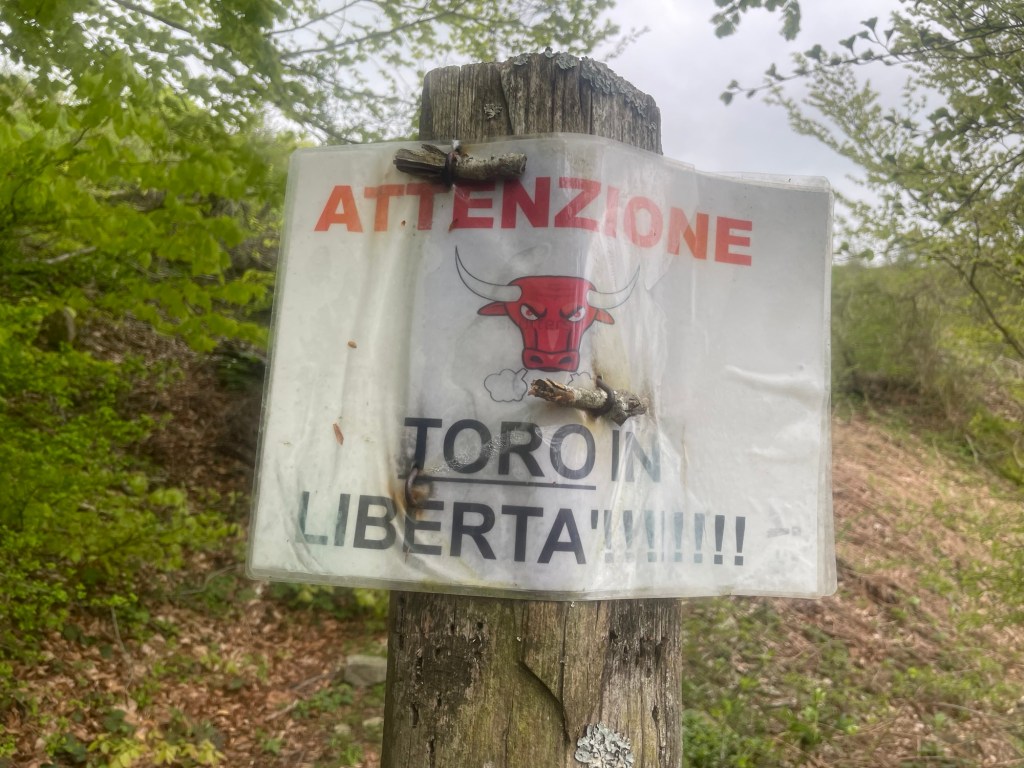
    The brooding clouds delivered the first spits of rain. I crossed a field with the sign, ‘Attention, wild bull!’ and crossed a pass called ‘Hell’s Hill’.

    I followed a man who was walking slowly with stick behind his back. We kept pace. I was about ten metres behind. The path was now lined with a brown brush-like plant. 

    It was still two hours to the waterfall. I wouldn’t get there before six, I realized.

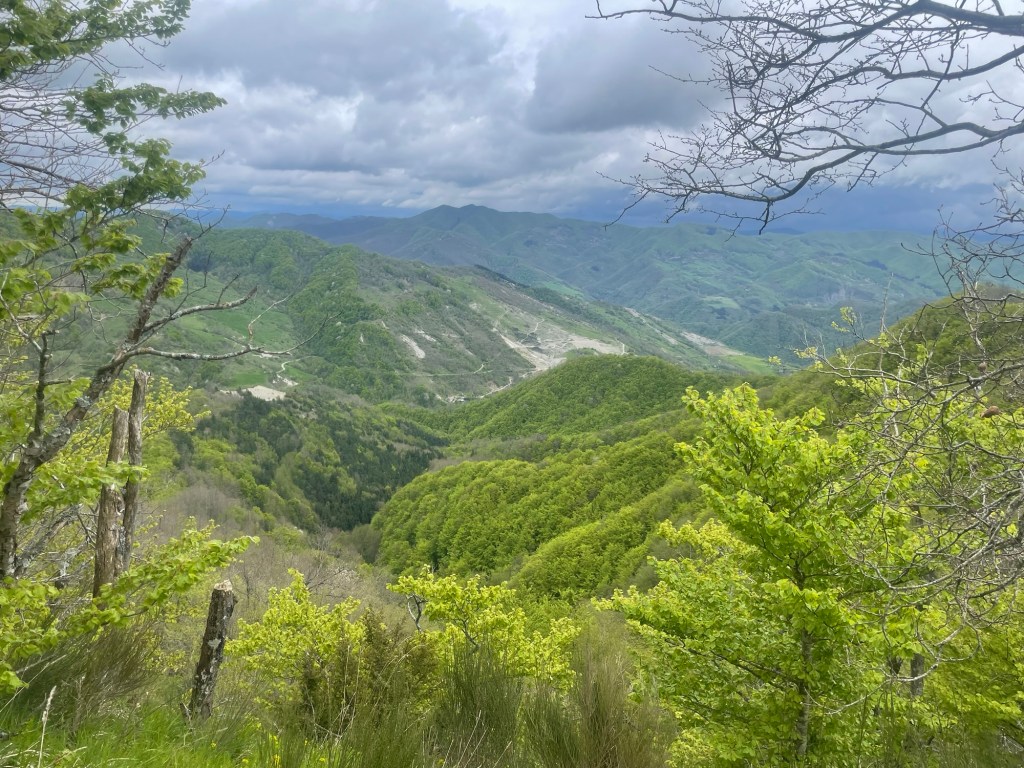
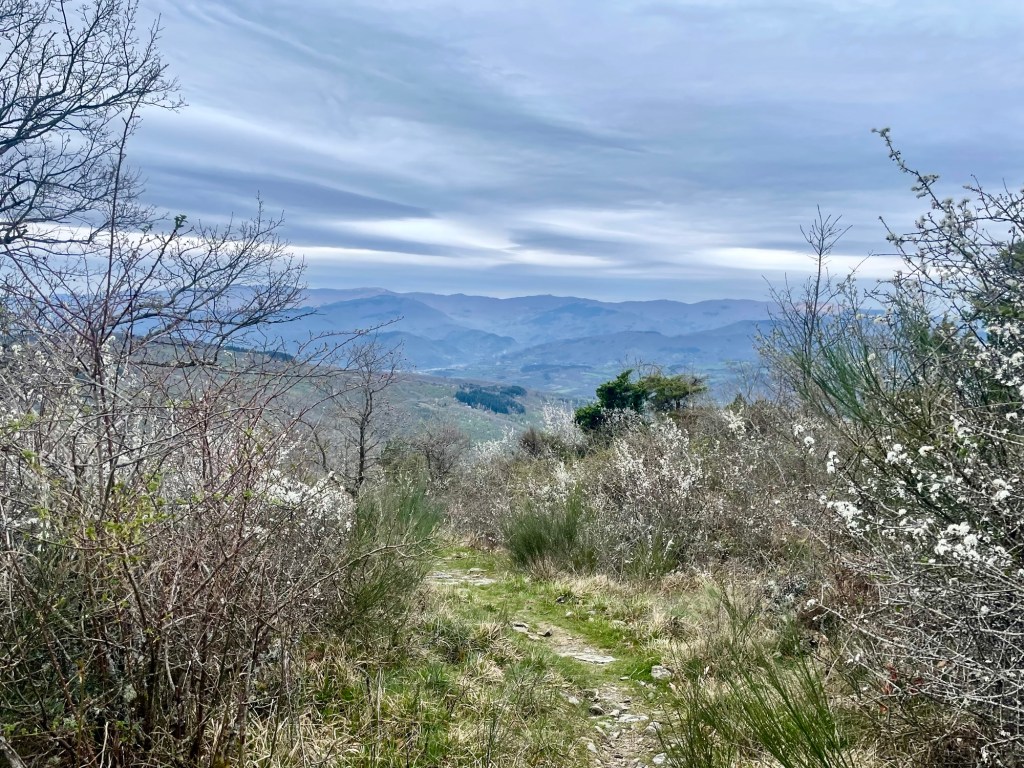
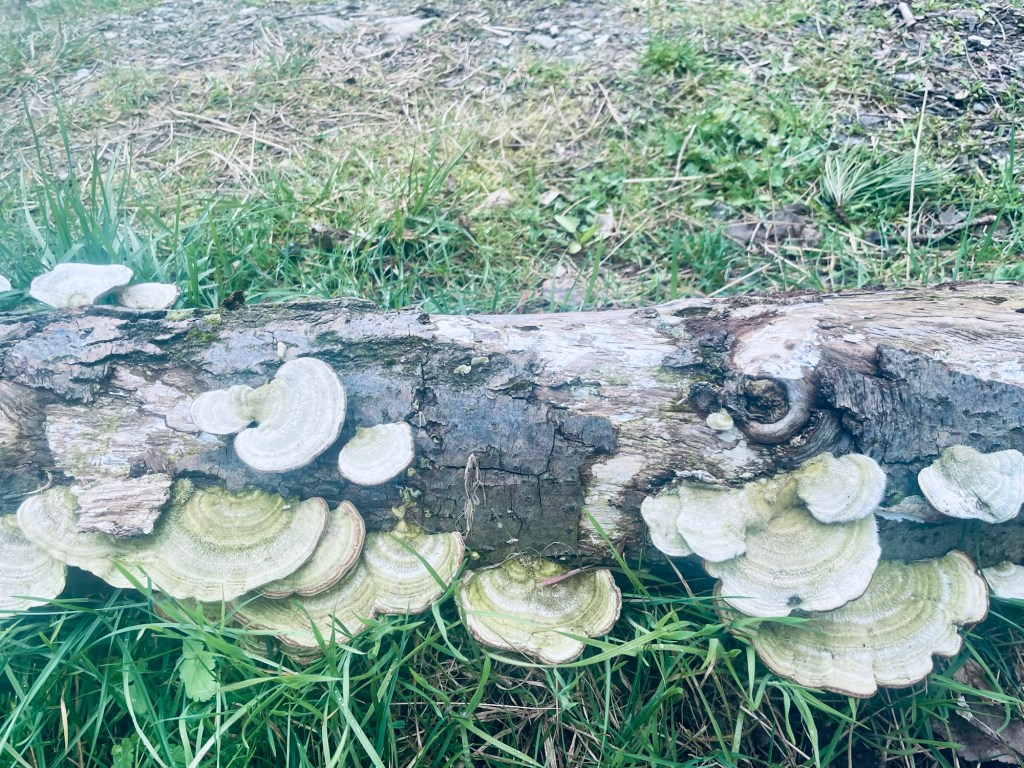
    I was straddling the border between Tuscany and Emelia Romagna as I walked, observing stunning sweeping panoramic views of the mountains which were many shades of green. I stopped to observe from mushrooms sprouting on a log. Enrico would have known how to identify them. 

    A hawk swept across the landscape, crying out. This was the only sound I heard as I started the descent. 

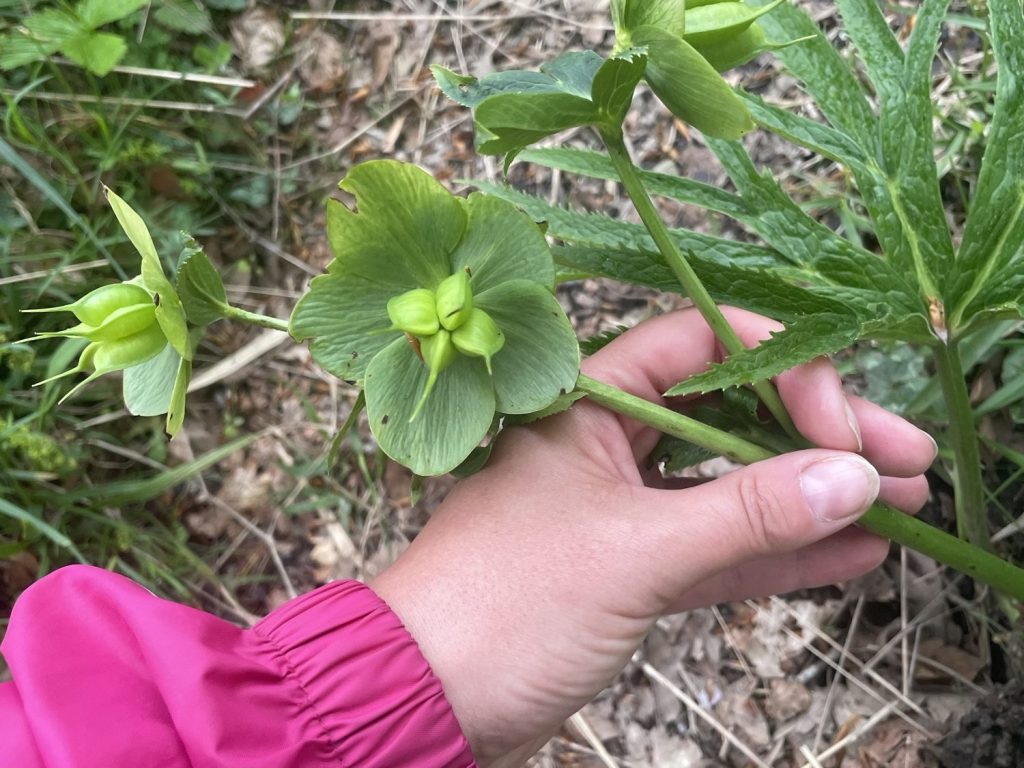
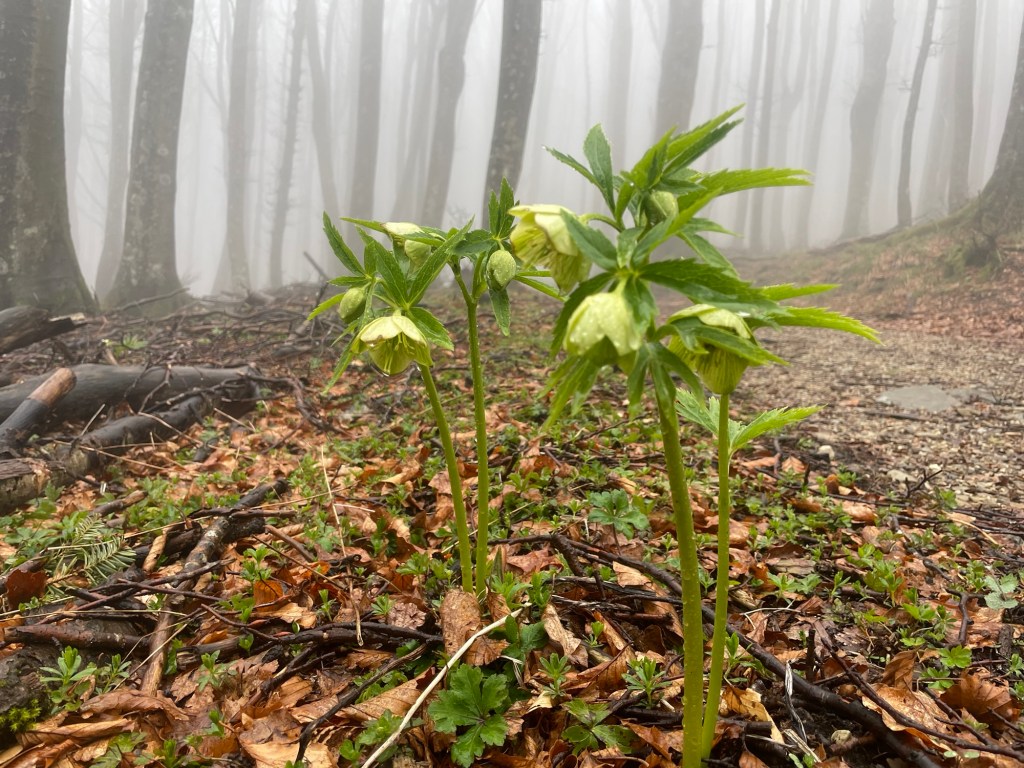
    The cloud hung heavy in lines over the mountains and as I walked, slabs of sedimentary rocks came unstuck from the cliffside. I was trotting again down the steep bank. Patches of a new plant appeared. Was it a kind of hellebore?

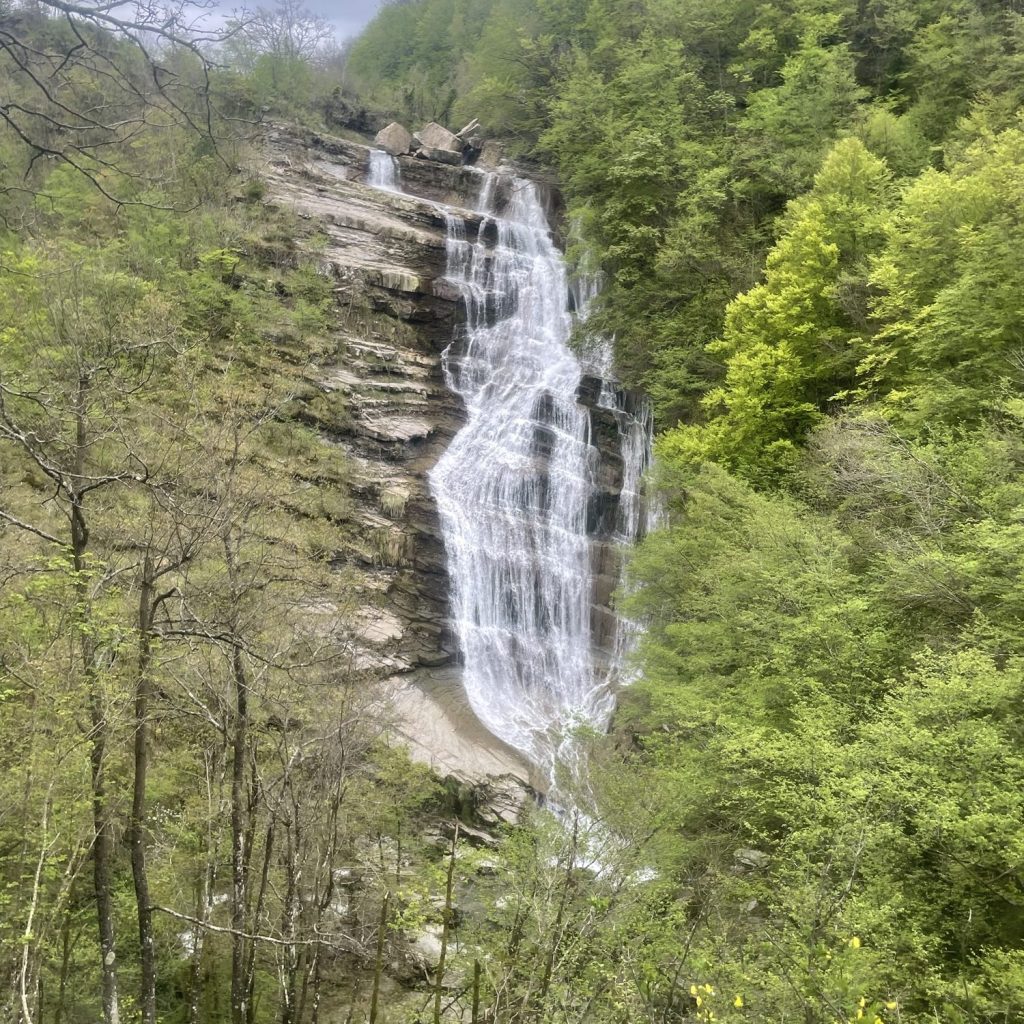
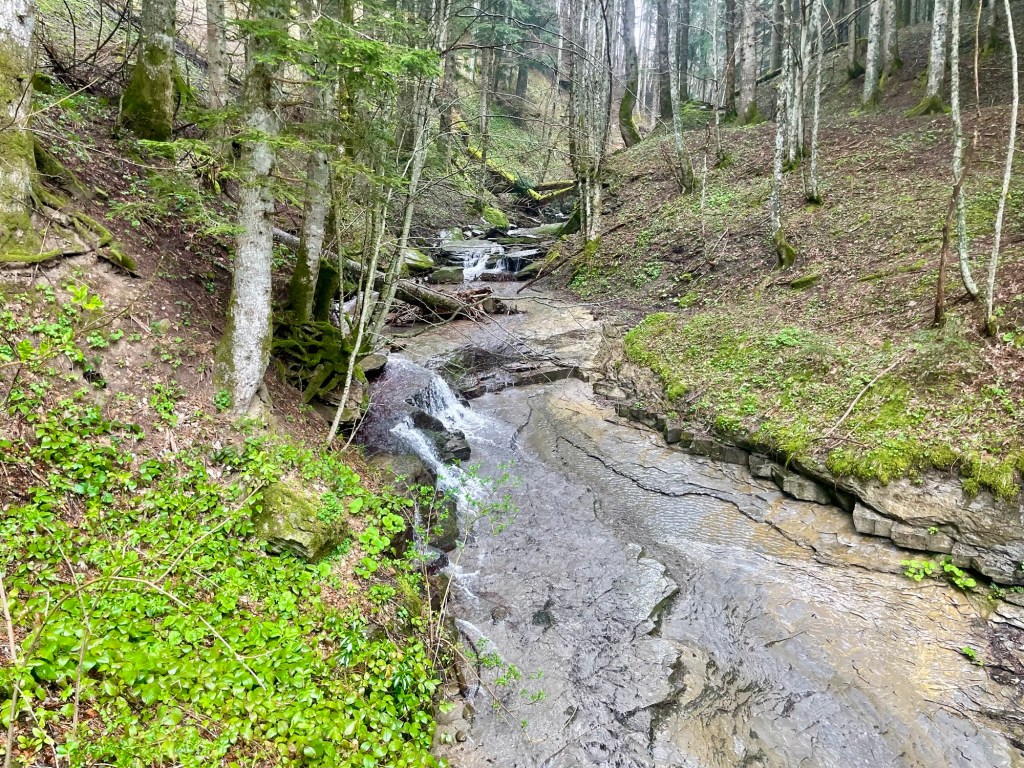
    Now, as I passed a small permaculture plantation where two hippy-like women were chatting, I could hear the waterfall of Acquacheta. And then there it was: I got the first glimpse of the roaring tundra which spouted water from the top of the sky.

    Dante references this impressive waterfall explicitly in the Divine Comedy. In Inferno, canto 16, he writes,

    ‘And even as the river that is first
    to take its own course eastward from Mount Viso,
    along the left flank of the Apennines

    (which up above is called the Acquacheta,
    before it spills into its valley bed
    and flows without that name beyond Forli),

    reverberates above San Benedetto
    dell’Alpe as it cascades in one leap,
    where there is space enough to house a thousand;

    so did we hear that blackened water roar
    as it plunged down a steep and craggy bank,
    enough to deafen us in a few hours.’

    A young couple were cuddling on a bench beside the torrent and a family with two children were accompanied by a golden retriever. 

    ‘Let’s wait for mamma,’ said one of the children to the other, ‘it’s too slippery.’

    As I contemplated the abundance of water, my own tears finally came. I let gulped down sobs as I slid my feet through the boggy path. 

    I was alone and I realized stopping for a rest on a stone bench just how much my feet hurt. I had another bite of my sandwich. It was 4.30pm so I still had a good three hours of light. I pulled out my laptop to check where I was staying and let the happy family go on ahead of me.

    Once I was back on the trail I passed another couple. A woman cried out, 

    ‘Mamma Mia, the water shines like a crystal!’

    It did. At the bottom of the cascade the water collected in iridescent turquoise pools.

    Each time my stick got stuck in the mud I thought of Franco once more with enormous gratitude.

    Now wasn’t a good time to be alone with my thoughts and I was reassured by the cries of the children ahead. One of them had written ‘Forza Milano’ on a rock using a stone as a pen.

    I passed another smaller waterfall and a refuge to my left. I was entering a zone for protected fish, a sign informed me. 

    I crossed two rickety bridges and tried to ignore the cramps in my feet which were becoming intolerable. I was an hour from my hostel still and the path was now largly up.

    I passed a little girl with Barbie and a man on a vesper. A couple were taking a sausage dog for a walk. If they could do it, I could.

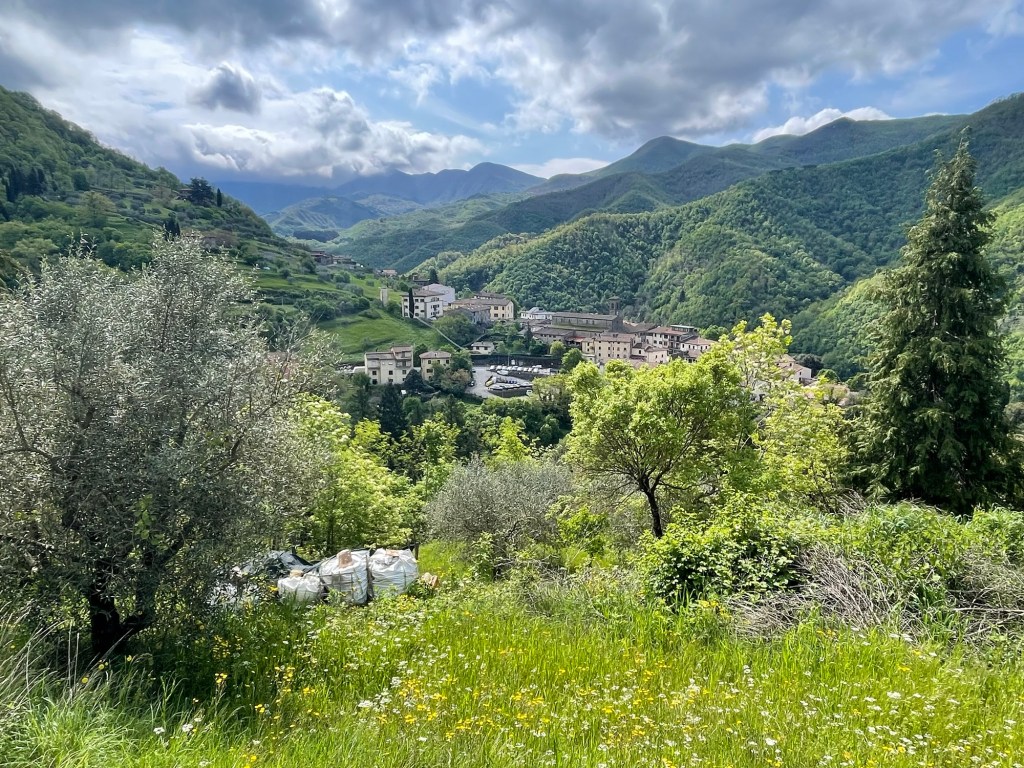
    As I arrived in the village, I passed two elderly bearded men who were selling eggs and honey. I had never been so happy to see a recycling bottle bank which announced that I had made it to the town.

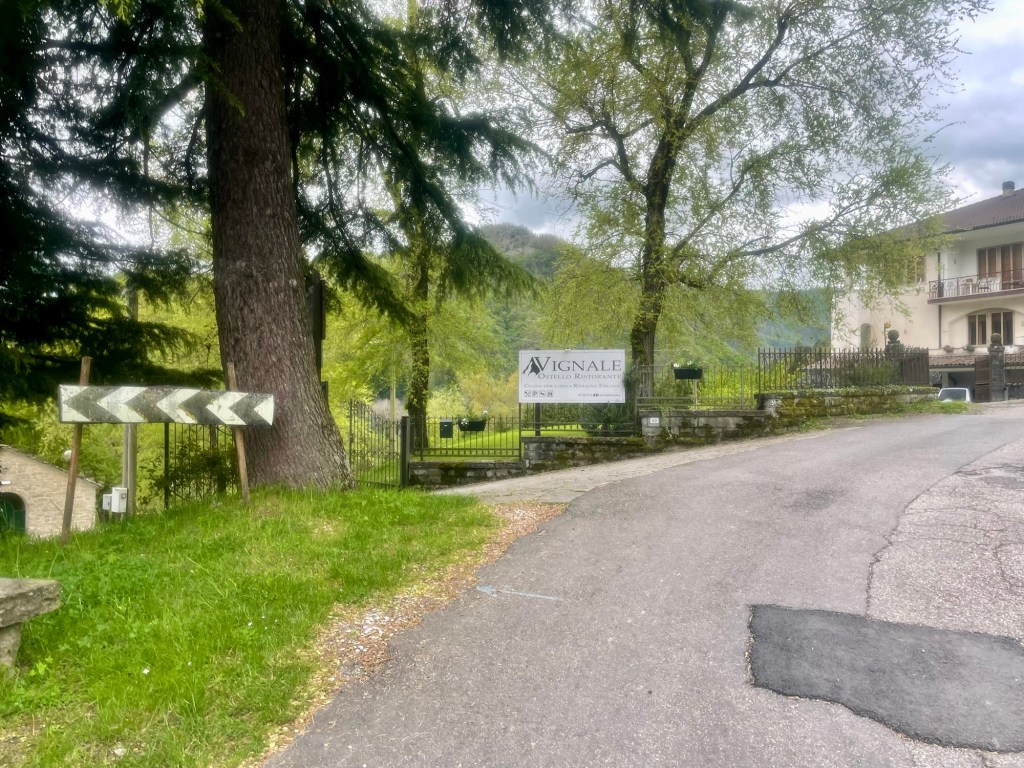
    I passed a campsite up the windy hill and finally made it to my accommodation for the night, Ostello il Vignale. It was very basic, a room of bunkbeds with a shared old-school drop toilet and very thin blanket that would do little to keep me warm during the night. 

    The church bell sounded out six and with that, exhausted emotionally and physically, in the words of Dante when he is overcome in canto five of Inferno,

    ‘I fell like a dead body falls.’

  • Tuna and Cheese? From Monte Romano to Marradi

    A short walk today ended in a disaster when one of my hiking poles broke, and I made a faux pas ordering fish with cheese.

    I woke up for breakfast at 7am and was thrilled to meet Enrico’s wife, Daniela, who had returned from saluting the late Pope in Rome. After setting off early at 2am, she had only had to wait two hours in line. I thought of when the Queen had died and the epic queues I had witnessed on TV. David Beckham had spent a day among the plebs waiting to pay his respects to her. 

    I secretly wanted the Beckhams to become to new Royal Family. Though, in an early communist rebellion perhaps, I had cut Posh Spice out of my posters, she was now my favourite Spice Girl. I admired their family and the way she and David shared a mutual work ethic.

    Enrico and Daniela explained to me that their dog, Mia, with whom I’d shared cuddles the evening before, had been named after the song ‘Romagna Mia’ which had become a hit during the floods of 2023 to give strength to the local people. Their other dog, Cillian, meanwhile, was named after the Gallic for warrior.

    The Romagna people are definitely proud of their heritage. Their territory spans half of Emilio Romagna towards the sea and their language, or dialect, is quite specific. 

    Dante was sensitive to these vagaries in language as he wrote in his Latin treatise on language, De Vulgari Eloquentia. Written between 1303 and the first months of 1305, his work was perhaps the first published European socio-linguistic research.

    Over breakfast, Enrico and Daniela revealed that they were seasoned travellers who had visited over 100 countries, often to chase a solar eclipse. They had been to Sudan, Libya… I thought of the way my own parents had taken me travelling to exotic locations as a child. This was a real home stay alright. I couldn’t have felt more at home if I’d tried.

    I drank nearly a whole family pot of espresso and ate a banana at Alina’s recommendation to alleviate the cramps in my feet. I had a Zoom meeting with a student whose dissertation was on Chinese, UK and US medical care models which felt somewhat discordant from this place of Paradiso. Then I did some gentle yoga stretches and massaged my feet. Today was a relatively short day of walking but I still felt my feet resist.

    I slept for another hour.

    At 11 o’clock, outside, me, Enrico and Daniela took pictures. 

    ‘The sky is so huge it can reduce the pain of everyone,’ counselled Enrico.

    ‘You feel tiny and so do your problems. It is a tiny comfort for us to see the stars.’

    I hesitated, then went for it: I asked about how the two of them reconciled their love for science with religion.

    ‘Something was put it in motion,’ came Daniela’s reply.

    Although I was not collecting stamps in a passport on my Dante journey, Enrico gave me one along with a pretty star decoration that I would put upon my Christmas tree. 

    I was grateful beyond belief.

    Enrico walked with me the first kilometre to the Dante trail with his two dogs. At one point Cillian started barking in a frenzy and then, there it was, a deer! 

    Enrico identified it as a female as it had no horns.

    How wonderful. I’d only ever seen them in the wild in Salmon Lake in California. She skitted across the hills gracefully as if she were aboard my nephew’s pogo stick.

    It was nice to walk alongside Enrico. The family had two pilgrims expected that night and also a family who were returning. They had come last year during the cammino and were coming back to see the stars. I knew I’d also be back. Hopefully with my mum.

    There was the patch of woodland where he collected mushrooms, indicated Enrico.

    And here was the crest I would traverse today.

    At the crossroads, I turned left towards Florence and saluted Enrico. I put on my waterproofs and covered my bag thinking, suspiciously, that then it wouldn’t rain.

    I’d made the right decision to sleep a bit more. I would follow the crest and then descend into the valley of Marradi.

    I passed the church and I was back on the Cammino de Dante. A familiar cuckoo sung its heart out, seeking to attract the midday sun.

    I stopped to meditate on the view and sent my French friend Marie a Happy Birthday message. It had been too long since we’ve been in touch. 

    After 3 kilometres I stopped to dry the sweat off of my forehead. Had my face ever been this red? It had. At 15 I had been national karate champion and one of my unintentional tactics had been to scare the opponent with my red, sweaty face. Now my niece, at 12, was a green belt, taking on the mantle. It had been agonizing attending her recent karate competition. 

    ‘Don’t you dare cheer, Auntie Jenny.’ She’d warned.

    I’d had to put my hands in my mouth. As it was, she had come out with a gold and I had had a little happy cry in the carpark. 

    Kelsey sent me some videos from the lesbian conference she was attending in Rome. A gaggle of women were singing Bella Ciao and the chant, We Are All Antifascist!

    I thought back to singing Bella Ciao at my old school on one of the many occasions I had gone to visit to give talks to aspiring pupils. Lord Grey Could, went the motto. If I had got into Oxford, they would too. 

    I was relieved that my feet seemed OK. I would take it slowly and I had the delightful knowledge that, tonight, I would be staying at a pizzeria. 

    After an hour of walking, I stretched out my feet as my nurse mother had advised me (yes, she had practiced as both a geologist and a nurse). I was determined to avoid cramps today, ready for tomorrow’s epic hike. I had to make it to Florence, I had to. Now it was written in the stars.

    A guy passed on a mountain bike coming full force up the hill. I was impressed, I signalled.

    I reflected, as I walked, of how Enrico had told me that his daughter had done her thesis on the French writer, Flaubert. I had loved Madame Bovary. I thought about my relationship to France. When had Italy taken over as my soul place?

    I recalled the quote I loved so much from his famous novel,

    ‘Human speech is like a cracked kettle on which we tap crude rhythms for bears to dance to, while we long to make music that will melt the stars.’

    La parole humaine est comme un chaudron fêlé où nous battons des mélodies à faire danser les ours, quand on voudrait attendrir les étoiles.

    And with that thought I realized I’d gone wrong. I went back up the hill, annoyed at the 10-minute detour.

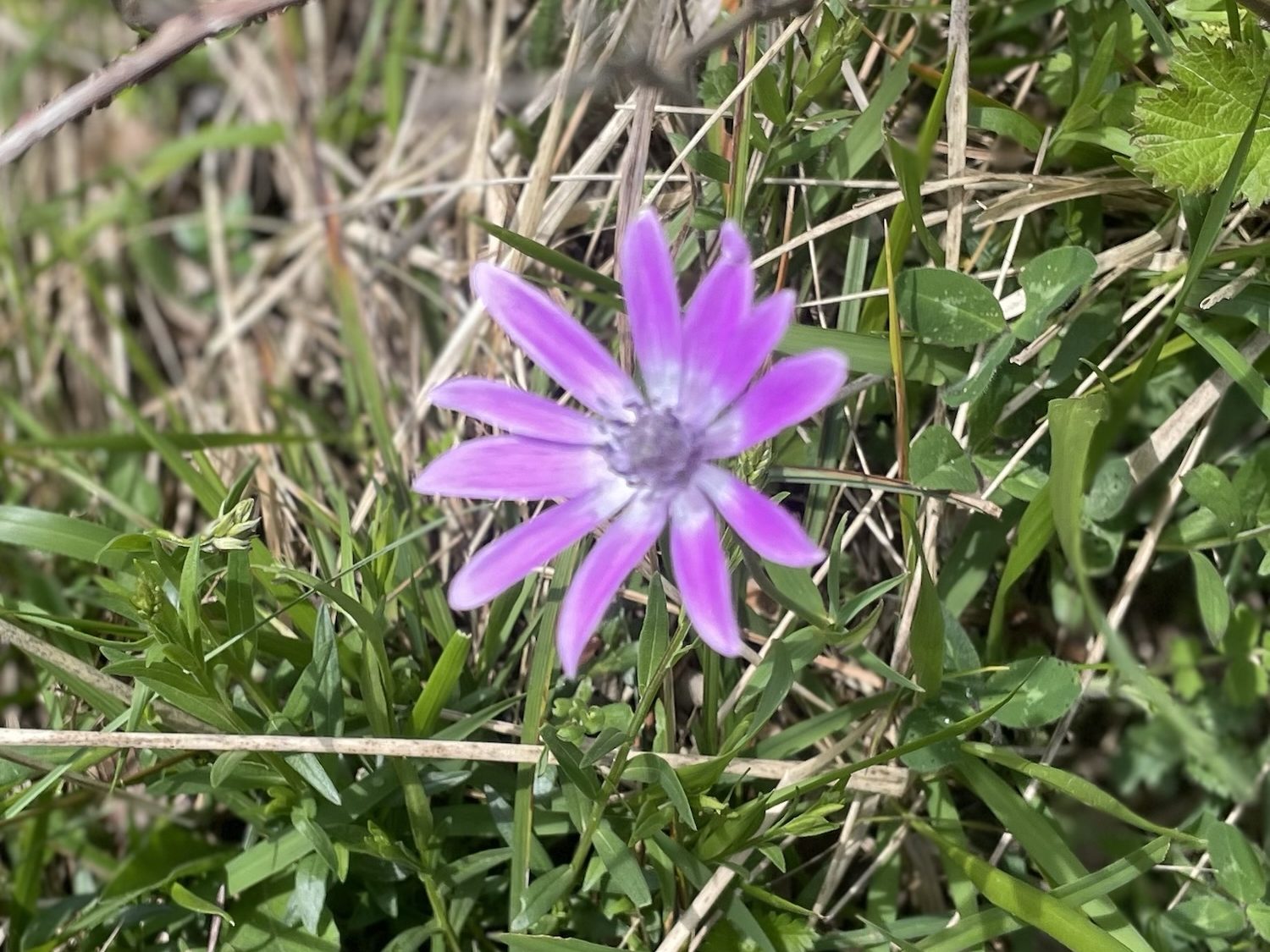
    On the woodland path were mounds of excrement full of seeds. A broad-leaved anemone, neon pink, shot up from the verge.

    The puddles of sunlight on the path appeared briefly then disappeared again, a kaleidoscope of light.

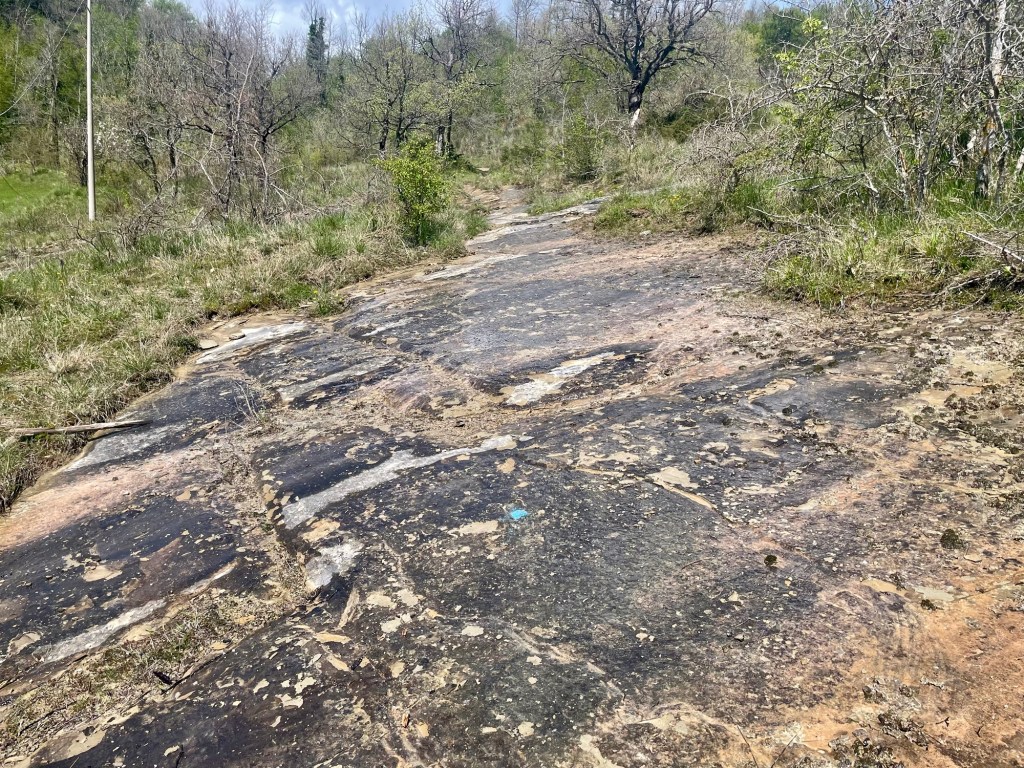
    From a prairie, I descended to flat vertical rocks which looked like lava slipping down the hill.

    I ate some bread, cheese, and tzatziki in the tentative sunlight.

    There were three different types of purple flowers. A yellow butterfly with orange tips saluted me. An ant ran across my bag and a bee buzzed.

    The sun felt great on my skin, though I had left my moisturizer at a previous B&B. The bee who hovered around my lunch was a really fluffy light brown.

    The view of the Apennines was striking.

    I enjoyed the crunch of the crisps with the soft cheese and bread. The spectre of work was haunting me, but I tried to focus on the soft buzz of the flies.

    Oh, I could lie here in the sun all day.

    But I was only about halfway. The sun momentarily went in and I took my leave.

    I felt steady on my feet today, maybe tomorrow I’d be OK.

    After another 2 kilometres, I cracked open the pistachio nuts that I’d been lugging around. Then there were five cereal bars, and some trail mix, that had accompanied me from the start. I was wary of slipping on the hazardous vertical rocks and wanted to make sure that I was strong. I stuffed them into my mouth.

    Two bees were mating, tumbling over one another on the ground in a cartwheel of evolution.

    The shadow of the leaves decorated the rocks.

    I turned the corner, past an abandoned house, and rolled my socks down. My black leggings were calf length and the wind felt good against the inch of leg that was bared. Why on earth had I been heaving around two pairs of shorts, I wondered. Only one had even seen the light of day.

    I lightly twisted my ankle as I descended the uneven terrain which led to more derelict houses. These ones were for sale. I stopped again to massage my feet. A. black beetle crossed the path before me.

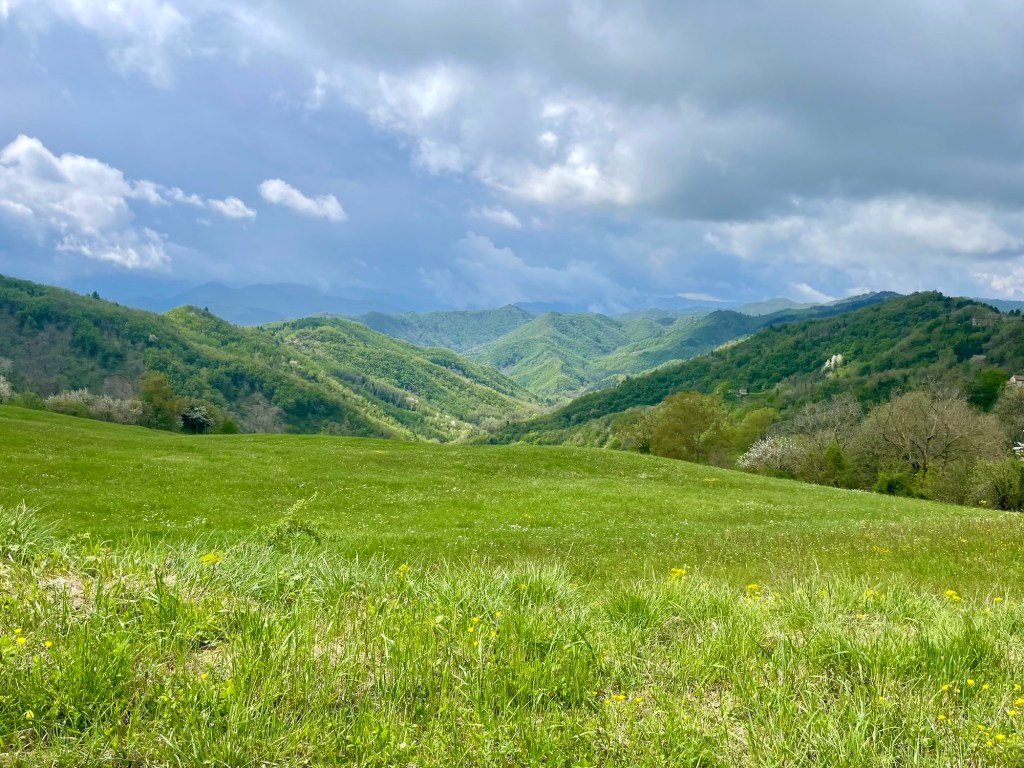
    I exited the woods into a panoramic landscape with 180 degree views of the beautiful rolling mountains. The sound of birdsong warmed my heart.

    Then, fuck.

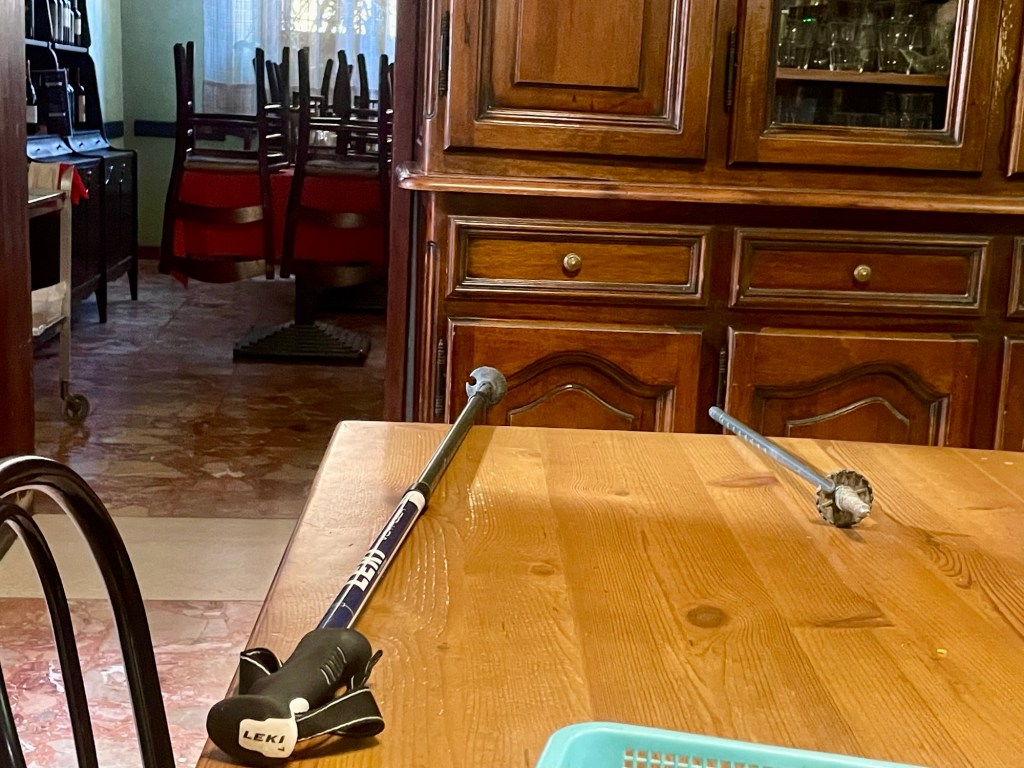
    One of my hiking poles had got stuck in the mud and had broken half way down. The expandable mechanism had completely detached.

    I thought of what I had in my pack to repair it – the sellotape Alina had left me – nope, not strong enough. Some plasters? Again, too weak.

    I would have to continue today’s gentle walk with only one stick, but what on earth would I do tomorrow which was famously one of the most difficult days of the trail?

    I tried not to cry, recalling how when I was hiking with Alina for the first four days I hadn’t used them. And I’m quite sure Dante hadn’t had silicone hiking poles.

    I was now starting the descent. I used my one stick to navigate the hard tug of the mud.

    It was a steep rock path down and, without two sticks, my knees were taking the full thrust of the incline. There was a quarry to my right. I late some dark chocolate and listened to Romagna Mia on repeat to lift my mood.

    I was struck again by the ubiquity of white snail shells on the path. Were they made that way or had their shells been bleached like my hair which was ever more blonde with every day of the cammino?

    There was moss snuggled between slabs of rock.

    I pulled my socks back up to cover my legs as I traversed a patch of brambles. In the distance, I could see Marradi. There was still quite a descent.

    Without my pole I felt weak. It was like losing a limb. I’d been a four-legged insect this whole time. Perhaps at the B&B they’d have some superglue.

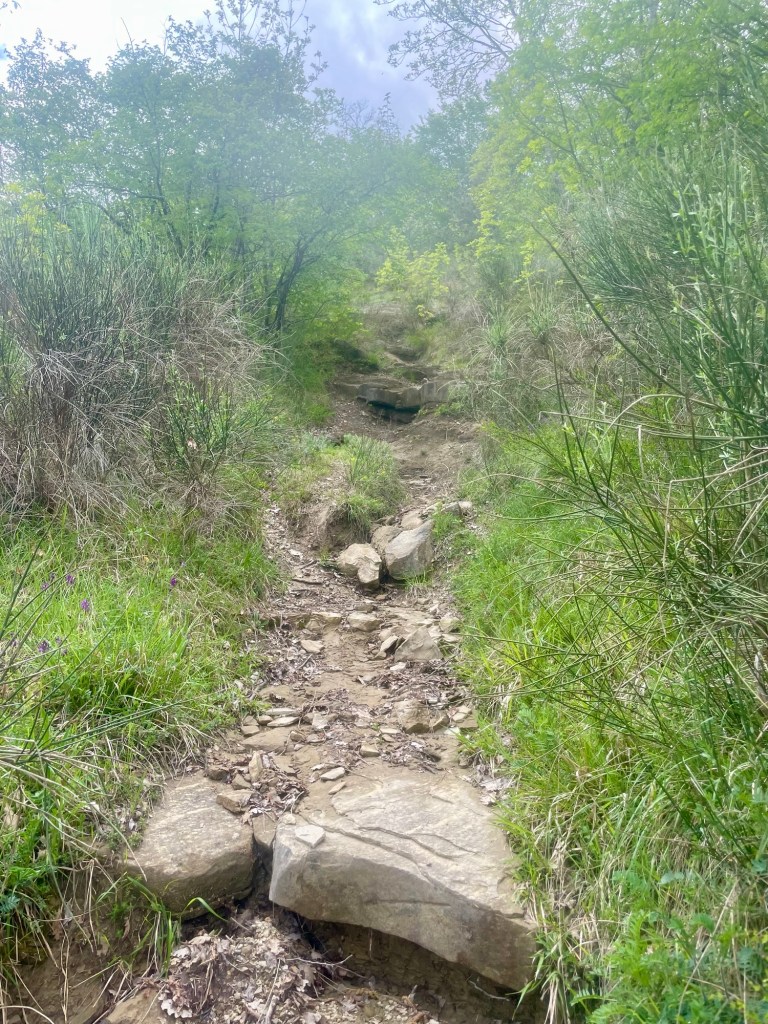
    I let a cyclist past and continued on my downwards route. The path had been reinforced by wooden logs like staggered steps. A thin arch was constructed at one junction which I found it impossible to fit through. I jumped the fence.

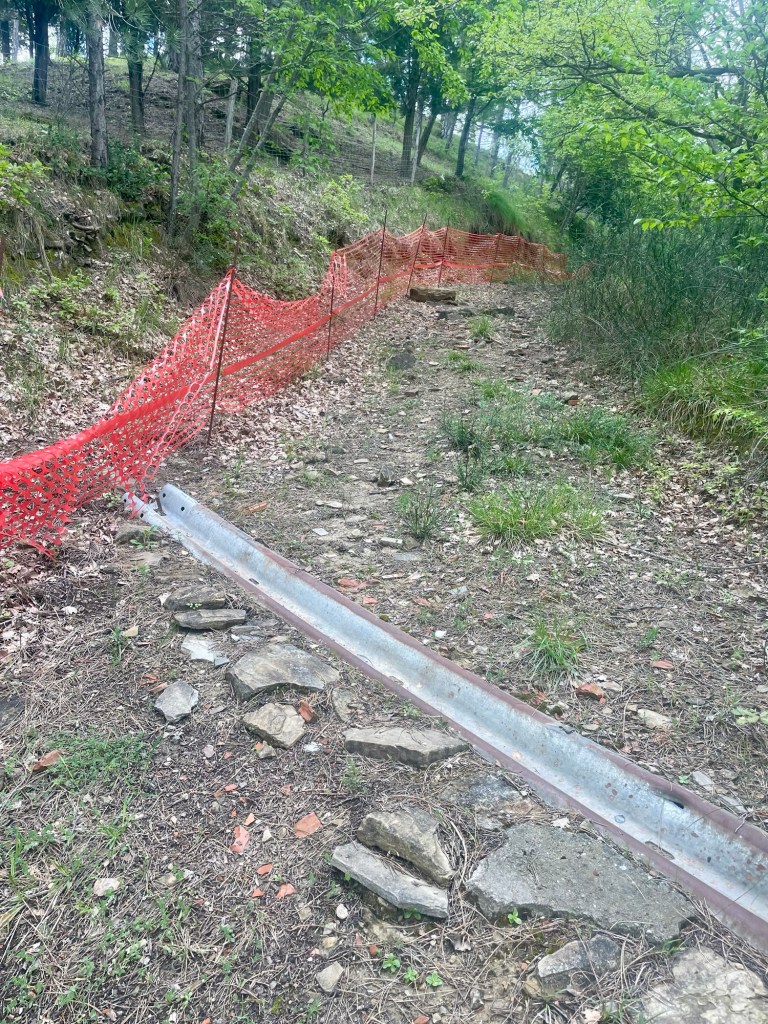
    And here was that hideous orange netting again, signaling a landslide.

    Now there were also troughs in the road to catch the water.

    I was nearly there.

    I walked sideways for the last bit. It was steep and treacherous, and I’d already fallen once today – the incident where I’d broken my trail stick. 

    Then a winding path led me into the town where I heard the hum of cars and the roar of the stream. There was a sign boldly featuring a lily – I was back in Tuscany, alright.

    Marradi was an old medieval city that had been decimated in 1616 by an earthquake. 1775 had heralded the start of its neoclassical architectural reconstruction.

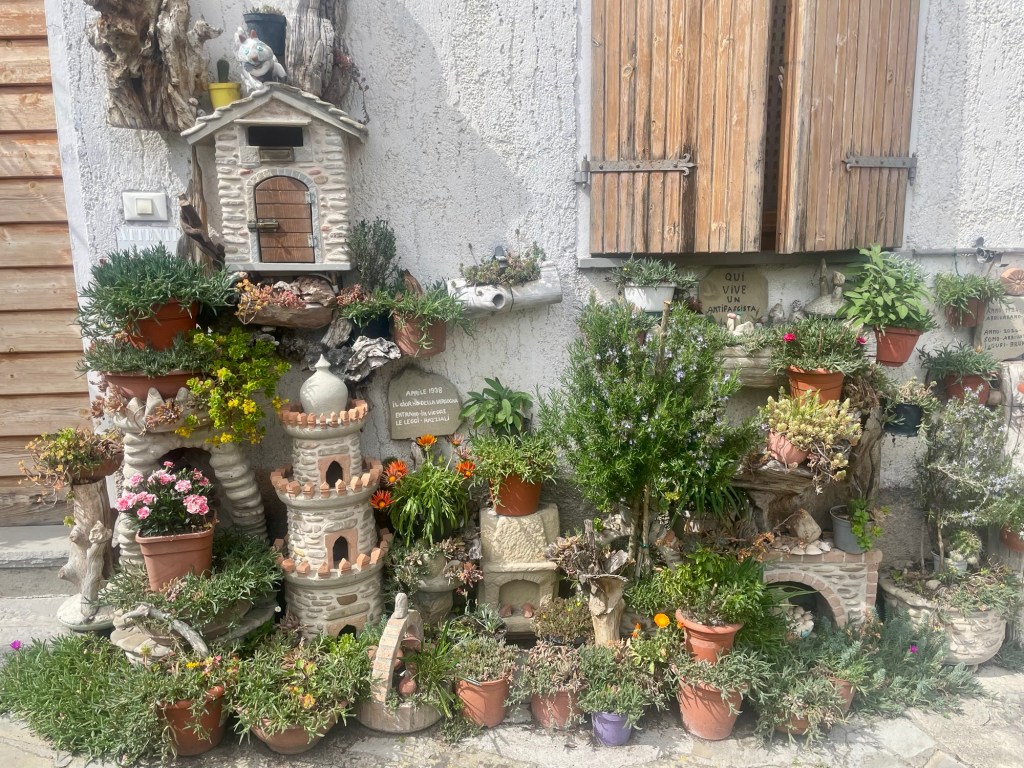
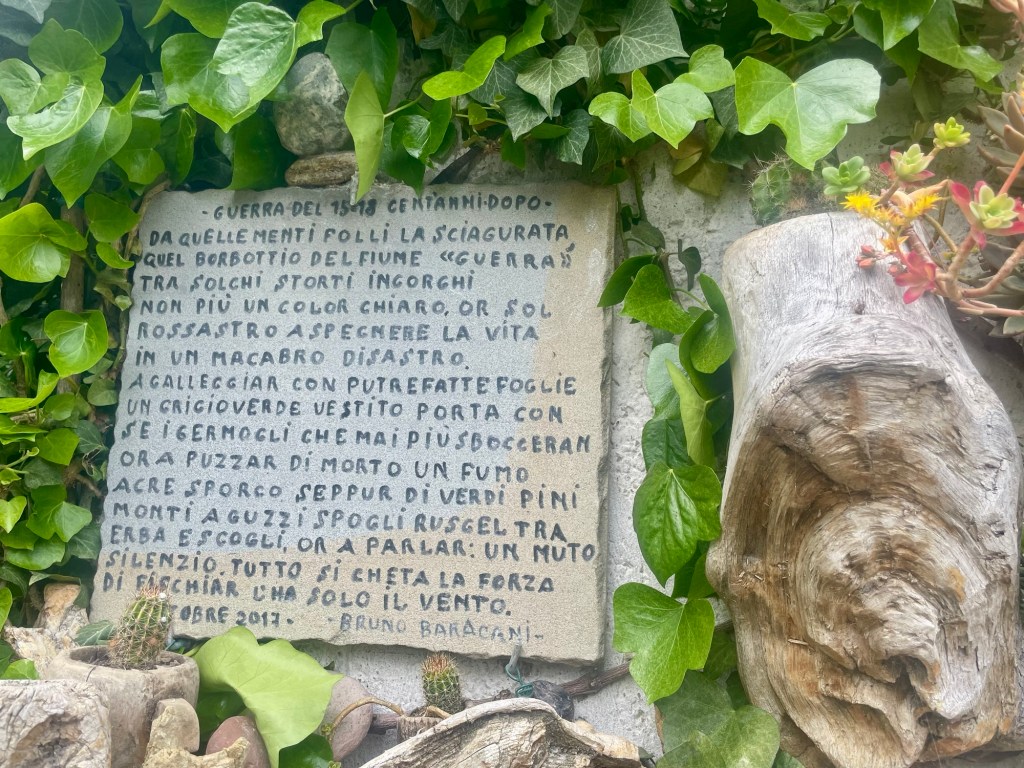
    A house to my left was decorated with pretty succulents, stone sculptures and shells, and poetry was displayed upon the wall next to a sign that read,

    ‘Here live anti-fascists!’

    I thought of Kelsey at her conference and how I should make more of my front garden back home as a kind of public art exhibition. As it was, I had decorated it with some of my mosaics and a fuchsia or two.

    There was the smell of a plant I struggled to identify – it was sweet like grapes – and vegetable gardens were staggered to my right.

    One poem, by Bruno Baracani read:

    Good Day

    Good day to those who pass by
    This street to breathe the scents of
    Spring as if it were speaking.
    The air, in the shade of those leaves
    From the song of the birds makes
    Cheerful the day, the first
    Leaves turn from green, to yellow.
    In the middle the chestnuts fruit
    From the tree, and the first
    Petals white as roses
    Cover the ground, in that
    Magical splendor that the mountain breeds.
    I send you wishes of a good day in peace
    Of so much love that accompanies you.


    (April 2023).


    A second poem on the wall read:

    War of 1915-1918, 100 years after

    From those mad minds, the wretched, 

    The crooked furrows, traffic jams

    More a light color, now, only

    Reddish waiting for life.

    In a macabre disaster

    Afloat with rotten leaves

    A gray-green dress brings with

    It the buds, most of which will bloom.

    Now a smoke stinks of the dead

    Acrid dirt, even if, the sharp mountains,

     Green pines snuggle between them.

    Grass is haggard, now to speak: a mute

    Silence, everything is quiet.

    Only the wind has the strength to whistle.

    (October 2017).

    My phone battery died just as I was entering the town, so I plugged in my power bank. Pink blossom decorated the road like frosting on a cake.

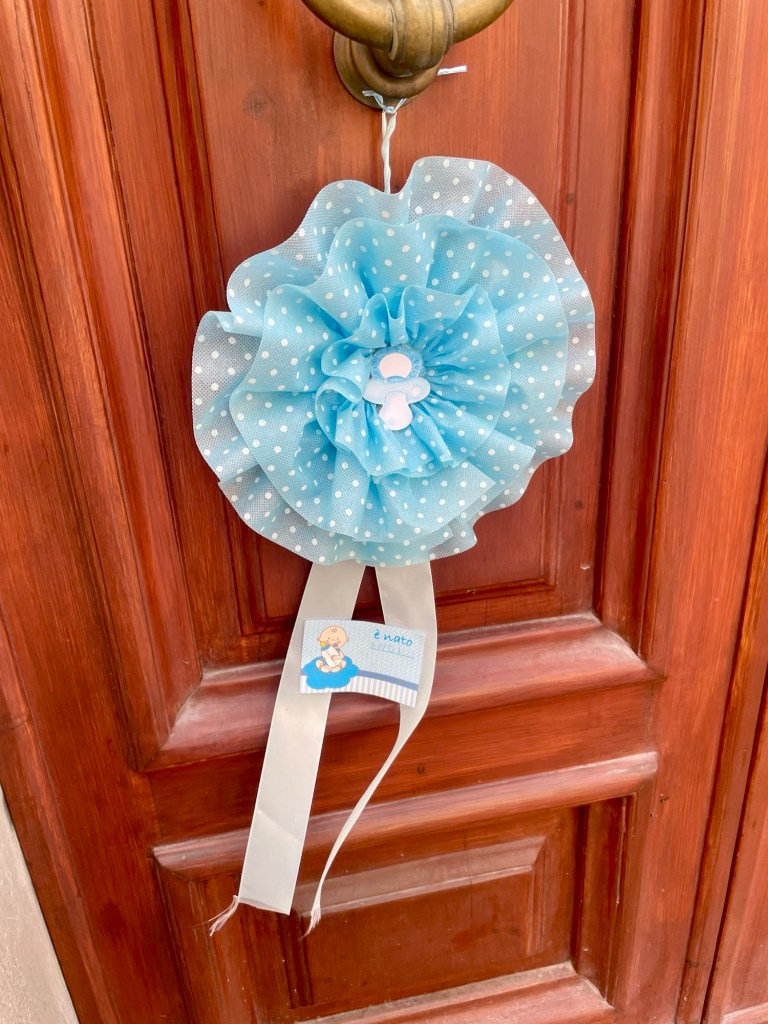
    Tiny succulents sprouted from in between bricks. Someone had graffitied a smiley face onto an electricity box similar to those my dad would draw on my prominent mole as a child. A rosette on a door announced the birth of a boy child.

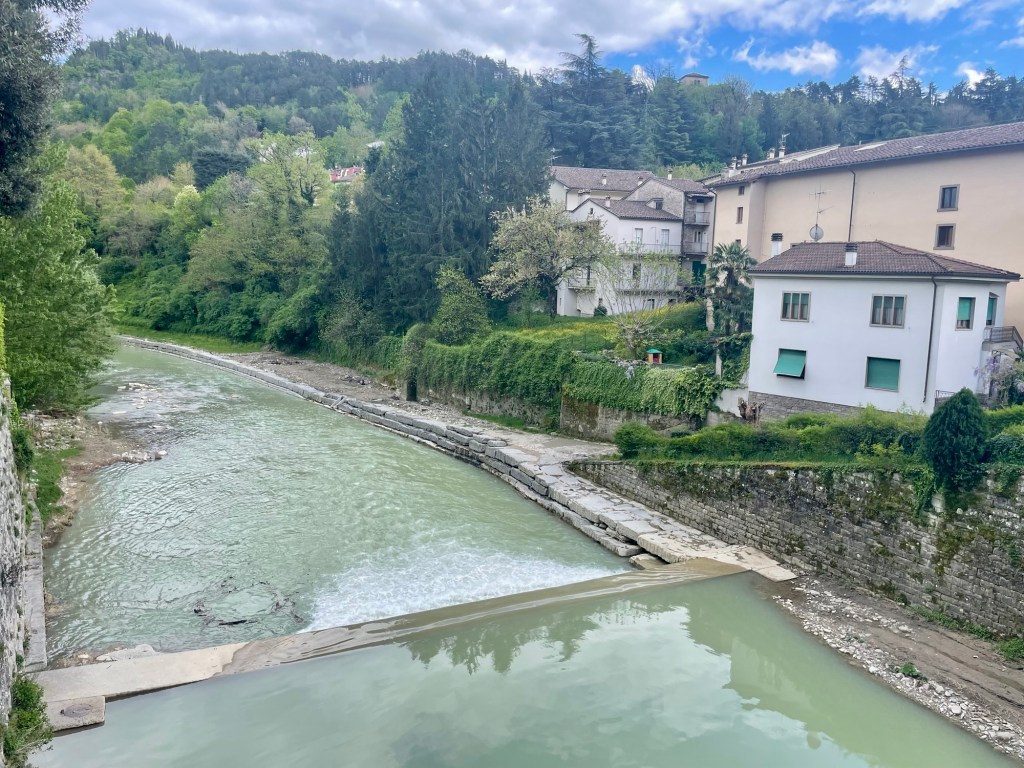
    As I passed the church, the stream ran into the river. A man was reading a book in the Square and a palm tree sprung from someone’s garden which was also decorated with Italian flags for Independence Day. It felt good to be in the city again and to see the Tuscan shield. 

    I stopped at a bar on the corner, Café Teatro. Reggaeton music was blaring. There was a gaggle of other walkers who were accompanied by a brown dog and a guy with a crystal around his neck and palm trees on his shirt. He was chatting to a girl with braids with gold beads, a belly button piercing and a miniskirt. She wore big gold hoop earrings and leather boots. They were drinking tequila shots. 

    I passed an opticians on my left and then climbed some steps to arrive at my destination, Pizzeria and B&B Le Scalelle.

    I rang the bell and waited five minutes but no one came. I tried phoning the number on the door. 

    ‘Arrivo!’

    Now, someone was coming.

    I watched a little boy with a helmet on playing with his scooter in the square. 

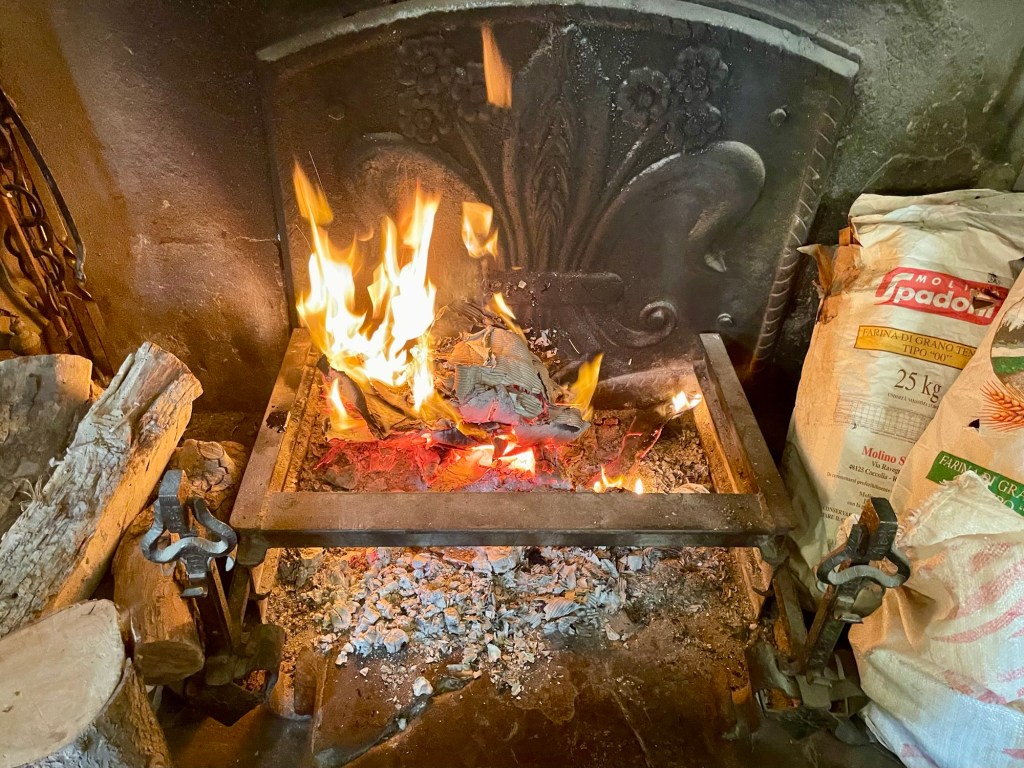
    Finally, Franco welcomed me and led me into a room which was filled with smoke from the fire he had just lit in the restaurant. Did I want a coffee? 

    My room was just by the toilets. So much, I thought, for an early night.

    Then here it came again, ‘Are you alone?’

    I’d caught the sun today. I wanted to buy some more sunblock along with paracetamol for my foot cramps but the pharmacy was closed. Of course it was, it was a Friday.

    On a little wander, I discovered two ice cream shops. Oliver had sent me a message to enquire after my feet. He remembered then.

    That night, I ate a huge parmigiana pizza with fries. The waiter, Kevin, asked abount my laptop. His sister lived in England and he was a student of IT.

    I washed my socks and knickers in the bidet and put them to dry on the abundant heater for which I was glad. These kind of things had become extremely precious to me.

    I drank a bottle of fizzy water and used the special throat medication Kelsey had left me preventatively. 

    Tomorrow would be hard, but I would do it. I had to do it.

    Before I went to bed I asked Franco to make me a sandwich for lunch the next day. 

    ‘Tuna and tomatoes is ok?’ he’d asked.

    ‘Could you also add some cheese,’ I’d responded.

    Fish and cheese, together, in Italy. What had I been thinking.

    And this was my last thought before, at 10pm, I fell into a deep, deep sleep.

  • Into the misty morning: from Casalino to Passo della Calla

    Today’s hike zigzags the Tuscany and Emilia-Romaña borders across the Apennine ridge where ghosts from historic battles give it a spooky air.

    I woke up at 6am to see Alina off. Massino Kyo had kindly offered to take her down to Prato Vecchio to catch the bus back to Florence from where she’d take the train. Refugees in Italy are obliged to not leave their accommodation for a certain amount of time or they lose it. So, despite her newfound love for hiking, the prospect of Alina continuing with me wasn’t possible. 

    Unlike when Virgil leaves Dante in Purgatory, suddenly and without warning, Alina and I shared a meaningful hug goodbye. Also in contrast to Dante, I was now completely alone, without a fellow traveller or guide. 

    Alina had left me a little glass vial of Chinese ointment for my aching limbs. She also accidentally left her impractical mismatching socks which were glittery: a sea blue and an emerald green. Though every ounce counts in long distance walking, I carried them with me. I was too sentimental to throw them away. 

    At 7am I was cooking ravioli to take with me for lunch. The weather forecast predicted rain and I had ahead of me a steep climb of 23 kilometres and 255 floors up.

    I was on the road by 9am as I had to wait to go over the calculations of the heating costs in extensive detail with our host. This is something I’ve only ever encountered in Italy – that in B&B’s you pay only for what you use in electricity.

    It was a steep climb up out of the village and the rocky terrain reminded me of the White Mountains where I’d hiked in New Hampshire during the year and a half I lived in Massachusetts. I’d joined a meet-up group called Ridjit where we carpooled to go on walks most weekends. I joined the Appalachian Mountain Club and by the end of my time there, I’d succeeded in climbing 14 of the 48 4,000-footers. I’m determined to go back and cross off them all.

    The path was uneven and steep and composed of grit and stones. This stood in contrast to some of the other paths I’ve trodden on the cammino which are scattered with shards of terracotta and old tiles in shades of pink, white and blue. As a mosaicist, it has been difficult not to succumb to the temptation to pick up little pieces, but I know the extra weight is not worth it. 

    Mushrooms jutted out from tree trunks like fairy ledges making me think of the Enid Blyton book, The Magic Faraway Tree which my Granny would read to me in bed. We used to call her Granny Daisy though I’m not sure why. Perhaps because of her beautiful little garden and for the fact she once worked as a florist. It’s from her that I get my love of flowers. 

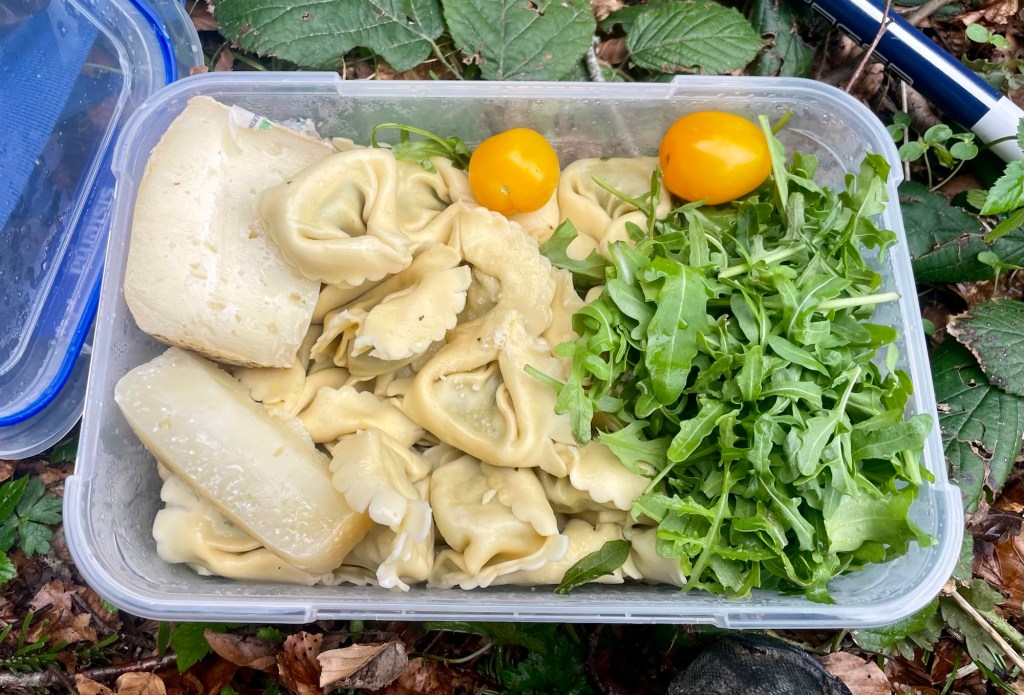
    At 11am the rain was immanent so I stopped by the bridge of Prato Al Fiume to eat some of my pasta which was still warm. I sat on a plastic bin liner which I’d unfolded to make an improvised tarpaulin. I’d brought with me Tupperware and a travel set of cutlery and now I stuffed rocket into my mouth with spinach and ricotta and bit, apple-like, directly into a chunk of pecorino cheese.

    The Via dei Legni, or ‘way of the woods’ has long been a place of cross-border encounter and trade but also of fighting. The North Apennine mountains ridge weaves across the border of three regions of Italy: Liguria, and also Tuscany and Emilia Romagna. I crossed between the latter two, straddling the nature reserves of Sasso Fratino and Pietra.

    Casentino, the Tuscan land between Arezzo and Florence, is the first valley of the river Arno – the same river that flows through Dante’s hometown of Florence. I could imagine that the enduring presence of this river was a great comfort to him, hence the ubiquity of rivers in the Divine Comedy.

    The abundant waterfalls and streams, which also feature in the Comedy, are a legacy of the glacial age. 

    If the water is one of the great riches of the high Emilian Apennine, we mustn’t forget that this is also due to the unusual microclimate. The area has record rainfall, exceeding, on occasions, 2000 mm of rain per year. The region is also known for its cumulonimbus, or thunderclouds, the only cloud type that can produce hail, thunder and lightning. The base of the cloud is often flat, with a very dark wall-like feature hanging underneath and it sometimes lies just a few hundred feet above the Earth’s surface.

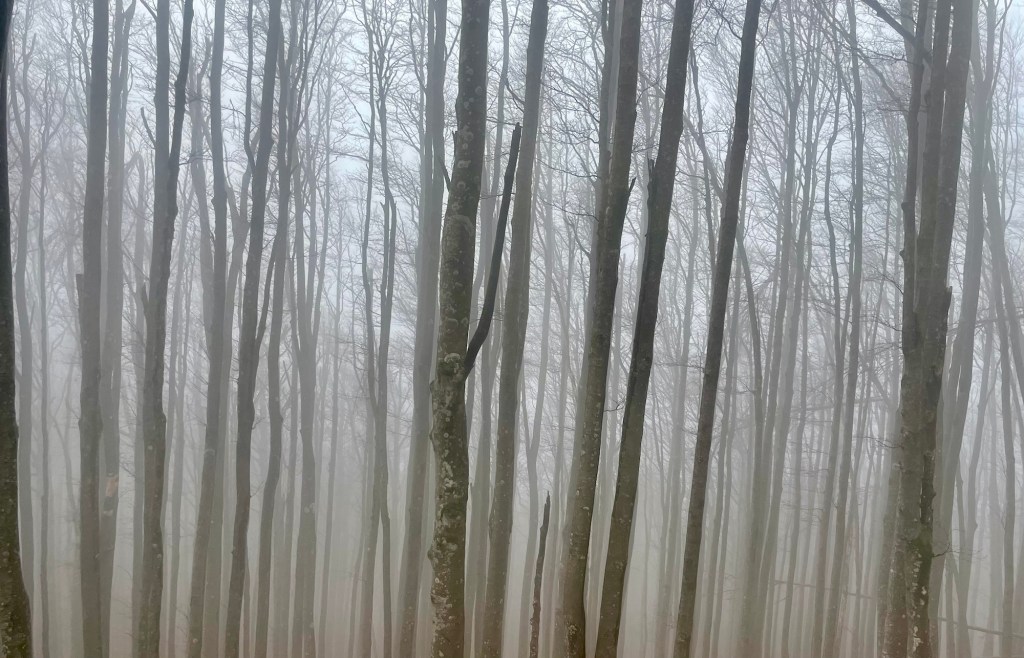
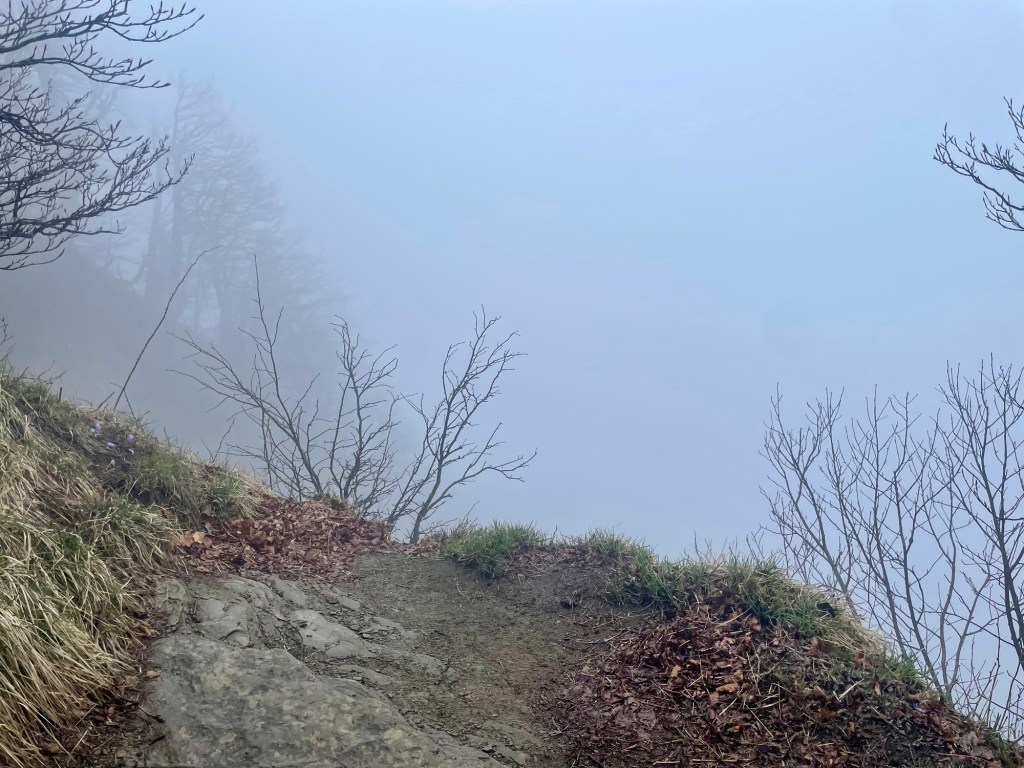
    Today the clouds started as white slivers but, as I ascended the Faggiolo mountain, they soon became a panorama of white which engulfed the sky like curtains at an opera. 

    The gray-blue clouds, laden with water from the Tyrrhenian Sea which is part of the Mediterranean Sea off the western coast of Italy, rise up with the thermal winds and clash against the Apennines. They are an integral part of the landscape of the ridge, and one I was to come to know all too well.

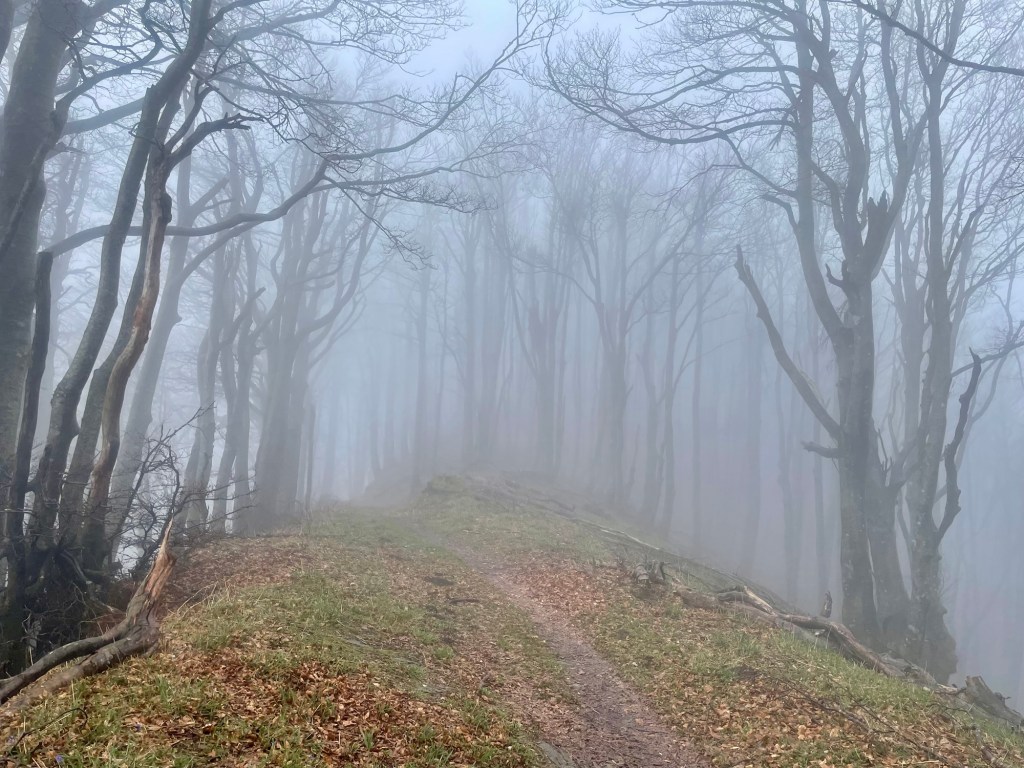
    While yesterday we had contemplated the rolling green hills, now the crown of surrounding mountains was obscured from view by the mist which served as an uneasy companion to the Spring blossom. 

    Shortly after eating, I arrived at the Monastery in Camaldoli, a monastic complex located within the municipality of Poppi, in the heart of the Park of the Casentinesi Forest. The place used to be known by the name Fontebuona  – literally, ‘good fountain’ – because of the high quality of its waters. 

    And with that the rain began to fall. 

    I had planned to visit the nearby castle of Poppi yesterday. Here Dante had been hosted for one year by the Guidi Counts in 1310 and here he likely wrote parts of Inferno.

    But my visit to Poppi on this occasion was not to be. Instead, today I contemplated Dante’s time in exile as I listened back to audio recordings of my Reading Dante with Refugees project and made voice notes into my iPhone. 

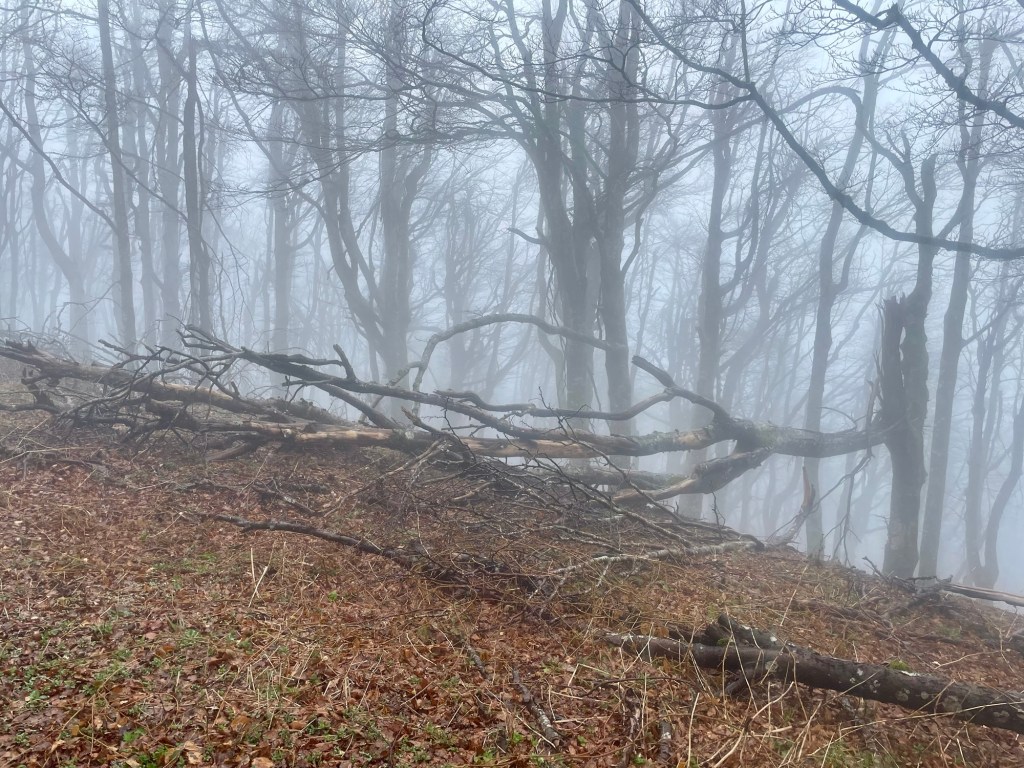
    As the panorama became spookier, with clouds hanging in the trees like gigantic cobwebs, I also contemplated Dante’s time in the military. 

    Between the castles of Poppi and Romena, on the plains of Campaldino on June 11, 1289, a 24-year-old Dante took part in the Battle of Campaldino between the pro-imperial Ghibelline troops from Arezzo and the pro-papal Guelph troops from Florence. It was likely he was on horseback. 

    It was a fierce clash in which Dante’s side, the Florentines, won but there were many fallen soldiers on either side. It is estimated that some 1,700 Ghibellines died and around 2000 were taken prisoner. The battle marked the beginning of the hegemony of the Florentine Guelfs over Tuscany which subsequently split into two factions – the black Guelfs and the White Guelfs of which Dante was a part.

    Indeed, Dante was exiled for being a White Guelf in 1302 when the Black Guelphs took control of Florence. The Blacks continued to support the Papacy, while the Whites were opposed to Papal influence, specifically the influence of Pope Boniface VIII who Dante prophesizes as being condemned to the eighth circle of Hell, that of the simoniacs. 

    Simony is the act of selling church offices and roles or sacred things.

    Dante directly references the Battle of Campaldino in canto 5 of Purgatory where the reader might be surprised to find a slain Ghibelline soldier granted redemption. From the terrace of those who have repented last minute and died in situations of violence, Bonconte da Montefeltro, interrupts his singing of the Miserere to speak. In the canto, three souls tell of their violent deaths: two in battle, and one at the hands of her husband. Bonconte da Montefeltro is the second soul who speaks to Dante. 

    After he led the Ghibelline cavalry at Campaldino, Bonconte’s body was never found on the battlefield. Instead, he explains to Virgil and Dante, it was carried by the elements into the river Arno:

    ‘…across the Casentino
    there runs a stream called Archiano—born
    in the Apennines above the Hermitage.

    There, at the place where that stream’s name is lost,
    I came—my throat was pierced—fleeing on foot
    and bloodying the plain; and there it was

    that I lost sight and speech; and there, as I
    had finished uttering the name of Mary,
    I fell; and there my flesh alone remained.

    His evil will, which only seeks out evil,
    conjoined with intellect; and with the power
    his nature grants, he stirred up wind and vapor.

    And then, when day was done, he filled the valley
    from Pratomagno far as the great ridge
    with mist; the sky above was saturated.

    The dense air was converted into water;
    rain fell, and then the gullies had to carry
    whatever water earth could not receive;

    and when that rain was gathered into torrents,
    it rushed so swiftly toward the royal river
    that nothing could contain its turbulence.

    The angry Archiano—at its mouth—
    had found my frozen body; and it thrust
    it in the Arno and set loose the cross

    that, on my chest, my arms, in pain, had formed.
    It rolled me on the banks and river bed,
    then covered, girded me with its debris.’

    Through describing the fate of Bonconte’s body, Dante gives us a stark description of the weather conditions in the region.

    Dante does not glorify violence. Quite the contrary. Teodolinda Barolini, Editor-in-Chief of Digital Dante writes that ‘when I read the Commedia, I am always struck by how forcefully Dante communicates historical pain.’ 

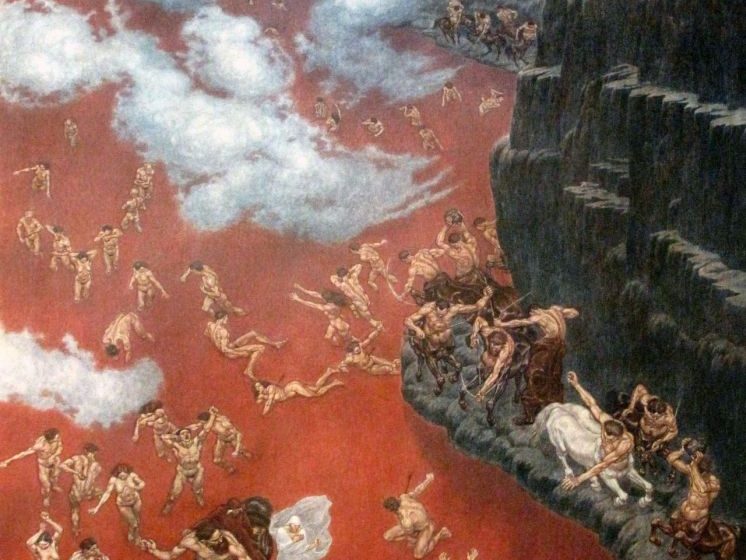
    In Inferno 12, the violent are immersed in a river of boiling blood, the Phlegethon. Meanwhile, in canto 21 of Inferno, Dante demonstrates empathy for the opposing soldiers who were defeated in the siege on the Caprona Castle in August of 1289. It is possible Dante may have also fought in this battle. He recalls the fear of the opposing side as they walked among their enemies following surrender: 

     “so I saw the troops fearful as they left Caprona under treaty, 

    finding themselves in the midst of their many enemies”.

    I was grateful for my hiking poles which I have not used until now as I made my way across the hostile terrain of the thick woodland.

    After hours of climbing uphill, I was so relieved at the prospect of going down that I missed my turning and took a 3 kilometre detour, having to climb back up the path from which I’d come. The view was completely obscured by the clouds. 

    As the rain metamorphosed from mist to drizzle, I covered my backpack with its light waterproof cover, sending contact lenses spilling across the mud as I removed it from a pocket at the front of the bag. I tucked my phone into my sports bra so that I could continue listening back to my Dante class recordings. I had bought earbuds, but hiking alone I felt vulnerable and wanted to preserve my senses. 

    The combination of sweat and rain pooled in my eyes which stung from the sun cream I had pointlessly applied that morning. As I got my phone out to check directions – the amazing team at Cammino di Dante have made a GPS of the walk – the water also saturated my power bank, causing my phone to alert me that water had been detected in the charging cable.

    My biodegradable phone case eroded from the rub of my breasts.

    I jogged some of the downhill in the afternoon to make up lost time, using my sticks like a four-legged animal. The path was well trodden but abandoned. My heavy backpack thudded against my spine with every step.

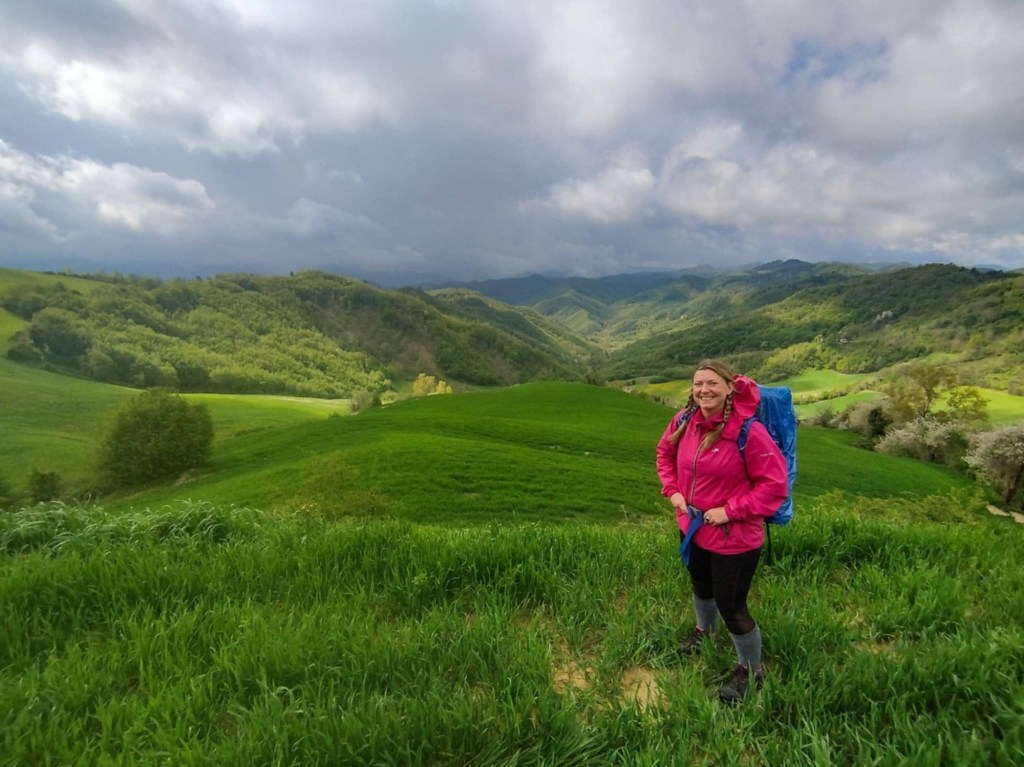
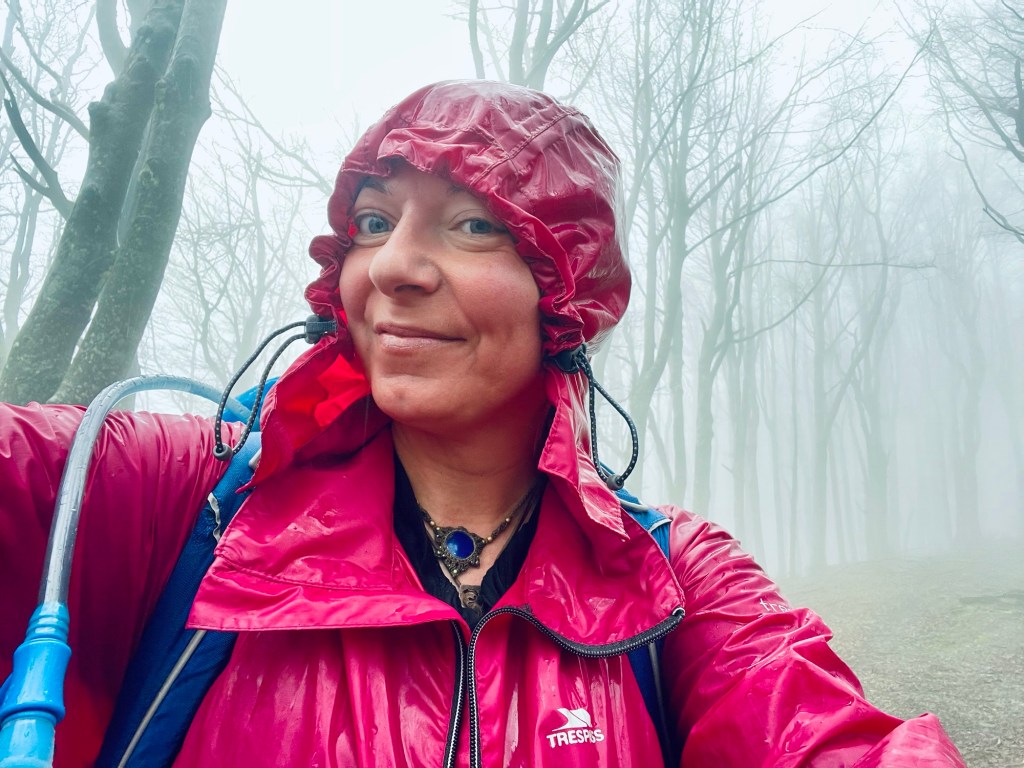
    I took a selfie and reflected how the flaps of my pink cagoule hung at my ears like Dante’s wimple. I felt like I was skiing as I rushed down the path, trees surrendering to my sight on either side. 

    Just after the Monastery in Camaldoli, I met the first fellow hiker of the day who was coming in the opposite direction, an Austrian woman who had a bad knee. She informed me that she had stayed at the same hotel to which I was headed and that it was luxurious. This motivated me to plough on with the steep climb back up. 

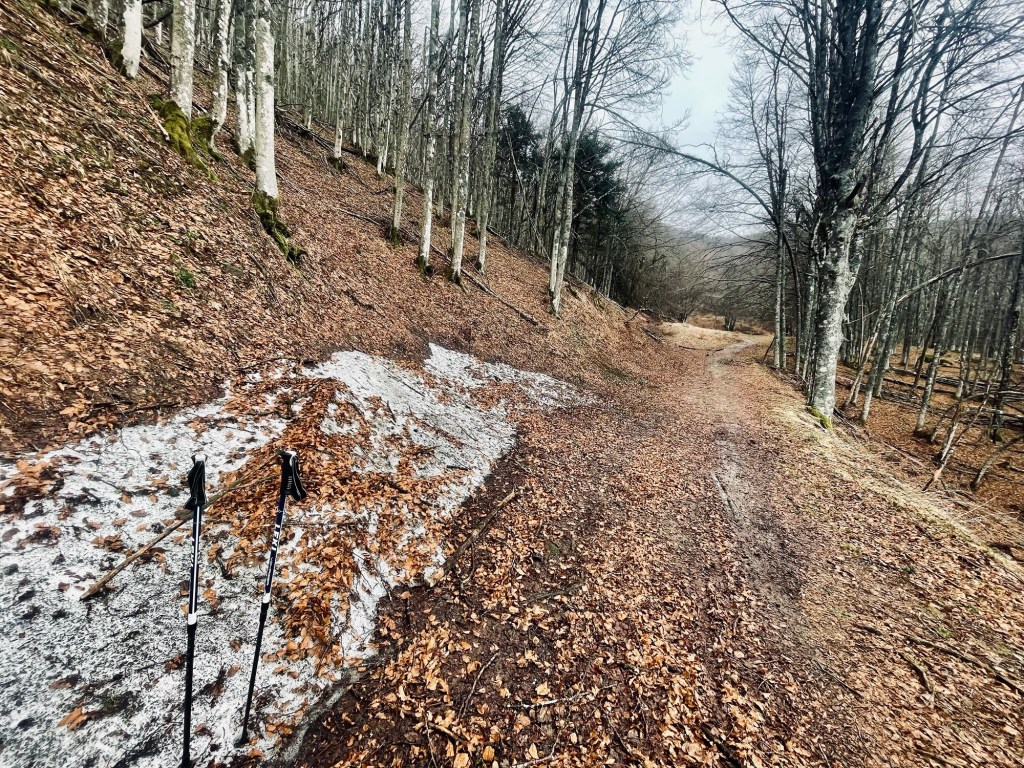
    At one point, to my left there appeared a mound of snow. I thought back to yesterday when I was dressed in old shorts and a t-shirt – an 80’s set up of leopard bottoms and a neon top that I could dump if needed. I had packed clothes for warm and cold weather but the contrast between the two days could not be starker. 

    I took a short break at 2.30pm, huddling under a protruding rock that served as a grotto for shelter – the first cover I had encountered all day. I couldn’t get my layers right – I was sweating but my hands were also starting to go numb. I truly felt like I was climbing Mount Purgatory as I weaved my path, staggering up and across the two regions. 

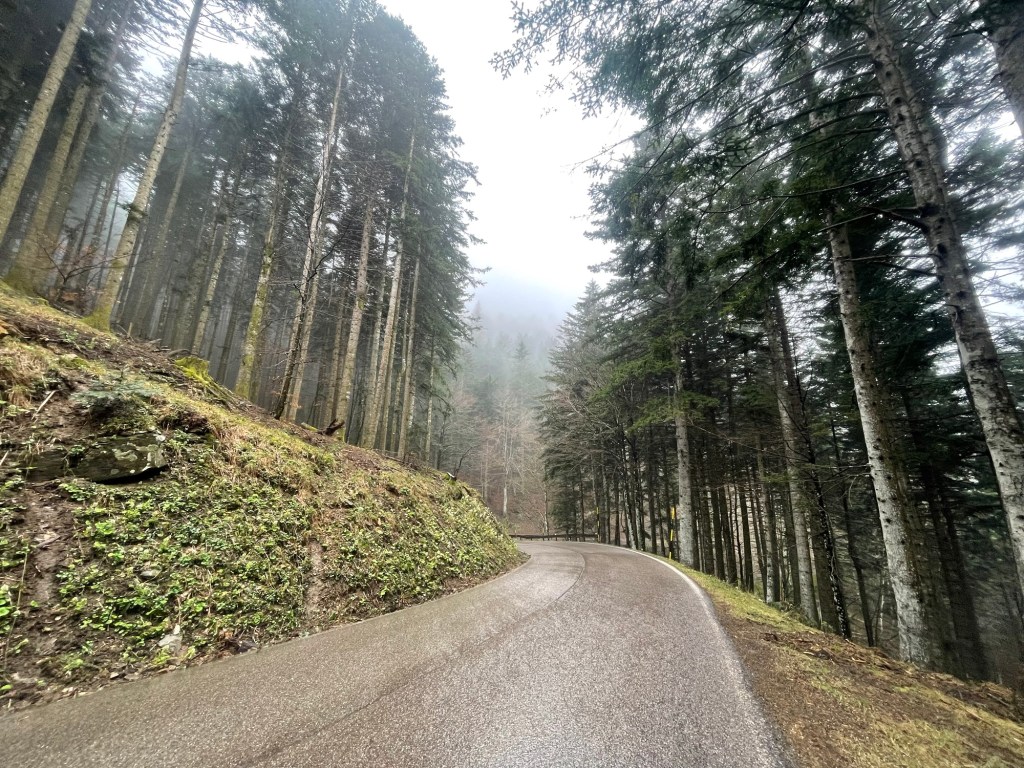
    I arrived at Passo della Calla at around 3pm then made the 40-minute descent down a steep, zig-zagging road to the Hotel Granduca in Campigna. The sky was white, not grey like when it rains in England.

    Phalanxes of pine trees lined the road, some of which had been damaged by the winter snowfall. Here and there, waterfalls cascaded down from where they had been diverted by man to preserve the road. I tried not to think about the climb back up that awaited me tomorrow. 

    I arrived at the hotel reception soaking wet. My purple leggings, in their sodden state, had turned a darker plum hue. 

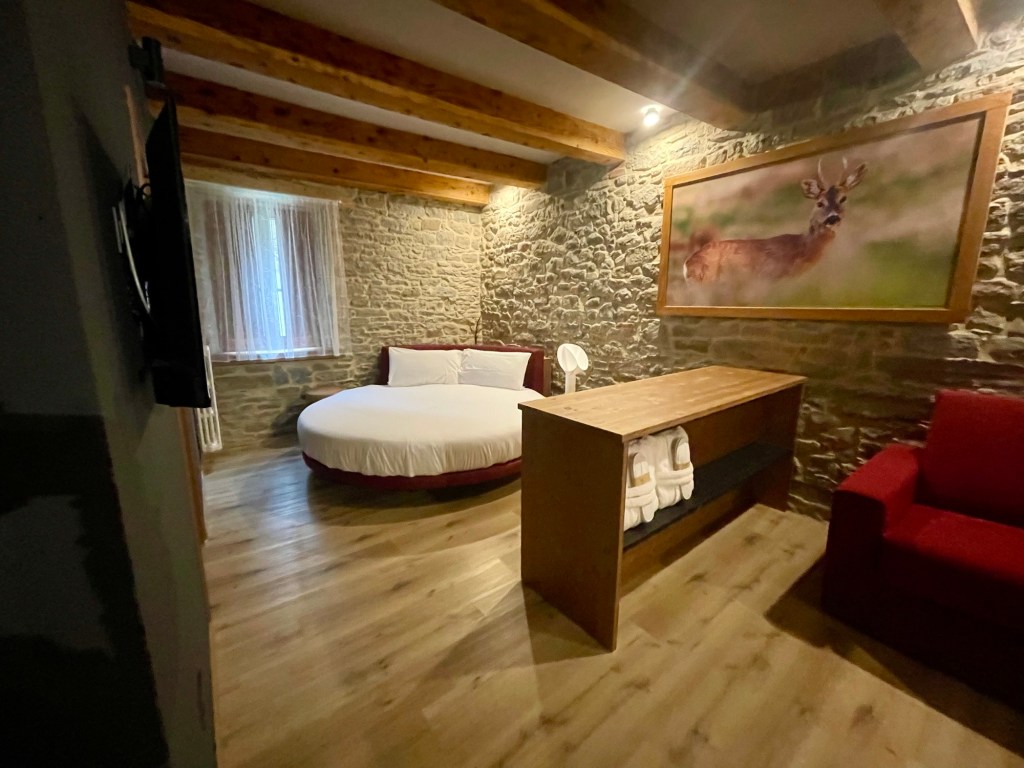
    Booking the Hotel Granduca was a treat for me at 100 Euros a night – much more expensive than most of my accommodation. But by God was it worth it.

    I made use of the spa, contorting my body in the water to project the jets onto the aching arches of my feet. And the bed in my room, which had its own personal sauna, was round! What novelty. 

    I had my first meal out of the trip: a sweet onion soup on which I burnt my tongue I was so eager to devour it, and a plate of tagliatelle marinated with local mushrooms. 

    A little girl sat playing games on an iPhone behind the bar. It turned out she was the daughter of one of the owners.

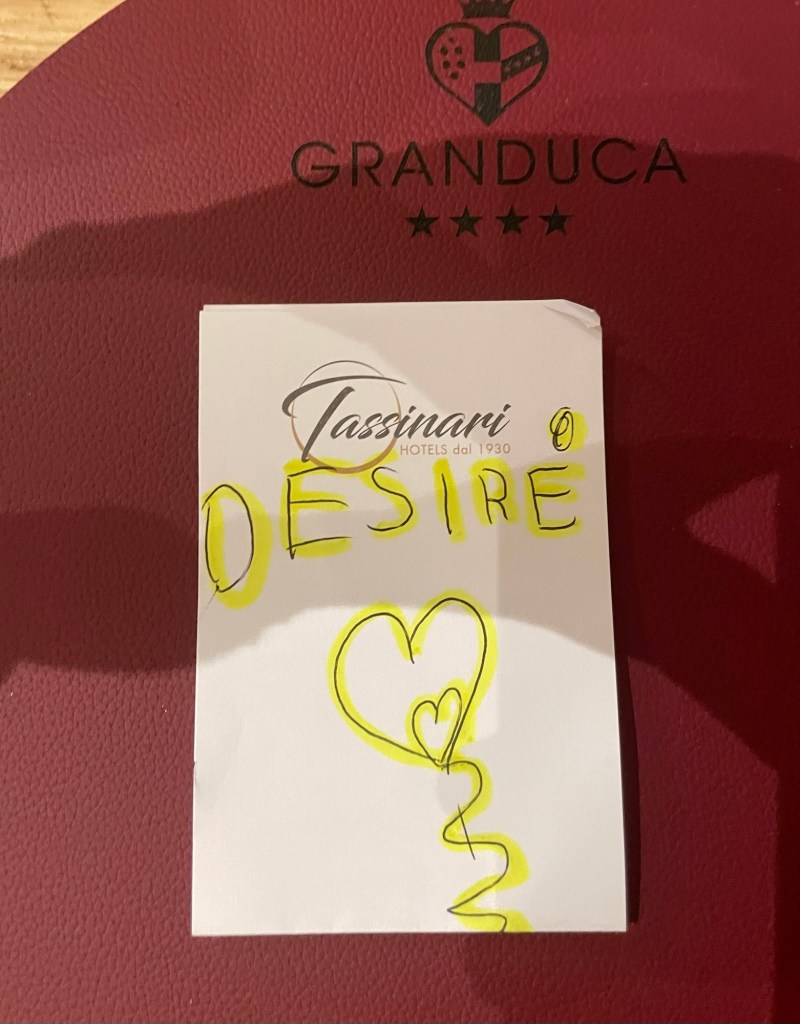
    ‘What’s your boyfriend’s name?’ she asked me, handing me a little note with her name on it, like a business card. 

    ‘I don’t have one.’ I said.

    ‘Come no!’ she exclaimed. She then proceeded to inform me that her own boyfriend Salvatore, was also 6 years old. 

    Finally, after a day walking in isolation, I’d made a friend.

    Recommended reading: The Magic Faraway Tree by Enid Blyton: https://en.wikipedia.org/wiki/The_Faraway_Tree

  • An Infinite Spring: From Castel San Niccolò to Casalino

    The expansive green landscapes and spectacular church complex of Romena will have you dreaming.

    The first thing I did in the morning was to line my eyes with a thick rim of turquoise eye liner I had purchased along with sun cream in the town pharmacy yesterday. Meeting Anna in Montemignaio had left a big impression on both of us with her organic, healthy way of life and I sought to emulate something of her serenity. I wouldn’t be able to keep sheep with my work schedule and pickling my own walnuts appeared too much labour, so make-up seemed like a good enough place to start. 

    Sei Bellissima,’ said Alina. And with that, we grooved on down to the song of the same name by Annalisa. 

    Then she introduced me to her chat GBT mentor. He’d searched me up online and recited a shockingly accurate amount of information in a friendly tone. 

    I’m a luddite. On this trip she is teaching me how to use the new technology my students swear by.

    We had another delicious breakfast of pesto toast on the patio in the rising sun and were up and at ‘em and back on the Dante trail by 8am. We passed houses where dried grain hung outside the porch. It shone golden in the sunlight. A child who looked about 8 sped past on a motorbike.

    The stunning hilly scenery around Castel San Niccolò is interrupted by industry. The path is thick with hoof prints and acorn shells and lined with buttercups, dandelions and grape hyacinth. Butterflies and petals from the blossoming trees sweep across on the wind. 

    Interrupting the hedgerows are flaming trees the colour or Alina’s hair. 

    We saw the first cows of our trip, stopped to pet a number of horses and were hissed at by geese who appeared menacingly above the fence like the three-headed Cerberus. 

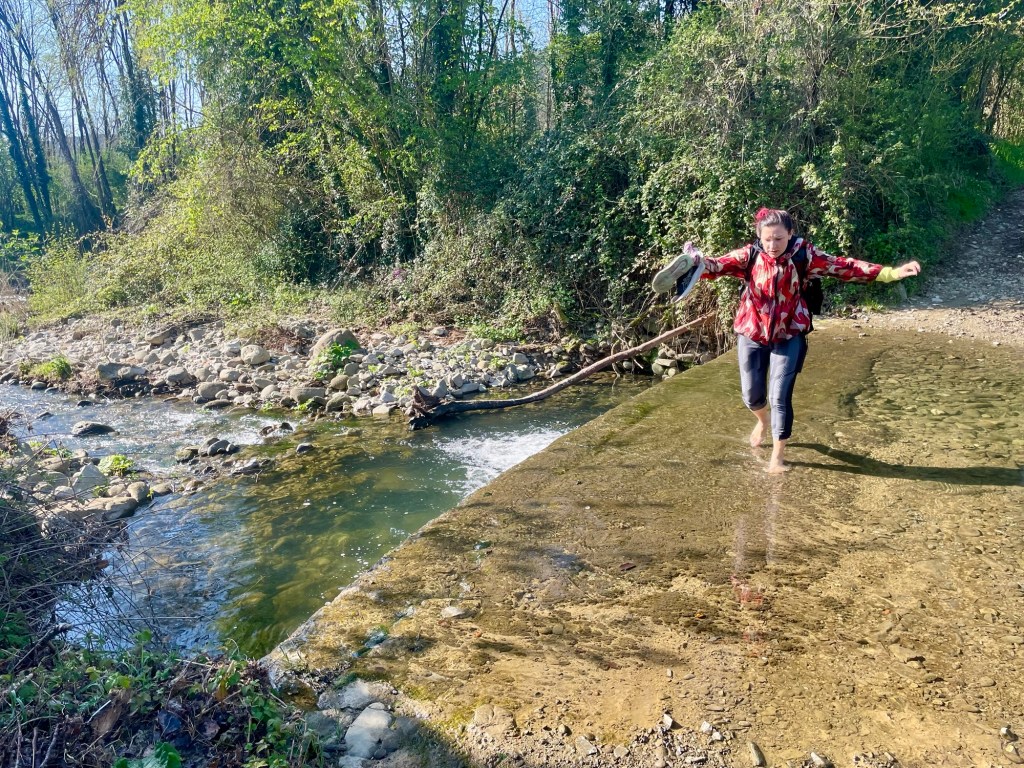
    On our way out of the town we crossed a stream. Alina had the sense to remove her trainers and traverse it barefoot. 

    I got wet feet. 

    I feel like Virgil would have chastised Dante for this stupidity as he does many times on their journey together through Hell and Purgatory. Alina just laughed. 

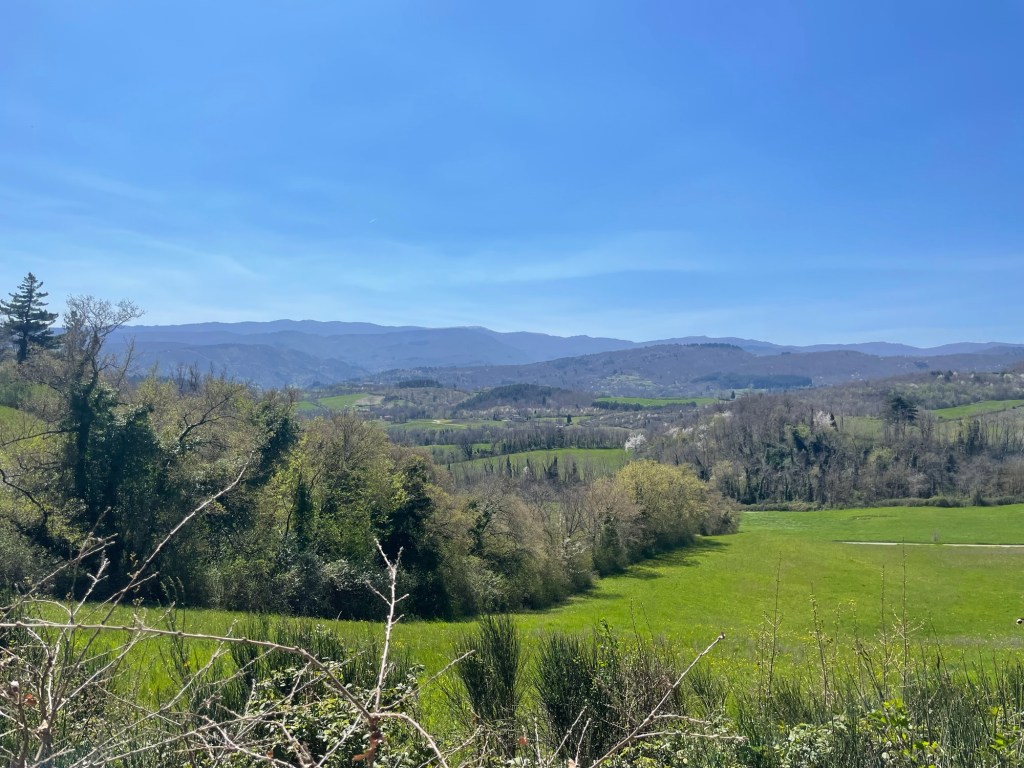
    We’d spent the last couple of days crunching through brown leaves in a climate that could have been mistaken for autumn if it were not for the primroses. But exiting the forest today, it felt like Spring had truly come. A gentle hike up afforded expansive views across the surrounding hills. The sun shone brightly on our faces and now it was my turn to be reminded of England. Alina said it also recalled Crimea where she would spend her holidays as a child.

    As we stopped in a field next to a towering hay bale which was taller than me at five foot two, I was reminded of the poem L’Infinito  by Giacomo Leopardi, an Italian poet born in 1798 in Naples. 

    The Infinite

    ‘This solitary hill has always been dear to me
    And this hedge, which obscures from me
    The endless horizon. 
    But when I sit and gaze, I imagine, in my thoughts,
    Endless spaces beyond the hedge,
    An all-encompassing silence and a deeply profound quiet,
    To the point that my heart is quite overwhelmed. 
    And when I hear the wind rustling through the trees
    I compare its voice to the infinite silence. 
    And I recall eternity, and all the ages past,
    And the present time, and its sound. 
    Amidst this immensity my thought drowns:
    And to flounder in this sea is sweet to me.’

    ‘Sempre caro mi fu quest’ermo colle,
    e questa siepe, che da tanta parte
    dell’ultimo orizzonte il guardo esclude.
    Ma sedendo e mirando, interminati
    spazi di là da quella, e sovrumani
    silenzi, e profondissima quïete
    io nel pensier mi fingo, ove per poco
    il cor non si spaura. E come il vento
    odo stormir tra queste piante, io quello
    infinito silenzio a questa voce
    vo comparando: e mi sovvien l’eterno,
    e le morte stagioni, e la presente
    e viva, e il suon di lei. Così tra questa
    immensità s’annega il pensier mio:
    e il naufragar m’è dolce in questo mare.’

    Once again, I’ve taken a stab at my own translation. ‘Naufragar’ – to flounder or to drown? I wish I had Anna’s Zingarelli dictionary.

    The poem, written in the Marche region in 1819, is a prescient nod to the modern mindfulness movement. This is something my colleague Will at the University of Birmingham refers to in a recent work as ‘McMindfulness’ for its ubiquitousness in social prescribing. Every other person seems to have an app on their phone, but how mindful are we really? 

    Leopardi’s poem reminds us that contemplating the infinite nature of the horizon when in nature can return us to a sense of peace. It’s not quite the same as having a low-pitched American drawl telling us to ‘feel our feelings and let them drift by like clouds in the sky’, but it’s something akin to it and dare I say superior?

    Alina and I spent a moment of silence contemplating the hedges and horizons around us and were quietly moved. 

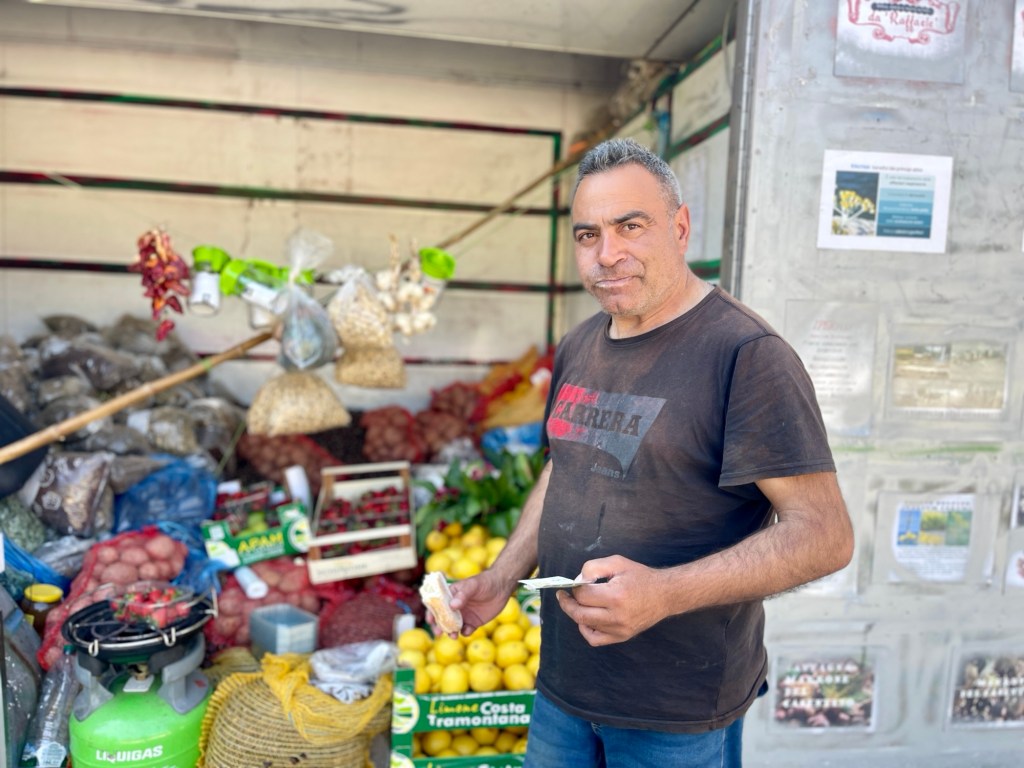
    Walking up to the steep path to the rural church and complex of San Pietro a Romena, we were greeted by a man selling groceries from a battered old vehicle. At first, I thought it was an ice-cream van – damn. But it turned out to be a worthy pit stop anyway. 

    ‘Where are you from?’

    We replied.

    ‘Oh shit, there’s a war in your country,’ he told Alina.

    ‘Thanks for letting me know,’ she said. 

    Bastardi, those who make war should make love,’ he continued, a look of lust creeping over his narrow eyes.

    Raffaele was eating straight from a can of tuna from which the tin lid flapped like a fin over the side. He had breadcrumbs around what he called his ‘muzzle’ and beseeched us to ‘stop and eat something with me!’ 

    He had a fuel stove and paper plates in his van. 

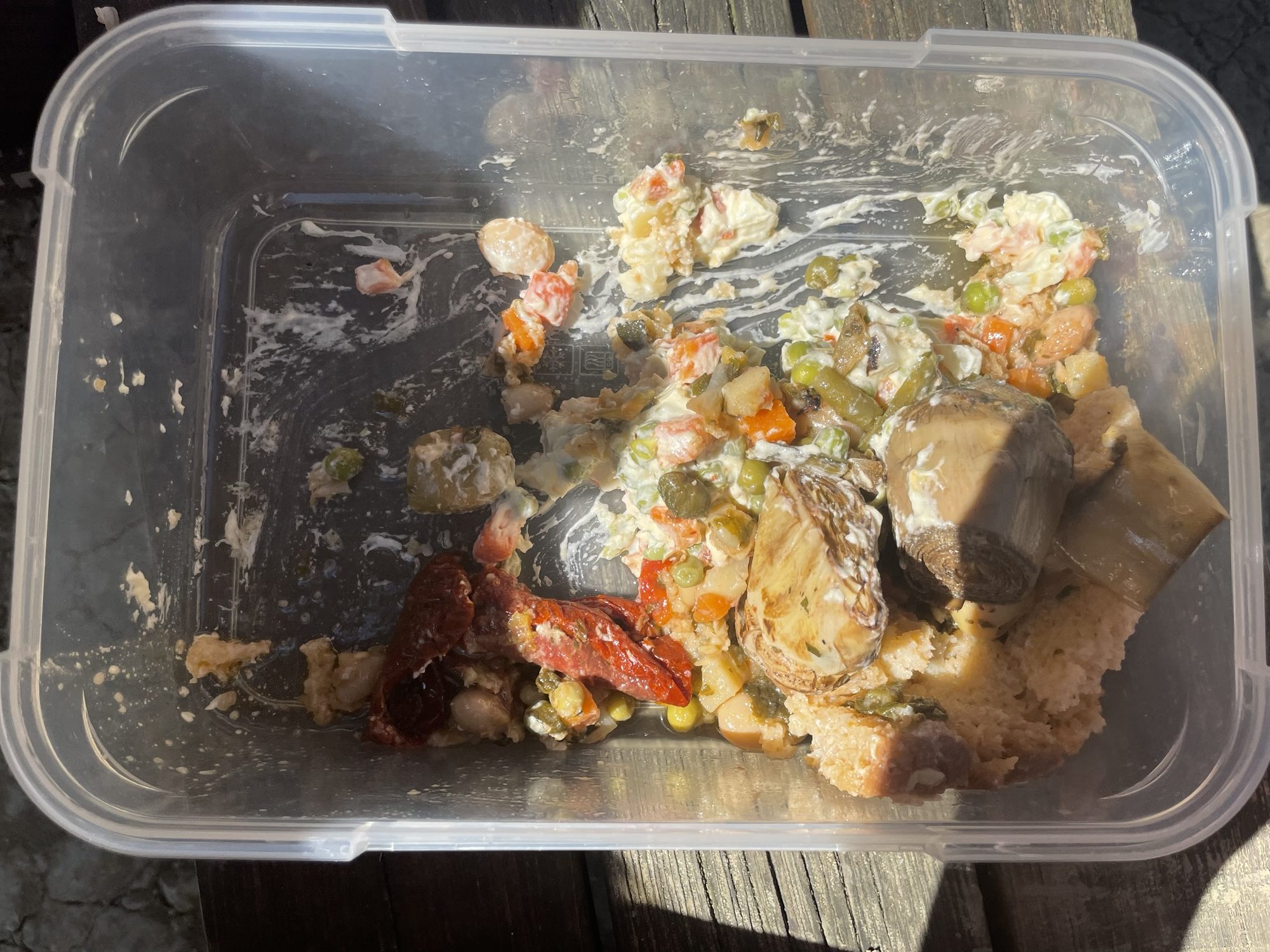
    We kindly refused the offer – we had a Tupperware full of treats from the deli yesterday to attend to. Alina said the way the salads had mixed together reminded her of the first day of January in Ukraine where you eat all the leftovers. She is a stickler for not wasting food.

    We purchased fresh strawberries and a huge bag of peanuts in their wrinkly shells for 5 euros and went on our way after exchanging a sweaty, and perhaps slightly too familiar, hug.

    San Pietro a Romena is a tranquil oasis which extends way beyond the Parish church over the cascading fields. 

    Located on the slopes of the hill dominated by the remains of the castle of the Guidi Counts, on the right bank of the Arno, in the territory of the municipality of Pratovecchio Stia, the baptismal church is a masterpiece of Romanesque architecture. 

    The building, declared a national monument for its importance, was built in 1152. The place name of Etruscan origin, Romena probably already housed a temple that was readapted in Roman times. A Christian building later rose on the pagan building. 

    Descending under the staircase on the right wall, you can admire the traces under the present raised presbytery of an early medieval church built between the eighth and ninth centuries.

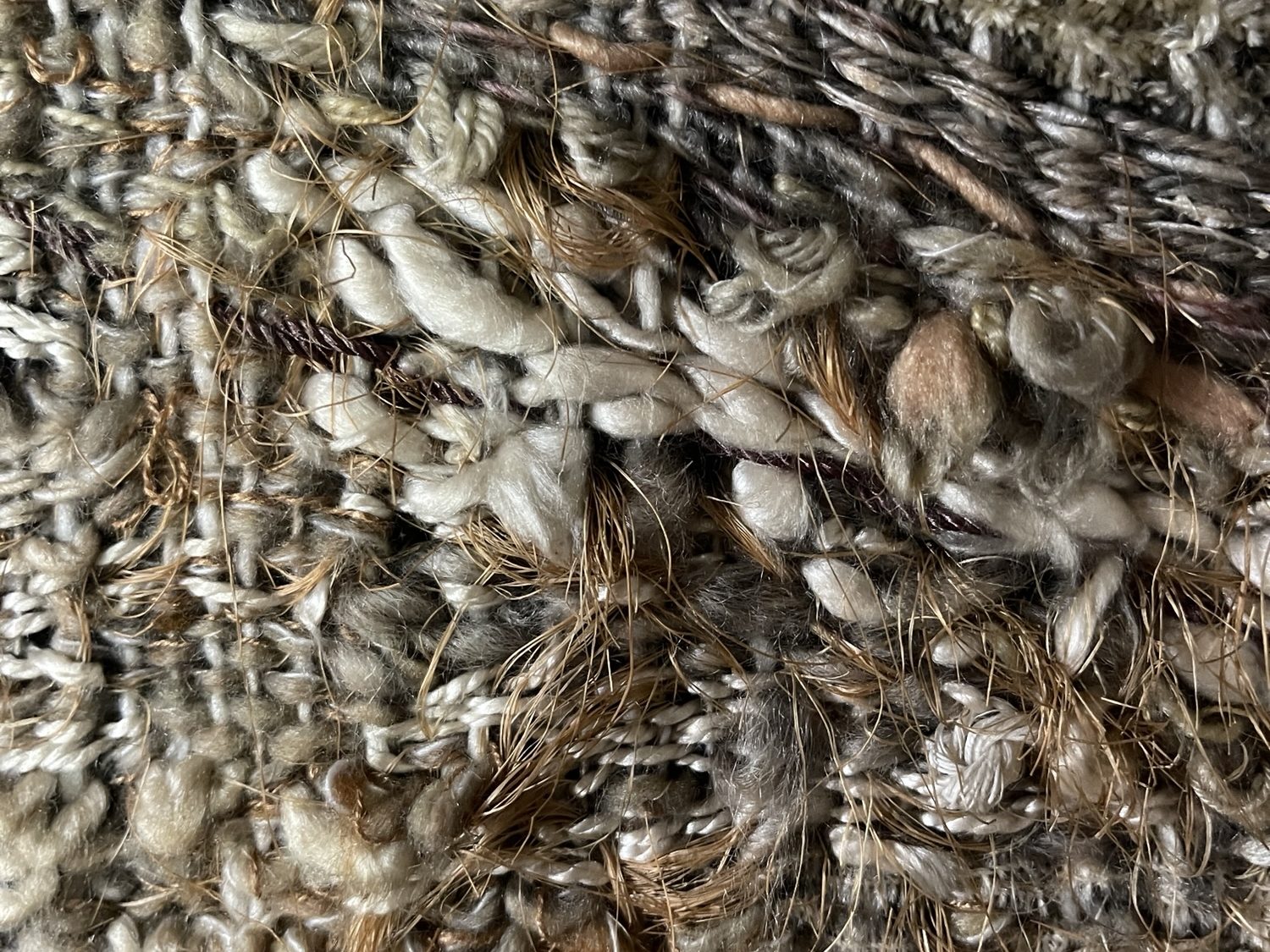
    Art adorns the church, though it is simple: rustic tapestries and painted wooden panels.

    Volunteers were cleaning and delicately placing olive branches in preparation for Palm Sunday. 

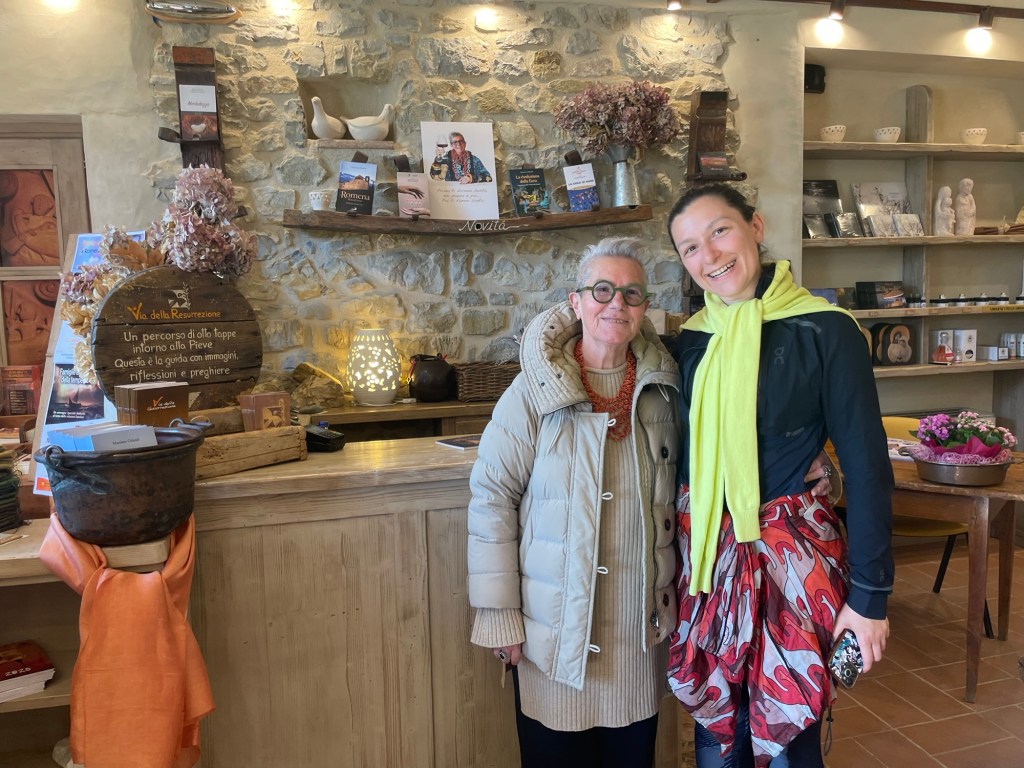
    Surrounding the church is a range of art, a conference suite, a meditation room, a café, bookshop, and gardens containing medicinal herbs and olive groves. There is no escaping the sense of tranquility afforded by the expansive complex. 

    A blend of Tracy Chapman and reggae played in the background as we perused the gift shop which was run by another spectacular 80-year-old woman who wore fashionable round, green glasses and a coral necklace. Behind the till, on the wall, friends had photoshopped her face and a glass of wine onto an image of the fashion icon, Iris Apfel with the quote, 

    ‘First they say enough, you’re crazy, then they make you a saint.’ 

    We admired her massive rings. One was made of silver, transformed into a circle of beads that encased a large labradorite. 

    ‘Oh cool,’ came the voice of Alina as she pawed a book about one of her favourite singers, Gianmaria Testa. It turned out he had performed here. The singer and guitarist, who died in 2016, is something of an Italian Leonard Cohen, though in his lifetime he didn’t receive the same critical acclaim.

    Throughout his musical career, Testa continued to work as a station master at the train station in Cuneo. One quote from the book read,

    ‘Poetry is literature’s form of combat.’

    A dozen other quotes and pieces of art were scattered across the complex. These included a steel silhouette of Banky’s Girl with Balloon and a beautiful white sculpture of a couple embracing.

    On an old door there appeared the words,

    ‘Everyone is looking for a bit of bread, a bit of affection and to feel at home somewhere.’

    The place was very quiet, but we were informed that on Sundays it attracts up to 1,000 people, as we would soon find out.

    ‘The door is always open’, the lady in the café informed us.

    A wooden placard beside the door displayed a quote by Marcel Proust,

    ‘Real travel doesn’t mean looking for new lands, but having new eyes.’

    A sign in the café read,

    ‘A coffee, 3 euros’

    ‘A coffee please, 2 euros.’

    ‘Hello, may I have a coffee please, 1 euro.’

    After a peaceful break, we hiked up the hill to Branda font. It is referenced by Dante in Inferno, canto 30 which depicts mutilated souls who, as follows the principle of contrapasso whereby the sin becomes the punishment, have been damned for representational and economic fraud.

    Dante was clearly struck by the streams and hills of the Casantino landscape too and likely stayed in the castle on the hill. He writes of one soul from Romena who counterfeited money,

    ‘The rivulets that fall into the Arno
    down from the green hills of the Casentino
    with channels cool and moist, are constantly

    before me; I am racked by memory—
    the image of their flow parches me more
    than the disease that robs my face of flesh.

    There is Romena, there I counterfeited
    the currency that bears the Baptist’s seal;
    for this I left my body, burned, above.’

    Dante then stages a meeting with Guido, Alessandro, or their brother,

    ‘I’d not give up the sight for Fonte Branda.’ He writes. Dante also mentions the Castle of Romena where the forger Adamo produced his florins.

    The punishment of those in Hell is that they are perpetually tormented by memories of their past lives without being able to move forward. 

    Alina and I moved forward, walking past the castle through an avenue of lego green cyprus trees.

    On our descent into the town of Pratovecchio, we encountered rusty tractors pulling ploughs in fields and beehives buzzing with life. It was easy to imagine Dante here, sat beside one of the many streams. Time seemed to have stopped in this part of Tuscany, if it were not for the electric cables and roar of motorbikes on the asphalt road.

    In Prato Vecchio, known for the swallows that inhabit its grand porches, we stopped for a drink in a small café where we met a musician, theatre producer and yogi from the south of Italy, called Massimo Kyo. He had medium-long hair which was half tied back and kind eyes. He told us his second name had come to him in a dream. 

    Like Raffaele, Massimo Kyo also asked us where we were from. But he was somewhat more diplomatic in his reply when Alina responded with ‘Ukraine.’

    ‘Oh…I mean, how do you feel?’

    She was surprised at the question – ‘no one ever asks me that,’ she said. 

    During the next hour of casual conversation he informed us that ‘Casentino is a magical place where you meet the people you have to meet’.

    When we shared that we were on the Dante trail he offered up the theory that Dante had experimented with natural drugs to enter his imaginative afterlife. 

    ‘Young people here go and look for mushrooms that grow in cow shit nearby,’ he explained.

    Massimo kindly offered for us to use any of his music or jingles we liked for the podcast we have been recording as we walk and invited us to spend the next day together, saving Alina’s number in his phone as ‘Alina walker’.

    I went to pay in the bar, commenting that I liked the tattoos of the bartender, one of which showed the stylized outline of a little girl holding her mother’s hand. 

    ‘Oh, this is my little girl who never was,’ she explained.

    ‘She’s beautiful,’ came my reply.

    The toilet was an old school squat. 

    We spent Sunday, our rest day, with Massimo, returning to Romena where he showed us his favourite spots. They included the Via della Resurrezione – the Path of Resurrection. On the way a sign read,

    ‘Before long you will do something new, in fact you’ve already started, don’t you see it?’

    The path ,which was pitted with art, flowed through the olive groves , ending in a stunning waterfall that fell into a turquoise pool the colour of my eyeliner. We sat and Massimo asked if we’d like to sing some mantras together.   

    We did.   

    I was taken back to Sri Lanka and to Tye, my mantra teacher who would bring us all to tears with her harmonium singing the Ganesh Maha Mantra, Om Gam Ganapataye Namaha.

    Thereafter we discussed our hopes and dreams. I shed a tear as I declared that one of mine was to finish the cammino. 

    ‘You will,’ Massimo sagely confirmed. 

    Though I don’t believe in God and think this life is all we have to make what we can of it, I really did feel like a pilgrim.

    Perhaps I do have a latent spiritual side after all. 

    Before we left, we returned to the giftshop where I bought Alina the Gianmaria Testa book and, at Massimo’s advice, some ‘nardo’ oil, made at the property.

    Known in English as Spikenard, nard, nardin, or muskroot, nardo is a class of aromatic amber-colored essential oil that comes from a flowering plant in the honeysuckle family. The oil has been used over centuries as a perfume, a traditional medicine, or in religious ceremonies across a wide territory, from India to Europe. It is said that the Virgin Mary used it to anoint the body of Jesus when he was removed from the cross.

    Back outside, Alina gifted me a beautiful artisanal necklace that she had bought which depicts an almond tree. The accompanying card contains a quote from Luigi Verdi,

    ‘Like the almond tree, you are the first to flower and the last to give fruit.’

    ‘It reminded me of you and your Dante book,’ Alina explained. ‘You’re flowering now, and you have to trust that the fruit will come.’

    On the way back, Massimo took us to the supermarket, kindly relieving us of the one hour hike up to Casalino we had done yesterday which would have been strenuous with shopping bags, however beautiful with its surrounding fields and pathway through the ‘park of endangered fruit trees’. Alina had experienced foot cramps on the steep hill and so we’d stopped to record our podcast overlooking the fertile valley which was lit up by the sunshine like a strip light over a painting in a gallery. 

    I bought Massimo a little succulent with three buds,

    ‘It’s us,’ I said. 

    He blinked a few times and smiled.

    Back at our air b and b we had an aperitivo with a selection of regional cheeses and made daisy chains in the pretty garden which we accessed from our apartment, number 74, via terracotta steps. 

    Alina’s method involved plaiting the flowers together whereas mine relied on poking holes in the stems and threading them through. I was thrilled to do this since as I child I bit my nails and was unable to do so. 

    I was reminded of Dante’s dream in Canto 27 of Purgatorio where he encounters the Old Testament characters of Leah and Rachel who were traditionally interpreted allegorically by the Church as figures of the active and contemplative life. Dante writes,

    ‘… in my dream, I seemed to see a woman
    both young and fair; along a plain she gathered
    flowers, and even as she sang, she said:

    “Whoever asks my name, know that I’m Leah,
    and I apply my lovely hands to fashion
    a garland of the flowers I have gathered.

    To find delight within this mirror I
    adorn myself; whereas my sister Rachel
    never deserts her mirror; there she sits

    all day; she longs to see her fair eyes gazing,
    as I, to see my hands adorning, long:
    she is content with seeing, I with labor.’

    We drank hot water, a habit Alina had picked up in her decade in China. She looked lovely in a forest themed patterned cotton top and trousers made by her fashion designer mum.

    ‘How have you packed all this into such a small bag!’ I exclaimed. ‘You’d make a good refugee.’ 

    We both laughed. This is the kind of dark humour that keeps me sane.

    After a simple dinner of spaghetti and green beans, we were delighted to discover not just a bin but a bucket and washing up basin into which Alina and I placed our aching feet in hot soapy water as has become tradition.

    Before bed, we sat outside and contemplated the full moon. 

    ‘You know no woman has ever walked on the moon?’ I said

    ‘Yet,’ replied Alina. ‘Who knows what wonders the future holds.’

    I held my necklace in my hand and made a wish. 

    Recommended listening: music by Massimo Kyo: https://open.spotify.com/artist/72MZKpGf1ARioeXiHAWXCw?si=4CfTY_SbTk2KGSCMCRCPWw

    Recommended listening: the music of Granmaria Testa: https://youtu.be/4f_4HW340Cw?si=JRfV45WqVPUDwt0B

    Recommended using: Nardo oil: https://en.wikipedia.org/wiki/Spikenard#:~:text=Spikenard%2C%20also%20called%20nard%2C%20nardin,Nepal%2C%20China%2C%20and%20India.

  • Living Well and ‘Leidenschaft’: From Pieve a Pitiana to Montemignaio

    The way up was steep, but inspiring company and a delicious supper awaited.

    I awoke at 2am to refuel the log burner in the community arts room where we were lodging and there followed a difficult but warm night of sleep. My day started at 7am when I rose to write and check work emails. It felt like breathing a new kind of air to have the time to write as the birds chirruped outside the window. 

    At 9am we were packed and having a breakfast of cereal and yoghurt with Stefano and his youngest son. My placemat read, ‘today is a good day to…love nature’. It felt prescient. 

    Alina and I said our goodbyes to our hosts and headed uphill for what was supposed to be a much easier day of the cammino. 

    The sight of the church slowly disappeared from view as we climbed up the road which hugged sinuous vineyards. After yesterday’s experience and reflection on Dante’s wood of suicides, I found myself noticing each tree and wondering what kind of soul would be trapped within it. This one, here, with its gnarled roots and stubby fingers; and there, an oak with its sturdy frame. 

    Although the path uphill was quite straightforward, we missed a turning and ended up in the small, deserted town of Saltino (the official and much shorter route threads an arch to the side of it.).

    The village appeared post-apocalyptic except for a bar where a lady with bleach blonde hair served us drinks – a cappuccino for Alina and an espresso macchiato for me. Alina introduced me to the song, Espresso Macchiato which is this year’s Estonian Eurovision song context entry.

    ‘Life is like spaghetti, it’s hard until you make it,’ sings Tommy Cash. 

    Eurovision has always been a big part of my life. I love the campness and the way that the heavy burden of nation states and regional strategizing is rendered playful, all accompanied in England by the teasing commentary of TV personalities Graham Norton and the late Terry Wogan. My sister-in-law, Jenny, is Swedish, and, in Sweden, Eurovision means business!

    In recent months, after making a new year’s resolution to spend more time with my niece and nephew in light of the realization that I likely won’t have kids of my own, I’ve been driving the two hours in my blue Mini every month to visit them. This has included joining them in watching the Swedish nationals where viewers vote for this year’s entry. It’s a hyper produced show and luckily you don’t need to speak Swedish to enjoy it. I felt a stab of pride as my 12-year-old niece Louisa fluently translated the commentary for me. Oh, to be raised bilingual.

    The winner of this year’s Swedish nationals who will travel to Basel, Switzerland for the competition in May is the Finnish band, KAJ, whose song, Bara Bada Bastu is about the joys of the sauna. It’s a catchy, extravagant number which will, for sure, give Estonia a run for its money. 

    Now here comes a fun fact I bet you didn’t know. Eurovision song contest entries don’t have to be from the country they represent. In 1988, Canadian artist Celine Dion represented Switzerland and won with the banger, ‘Ne partez pas sans moi’. Check out the video – she sports a tutu and a military jacket, quite the contrast to her sleek performance at the 2024 Paris Olympic Games (yes, I cried at it too). 

    I had the opportunity to travel to Finland myself in November last year during a research project for Save The Children on violence against children at EU borders. Between interviewing refugee children in reception centres, I had the pleasure of indulging in my own sauna experience. After singeing my skin red, I dived from Helsinki’s dock into the ice-cold ocean. Well, I say dive. In reality, I awkwardly and tentatively made my way down the metal steps until my body was under. Then my neck. Then my head. 

    Whoosh. The feeling was intoxicating, something between an orgasm and being burnt at the stake. I can see why the Fins are such a prosperous nation. 

    Saunas are such a big part of Finnish life that even one of the reception centres I visited had a sauna where a 17-year-old Colombian girl who was waiting on the result of her family’s asylum application told me she liked to spend time with her friends. I could imagine the Daily Mail headlines – ‘now SAUNAS for refugees!’ It made sense to me. It was freezing cold and in Finland, sauna equals life.

    On our departure from the town up to Vallombrosa we passed a sign warning cars to slow down for migrating frogs. 

    The expansive abbey loomed over the surrounding landscape which included an empty water feature which was also signaled, ‘no fishing’. Italians in these parts seem to really like their public signs. 

    ‘Sti Italiani!’ repeated Alina with her Roman lilt.

    From there it was a steep climb up what seemed like one thousand stone steps which looked over one of several waterfalls we would cross today. Each corner of the cliff was marked by a little shrine. 

    At the start of Dante’s journey, he meets three beasts in the woods: a leopard, a lion and a female wolf that represent his fears. Readers have argued for centuries about what they signified for him – pride, lust, greed? 

    As we climbed, we distracted ourselves by discussing what our three beasts would be. Mine were fear of dying without realizing one’s talents and potential, perfectionism, and the terror that assails me from time to time that I might not be the good person people think I am. Alina is a Jungian. She reminded me, in a chastising tone, that ‘we all have shadow selves. Me, I can’t get enough of you.’

    We are recording parts of our conversation as we walk for a future podcast since, to add to her already impressive portfolio of creative talents, Alina is currently studying sound design. As I adjusted my bra strap to ease the rub of my backpack, the portable microphone Alina had brought with her nearly went careering over the steep edge. Luckily it just fell a short way into the leaves where is disturbed a dozing lizard. 

    Alina and I have different body temperatures. I was sweating into my t-shirt, a gift from her which read Dante On the Move after our anthology of the same name, while she was wearing two jackets with a yellow jumper the colour of primroses tied around her neck like a scarf. 

    ‘This was meant to be the easy day!’ exclaimed Alina.

    We were rewarded with sweeping views across the surrounding hills. Then came the steep descent. It felt like we were walking down into Dante’s Inferno, each circle lined with ridges from which I could imagine Dante and Virgil looking down at the sinners below. 

    The sound of a stream accompanied our pilgrimage. 

    Animals have been a big part of our trip: we stop to pet every cat and salute every barking dog. But upon entering the town of Montemignaio we were greeted by two friendly sheep.

    ‘Salve!’ cried the owner who was walking them along a small lawn which was dotted with daisies. 

    ‘Buona sera’ we replied.

    ‘Would you like to see where they live?’ asked the friendly lady. We did.

    There followed an extraordinary evening.

    First, Anna showed us the beautiful paddock in which the sheep resided at night to protect them from local wolves. It was built to specification, she proudly declared, by a shamanic Venetian man who spent three years alone in the virgin forest of Bolivia, where he acquired much of his knowledge and wisdom. Inside the straw was fresh and dry and the circular structure had a domed ceiling crafted with all the care of a Florentine cathedral. Alina and I joked that we could have happily spent the night there instead of continuing to our air b and b. 

    Then came the chickens, equally spoiled in a bountiful enclosure on the hillside, made out of all organic materials.

    Anna had a way with the animals. She hugged them to her chest with a filial warmth. 

    As we were petting the sheep, a handsome stranger wearing an embroidered scarf and long leather boots made his way through the front gate to join us.

    ‘Ciao, Anna!’

    ‘Ciao, Matthias!’

    They embraced.

    Matthias, it turned out, was a fellow German. A writer who had moved to Montemignaio some eight months ago where he now runs a hostel for pilgrims, Frate e Sole

    ‘So, you’ve met the wonderful Anna!’ he exclaimed. 

    They clearly had a bond. She traded with him ‘happy chicken’ eggs, fresh vegetables from her garden and her homemade walnut liquor. 

    When asked about what we would be eating tonight, we replied that we hoped to pick something up at the village shop. Anna and Matthias exchanged raised eyebrows. 

    ‘But it’s Wednesday,’ came their response. As if, of course, logically, on Wednesday the shop would be closed.

    ‘Sti Italiani!’ repeated Alina playfully.

    We were contemplating the prospect of dining on unsalted bread and cereal bars when Matthias invited us to spend the evening together. 

    ‘It will be a simple fare, but healthy,’ he counselled. We were in. 

    Matthias bid us farewell for now and Anna invited us in. 

    Next to a beautifully landscaped vegetable garden sat Anna’s home, an old stone building which she’d had renovated. When Covid hit in the year 2020, she had relocated from her native Germany.

    It was simple but spectacular. Every room was full of ornate bespoke wooden furniture that had been made for her great grandfather – a wardrobe, desk, sideboard – all had been shipped over at great expense from Germany. Anna was in no two minds. This was now her home. And she was ‘living well’ here.

    Over the next hour, Anna shared insights from 82 years of life experience as we listened eagerly to her perfect English. Though she was born in the war in 1942, she looked not a day over 60. She radiated peace around her. The secret to being happy, she advised us, is to be grateful and to live in the moment. Her home had a traditional Etruscan metal handrail and organic earthen tiles the colour of doves. 

    In one room there greeted us the sight of marinating eggs and vegetables, in another vegetable seeds sprouted in tiny pots and here, in the bathroom, were a range of tinctures and ointments that she had made by hand. She showed us her traditional copper Florentine bed and her office which consisted of a shelf with an old Nokia mobile phone, an address book and a paper and pen. 

    ‘This is why I look young!’ she chortled, entreating us to follow her into the next room which contained a small library and more budding seeds. 

    It turned out Anna carried the seeds around with her throughout the day to make sure they were always at the optimum temperature,

    ‘This is my little kindergarten’ she explained with glee. ‘Right now, some are sleeping but tomorrow, who knows!’

    Anna shared with us some of her prized possessions. A steel candlestick holder from the war, a signed Zingarelli Italian dictionary and a book she had made herself with thick marbled Tuscan paper containing photographs from her collection – she was an artist too, it seemed. Alongside each photo was a short description which mindfully described the scene. One showed a rag rug made out of old textiles.

    The accompanying text which was tucked into a pocket, sewn into the page of the book, read:

    ‘After

    All those clothes

    Sewn, worn and torn,

    After being woven into this mat,

    After the passage over it

    Of so many feet, big and small…

    Now, finally:

    Loosen the grip,

    Gracefully dissolving

    Into a harmony of fading colours’

    Anna was dressed like a farmer in a pink jumper and dungarees and she had circled her eyes with a turquoise eye liner. It looked magnificent. It reminded me of my late Italian teacher, Andi Oakley, who would line her eyes in a glittering violet hue.

    As we parted ways, Anna gave us a bottle of her homemade walnut liquor and a dozen eggs and hugged us the way I haven’t been hugged in a long time. Her arms, strong with the labour of running her little farm, held me tightly while her calloused fingers caressed my back. 

    Of course, we were late to dinner, but we knocked on the way down and gave Matthias the heads up. 

    ‘We’ve been with Anna,’ we explained, and he immediately understood.

    After a quick turnaround, we arrived at his homely place where he’d lit a roaring fire. We found a table set with plates and crystals that glowed in the throw of his Himalayan salt lamp. The green man watched over us.

    While Anna’s walls had been bare, here art and tapestries occupied the space: Monet, Van Gogh, Kandinsky. I was quite impressed that, between us, Alina and I managed to identify nearly all of them. Next to the fire was a bible. Matthias had moved to the town after doing the St Francis’ Way, or the Via di Francesco, which runs from Florence to Rome and shares some of the same route of the Cammino di Dante, including passing through this magical town. 

    Matthias explained how he sought to integrate the teachings of Saint Francis into his own life: living simply, staying humble, being kind to those in need (and saving hiking strangers from starvation because the bloody shop was closed.) He made his money writing short stories for German magazines. 

    We ate a delicious but humble meal of homemade bread which he’d taken 24 hours to prepare using a local method he’d learnt from Anna with flour from the local mill. The salad contained fresh beetroot and the garlicy local leaf known as ‘erba orsina’, a name that refers to the fact that a bear (orso), awakening in springtime after his winter sleep, goes for this herb in order to get strong and potent again.

    We discussed our mutual love of Erich Maria Remarque (Alina) and Stefan Zweig (me) and Alina read one of the poems from her new collection called, Why Do We Choose To Suffer. We discussed the meaning of leidenschaft – as artists, there is passion in a certain kind of suffering, we agreed.

    This was something our feet knew all too well as we climbed back up the hill to the welcoming Agriturismo di Mela where we were greeted with milk for our morning coffee, supplies for an emergency dinner – which thankfully we didn’t need – and soft sheets.