I said goodbye to Pope Francis, was humbled by the kindness of strangers, and struggled over the staggering mountains.
It’s common that Italian bars and restaurants have TV’s on in the background, so over a breakfast of a croissant and cake I watched as the news anchor looked back on Pope Francis’ life. There was no doubt about it, he had been an incredible man.
Although I’m not a Catholic, for all intents and purposes it seemed he had been a good Pope too.
I recalled how struck I had been when he’d blessed arriving migrant ships in Lampedusa and washed the feet of refugees. The news reported that migrants, along with homeless people and individuals in prison, had been among those invited to his funeral. Pope Francis had also spoken out about climate change. He would be sorely missed.
500,000 pilgrims had descended on Rome to pay their respects. Kelsey, who lived there in an apartment by the Colosseum, said that the atmosphere was electric.
I reflected that Prince William looked handsome with a beard and wondered how the encounter between Trump and Zelensky would go down. I had watched the entire video of his ritual humiliation at the hands of Trump and Vance at the Whitehouse and was left with the feeling that I had witnessed an act of bulling and extreme abuse occur upon the screen.
11,000 police and security officers had been mobilized by the Italian state.
I watched Starmer greet Meloni with a kiss on the cheek and was reminded of the cruel recent UN approval for offshore processing centres for asylum seekers, a policy the UK had borrowed from Italy.
Franco appeared from between two baby chairs.
‘Buongiorno!’ he saluted me. He was wearing shorts and looked almost German with his fair hair and skinny legs.
‘Buongiorno,’ I replied.
‘Ah yes, the Pope of the people, he was,’ reflected Franco.
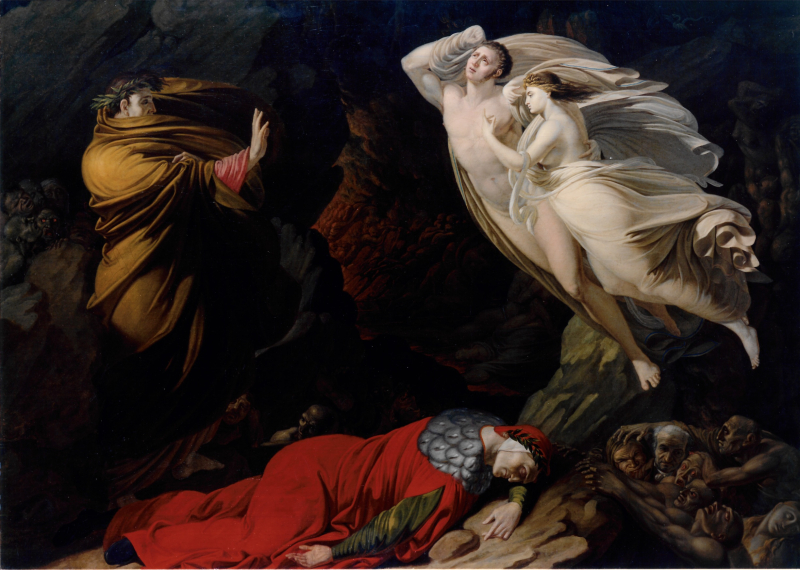
I thought of Dante’s tumultuous relationship with the Popes, many of whom he’d put in Hell where they were buried in the ground headfirst with their feet on fire.
‘O Simon Magus! O his sad disciples!
Rapacious ones, who take the things of God,
that ought to be the brides of Righteousness,and make them fornicate for gold and silver!
The time has come to let the trumpet sound
for you; your place is here in this third pouch.’
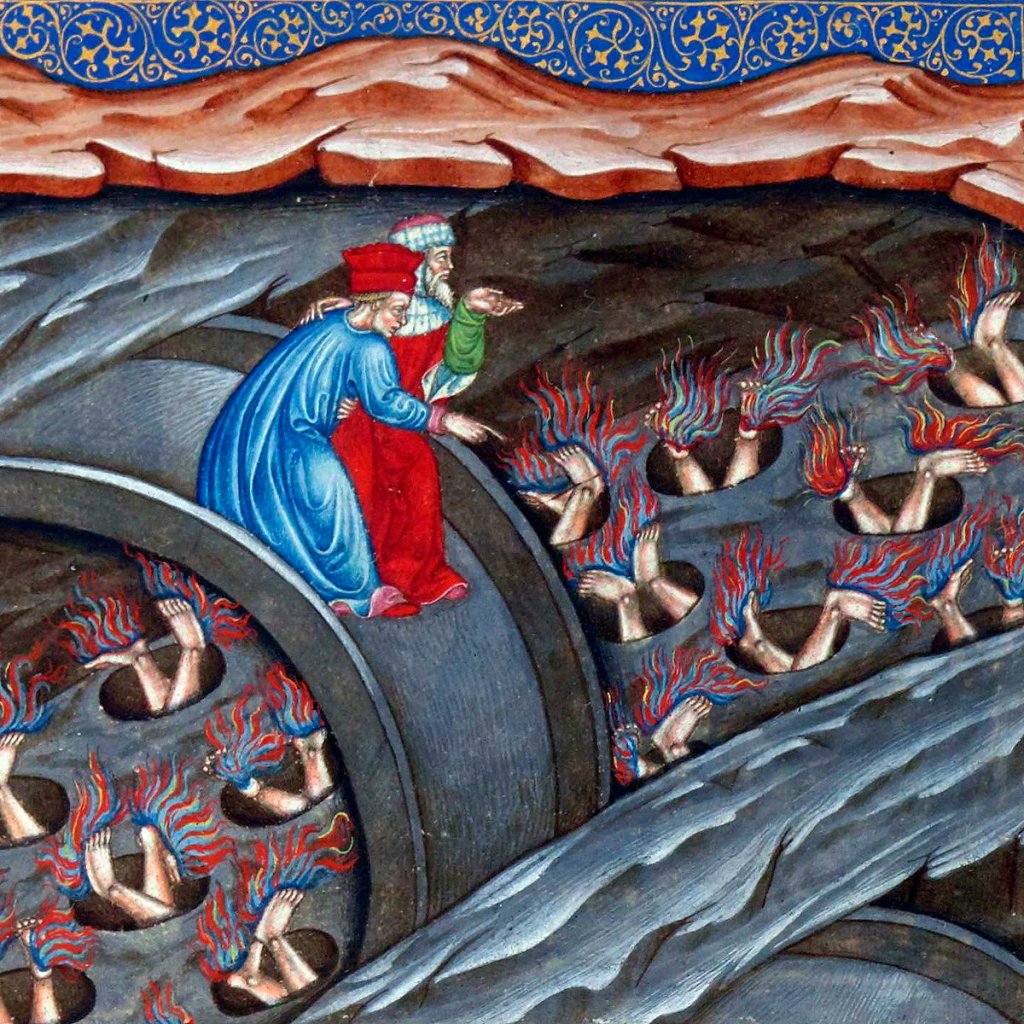
In this canto, Inferno 19, the prostituting of the Church-bride by her Pope-bridegroom picks up and metaphorises the sexualized language of previous parts of the Inferno. This canto is the first of several indictments of the Church in the Divine Comedy. Indeed, it picks up on some earlier indications that Dante links the clerical establishment with the sin of avarice. In Inferno 7 he says that he sees cardinals and popes among the misers in the fourth circle:
‘ These to the left—their heads bereft of hair—
were clergymen, and popes and cardinals,
within whom avarice works its excess.’
I was captivated by the news but I had to get moving. Today was a long one and starting at 9 was already a bit ambitious, Franco warned me.
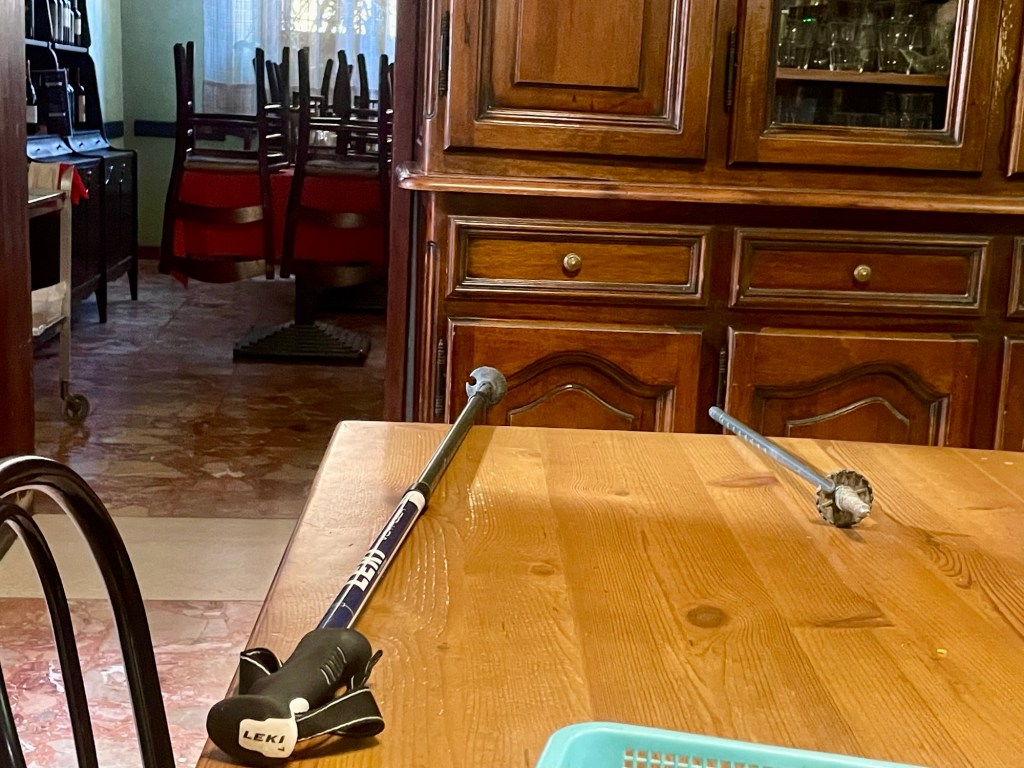
He noted that one of my hiking poles was broken and I followed his gaze.
‘I don’t suppose you have any glue or something to fix it,’ I asked.
His face lit up.
‘I have just the thing’, he said.
My host disappeared into a back room with the broken pole and reemerged ten minutes later. He had completely fixed it. It was sturdy as the mast of a ship.
‘But how did you manage that?’ I questioned.
‘Ah, it’s a secret,’ came his reply. ‘A bit of magic and good will.’
I was beyond grateful. I was also grateful that after I’d finished my third espresso macchiato Franco handed me a fruit juice bottled filled with espresso.
‘You’ll need this,’ he said, ‘it’s for the road.’
One of the passes I would cross today was named ‘Hell’s Hill.’
I tucked it into my bag, delighted.
I carefully removed a tick from my stomach as I watched a lady place flowers in boxes outside her store from the window. I realized I’d left my glasses and moisturizer at a previous hotel and was grateful for my contact lenses and Vaseline which I applied to my chapped face instead.
And with that, I set off back into the mountains. I saluted Franco. He left me his number in case I needed anything. He had been another ‘trail angel,’ as Kelsey called them.
Though I had enjoyed by brief interlude from the 24-hour news cycle during my cammino, now I listened to the BBC World Service as I ascended out of the town. The Pope’s funeral was about to start and I was curious about how it would be covered.
It was a sunny but fresh day and I’d known better than to wear shorts. It would be cold up in the mountains and so I’d put on my trousers.
There was no two ways about it, the ascent out of the city was steep. My back and shoulders hurt today as well as my feet. Today was going be a beast. I could feel my calf muscles twinging to life. I’d done some gentle stretching the night before but this was a burn.
The sweat dripped off my nose and my hands slid, sweaty, on my poles. I had only been going for 20 minutes!
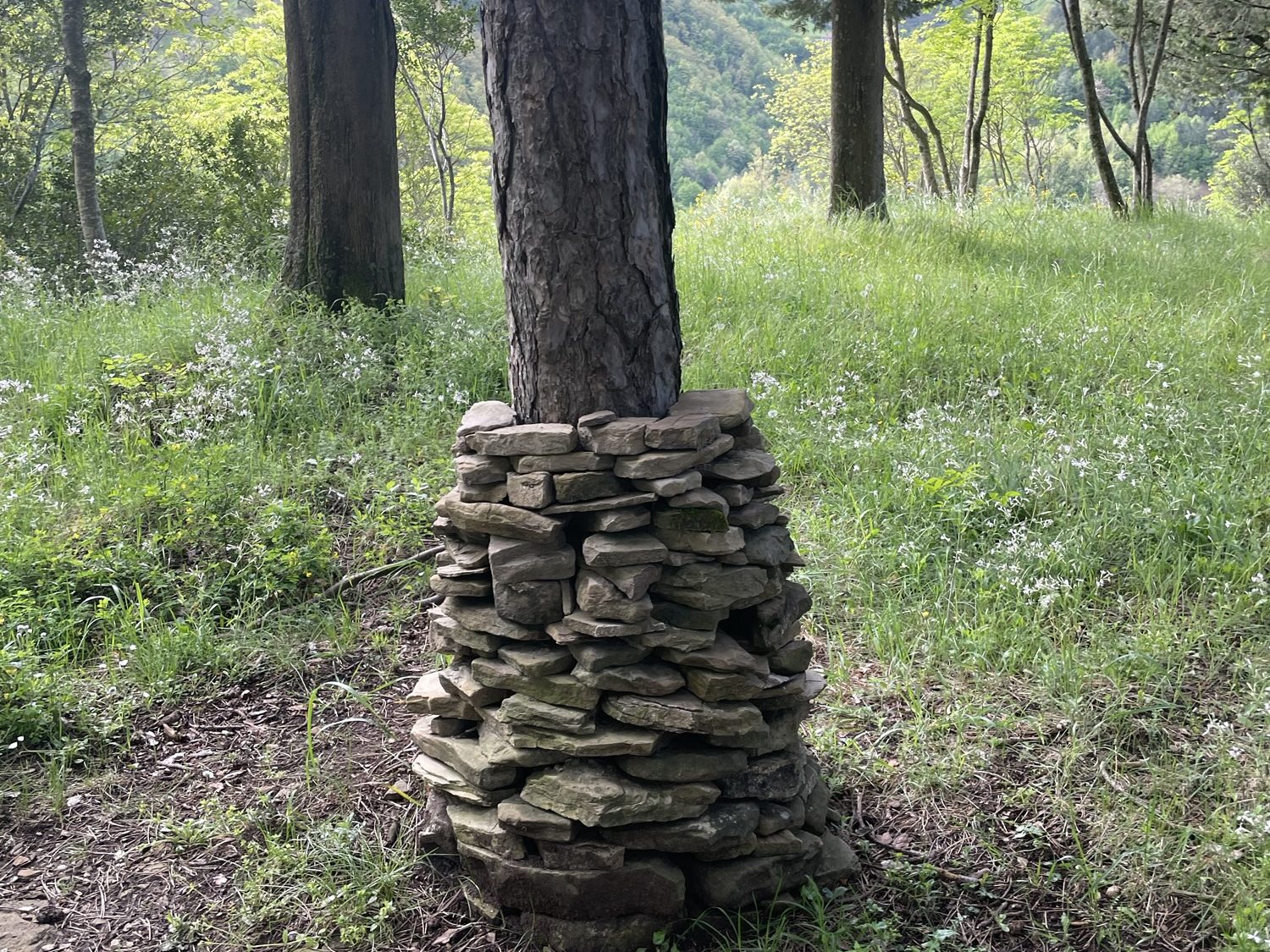
A few mountain bikers past who I saluted – it was a sport I’d never tried. Someone had laid stones at the bottom of a line of trees like a familiar cairn.
I’d felt on the edge of tears for the last few days. Maybe today would be the day.
I drank water liberally since I was counting on stopping at the Hermitage to restock on the way.
I was religiously checking directions. I really didn’t want to add time to what would already be a super long day.
The radio informed me that there had been a bishop in Rome for over 2000 years and that there were 1.4 billion Catholics in the world. Pope Francis had spoken out against the wars in Ukraine and Gaza. He had said that ‘a pastor should never lose the smell of his flock.’
50 heads of state and ten monarchs were in attendance. 40,000 celebrants filled St Peter’s Square and 100,000 more were crowded before large screens on the Italian side of the border. The Vatican was, after all, its own city state.
Someone said that the Argentinian Pope had even been able to do the impossible, make Brazilians forget their football rivalry and connect across the border. He had been a champion of interfaith dialogue.
Then came the 10am news bulletin. Trump’s administration had deported a two-year-old to Honduras in breach of due process. Of course he had. This is what I hadn’t missed about listening to the news. I felt sick at the thought to it and recalled the poem:
‘First they came for the socialists, and I did not speak out—
Because I was not a socialist.Then they came for the trade unionists, and I did not speak out—
Because I was not a trade unionist.Then they came for the Jews, and I did not speak out—
Because I was not a Jew.Then they came for me—and there was no one left to speak for me.’
I followed the first of two detours that had been designed to avoid landslides, adding about two kilometres to my route. I dodged another group of mountain bikers, one of whom was topless.
It was very muddy on the path and I was immensely grateful for my poles to help me avoid a slip. Franco, you angel!
There emerged a big rain cloud and the wind picked up.
The radio continued with its commentary of Pope Francis’ funeral. 130 delegations were in attendance. Putin was not. He would have been arrested by international warrant if he’d set foot on Italian soil.
Pontiff, I leaned, means ‘bridge builder’.
In other news, North Korea had launched a new missile ship. What a world.
A group of scouts came hiking towards me in the opposite direction. They saluted me cheerfully. Their backpacks suggested they were campers. I hoped for them as well as for myself that the rain would hold.
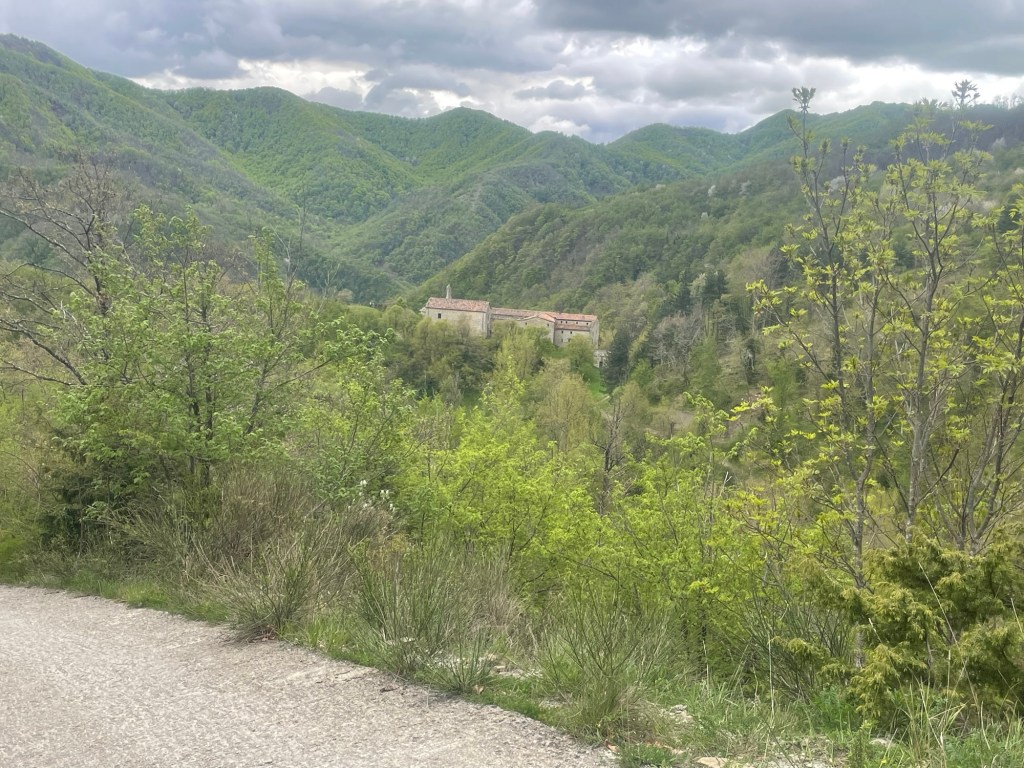
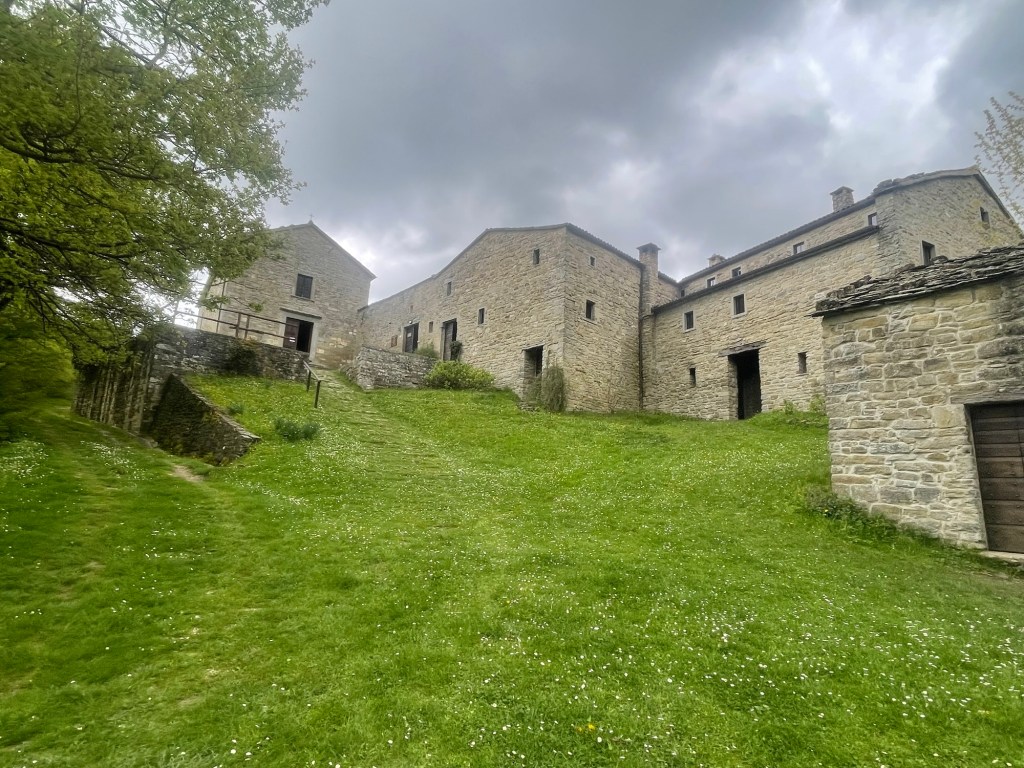
I lost signal as I approached the Hermitage of Gamogna where an order of sisters lived and prayed. I passed two such nuns, one of whom was wearing a wooly hat, and they invited me to enjoy the church. The complex, a sign informed me, had been founded in 1053.
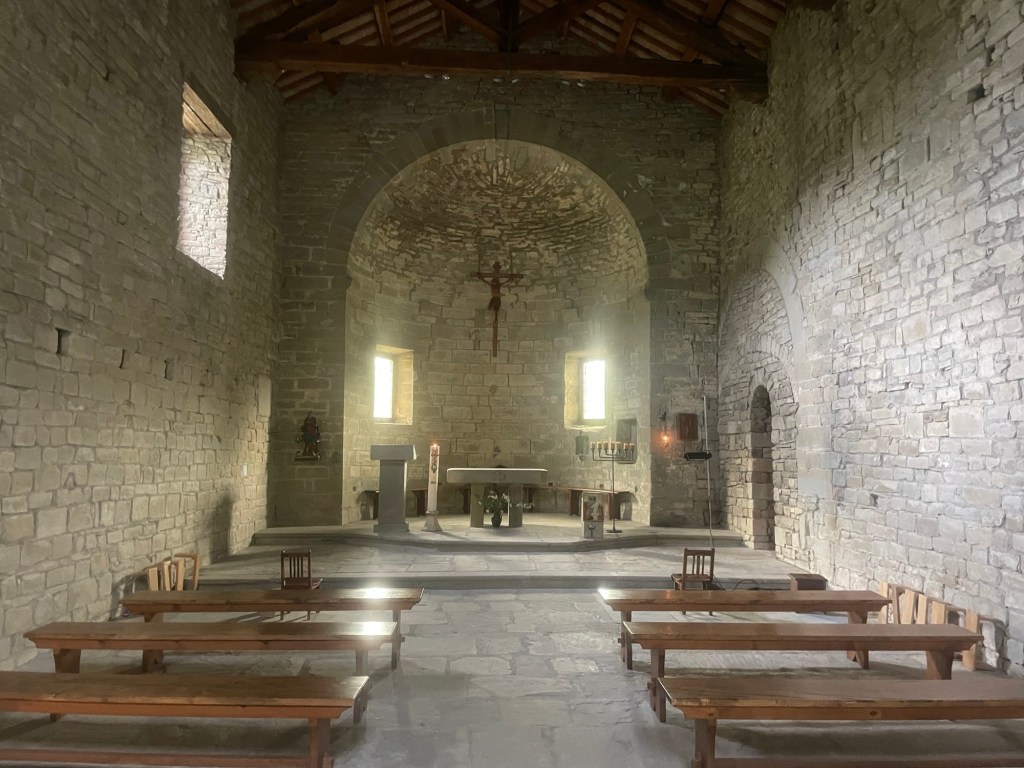
I took off my cap as I entered the simple stone building and took awhile to sit on a pew and rest. It was incredibly tranquil. Before I left, I signed the prayer book.
‘With the wish of peace to all refugees and that I may complete this cammino,’ I wrote.
I ate half of my controversial tuna and cheese sandwich in the pretty courtyard and refilled my water tank from an outside tap by which there was an abanonded toothbrush. I also drank half of the coffee that Franco had so kindly prepared for me.
Yum.
A French couple were having a picnic and a couple of other hikers were making their way up to the church.
It was 12.30pm. I followed the. prominent Cammino di Dante signs up to a field that was cordoned off with barbed wire – that’s not very nun-like, I thought. Then I crawled under it. My anorak was snagged. Would I regret this?
I looked back at Oliver’s messages and texted him, waiting for his advice. There were footprints; somebody had come before.
The woodland I entered was dotted with little wildflowers that looked like miniature violet pansies, and here was the familiar sprinkle of primroses.
I exited the patch of woodland through another barbed wire fence, but this one, I noted, had a gate mechanism you could cross through and a sign that clearly indicated that livestock were grazing. I must have missed the gate in the previous fence. The nuns were ok after all.
Oliver had helpfully signaled to me where the path goes right off the road – it would be would be easy to miss – and up, up I went along a dirt path.
It was now 2 o’clock and I was about halfway. I was hungry. I ate some more of my sandwich. I was so grateful Franco for fixing my pole. Today’s hike would have been near impossible without it.
The brooding clouds delivered the first spits of rain. I crossed a field with the sign, ‘Attention, wild bull!’ and crossed a pass called ‘Hell’s Hill’.
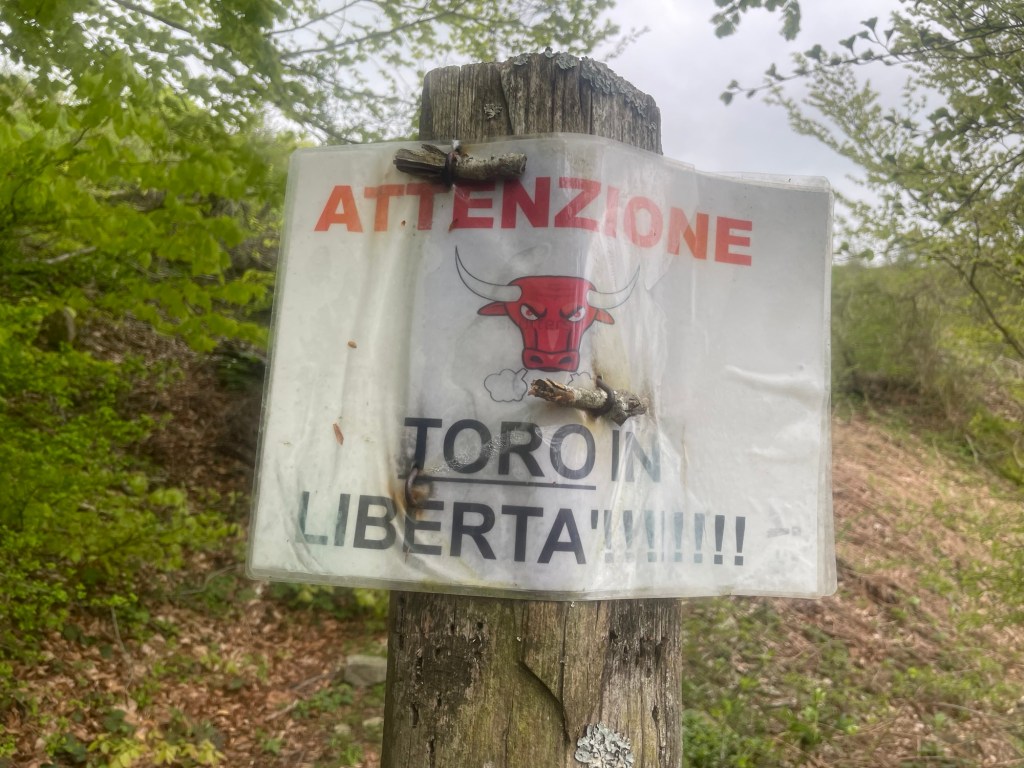
I followed a man who was walking slowly with stick behind his back. We kept pace. I was about ten metres behind. The path was now lined with a brown brush-like plant.
It was still two hours to the waterfall. I wouldn’t get there before six, I realized.

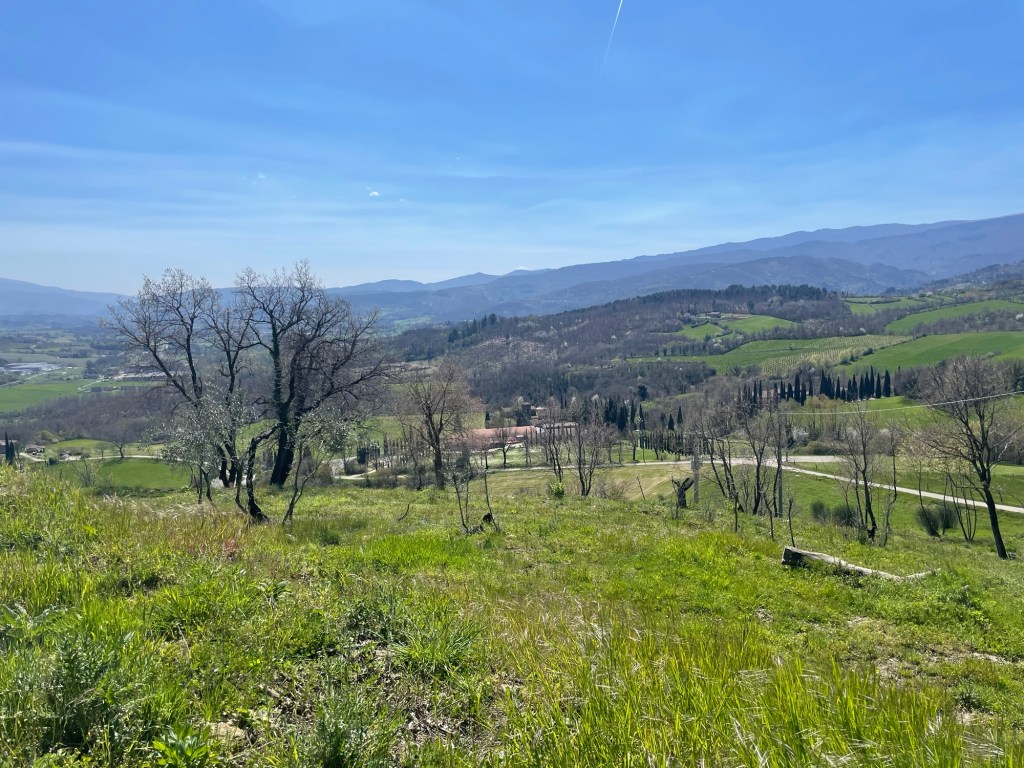
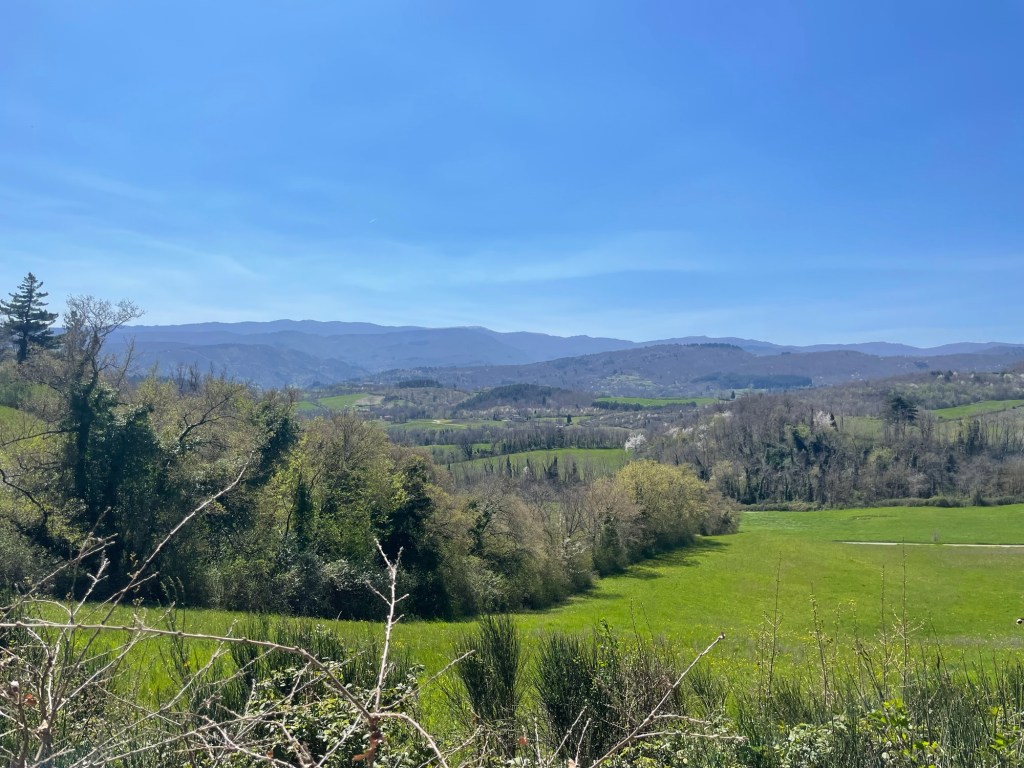
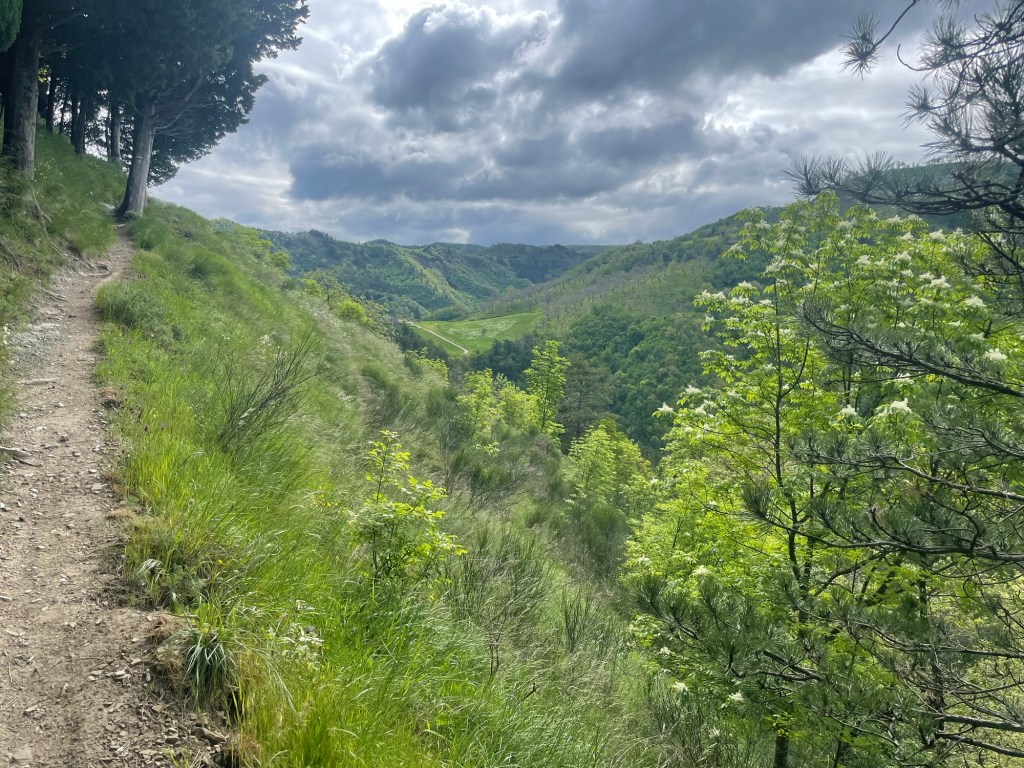
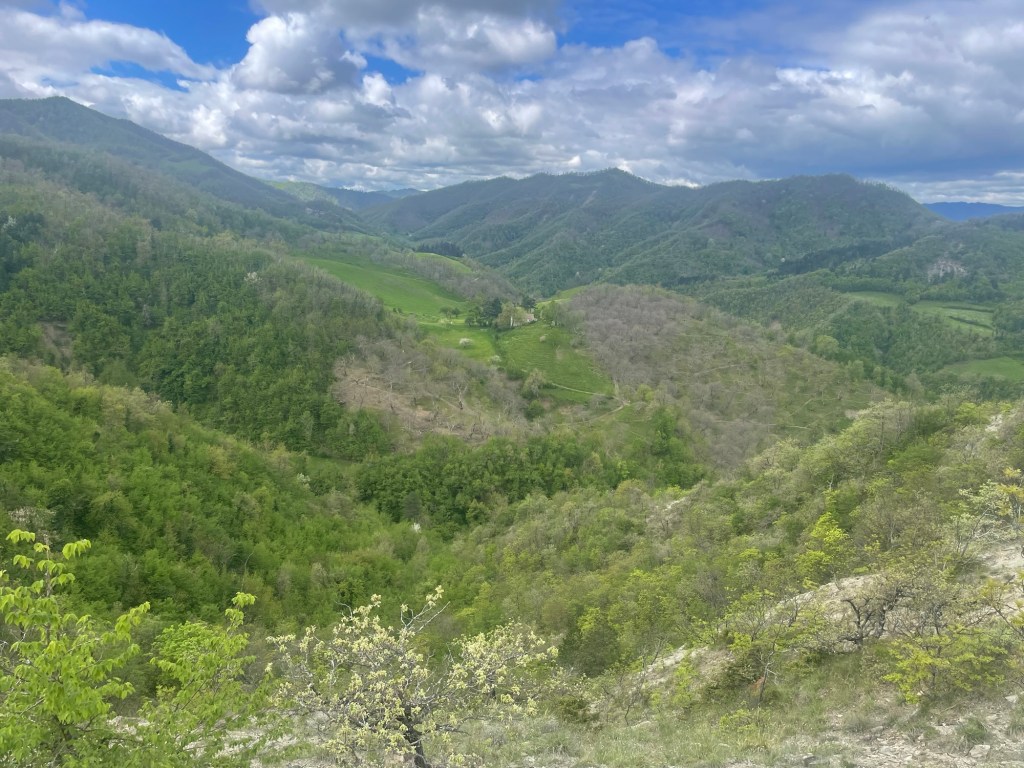
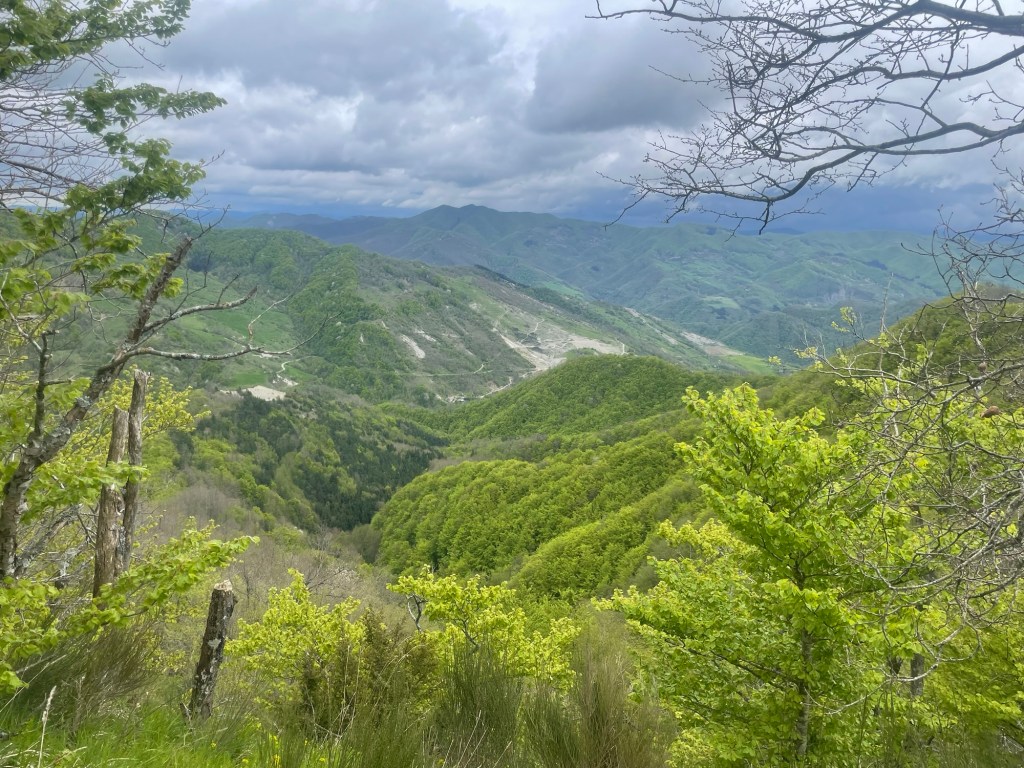
I was straddling the border between Tuscany and Emelia Romagna as I walked, observing stunning sweeping panoramic views of the mountains which were many shades of green. I stopped to observe from mushrooms sprouting on a log. Enrico would have known how to identify them.
A hawk swept across the landscape, crying out. This was the only sound I heard as I started the descent.
The cloud hung heavy in lines over the mountains and as I walked, slabs of sedimentary rocks came unstuck from the cliffside. I was trotting again down the steep bank. Patches of a new plant appeared. Was it a kind of hellebore?
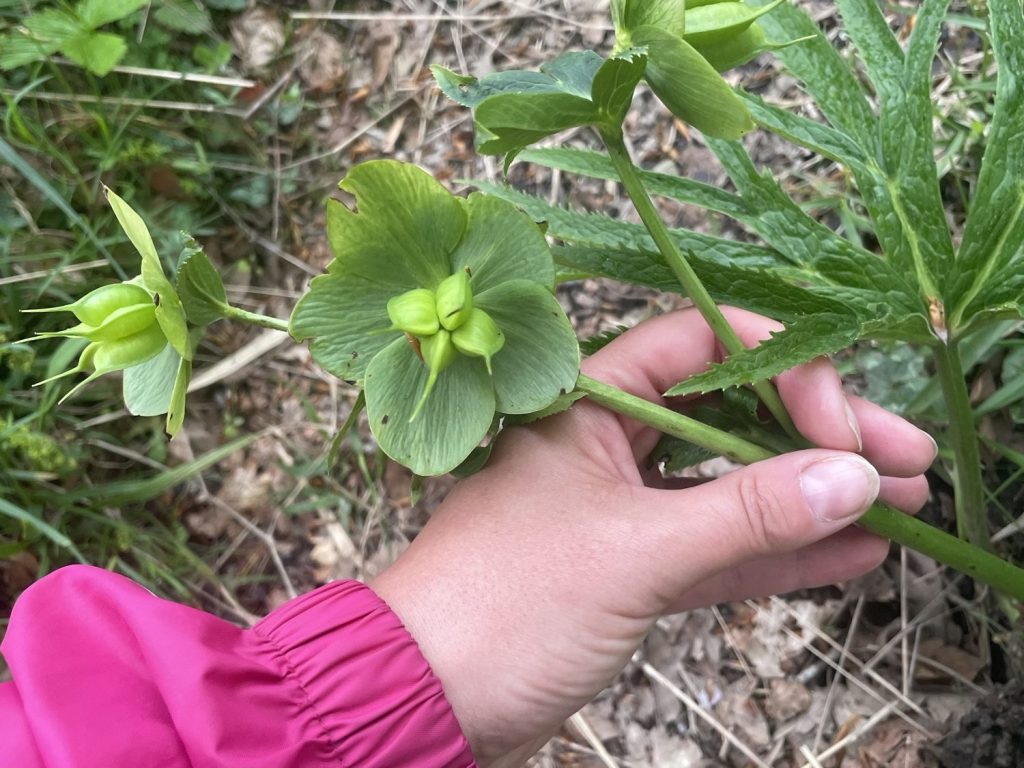
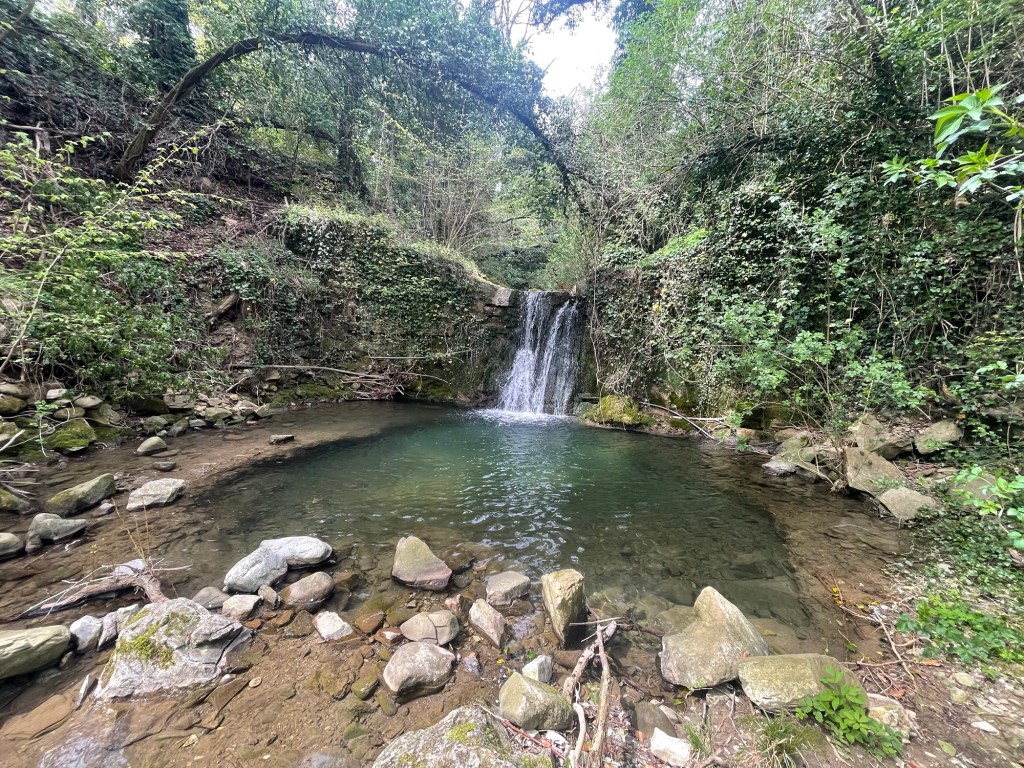
Now, as I passed a small permaculture plantation where two hippy-like women were chatting, I could hear the waterfall of Acquacheta. And then there it was: I got the first glimpse of the roaring tundra which spouted water from the top of the sky.
Dante references this impressive waterfall explicitly in the Divine Comedy. In Inferno, canto 16, he writes,
‘And even as the river that is first
to take its own course eastward from Mount Viso,
along the left flank of the Apennines(which up above is called the Acquacheta,
before it spills into its valley bed
and flows without that name beyond Forli),reverberates above San Benedetto
dell’Alpe as it cascades in one leap,
where there is space enough to house a thousand;so did we hear that blackened water roar
as it plunged down a steep and craggy bank,
enough to deafen us in a few hours.’
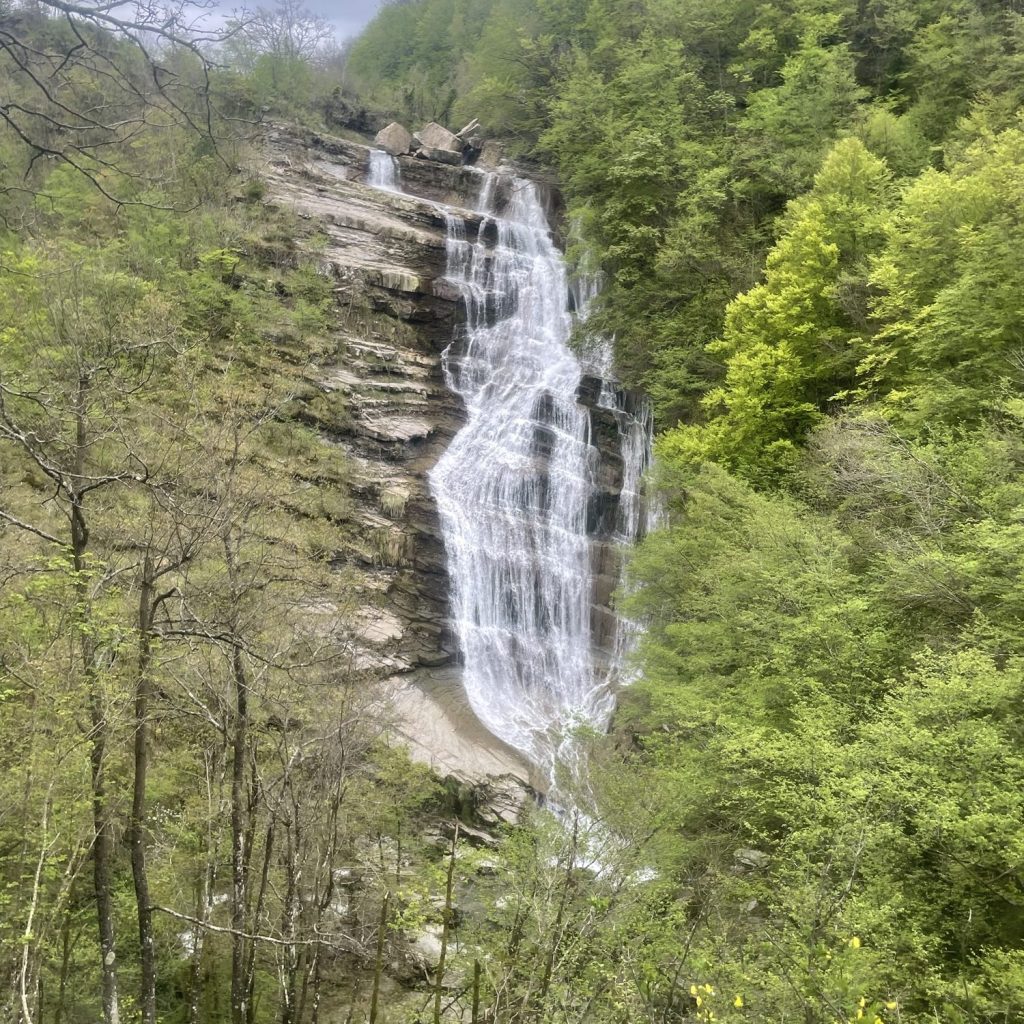
A young couple were cuddling on a bench beside the torrent and a family with two children were accompanied by a golden retriever.
‘Let’s wait for mamma,’ said one of the children to the other, ‘it’s too slippery.’
As I contemplated the abundance of water, my own tears finally came. I let gulped down sobs as I slid my feet through the boggy path.
I was alone and I realized stopping for a rest on a stone bench just how much my feet hurt. I had another bite of my sandwich. It was 4.30pm so I still had a good three hours of light. I pulled out my laptop to check where I was staying and let the happy family go on ahead of me.
Once I was back on the trail I passed another couple. A woman cried out,
‘Mamma Mia, the water shines like a crystal!’
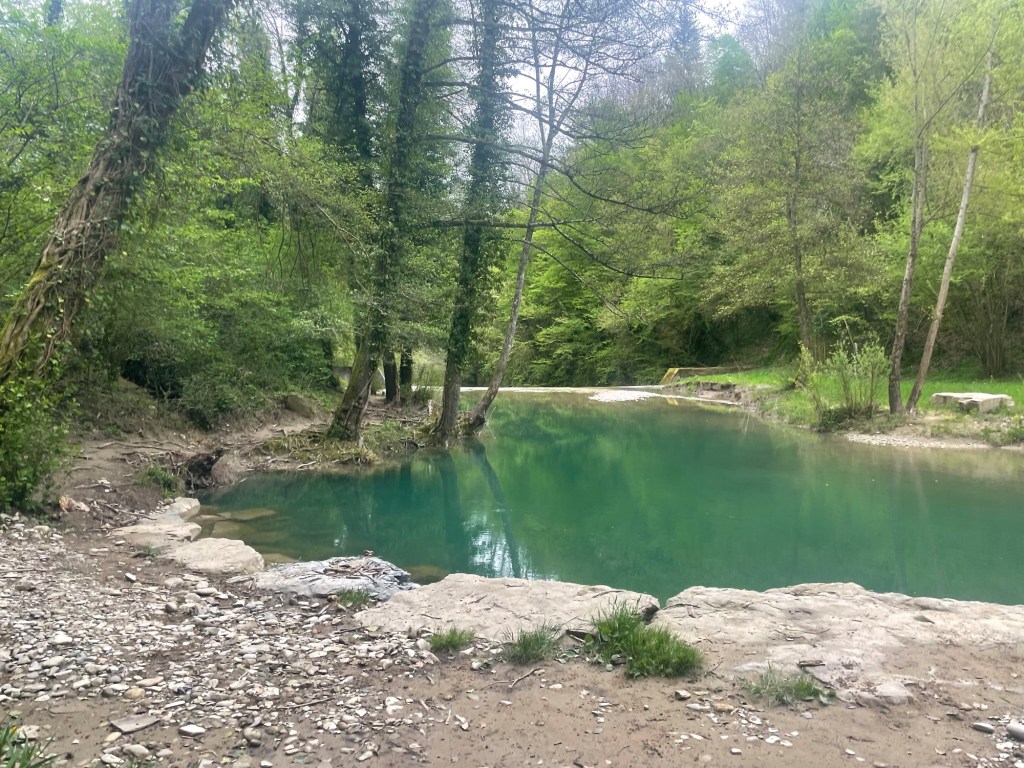
It did. At the bottom of the cascade the water collected in iridescent turquoise pools.
Each time my stick got stuck in the mud I thought of Franco once more with enormous gratitude.
Now wasn’t a good time to be alone with my thoughts and I was reassured by the cries of the children ahead. One of them had written ‘Forza Milano’ on a rock using a stone as a pen.
I passed another smaller waterfall and a refuge to my left. I was entering a zone for protected fish, a sign informed me.
I crossed two rickety bridges and tried to ignore the cramps in my feet which were becoming intolerable. I was an hour from my hostel still and the path was now largly up.
I passed a little girl with Barbie and a man on a vesper. A couple were taking a sausage dog for a walk. If they could do it, I could.
As I arrived in the village, I passed two elderly bearded men who were selling eggs and honey. I had never been so happy to see a recycling bottle bank which announced that I had made it to the town.
I passed a campsite up the windy hill and finally made it to my accommodation for the night, Ostello il Vignale. It was very basic, a room of bunkbeds with a shared old-school drop toilet and very thin blanket that would do little to keep me warm during the night.
The church bell sounded out six and with that, exhausted emotionally and physically, in the words of Dante when he is overcome in canto five of Inferno,
‘I fell like a dead body falls.’