Today’s short hike promised a rainbow but real colour came in the narrow streets of the medieval town where Beatrice’s family lived.
‘Gloom of Hell or of a night deprived
of all the stars, beneath a barren sky
Which everywhere was overcast with clouds’
With these words Dante begins the canto of Purgatorio 16. I could relate. All night, it hadn’t stopped raining and, as I opened the curtains, the grey clouds still hung in webs.
My top and bottoms had dried on the radiator, but my anorak was still slightly wet. My boots were soaked through.
Nadia had given me some sweet treats for breakfast the night before since, though it was Tuesday, today was their day off. They coordinate in the village so that no one closes on the same day.
There was no big rush to get going today since the hike to Portico di Romagna is one of the shortest of the cammino at around 10 kilometres. But still, I was a little wary after yesterday’s experience of getting lost.
I caught up with work emails, performed my usual ritual of folding my hiking socks over my laces so that they would not become untied, and by 11am I had set off into the spitting rain. I stopped briefly at a panettiere – bread shop – and bought a slice of vegetable pizza to complement my sweet breakfast, breaking the hard and fast Italian rule of not eating on the move.
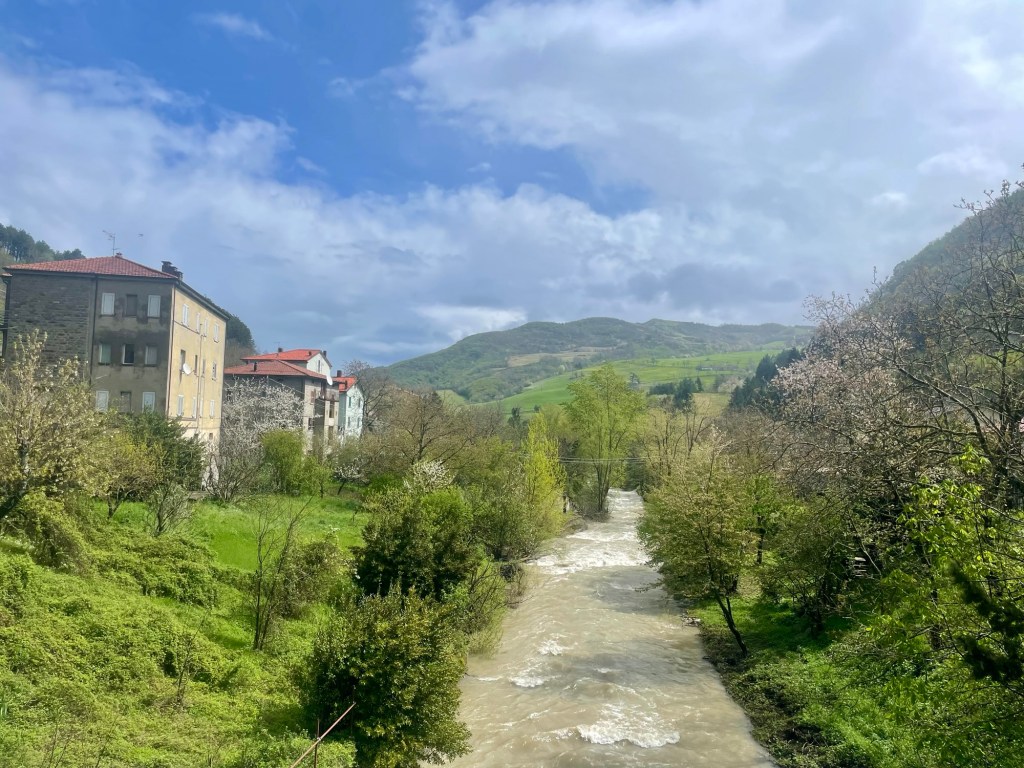
By the time I exited the town over the bridge, the rain had eased off a bit and sunlight was pushing through the clouds. In Canto 17 of Purgatorio, Dante makes a similar observation on the particular microclimate of the region, writing,
‘Remember, reader, if you’ve ever been
caught in the mountains by a mist through which
you only saw as moles see through their skin,how, when the thick, damp vapors once begin
to thin, the sun’s sphere passes feebly through them,
then your imagination will be quick’
It was. I scanned 360° for a rainbow but was left disappointed.
As I made the ascent, I thought of the line from the film Forrest Gump, ‘I’d never seen so many shades of green until I went to Vietnam [insert Premilcuore].
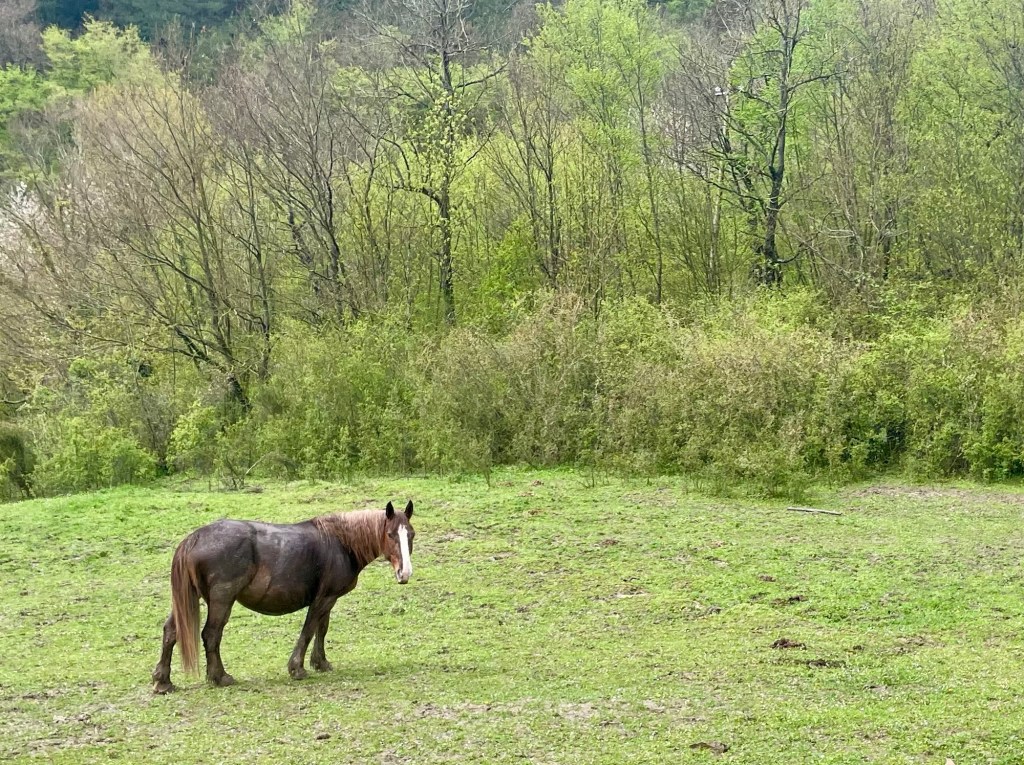
To my left were horses with bells tied around their neck nodding in the rain, their mains slick to their necks.
There was something in the rolling hills of the Lake District in my native England as I looked back down towards the town.
A brown spider the size of my little fingernail crossed the path.
The concrete way had foot and paw prints cast into it, reminding me of the concrete in my garden back home. I’d have to do something with it upon my return. I thought of my Great Aunt Lena who in her older age would still bend forward with a butter knife to tease the weeds out from the cracks.
The path transitioned to tarmac which was coated in petals that had been cast into the air like confetti at a wedding. Some of the blossom had caught on the needles of the pines, embellishing them like Christmas trees.

It felt strange to be walking along the path strewn with the petals. I was reminded of my wedding to my former husband which had taken place in Port Meadow, Oxford. I had been an excellent bride, but a terrible wife, though I still have fond memories of the day which was themed around love art, and revolution. I had shown Alina some pictures two days before. She had complemented my mother’s sewing work on the dress I wore in the engagement shoot in Wadham College gardens.
Here the path turned to mud with a little strip of green running down the middle, riddled with an abundance of rust-coloured pinecones. Encroaching at the sides were imposing, prickly trees. I thought of the aide-memoire I’d learnt to identify plants in the White Mountains – ‘spiky, spruce; friendly fern.’
I suddenly realized that with the rain had come the absence of lizards, bees, and butterflies and I missed them.
I was feeling tired, achy and nostalgic.
Dante, like me, had not suited married life, though for him it had been more of a familial negotiation rather than anything to do with love. When he was exiled, it is said his wife Emma Donati would cry in the streets where she was left behind with her children. Dante, on his travels, continued to pen poetry to his one true love, Beatrice Portinari.
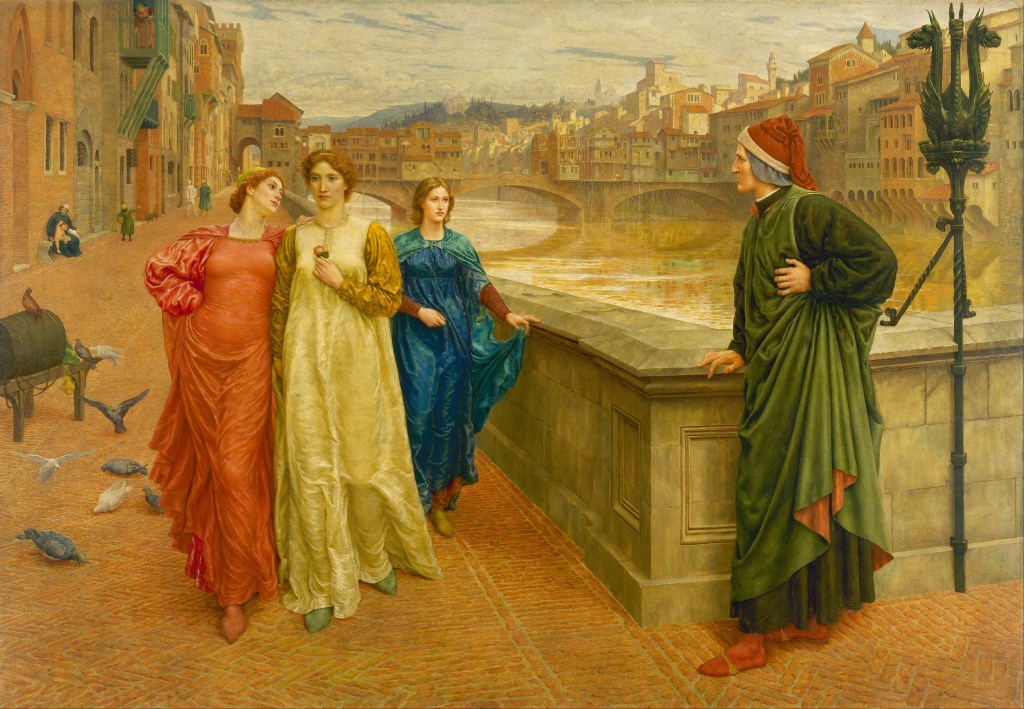
An ancient legend goes that Dante met Beatrice in Portico di Romagna where her family owned an estate, though Dante himself writes that he first saw her as a girl and then when she was 19 in Florence on the Santa Trinità bridge. This image was rendered immortal by Henry Holiday in 1884.
Dante’s treatment of women in the Divine Comedy is proto feminist. Although they rarely speak, he was one of the first writers to document the lives of women in Medieval Italy at all and he depicts them in various roles: as victims of domestic violence, harlots and saviors. The fact that he was guided in Paradise by a woman was revolutionary and, though she is put on a pedestal, she is also ‘real’. She chastises Dante for his sins and baulks at him for not listening attentively to her philosophizing.
Another woman, Mathilda, is given the task of baptizing him in the river before he can enter the Earthly Paradise at the top of Purgatorio. For the umpteenth time, Dante passes out, and when he comes to, Mathilda is reviving him in the river Lethe. Some people believe Dante may have had a condition like epilepsy or narcolepsy because of how many times he passes out, and how realistic his descriptions are of coming back to himself.
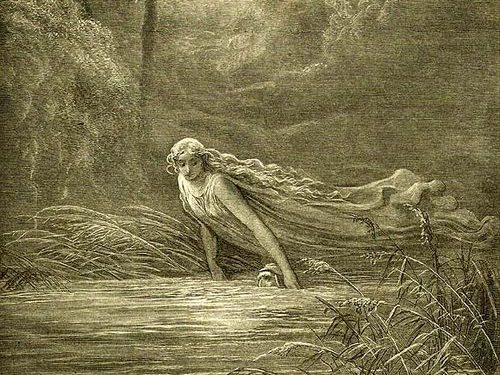
Mathilda has been compared to a priestess, although the Roman Catholic Church forbids women from being ordained as priests. Dante confesses to having erotic feelings for her however she quickly assumes the role of teacher and sister-in-Christ to Dante when she scolds him and refers to him as frate, or ‘brother’. Mathilda, far from being a romantic interest for Dante, demonstrates the brotherly love found between the blessed souls of Paradise.
This representation of the Beatrice and Mathilda is foreshadowed by Dante in Canto 27 where he has his character dream of Leah and Rachel, Mathilda and Beatrice’s biblical counterparts.
The issue of women was in my mind today as the UK Supreme Court made a controversial and cruel ruling to deny rights to trans women by deciding that the legal definition of women in the Equalities Act only relates to biological sex. I messaged my trans friend Andie back home to see how she had received the news.

‘I’m terrified,’ she replied. ‘I can’t change – I’ve come too far. But had I not come out in 2017, I wouldn’t come out in today’s climate. How fucking sad is that?’
To the right the slope was precipitous. A blister at the top of my middle toe pushed painfully against the inside of my wet shoe as I kicked conkers along the trail that had fallen from the horse chestnut trees. As kids, my brother and I had tried all sorts of tactics to try to strengthen them so that we might compete with them honorably in the playground: baking them, freezing them, soaking them in vinager. How did we play? Well, you would thread a string through with a needle and then compete to crack open the opposing party’s conker. It was good, honest fun, but fun that had been banned in my Middle School on health and safety grounds.
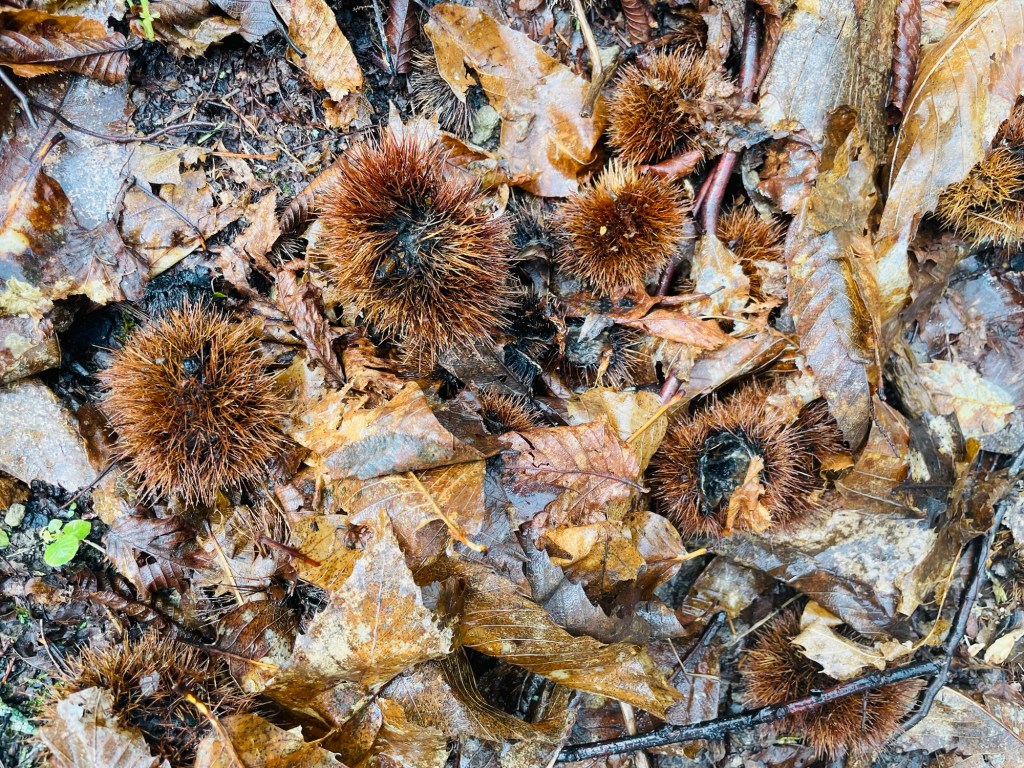
Their cases lay split open like sea urchins on the ground.
The air was fresh and my spirit lifted.
Now that the path was easy to follow and I knew the day was short, it was fantastic to be outside alone in the forest. With absolutely no one around, I listened to some music on my phone which was tucked into my pocket – the Italian composer Einaudi’s album, Seven Days of Walking.
Needles from the pine trees reminded me of another childhood game, pick-a-sticks, where you’d let a tray of thin sticks go from your hands and then try to remove them from the pile without disturbing the others. There was a version at Anna’s house Air B&B in Castel San Niccolò , but Alina and I had been too tired to play.
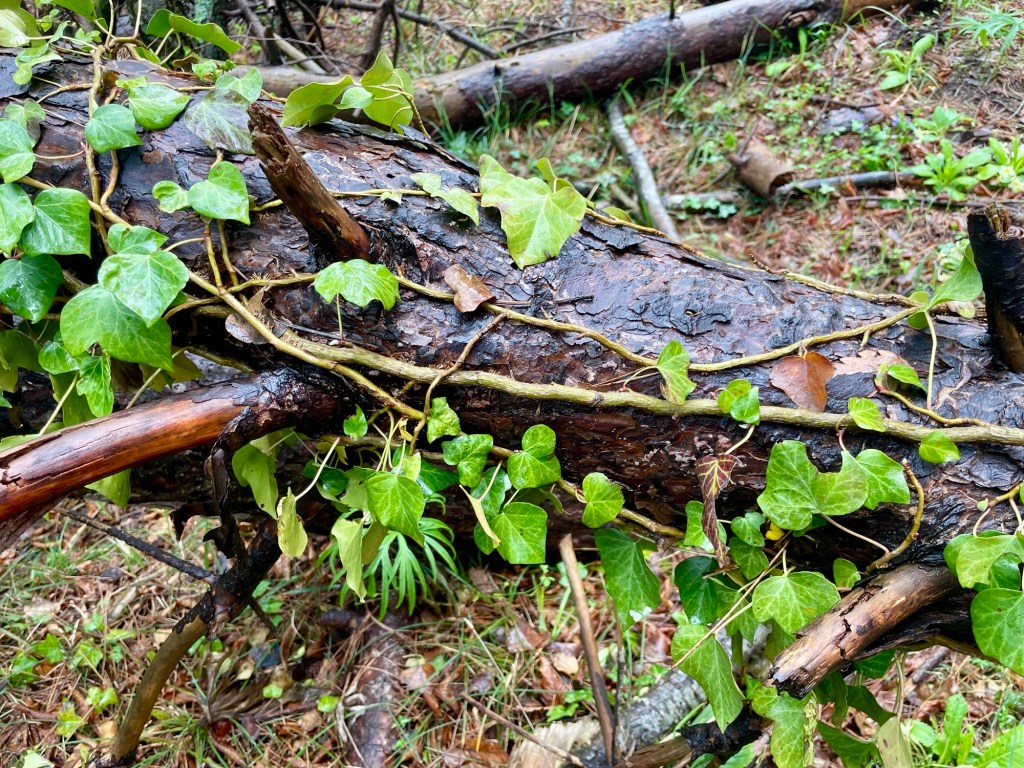
A tree which had fallen down was consumed by ivy which threaded tightly around it like the serpents who take over the souls’ bodies in Dante’s circle of the thieves.
A cuckoo sounded like a hollow wooden wind instrument
I walked downstream tentatively over the slippery lime, disturbing several boulders. I was still cautious after yesterday’s fall, though I was relieved to see that my arm had not come out in a bruise.
As Dante writes of him and Virgil in canto 12 of Inferno,
‘And so we made our way across that heap
of stones, which often moved beneath my feet
because my weight was somewhat strange for them.’
Unlike the other souls in Hell who are bestowed with the quasi-Foucauldian invention of ‘aerial bodies’ that can experience pain while exerting no weight, Dante, the living pilgrim, also disturbs the land around him.
Now it was raining in earnest but not quite so hard as yesterday. The sun still couldn’t make up its mind. I kept my hood down, enjoying the pitter patter of raindrops on my forehead.
A small brown bird chirped alone on an electric wire and something like bulrushes lined the little stream to the left of the path.
I was starting to enjoy my own company.
And with that, the sun exploded out.
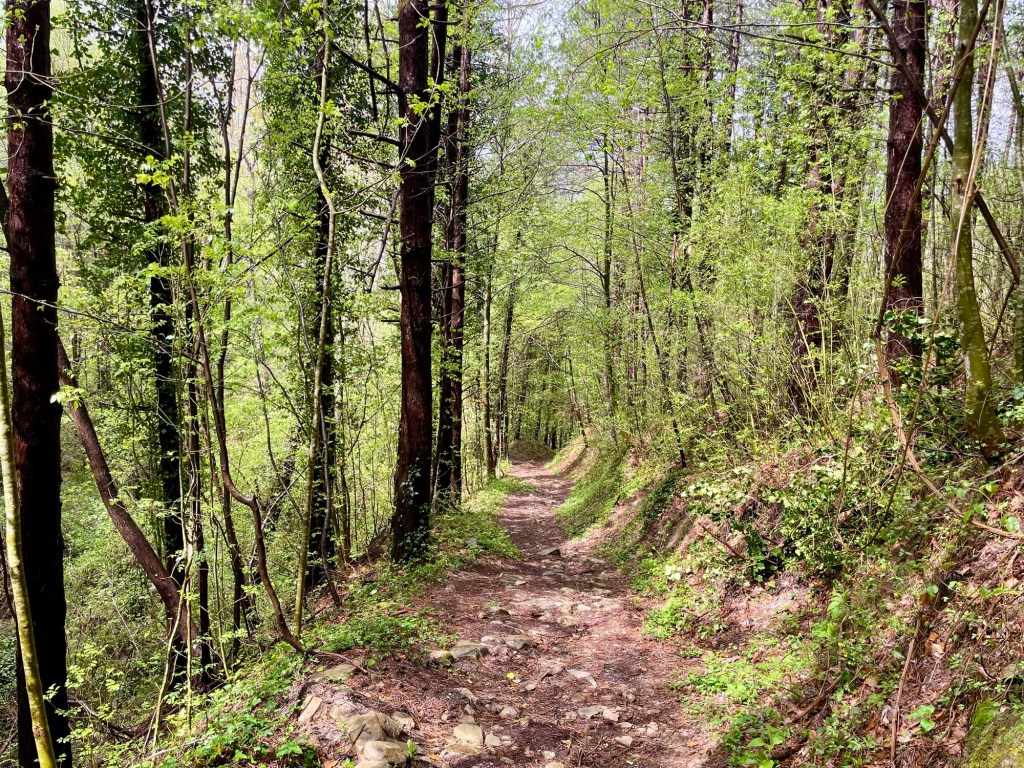
I was so happy to see the sun again that I stopped to nibble on a pistachio and chocolate biscuit. A bee puffed past like a yellow pom pom; a tiny beetle the size of a penny coin climbed onto my rucksack, iridescent.
As I descended into Portico di Romagna, a range of stark orange tubes cut into the earth to channel the stream, the mark of humans interfering with the landscape to try to master the ubiquitous water of the region.
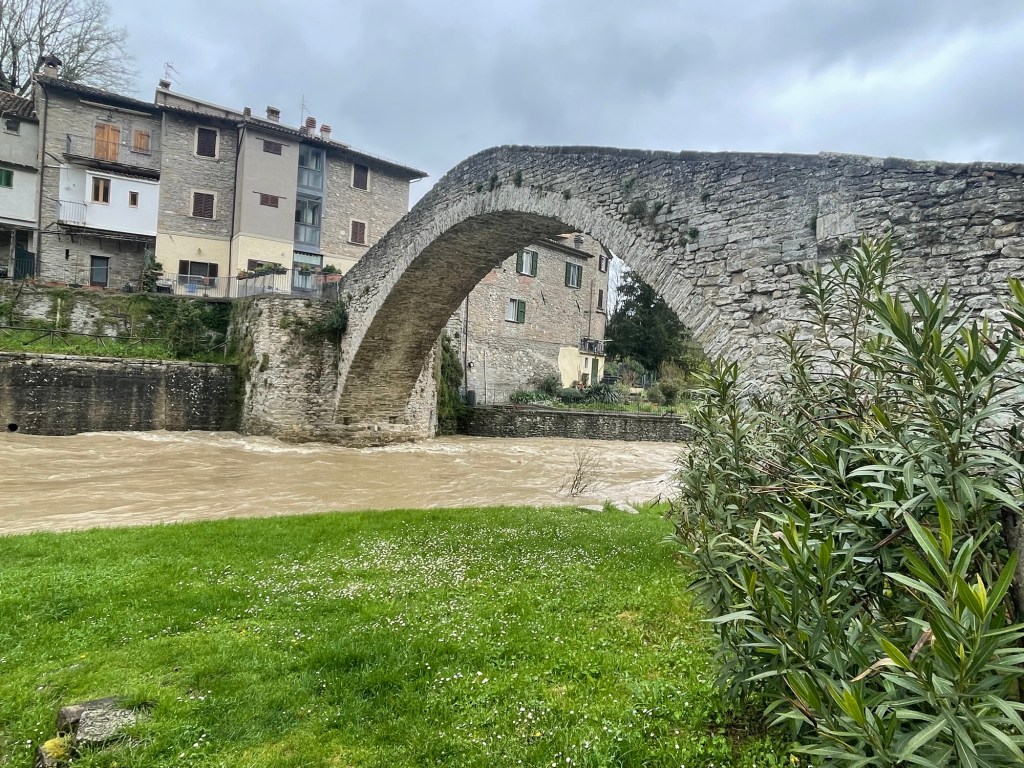
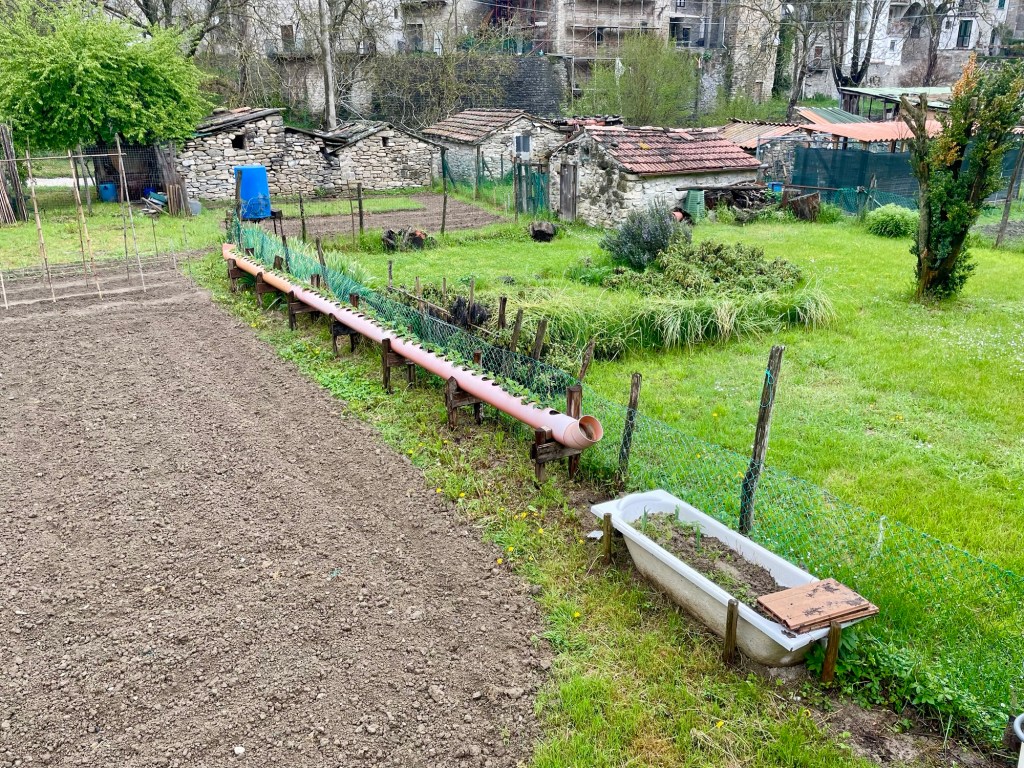
Before me lay a beautiful scene. A medieval arched bridge framed a permaculture plantation in which herbs sprouted in a bathtub and old pipe into which holes had been drilled. A tortured vine hanged from a scaffold. Something of the scene reminded me of Hebden Bridge.
The river ran ferociously in rapids from all the recent rainfall. It was a sandy brown, coloured by silt.
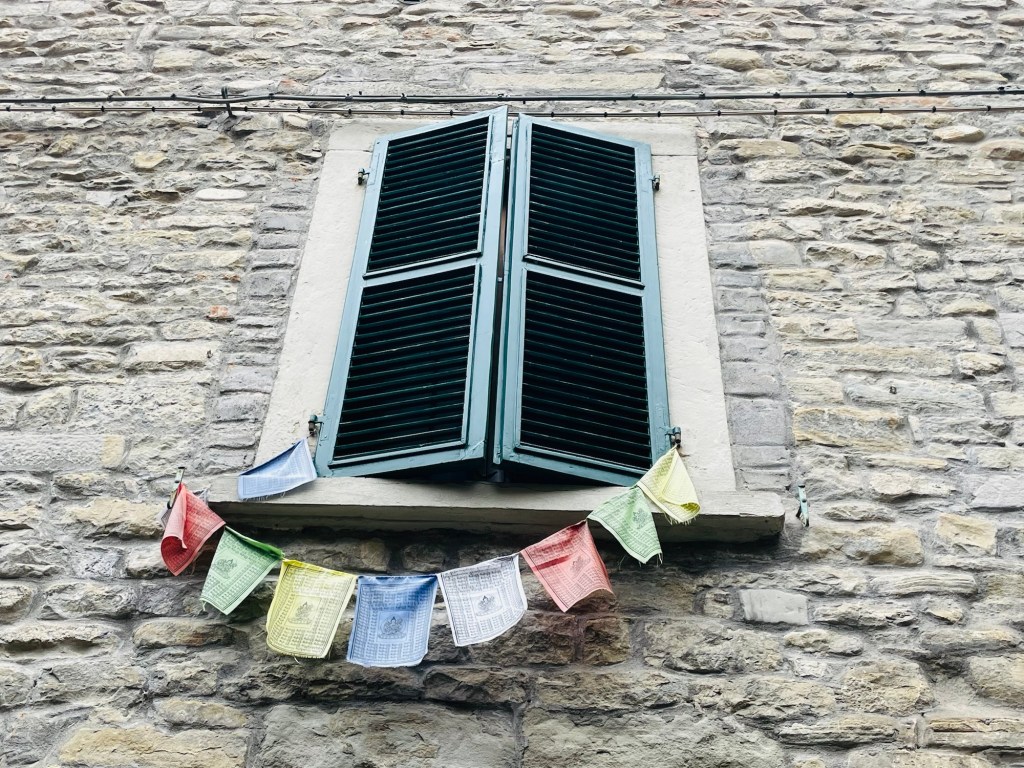
As I followed the steep street as it winded upwards, I was rewarded with the sight of flower boxes bursting forth with tropical plants which were clearly happy in the wet, temperate climate: bromelias, calla lilies and ferns. There were painted pebbles and succulents planted into tree barks. Someone had posted poetry on their door, another had hung Nepali prayer flags from their window.
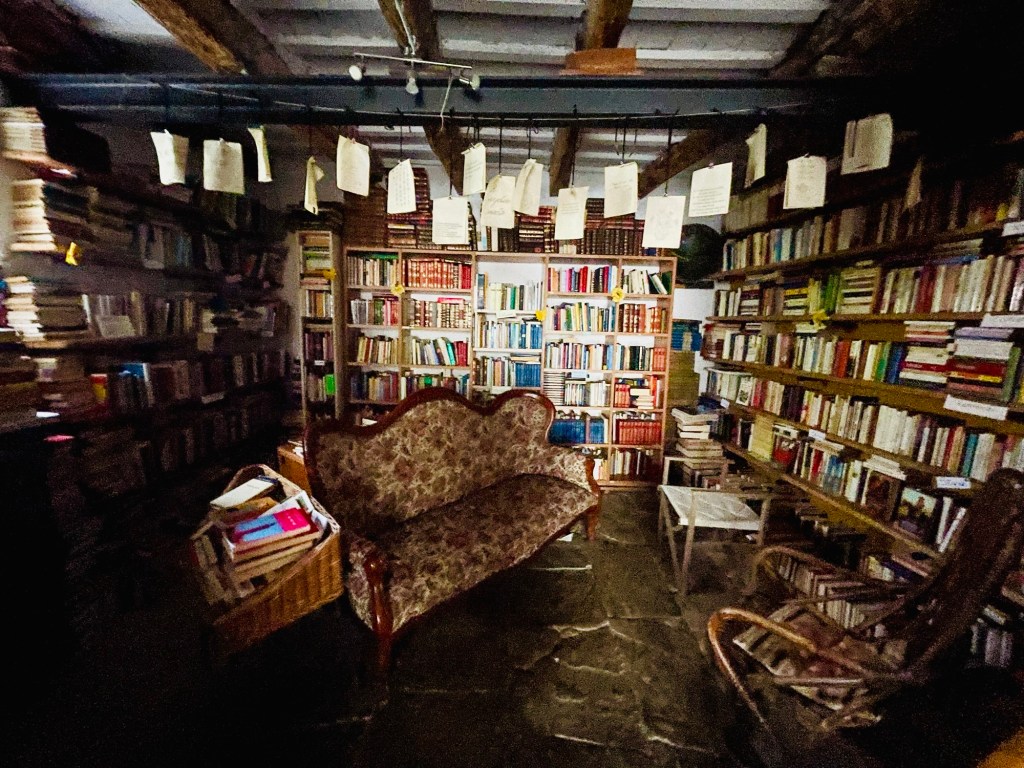
Around the corner, just before the central arch, there appeared the jewel of the town, the amazing ‘Libri Libreria’ or ‘free book bookshop’. Though I knew I couldn’t carry the weight of a book, I couldn’t help but go in. The walls were lined with all manner of tomes. Comfy antique sofas and strings of poetry made for a welcoming environment.
I rounded the corner and took a coffee in a bar in which a group of men, all wearing flat caps, were playing at cards. They were waving their arms around in the passion of the game. A younger man with a broken arm sat outside smoking. He was chatting to a man in an orange waterproof with a walking stick.
Lisl, the bar owner, told me there were two English couples who lived in the town who usually spent their evenings there. For her part, she told me she was from the Philippines. She offered to make me a sandwich for tomorrow’s hike.
‘I could live here,’ I thought.
I saw the longest worm I’ve ever seen as I walked down to the B&B, the Molino di Sopra. Next to the house, the river had burst its banks and was straying onto the lawn. I was reminded of the great Florentine flood of 1966 which killed 101 people and damaged or destroyed millions of masterpieces of art and rare books, including Ghiberti’s famous bronze baptistry doors which were rescued and given sanctuary in the Duomo museum. The doors you see in the city today are replicas.

There was a big pile of logs stacked outside. This is the nature of the region, wood everywhere: wood and water.
My hosts for the night, Orlando and Cinzia, were incredibly welcoming, inviting me to dry my wet clothes by the fireplace and showing me up to the modern two-story apartment with a bed at the top and a view of the river. They’d already heard of me and my journey from my blog. When I handed it over, even my passport was sodden.
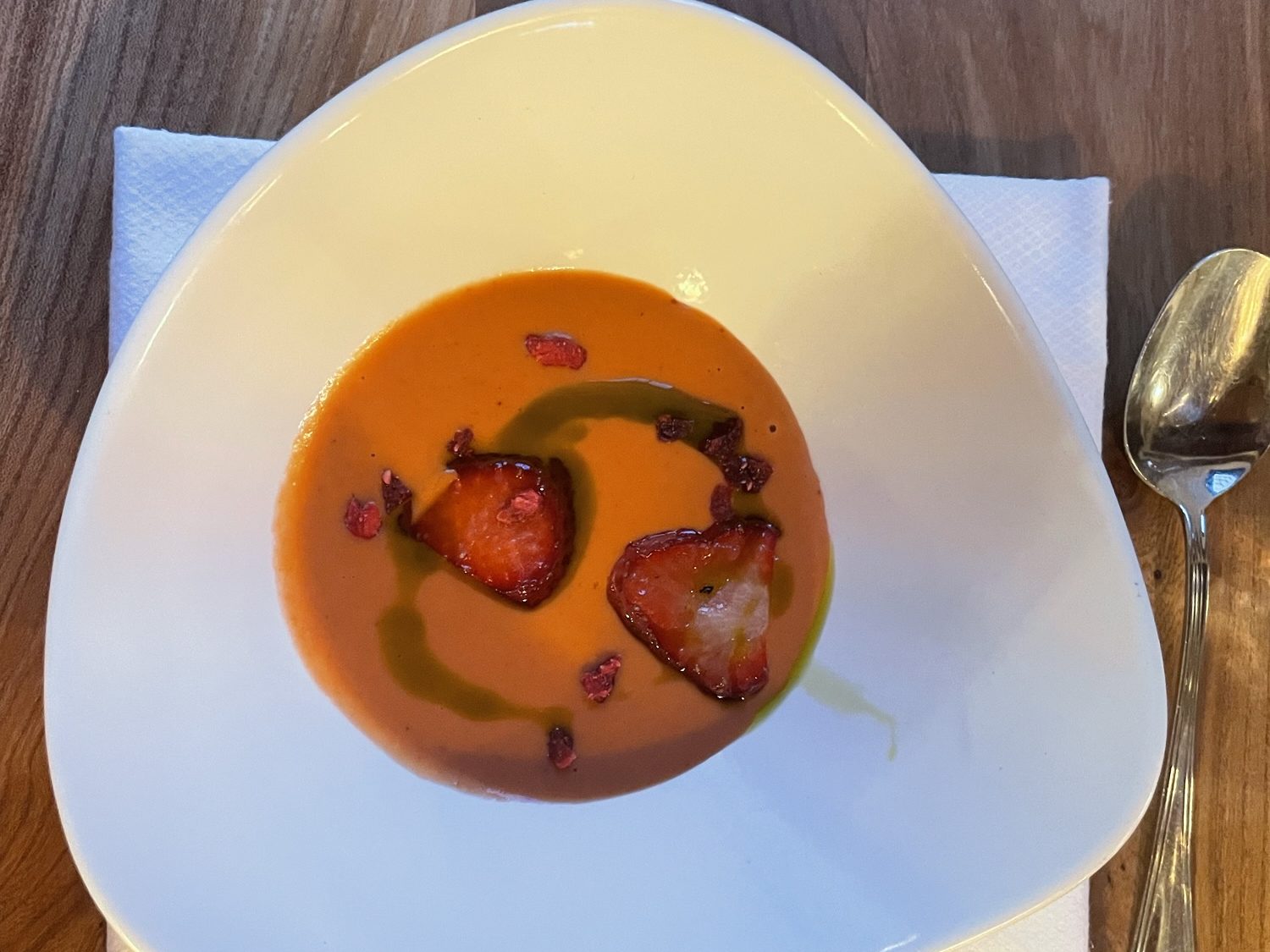
At 7.30pm I headed out to the only local restaurant, Il Vecchio Convento – The Old Convent, where I dined surrounded by orchids on an exceptional and somewhat extravagant set menu which included, among other things, strawberry gazpacho and wild rocket and carrot pesto gnocchi which were perfectly pan fried, like scallops.
Despite the fancy environs I was eager not to miss a bite so I ‘did the scarpetta’, the act of circling your plate with a piece of bread to absorb the remaining scraps and juices. The plates were flat with raised edges like the ones my friend Carly makes back home and my knife and fork came with a little raised plate to perch them upon. Lounge jazz played in the background.
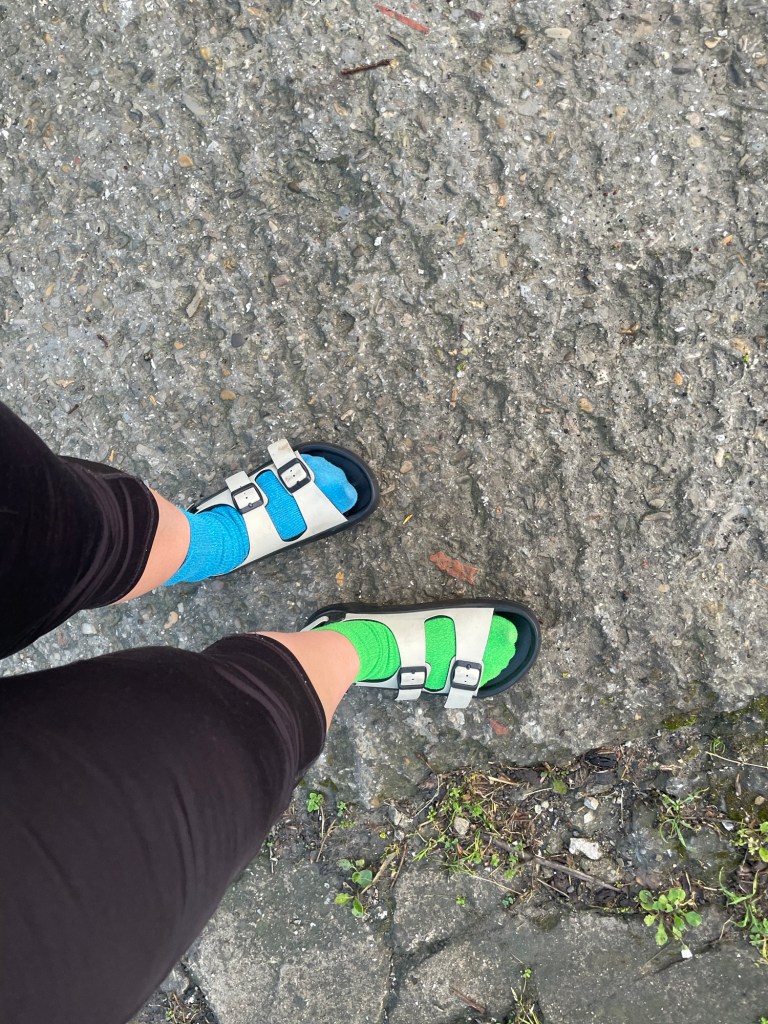
I felt underdressed in my hiking gear. At least I had put on, with my sandals, Alina’s glittery mismatching socks.
‘See,’ she later wrote to me, ‘they’re not that impractical after all!’ She also sent me a video she had made of our trip which nearly made me cry.
I was tempted to go back to the bar to meet the English locals but I was tired and had a long day of walking ahead and so I carried on back to the B&B beneath a night sky which was now strewn with stars. Finally, the cloud had lifted, and as Dante writes at the end of Inferno,
‘thus, we departed to see once more the stars’.
I stopped a while to contemplate the Big Dipper and Orion’s Belt and listen to the roar of the river.
Recommended Listening: Einaudi, Seven Days of Walking https://en.wikipedia.org/wiki/Seven_Days_Walking
Recommended Viewing: Forrest Gump: https://www.imdb.com/title/tt0109830/
