Tag: poetry

  • A Mosaic of Colour: Ravenna

    I felt immediately at home in Dante’s city of exile, but the most special encounter came in the form of the hospitality of Oliver, our new guide.
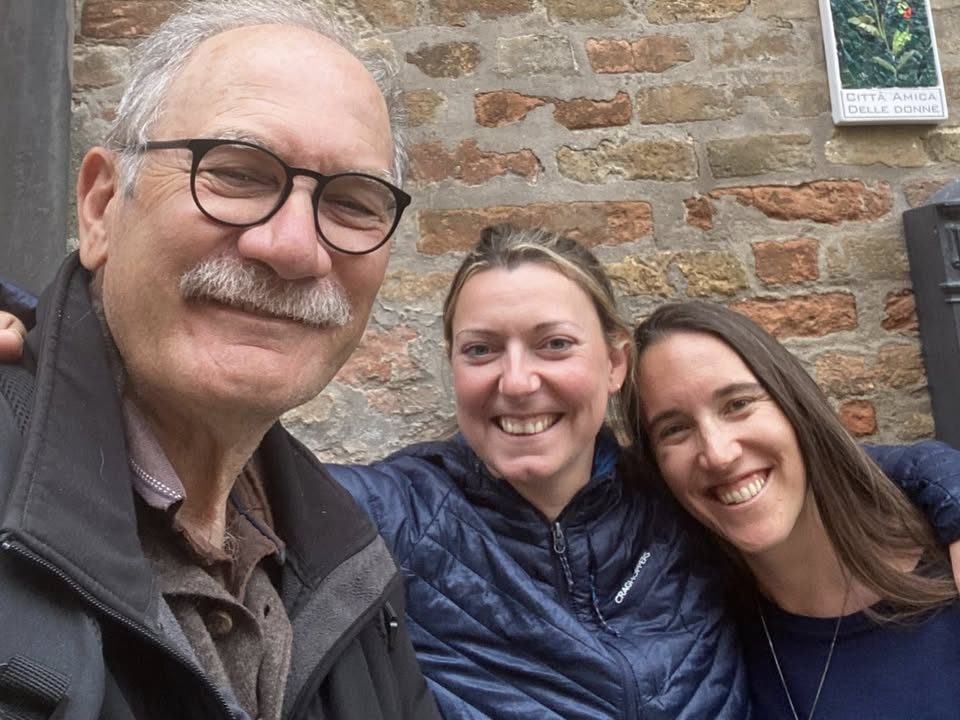
    I had had the fortune to visit Ravenna on two previous occasions, once on a road trip with my University friends Tor, Martin and Will, and once to give a lecture at the University of Bologna. Ravenna is known as the city of mosaics and, as a mosaic artist myself, I had felt immediately at home in the city. This personal feeling of sanctuary came flooding back as I wondered the streets.

    On every corner are little mosaic plaques that depict flowers and announce,

    ‘Ravenna, city friend of women’. 

    Though they are never explicitly cited, it is said that the Byzantine mosaics in the church complex in Ravenna (Ravenna has some 200 churches) inspired Dante’s Paradiso which he completed in exile here.
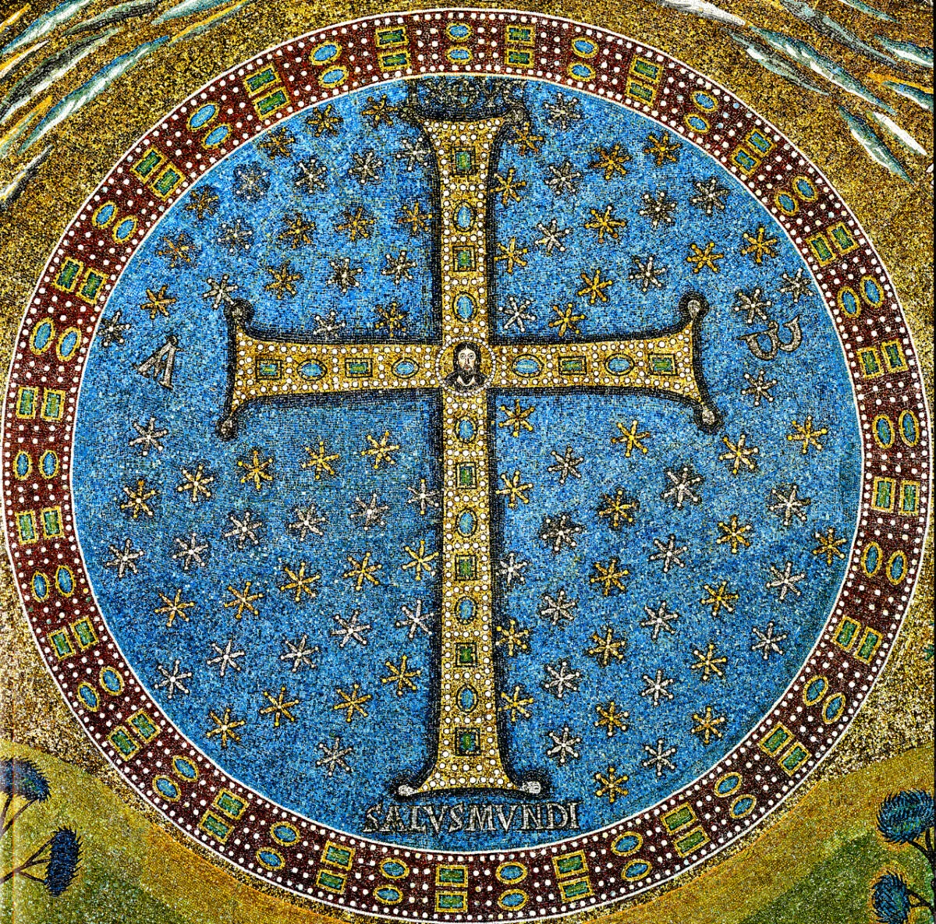
    Among the depictions that one can most easily recognize in the Dantean text is the mosaic in the apse of Sant’Apollinare in Classe which contains a sky dotted with 99 golden stars and a gem cross, in the center of which it is possible to see the face of Christ. In the 14th canto of Paradiso, the souls who welcome Dante arrange themselves in the form of a cross, with Christ placed in the centre:

    ‘As, graced with lesser and with larger lights
    between the poles of the world, the Galaxy
    gleams so that even sages are perplexed;

    so, constellated in the depth of Mars,
    those rays described the venerable sign
    a circle’s quadrants form where they are joined.

    And here my memory defeats my wit:
    Christ’s flaming from that cross was such that I
    can find no fit similitude for it.

    But he who takes his cross and follows Christ
    will pardon me again for my omission—
    my seeing Christ flash forth undid my force.’

    In the 10th canto of Paradiso, meanwhile, Dante encounters a group of blessed souls who surround him and his celestial guide, Beatrice, forming a crown of twelve. A second crown of twelve souls joins them in canto 12, which moves in coordination with the first.

    And I saw many lights, alive, most bright;
    we formed the center, they became a crown,
    their voices even sweeter than their splendor.’

    It is said that this image could recall the two domes of the Neonian and the Arian baptisteries, where the twelve apostles are depicted in a circle.

    It is also possible to imagine that Dante was inspired by the beautiful portrait of the Emperor in the Basilica of San Vitale. Paradiso 6 tells the history of the Roman Empire which Dante viewed as part of the divine plan of Christianity. Justinian has a prominent role. Indeed, the political sixth canto is dedicated to him:

    ‘Caesar I was and am Justinian,
    who, through the will of Primal Love I feel,
    removed the vain and needless from the laws.’

    The Procession of Virgins and Saints depicted in Sant’Apollinare Nuovo may also have informed his description of the grand procession that heralds the arrival of his Beatrice in the Earthly Paradise. 

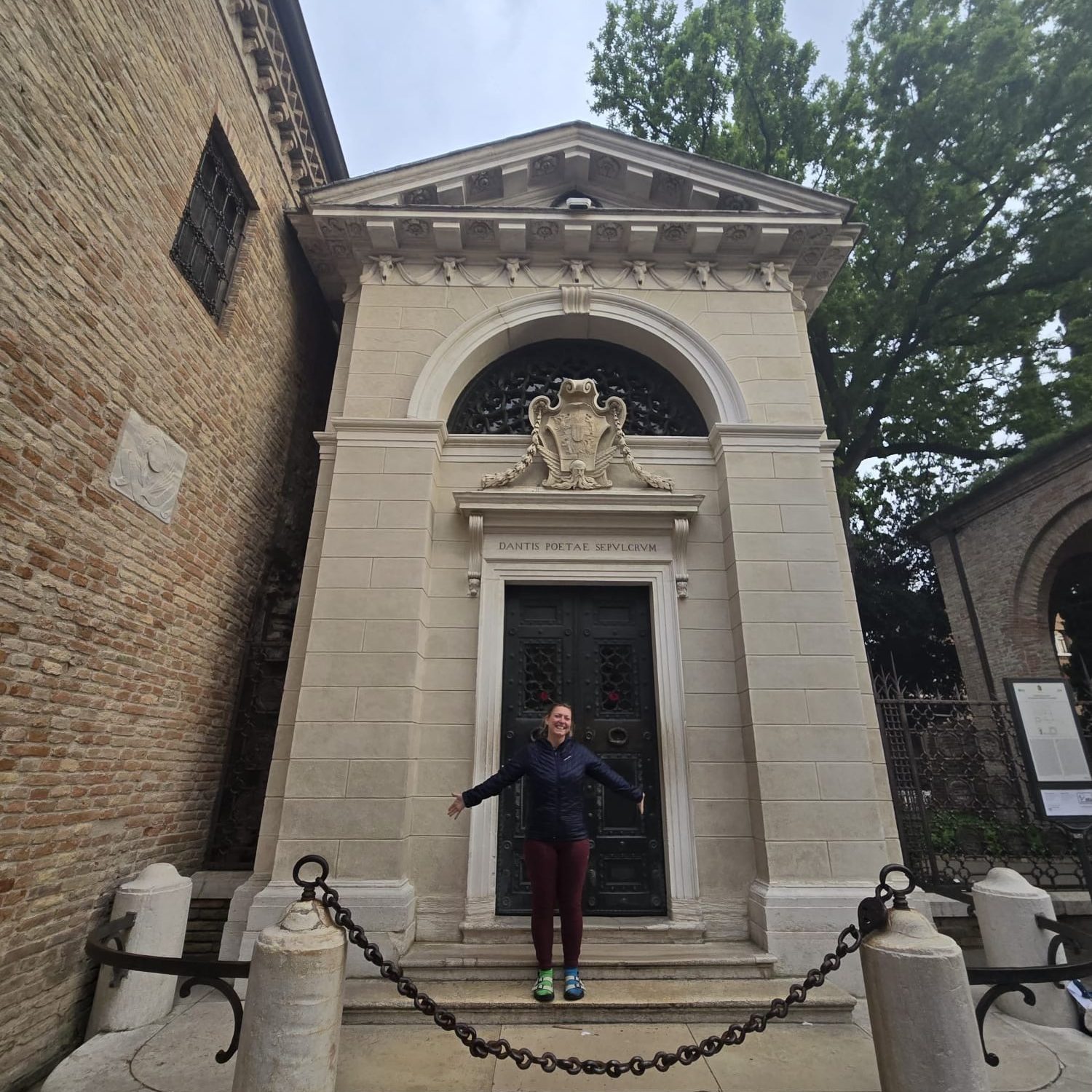
    I left Kelsey to explore the mosaics and caught up with some work during the day before meeting with the current president of the Association of the Cammino di Dante, Oliviero Resta, known to friends as Oliver. We had an appointment outside the tomb of Dante at 5pm. 
    Oliver is unassuming with his bushy moustache and two pairs of glasses, a contrast to the exuberant personality of Giordano, the founder of the trail, with whom who we had had the honour to spend the previous evening.

    His quiet presence is fatherly and reassuring and, once again, I had the feeling that I had met a kindred spirit.
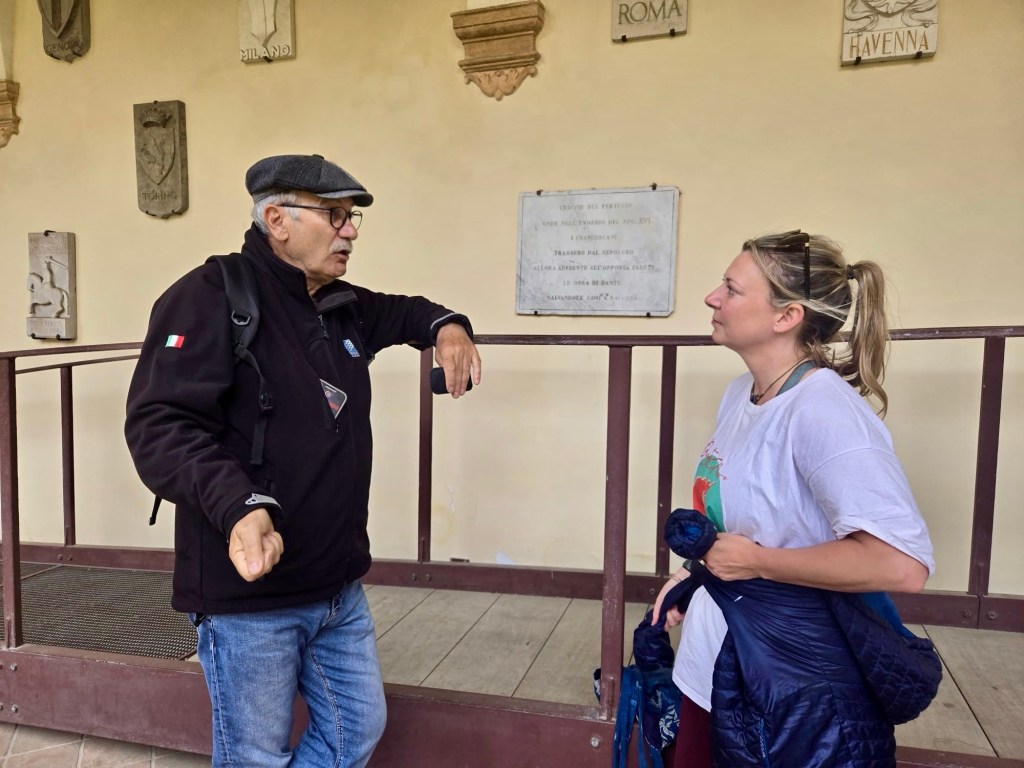
    That evening and the next day, Oliver was a host with the most.

    The first evening he showed us the house said to be home to Francesca di Rimini who is memorably depicted with her lover, Paulo, in a whirlwind of lust in canto 5 of Inferno. She is accompanied by Helen of Troy and Cleopatra. Her lyrical lament is among one of the most beautiful parts of the Divine Comedy,

    ‘Love, that releases no beloved from loving,
    took hold of me so strongly through his beauty
    that, as you see, it has not left me yet.’

    I recalled how when I had given my lecture on young refugees in Ravenna, two students in the front row had cried at the love story of Alim who, after being deported to Afghanistan from Leicester at the age of 18, had returned two years later only to find that his beloved had moved on and shacked up with his best friend. 

    As Dante says,

     ‘Alas, how many gentle thoughts, how deep a longing,
    had led them to the agonizing pass!’
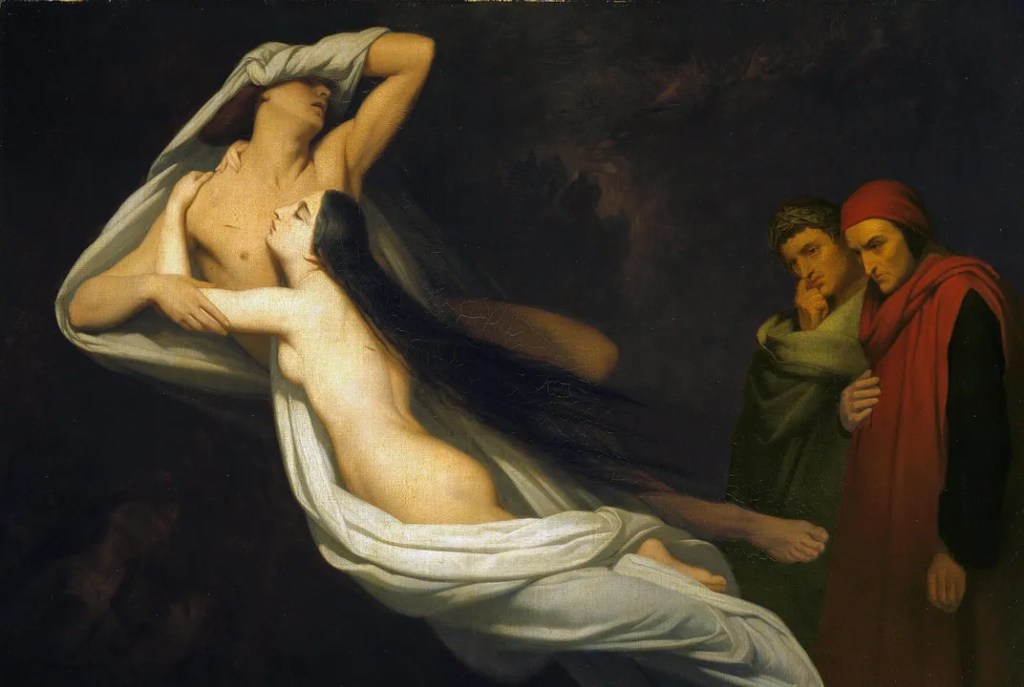
    The emotional and relational lives of refugees is a topic long ignored in contemporary scholarship. Dante helps to set the record straight that refugeehood can be a sight of lust and longing. 

    Oliver took us through the winding streets to see the Basilica which hosted Dante’s funeral. There were signs of the spectacular mosaic floor of the ancient church beneath the foundations which now, quite strikingly, housed a shoal of goldfish. 
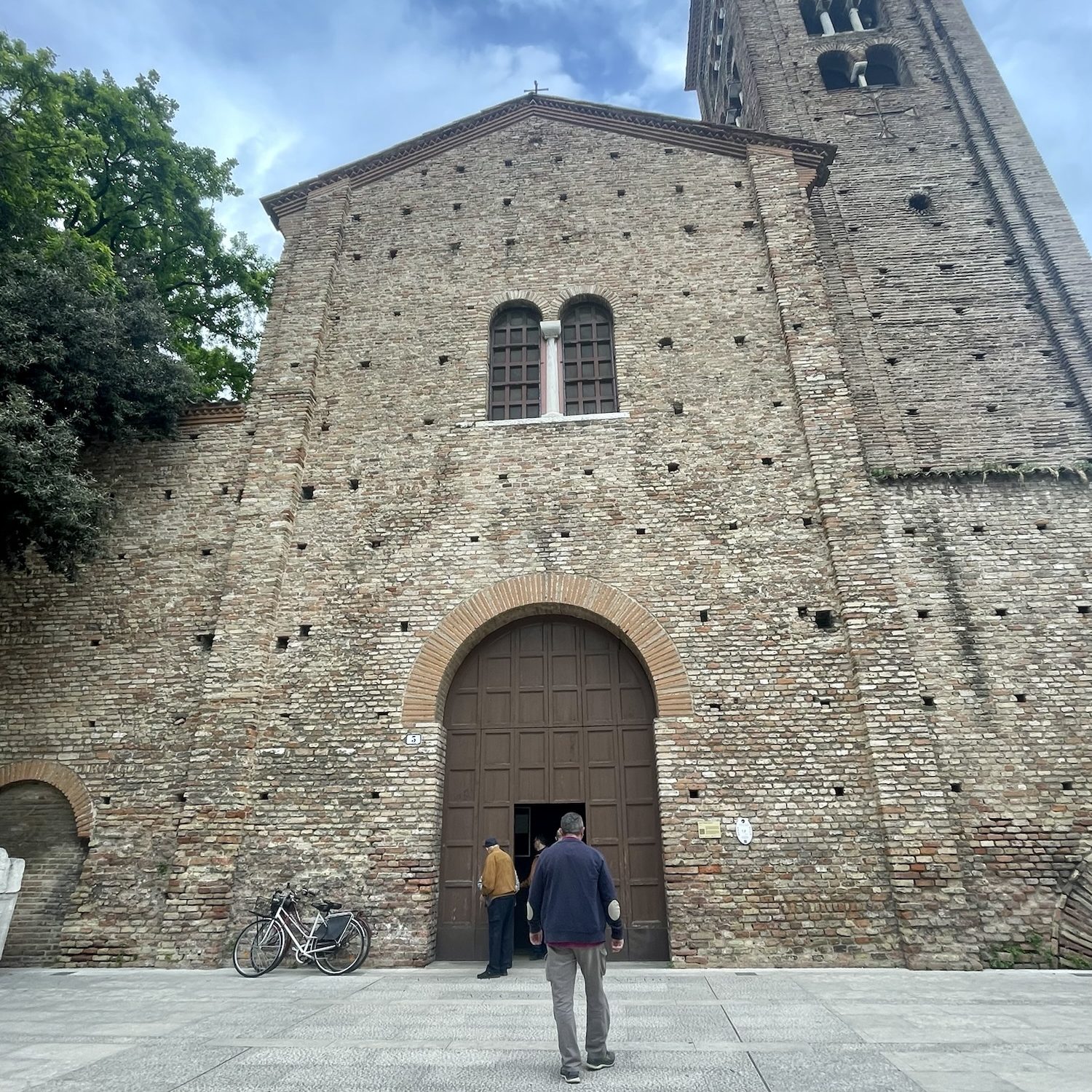
    At 6pm we returned to Dante’s tomb where there takes place, every day, a reading from the Divine Comedy. A crowd of about 50 people had assembled there to hear two women recite a canto from Purgatory. The tomb itself was constructed by Camillo Morigia between 1780 and 1782.

    We saw the hole in the wall where Dante’s bones had been hidden by Franciscan monks in 1810 to prevent them being claimed back by Florence. They were found by chance in 1865 and returned.

    Dante’s bones were once again buried in a secret place during the Second World Rar to protect them from bombardment by the Nazis. A plaque memorializes this event.
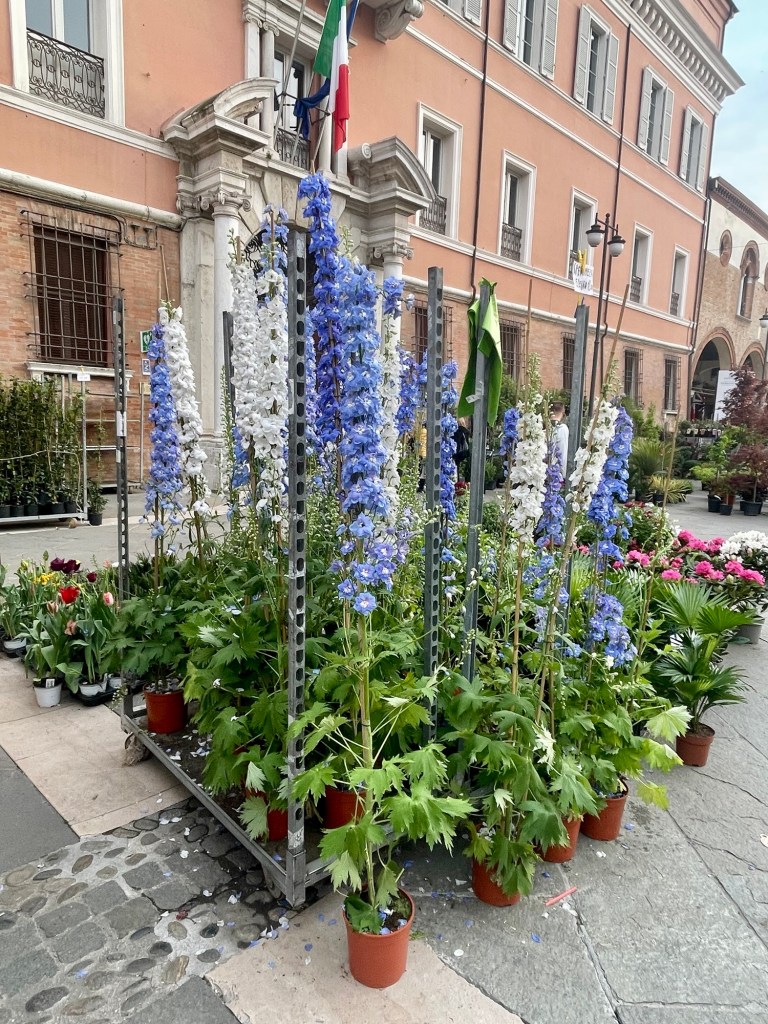
    In a pretty market in the square there was an exuberance of flowers and artisanal wares. I bought Kelsey a hand-whittled honey scooper.

    ‘I’ll think of you when I eat my honey,’ she said. 
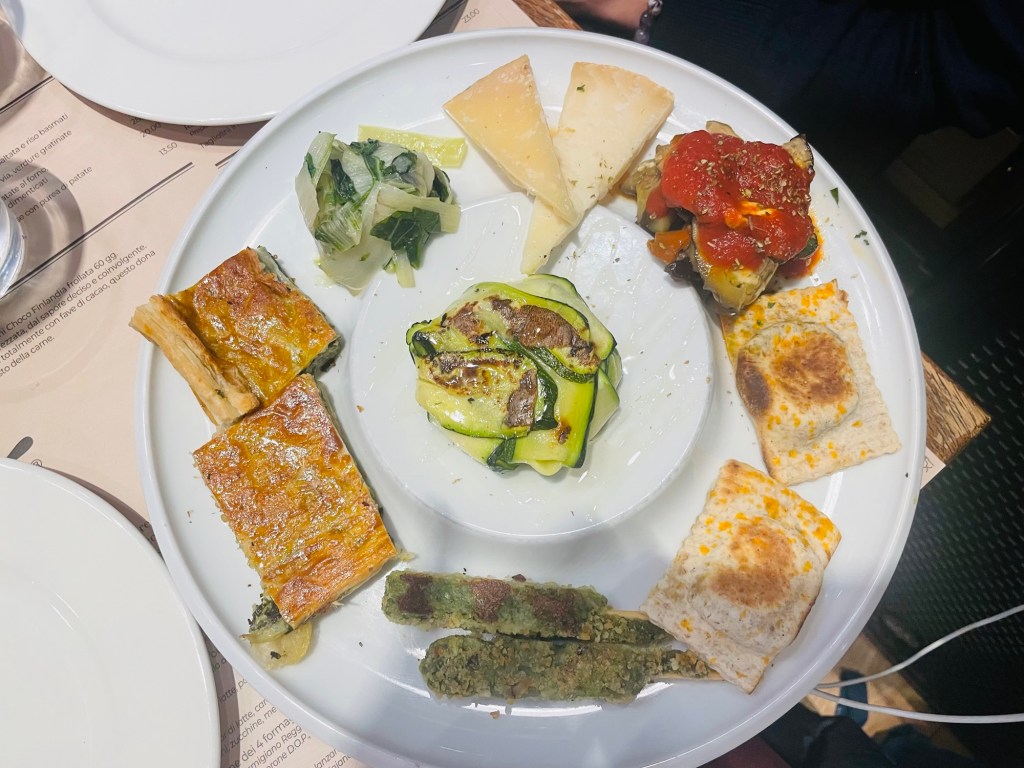
    That night we dined at Passatelli  which since 1962 has been serving delicious local fare in a converted old cinema. We ate all local food including passatelli, a thick pasta that resembles a maggot but tastes anything but.

    We purchased more roses from Mashalim which we weaved into the doors of Dante’s grave. It was touching to see that the roses we had devoted to him the night before were still there, embellishing the tombsite. 

    The next day Oliver picked us up in his battered old car that had Dante information boards stored in the backseats that he would put on the trail in the coming days with the help of Giordano’s son, Marcello. Together they maintained every detail of the cammino meticulously. 
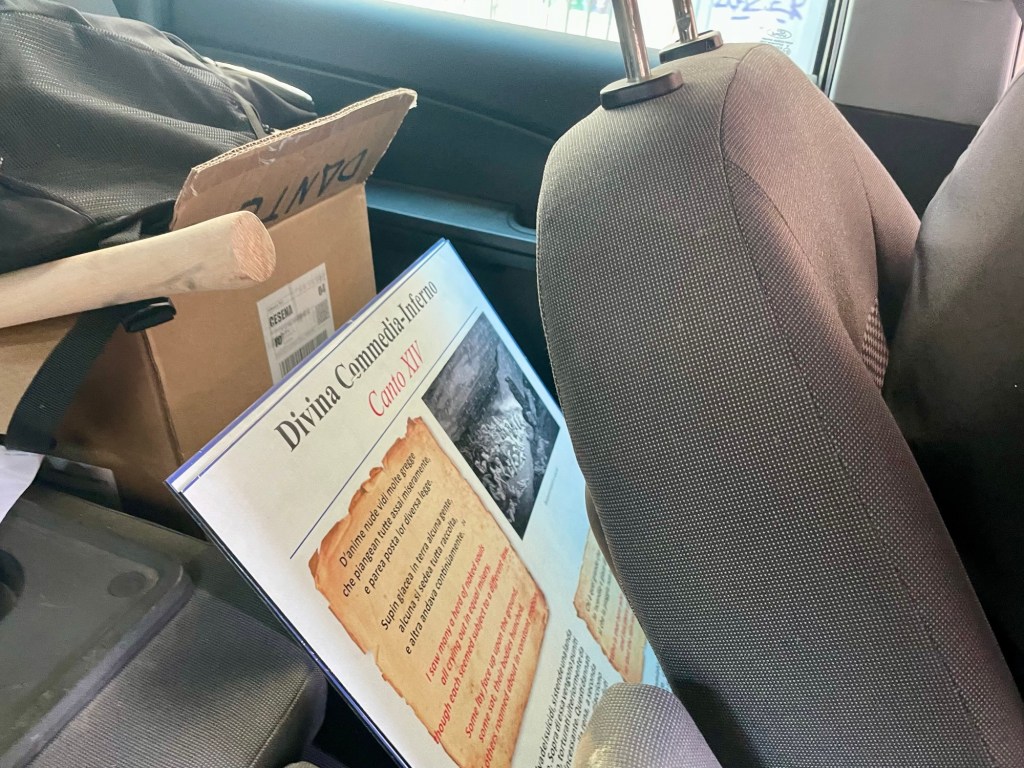
    We passed by the convent where Dante’s daughter had become a nun, taking the name of Beatrice, and visited the lido which had formerly been the port from which Dante had set off on his last perilous diplomatic mission to Venice to negotiate salt taxes. 

    Though the sea had now retreated some distance from the spot to create a wetland abundant with birdlife, you could imagine the scene. Though he arrived via water he returned from Venice on foot where he caught the malaria that would kill him on the night of the 13th of September, 1321. He was 56 when he died. 
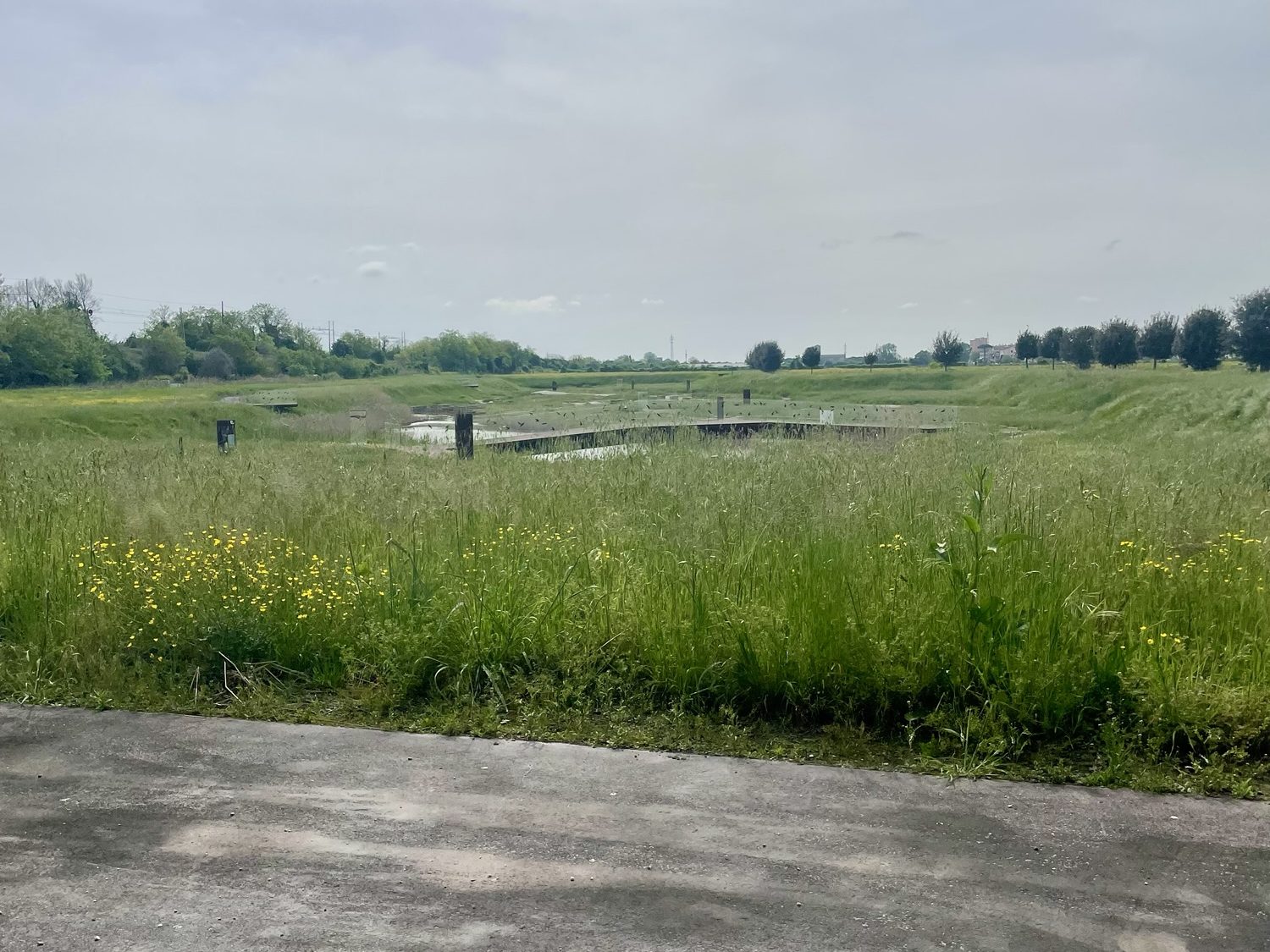
    Oliver explained that a river used to run through the heart of the city but it had been diverted to prevent flooding. The Ravenna of Dante’s day would have looked familiar but also different. 

    ‘Every pilgrim has his way,’ he said.

    Ironically, at 71, Oliver himself isn’t a fan of walking. Some years ago, he’d had a heart attack and had four stents fitted, just like my own father.

    Kelsey had a train to catch at 1.40pm which gave us just enough time to check out the Pine forest of Classe, located a few kilometers south of Ravenna, which inspired Dante in his representation of the ‘thick and vibrant’ woods of the terrestrial Paradise, which receives Dante and Virgil along their path in the 28th Canto of Purgatory.

    ‘A gentle breeze, which did not seem to vary
    within itself, was striking at my brow
    but with no greater force than a kind wind’s,

    a wind that made the trembling boughs—they all
    bent eagerly—incline in the direction
    of morning shadows from the holy mountain;

    but they were not deflected with such force
    as to disturb the little birds upon
    the branches in the practice of their arts;

    for to the leaves, with song, birds welcomed those
    first hours of the morning joyously,
    and leaves supplied the burden to their rhymes—

    just like the wind that sounds from branch to branch
    along the shore of Classe, through the pines
    when Aeolus has set Sirocco loose.’

    The forest was full of life. Wild asparagus sprouted in tall stalks and pines shot up like towers. They had been harvested to make boats in the medieval period.

    Wild honeysuckle exuded a delicious tangy scent and from an acorn, an oak plant tentatively hazarded a thin thread of life.
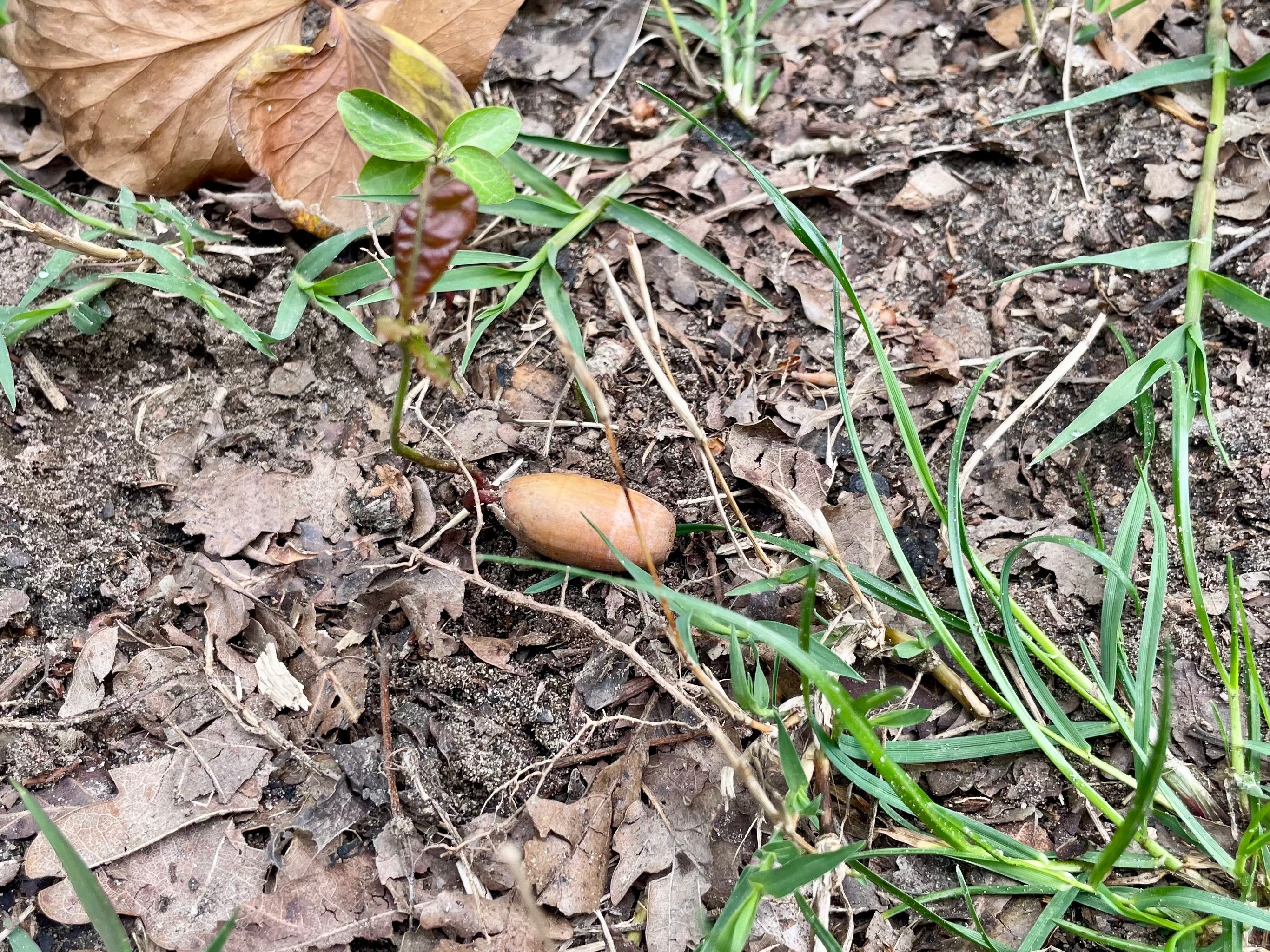
    ‘If you don’t visit a place and touch it with your feet don’t get it,’ said Oliver.

    He spoke fondly of his wife, Donatella, who he said was very much at one with nature – somewhat of a tree hugger like me. When she harvested wild strawberries from the forest she asked for permission, he said.

    ‘Man needs to realize that nature does everything by itself.’

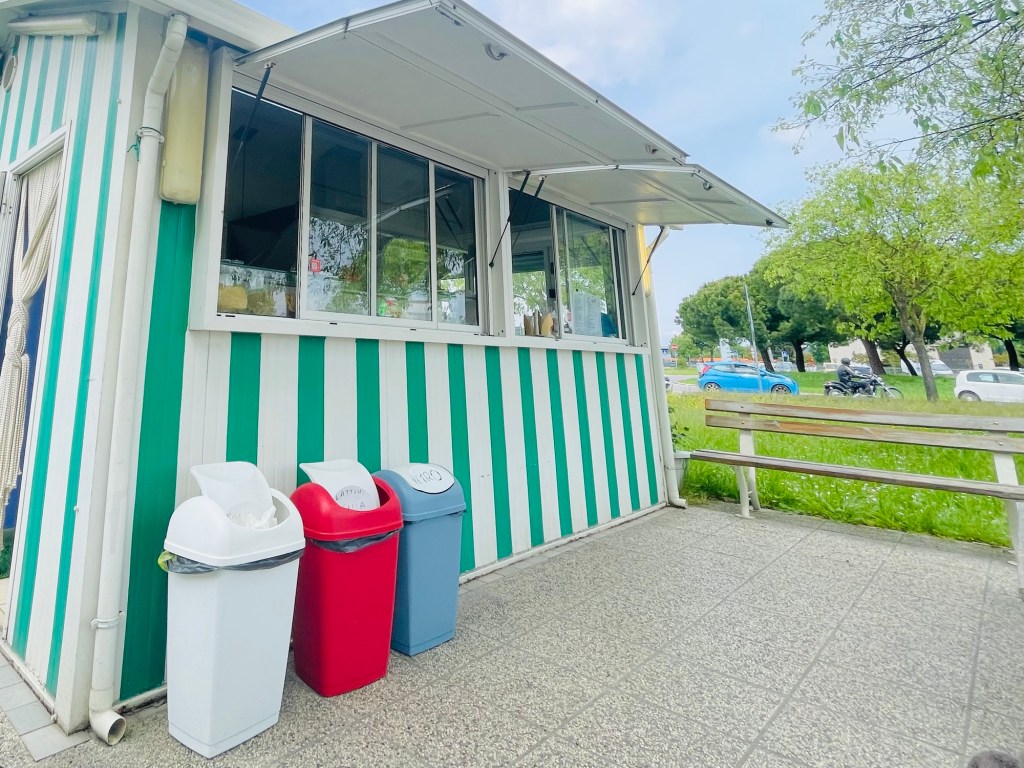
    Back on the road, we stopped at a piadina shack that was recognizable from its green and white stripes. I had one with rocket and a local runny cheese called squacquerone. Kelsey and Oliver had ham and hard cheese. I felt Italian, wearing my feather jacket in the midday sun.
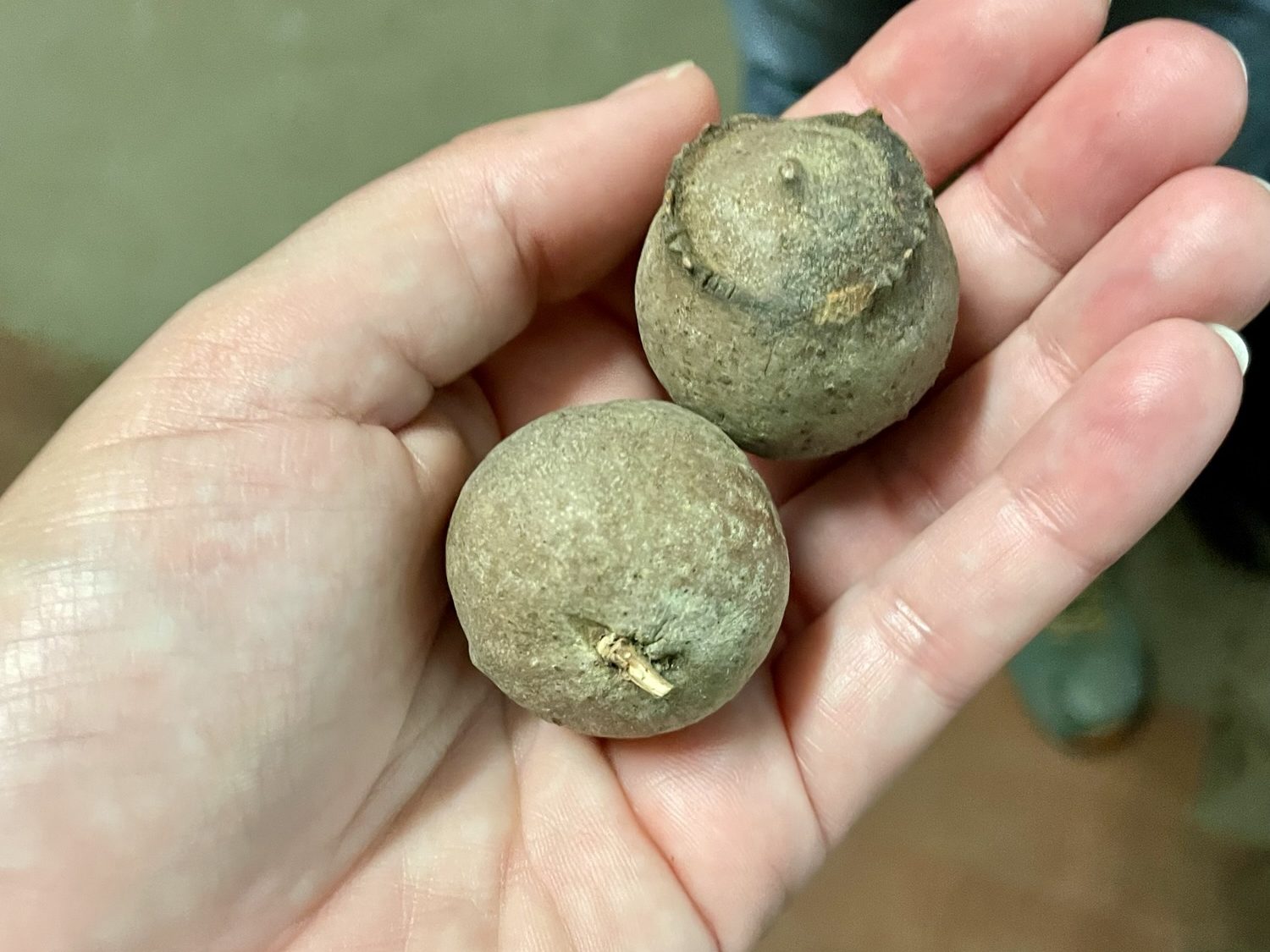
    Oliver then took us to meet Paulo, another extraordinary man who makes his own ink out of oak parasites, which are rich in tannins, and uses it to write out, by hand, stunning tracts of the Divine Comedy.

    This ancient way of making ink requires daily mixing, boiling and the addition of iron and copper to make black from red and green. Gum is added from apricots and peaches to create a substance that is tacky, doesn’t run and sticks to the page.

    His work was flawless.

    The ink smelt like balsamic vinager and he kept it in a sea shell which he used for his ink pot. He was, he explained, a man of the sea. Mountain scribes use stones with holes in as their ink pots. 
    He had started on his work with Paradiso since he had been sick at the time and wanted some lightness – Dante’s vivid depiction of Hell was too close to home, he explained. But now he was recovered and halfway through Inferno. It was the second time he had transcribed the Divine Comedy since he was unsatisfied with his first attempt which was rendered in a slightly different, gothic font. He had had to change the font he used because, with age, his hand was not as dexterous.

    It took him five to six months to complete a canticle. 

    On some of the pages you could see the light outline of the lead he had used to draw the lines to guide his careful script. And here and there, he had embellished letters in gold leaf.
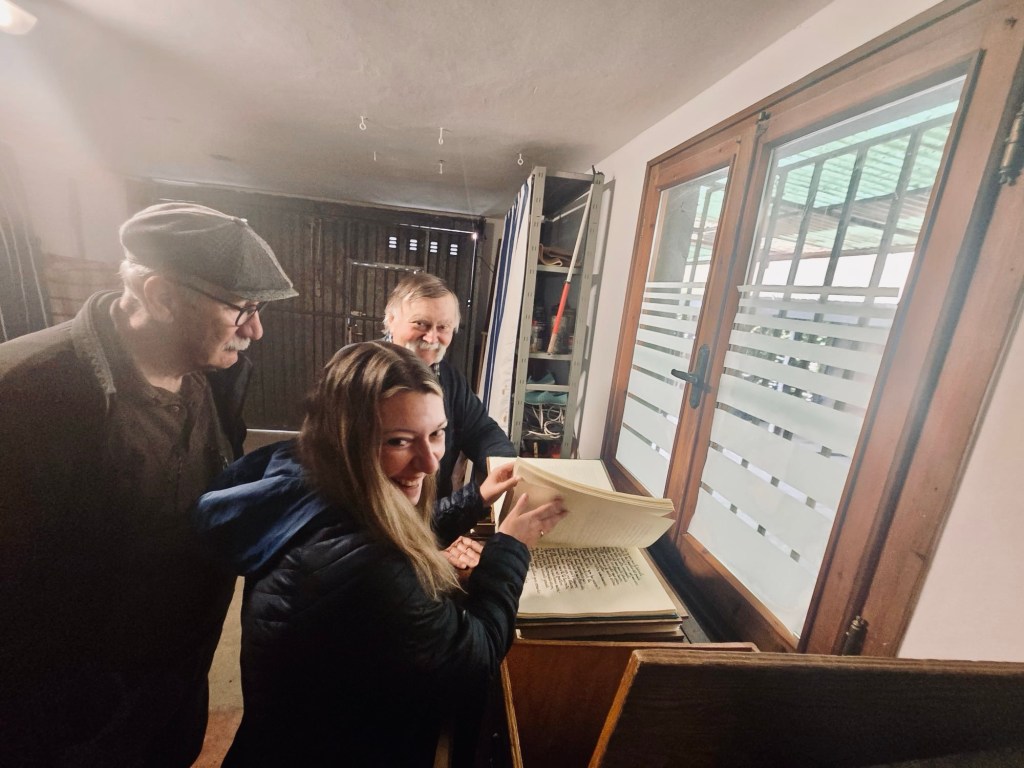
    Alongside the Divine Comedy he had transcribed the two volumes of Dante’s political tract, Convivio, and the Bible.

    After removing the car from his garage so that we could all fit in, he showed us his equipment of an eyeglass, goose feather quill, and a hare’s leg that had been taxidermized and stuffed with cotton. The softness of the hare’s fur gave a particular shine to the embossed parts of the manuscript, he revealed. Each text was written on paper made in the traditional way from papyrus. 

    The name for someone who handwrites manuscripts is an amanuense.
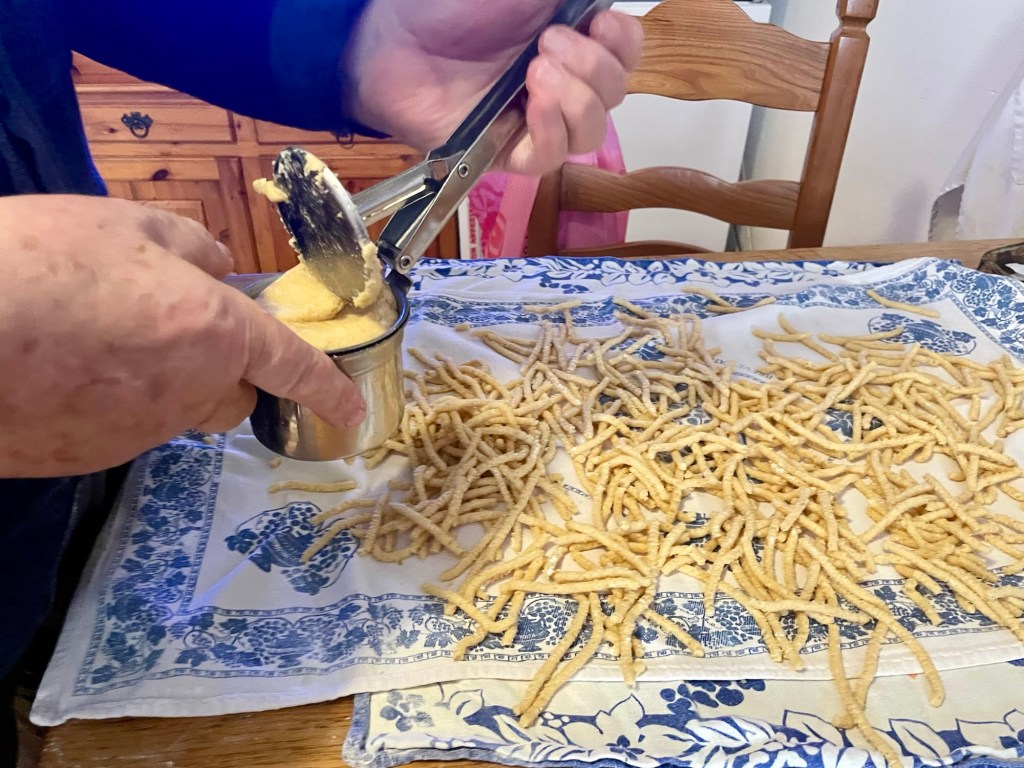
    When we had arrived, Paulo and his wife, Lucia, had been hand making passatelli. Of course they were, they said, it was Easter. They would eat it with prawns and courgettes in a soup, or brodo. 

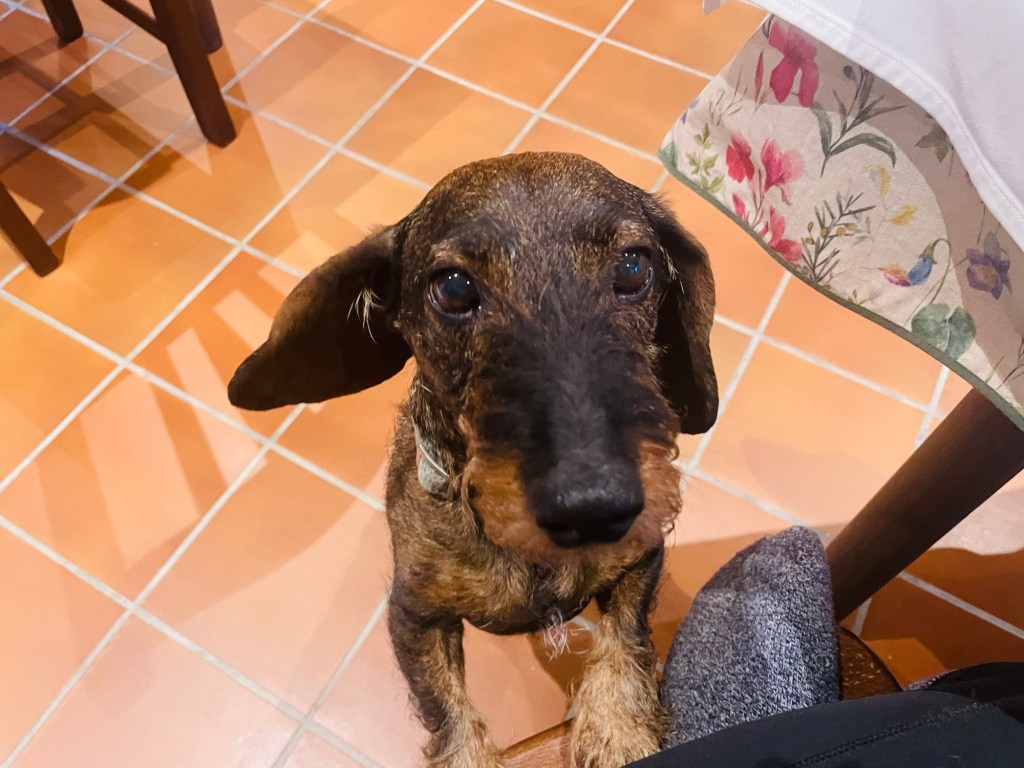
    On the walls were family pictures, some of which had come loose from the frame, and a white shaggy dog called Pipo bounded across the room in search of affection. An easter display contained eggs and plastic decorations of rabbits and chicks. From the study two budgerigars were tweeting. 

    Paulo appeared incredibly humble but also proud of his work. 

    ‘Many normal people do things that are seen by others are titanic,’ explained Oliver. 

    Then suddenly his wife appeared from the doorway of the garage.

    ‘The Pope is dead,’ she announced. 

    ‘He met J.D. Vance yesterday,’ said Kelsey, ‘shit I hope he didn’t contract the evil eye.’

    I was struck how quickly the conversation moved on back to the books. Paulo was a religious man and the Pope was important, but he was here to show us his own devotional work.

    I asked him what his favourite part of the Comedy was,

    ‘For me,’ he replied, ‘Beatrice is everything.’

    He explained that for him calligraphy was a form of meditation that empties his mind. 

    He read us the last lines of Paradiso and then offered to write it out for Kelsey and I. Yes please, we said. He would entrust it to Oliver to pass forward. 

    Paulo tucked up the pages he was currently working on in a leather cover as if he were putting to bed a baby. 

    He used to go into schools to explain his work to the next generation but he fears that the art is being lost. He was teaching a 16 year old called Giovanni and a student at the university had done a thesis on his work.

    I thought of my great aunt mary who had taught me how to handmake pillow lace. I’d have to pull out my cushion and bobbins when I got home and see what I could remember. 

    As we left, we asked if there was anything we could do for Paulo and he simply said ‘remember me.’ This touched me for its similarity to the pleas of the souls in Dante’s afterlife who ask him to remember them when he returns to the earthly realm. 
  • ‘Beware of the dog’: From Dovadola to Forlì

    The town of Castrocaro Terme offered interesting street art and engaging conversation, but a strange encounter with a dog left me melancholy.

    In the night we’d been visited by a storm which had brought with it thunder, lightning and heavy rain and so, over a breakfast of delicious fresh yoghurt, apricot jam and honey, I talked with Benjamin and Michaela, his partner and co-host, about the perilous weather in the region. 

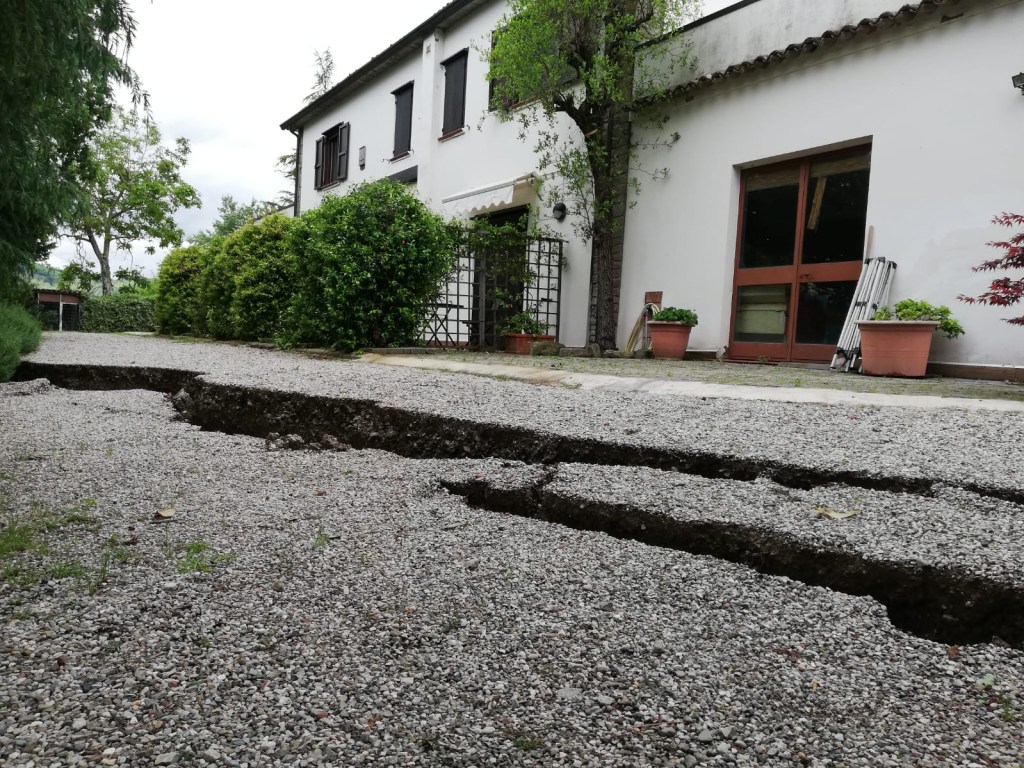
    Mud slides and flooding had occurred in May of 2023 and an earthquake had struck in September of the same year. Their driveway had been split in two. In Faenza the river had broken its banks and Montemignaio had been cut off completely for 10 days. Two people had lost their lives.

    Michaela showed me images on her phone – they were catastrophic. 

    Pepe, their small black dog, licked my hand, insinuating that he would be thrilled to share my breakfast thank you very much. 

    I’m not a big dog person and during this cammino I have been quite scared on occasion at the ferocious barking that greets you when you pass by houses in town and country alike. 

    They have, affixed to their gates, the sign, ‘beware of the dog.’

    Michaela who is an interpreter fluent in Italian, French and Spanish explained that her and Benjamin spoke to one another and their two female children in French but that the dog was Spanish.

    ‘Pepe, ven aquí!’

    I felt comfortable in this plurilinguistic environment and spoke to the dog in an accented Spanish that I had learnt in Cuba at the age of 19. 

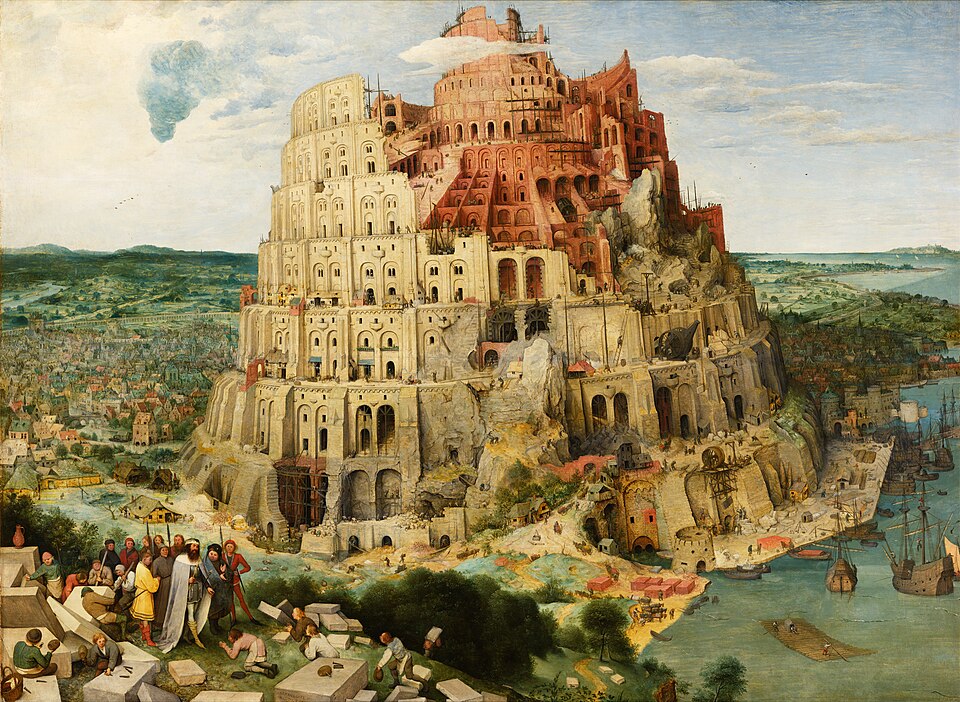
    In canto 31 of Inferno, Dante offers an explanation for the world having multiple languages, or a ‘confusion of tongues.’ As was church doctrine at the time, he sees it as a punishment for the construction, by Nimrod the giant, of the Tower of the Babel through which he sought to reach God and glory.

    ‘He is his own accuser;
    for this is Nimrod, through whose wicked thought
    one single language cannot serve the world.

    Leave him alone—let’s not waste time in talk;
    for every language is to him the same
    as his to others—no one knows his tongue.’

    It is said that this tower was destroyed by an earthquake,

    ‘No earthquake ever was so violent
    when called to shake a tower so robust’

    The Tower of Babel is the subject of three stunning paintings by the Dutch and Flemish Renaissance painter Pieter Bruegel the Elder.

    According to the principle of contrapasso whereby the punishment is an inversion of the sin, Dante punishes Nimrod not with linguistic diversity, as in all previous versions of the story, but by assigning him a non-language that communicates non-sense.

    As the Dante critic Teodolind Barolini explains, the social analogue to the linguistic fall is betrayal: the misuse and corrosion of the bonds that tie humans into social and familial consortia. 

    After the terrible weather events of 2023, Michaela and Benjamin had taken in two donkeys who had been displaced. Their names were Socrates and Augustine.

    I passed them and saluted them as I set off on my way. Ducks were quaking in the reservoir as I descended the hill at 11:30am. The rain was spitting. 
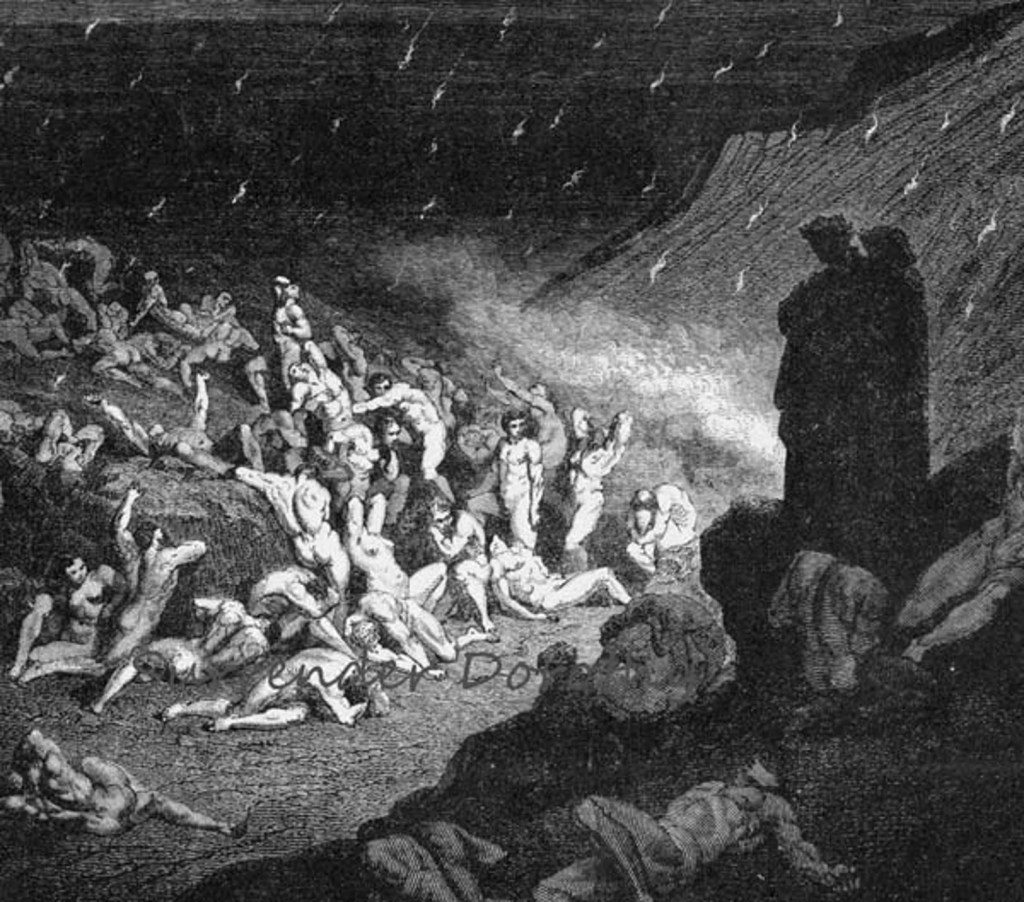
    Dante includes rain among the punishments for the violent against God, nature and art in canto 14 of Inferno, although his is a rain of fire. The arid desert of the third ring of the seventh circle is compared to the African deserts trod by Roman Cato, and Alexander the Great is evoked as having experienced in India a similar rain of fire:

    ‘Above that plain of sand, distended flakes
    of fire showered down; their fall was slow—
    as snow descends on alps when no wind blows.

    Just like the flames that Alexander saw
    in India’s hot zones, when fires fell,
    intact and to the ground, on his battalions,

    for which—wisely—he had his soldiers tramp
    the soil to see that every fire was spent
    before new flames were added to the old;

    so did the never-ending heat descend;
    with this, the sand was kindled just as tinder
    on meeting flint will flame—doubling the pain.’

    The rivers of Hell, meanwhile, Virgil informs Dante, are created by the tears of the Old Man of Crete. 

    It was cold and so I was wearing my yellow striped hoodie under my anorak, the only thing that I had left in my backpack that was dry. 

    I had washed my hair with the conditioner I’d purchased yesterday and tied it in two braids that hung down my neck. I’d put nardo oil on my feet before the plasters. I was getting short. I’d have to buy more in Forlì.

    I walked along a road for 15 minutes feeling anxious of the speeding cars. The clouds were bulbous and pregnant with rain.

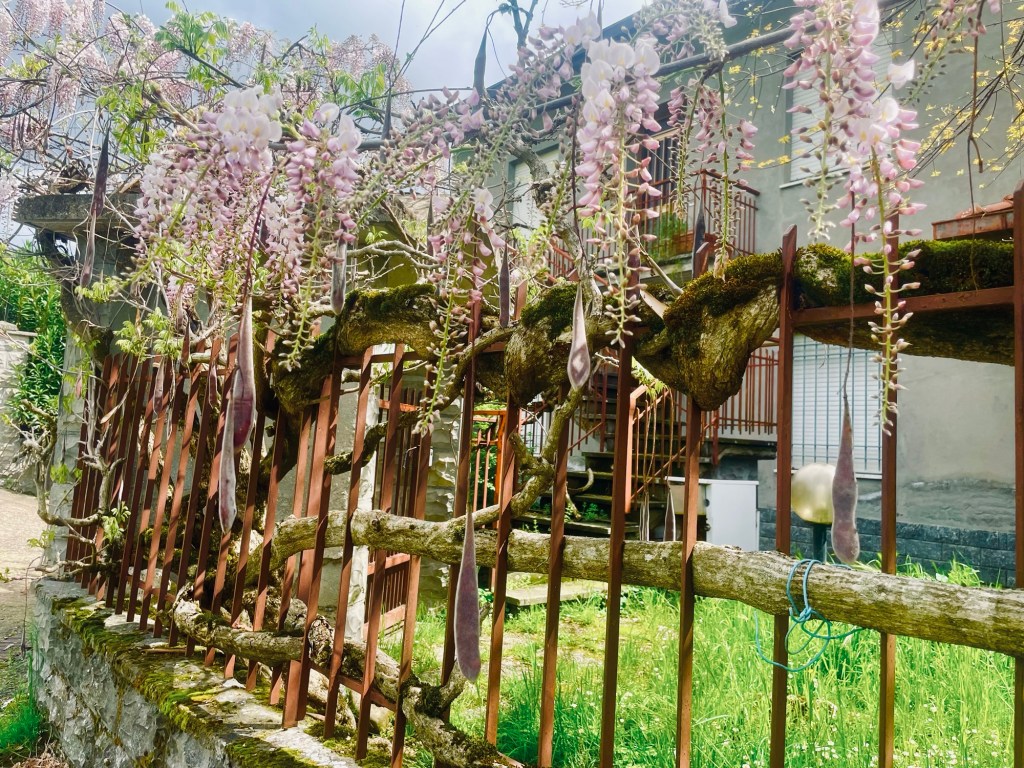
    Soon the roar of the lorries was replaced by that of the river and I proceeded to a more tranquil trail. Wisteria pods hung off their stems like runner beans. They were soft to the touch like donkey ears.

    I wondered why on earth I’d packed two pairs of shorts.

    I passed by vines which were contorting their limbs on one side of the path and, to the other, olive trees were bunched together, a dusty green.

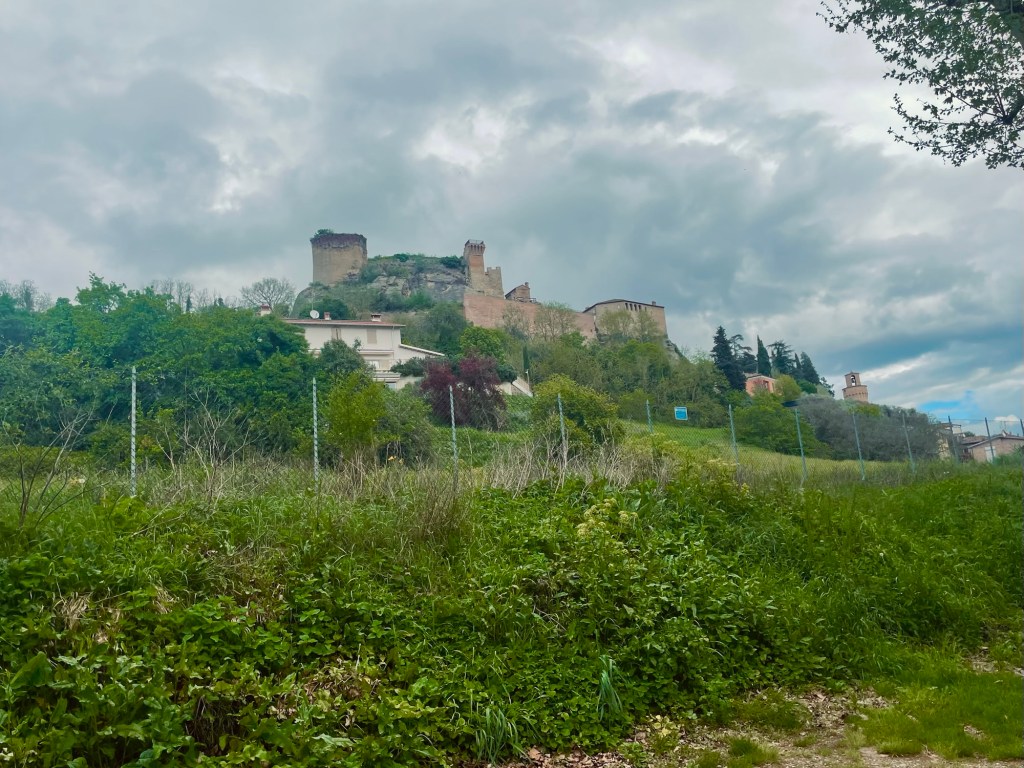
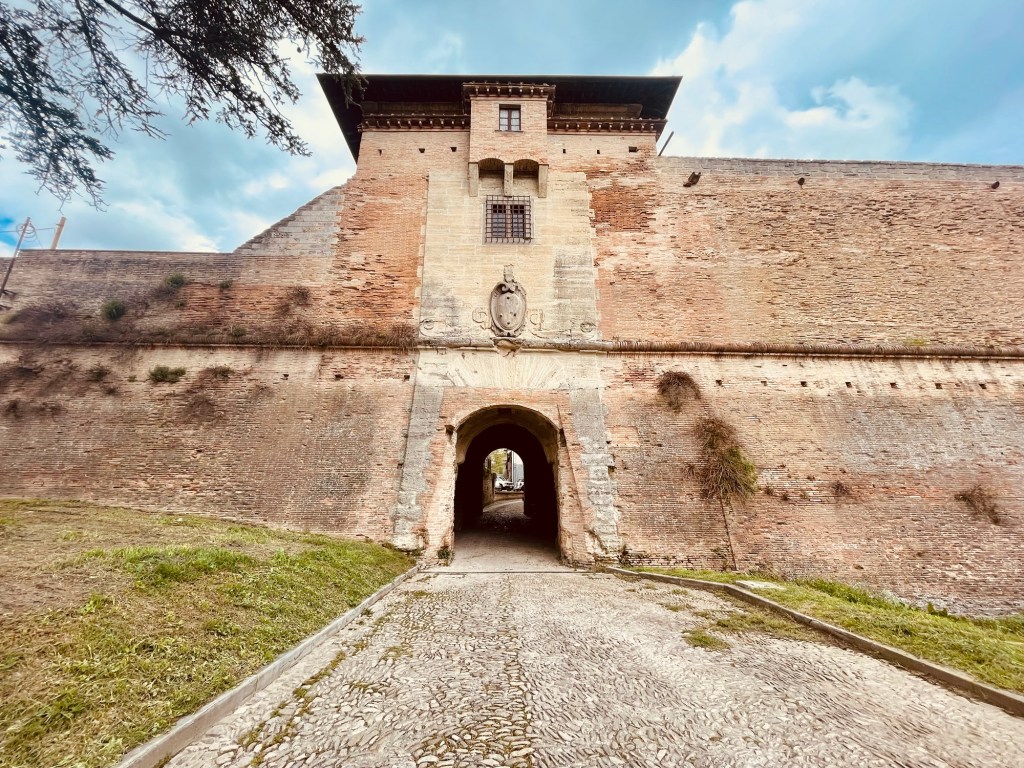
    Soon I entered the town of Castrocaro Terme which is known for its healing thermal waters. The fortress towered over me. The greenery on its top looked like a toupee.

    An acer tree thriving in the ground told me something of the composition of the soil. A DHL delivery driver in a yellow van was playing drum and bass.

    The first café I tried for lunch was closed – of course, it was a Thursday? But in a little square I found a bar outside of which an elderly man was coughing over a thick cigar. 

    As I ate a mozzarella and rocket sandwich which had been freshly prepared, we got chatting. His name was Silvano which means ‘man of the woods.’ When I explained about my cammino he began citing canto 3 of Inferno where Dante crosses the river Acheron, guided by Charon. 

    ‘here, advancing toward us, in a boat,
    an aged man—his hair was white with years —
    was shouting: “Woe to you, corrupted souls!

    … Charon, pilot of the livid marsh,
    whose eyes were ringed about with wheels of flame.’

    The demon Charon, with his eyes like embers,
    by signaling to them, has all embark;
    his oar strikes anyone who stretches out.’

    Although Dante’s verse doesn’t describe his crossing of the Acheron in Charon’s boat, since he faints with fear, his voyage has been imagined by several prominent painters including the Frenchman Delacroix.

    Silvano and I discussed the Euro, Brexit and who had killed Princess Diana. He was impressed, as was I, that King Charles had given a short speech in Italian on a recent visit to Ravenna. When he complemented me on my Italian I replied,

    ‘The Italian language is logical. Well, the language is logical, but not always what people say.’

    He chortled heartily. It felt good to be able to make a joke in a foreign language.

    A rum and tea was two euros fifty. 

    I took my jumper off since the rain had stopped and the humidity returned. Some of the other men in the bar chuckled, one explaining that when he’d gone to a wedding in England, he had been the only own dressed in a jacket while all the other guests were practically nude. Us Brits like to expose ourselves at the first sign of Spring, whereas the Italians cautiously hang on to their feather jackets, or piumini  until May at the very least.

    Silvano who had owned a gift shop by the seaside prior to his retirement was struck by my lapis lazuli necklace. It was gift from my East German friend Susanna who does ecological activism in Guatemala.

    ‘She’s doing the Grand Tour!’ one patron cried. ‘You’re here to cultivarti – to culture yourself, no? Just like the British elite did in the 19th century?’

    It turned out his name was Giovanni and he was a respiratory doctor who worked in the thermal baths.

    I left Silvano and Giovanni with a ‘buon appetito’ after an hour of rich conversation and carried on my way. Because of the weather, I decided not to take advantage of the many gelaterie.

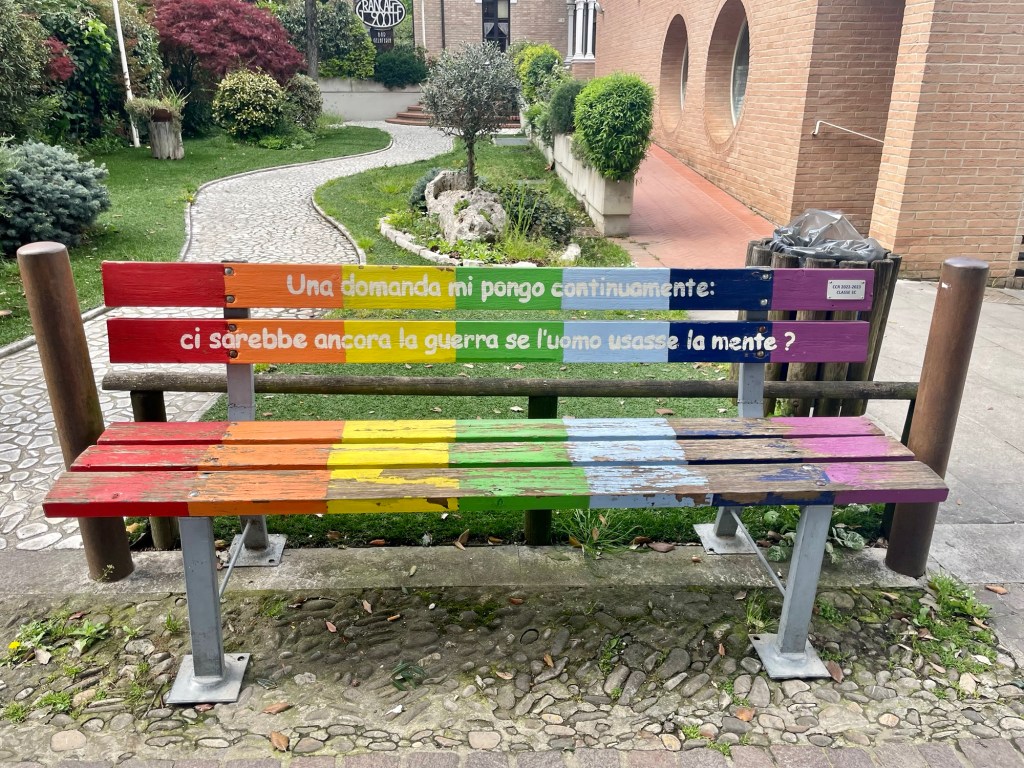
    The town benches had been painted in different colours with messages that sought to bring hope to the local people. One read, ‘I keep asking myself, would there still be war if people used their brains?’ Another, ‘no to violence against women’ and another still, ‘one less piece of rubbish in the environment is a smile for the people’ – a phrase that rhymes in the original Italian. 

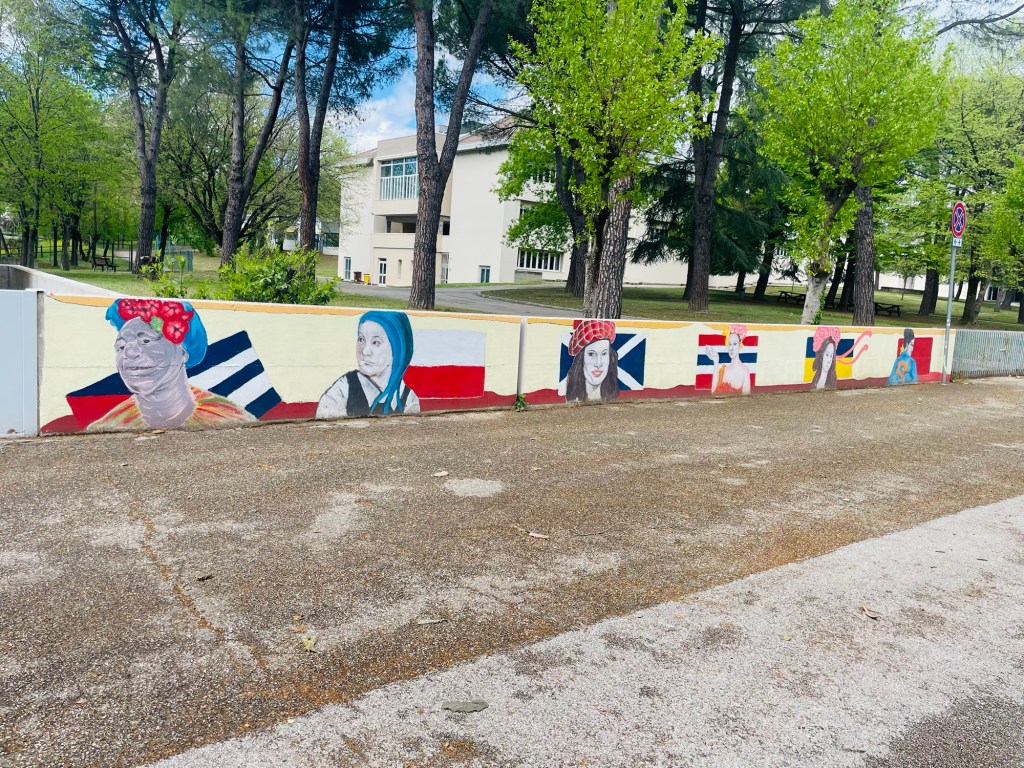
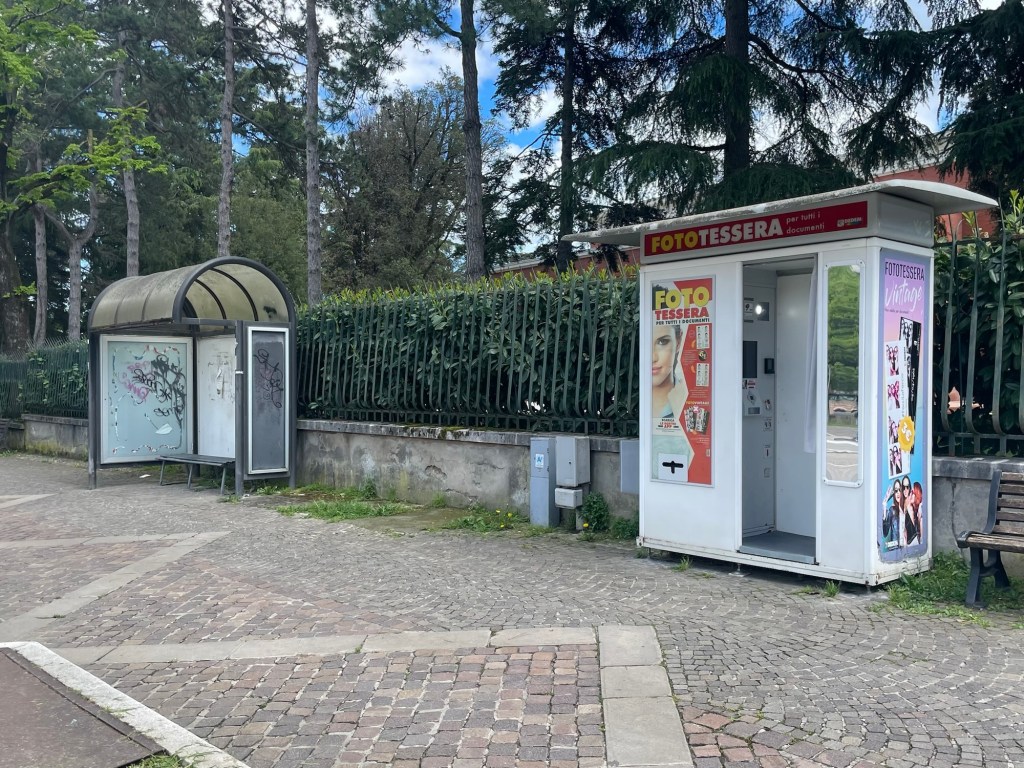
    There was a random photo booth in the street next to a Perspex bus stop. A school wall was painted with a mural depicting women from around the world and a garden contained a series of stone sculpture people.  

    The town had a surplus of banks, and there was the fizzy water fountain, next to a defibrillator. A small park with fairground rides sat next to an ugly breeze block hotel. Someone had graffitied a rather accurate penis on a bin.

    The town wouldn’t be a bad place to grow old, I contemplated. It reminded me of the spa town of Balneari Prats where I had spent time with my yoga guru Mary Paffard in Spain during multiple Springs.

    I exited through the medieval walls of the city, the cobbled stones serving as a welcome massage for my feet. Two children’s bicycles had been discarded on a corner without locks. There was an unexpected little forest of bamboo to the right.

    I stopped to explore the beautiful little church of Santa Reparata where there was a strong smell of bleach. Here too, women were cleaning in preparation for the Easter services. Outside, a lady was trying to entice two cats off the roof of her car. 

    As I proceeded to the off-road track that would take me all the way to Forlì beside the river, I met an Italian man with hiking poles.

    ‘Be careful,’ he said, ‘it’s super muddy.’

    I thanked him and carried on. Mud? I could handle mud by now. 

    Upon reaching the riverbank, I disturbed a heron who flew – dinosaur like – into the grey air.  

    The path was poorly trodden and tall grasses obscured it here and there. I’d attached my hiking sticks to my backpack since the terrain was flat and, without knowing what to do with my hands, I tugged on my braids and ran my fingers through the flora.

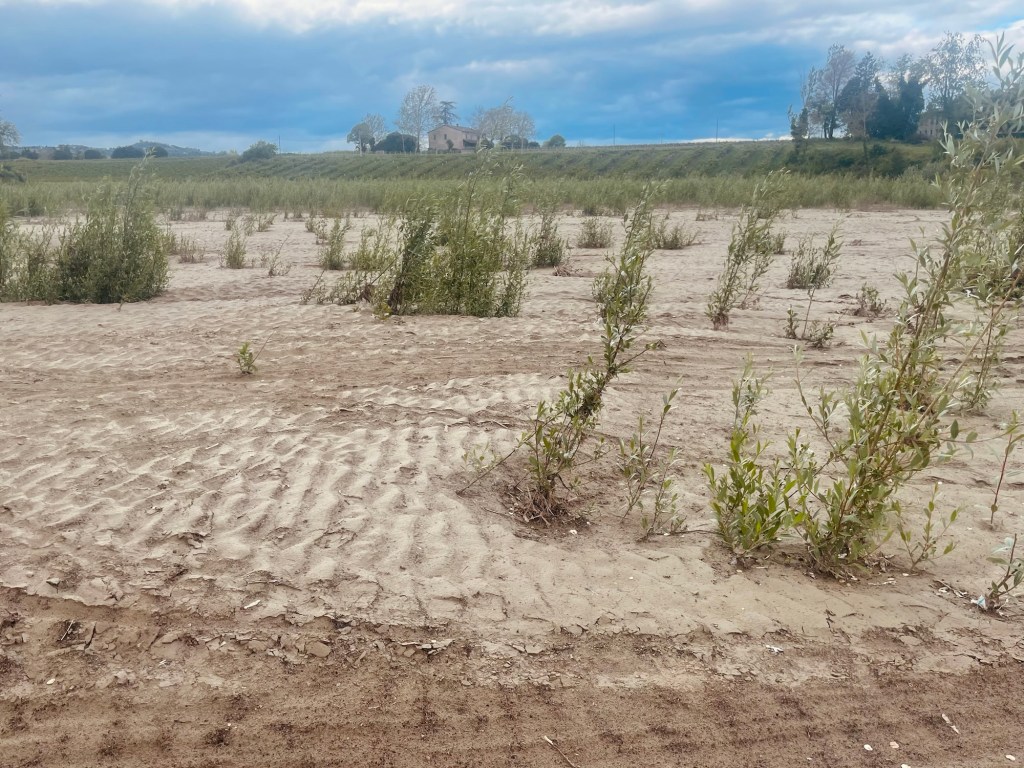
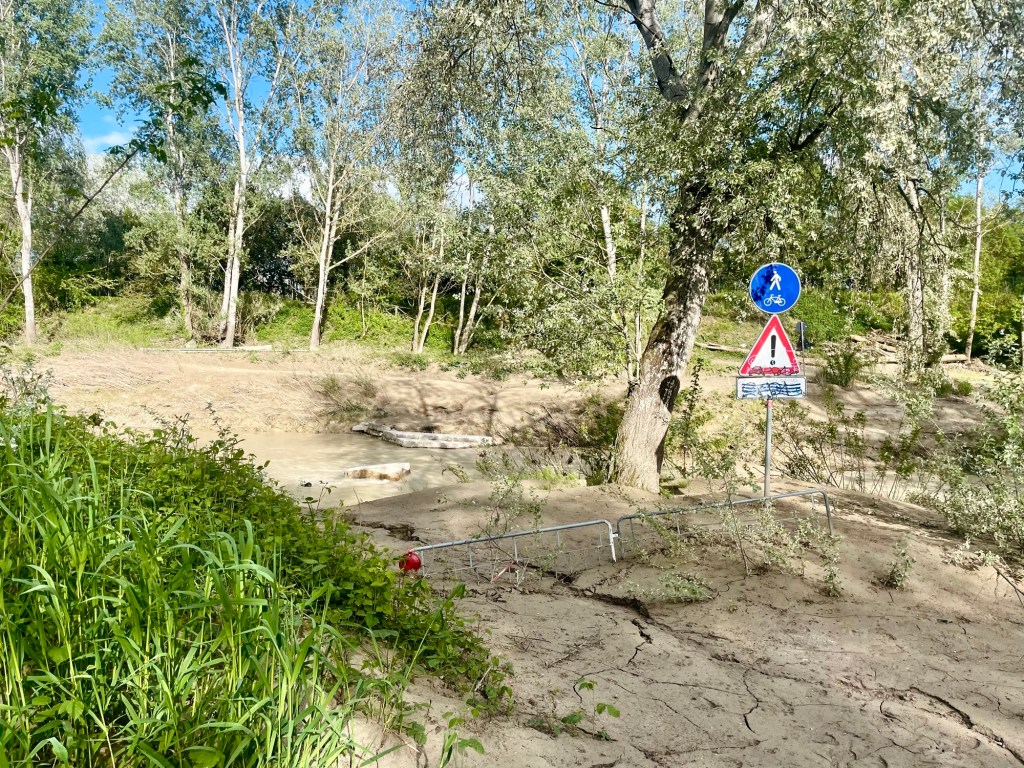
    Soon I arrived at an expansive mud flat which had the texture of quicksand on a beach.

    The Abominable Sands is a location in Dante’s Inferno. Indeed, it is the third and final region of the Seventh Circle of Hell.

    I thought of Dante’s description:

    ‘The ground was made of sand, dry and compact,
    a sand not different in kind from that
    on which the feet of Cato had once tramped.’

    In places, this sand was certainly far from dry and compact and the gentleman had certainly been right about the mud. I proceeded tentatively, one step at a time, managing to avoid submersion. 

    Red poppies clustered at the feet of vines to my left and an ugly piece of orange plastic netting blocked off a worksite.

    Then I took a sharp left into the woods. 

    The brambles reminded me of home, however I was relieved that there were relatively few nettles. A man mowed a lawn behind a hedge and I observed a plastic red chair stuck in a tree.

    Though the path was deserted, I took comfort in the dog prints that marked the path before me.

    The cloud still hanged low but the sun was starting to break through. I removed my anorak and enjoyed the feel of the breeze and occasional sun on my skin. My bare arms were covered in bramble scratches from earlier in the hike when I’d got lost in the woods with Alina.

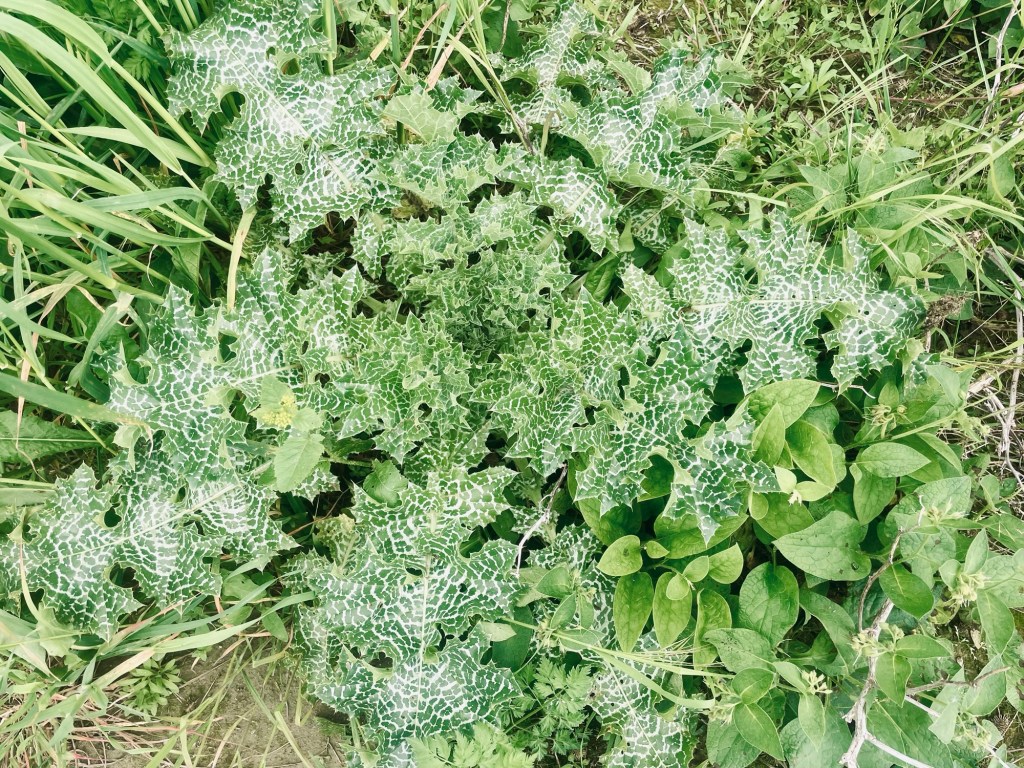
    I noted the contrast between the wild grasses and the tidy vines. There was an abundance of a beautiful spiky, thistle-like plant that was streaked white and green.

    Inspired by the morning’s conversation, I sent a voice note in French to my friend and former student Sahra from Afghanistan who had moved from Italy to Belgium a couple of months prior where she was applying for university. Her response came quickly in a mix of Italian and French. 

    ‘You’re like a Sufi,’ she said. ‘Sufis walk and wonder.’

    I recalled placing a basket bin on my head and spinning in my mum’s white silk dressing gown as a child after we returned from a holiday in Turkey.

    ‘I’m a whirling dervish,’ I had exclaimed.

    And then there was the time I’d been to a global Sufi gathering on the Algerian border with my Moroccan friend Miriam. One woman had become so ecstatic she had collapsed in a fit of ecstasy. Some say Dante was influenced in writing the Divine Comedy by Sufi mysticism. 

    I passed a greenhouse with plants erupting through the roof and briefly conversed with two ladies who were hiking with a dog called Clifford. They agreed with me that Dante would have wanted me to do the walk this way, finishing in Florence and not Ravenna. Did I need anything?

    Further ahead, I saw a family complete with a dog, toddler, bike and pram. The middle child was racing ahead on his cycle and circling back in a burst of freedom.

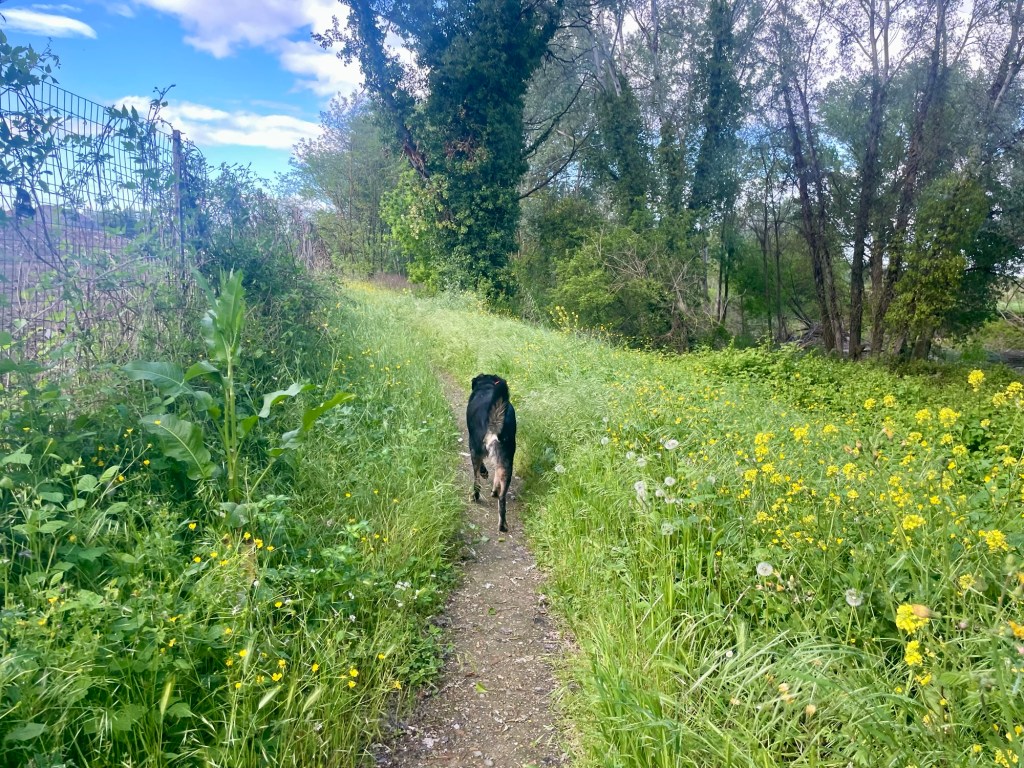
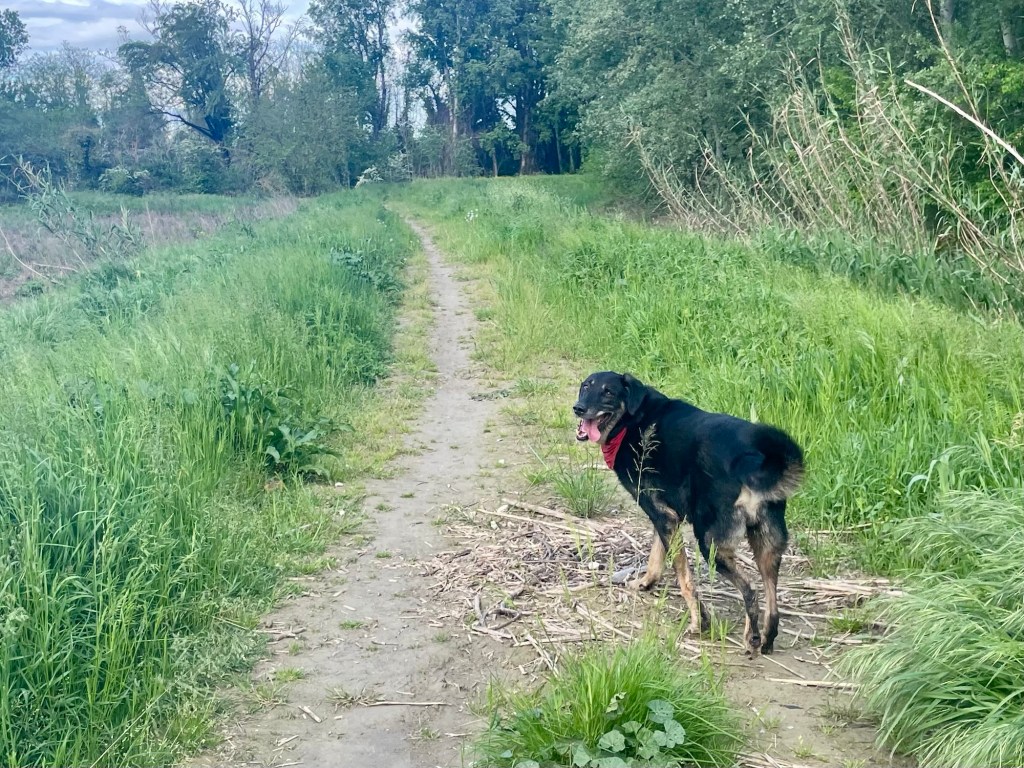
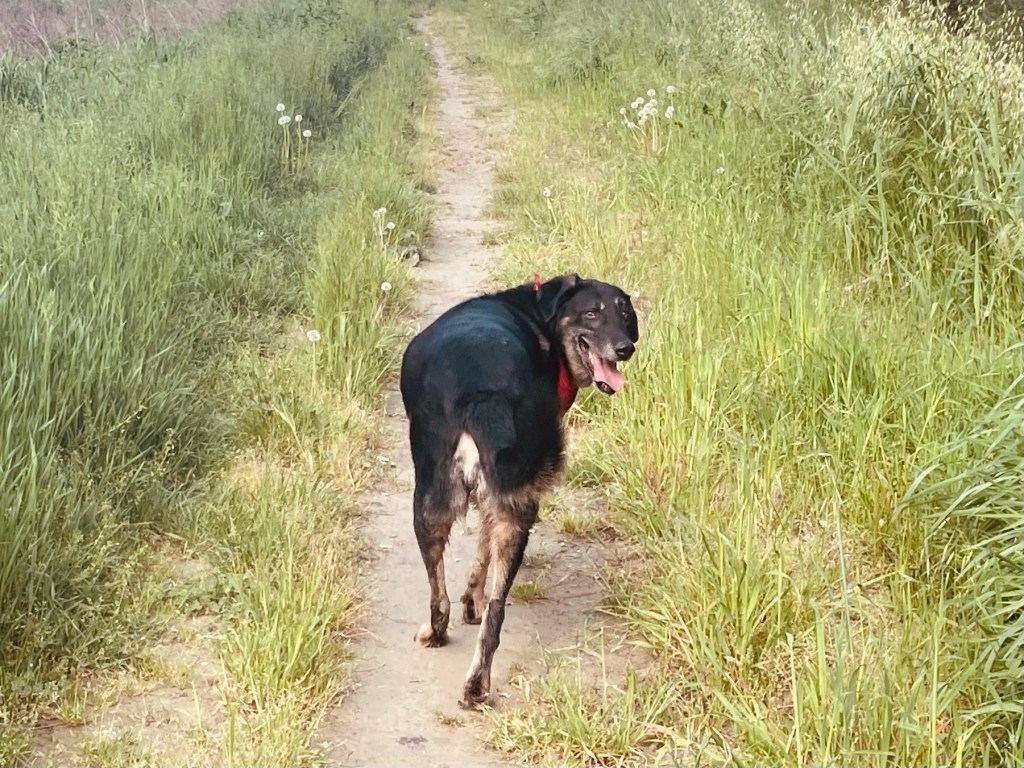
    As I turned a corner, there appeared a black dog who was sporting a red bandana round his neck. Cautious at first, I pulled my hand into a fist to let it sniff me which it did tentatively. Then it looked at me as if to say, ‘are you coming?’ and trotted on.

    For well over an hour, I followed the dog as it made its way alone along the Dante path. At each fork in the road, I wondered whether it might turn the other way. But on it went in the direction of Forlì. When I stopped to pee, drink or rest, so it stopped too. And mad as it sounds, it appeared to be smiling at me, lolling out its neon pink tongue and wagging its tail erect.

    As I ducked under a surplus of ivy, I lost sight of it and felt a pang of sadness. But then there it was again. This part of the path was more well-trodden and I imagined it was a common recreational ground for the locals. Still, there was nobody around except me and my new guide. 

    All the while, he kept ahead at a distance of around three metres. Now the dog prints ahead of me made sense. 

    I felt my belly rumble and wanted to stop for a snack, but I was scared of losing this dog who I had by now nicknamed Virgil.

    It stopped to defecate, yawning with his mouth wide open.

    My leg had acquired a sprig of sticky weed. I blew a dandelion for no one else but myself. One obstinate seed stayed on the stem.

    The river to my right gurgled like my stomach.

    I wondered if the owner had dropped Virgil at Castrocaro Terme to let him take himself on a walk back to his home in Forlì. I tried to approach him to check his tag but he wouldn’t let me come close, only follow him.

    He was quicker than me up the hill but when I turned the corner, there he was panting, still waiting for me.

    My shoes were rubbing and I would have stopped to rest and take some ibuprofen, but for the dog, I had to continue.

    He kept peeking his head back to check I was still there. Where was he going?

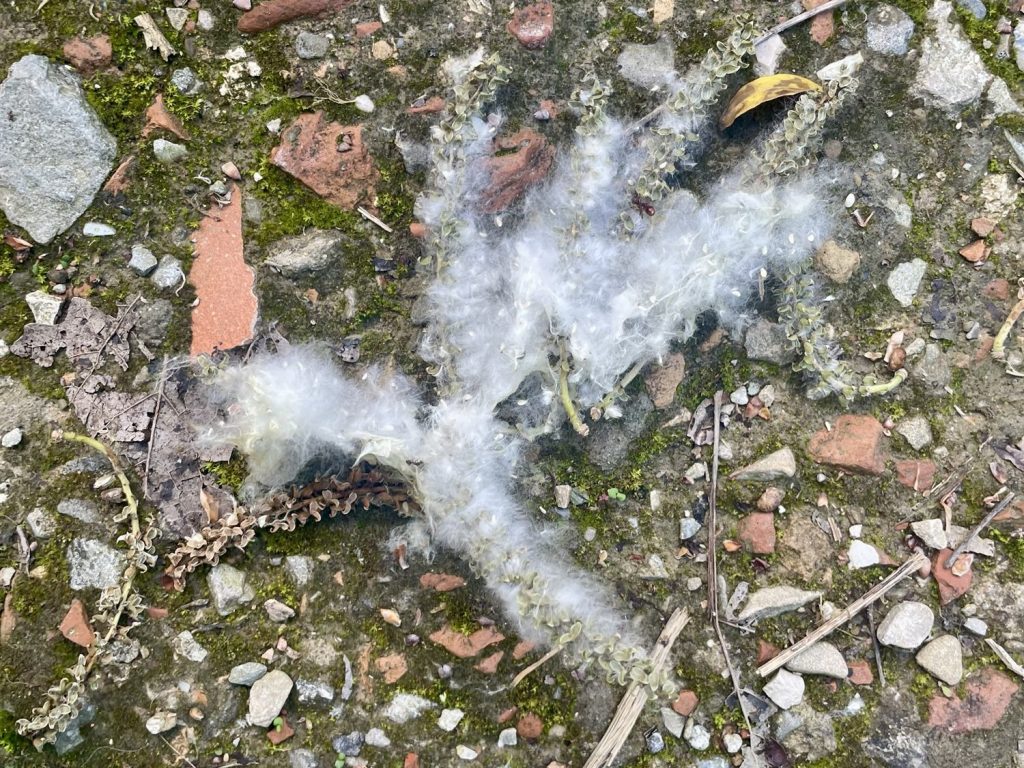
    On the ground were fallen ivy leaves shaped like hearts and soon, as we passed through another prairie, Virgil’s back became covered in yellow petals from the flowers. A seed that looked like soft cotton on stems and another that resembled a caterpillar fell from the trees above me to my feet.

    I thought we must be getting close to Forlì. There was some kind of industry that looked like a quarry on the left and pretty soon we hit a main road. Would Virgil now abandon me?

    None of my friends had dogs and I was a cat person. I had a cat called Dante Alighi-‘hairy’ and, before that, I’d had Toffee, a rescue with anxiety issues. When I’d gone to the vet to put her down, my friend Danni accompanied me. I was so traumatized that I had vomited in the sink in the veterinary surgery. I still owe Danni 100 pounds for the procedure.

    I was playing music on my iPhone which was tucked into my bra, the words of Talos rang out,

    ‘Your love is an island, I’m scorched in the sands of it.’

    Virgil went under an underpass. I thought the way would be to the left, but I followed him. When I checked the map, he was right.

    I wished I had some kind of treat to offer him, but the relationship was not reciprocal. He was leading me. Now, when he stopped to sniff something, I waited for him.

    ‘I’m here. Don’t worry I’m here,’ I said.

    I could suddenly understand how people got so attached to their dogs. He was so loyal.

    I think this was the longest I’d walked without taking a break. It was coming up to ninty minutes.

    It was 5 o’clock and the sun now definitively occupied the sky having won the battle with the rain clouds. Virgil drank from a clear puddle in the path that hugged a ploughed field to the left.

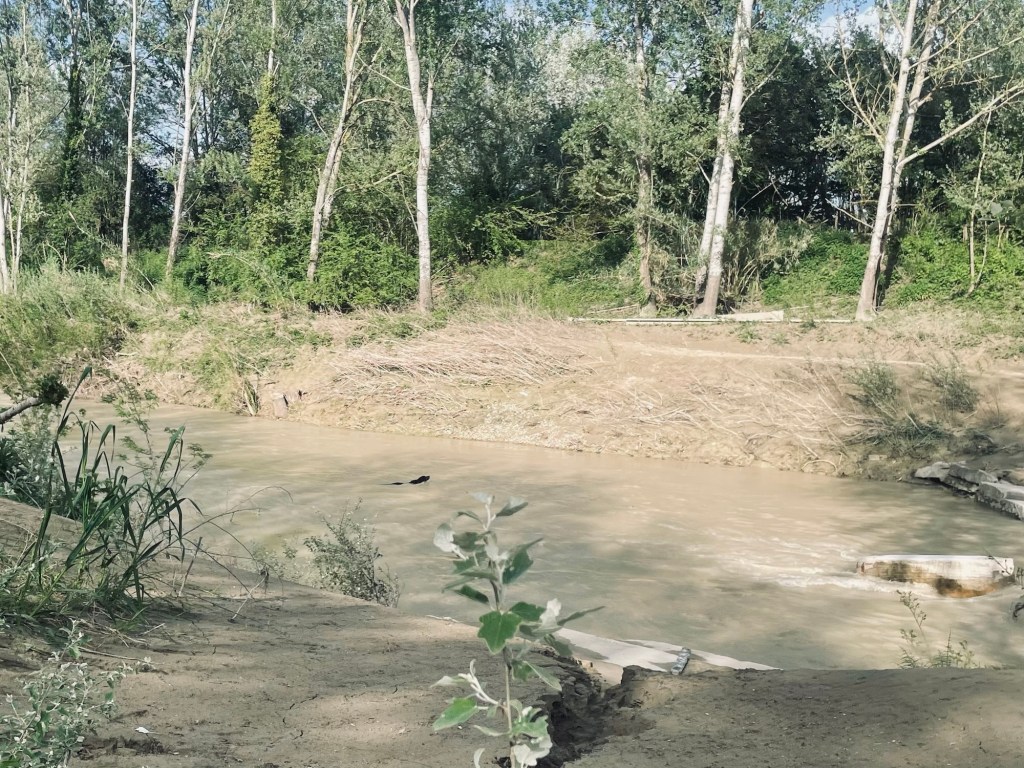
    When we came back to the river where I was supposed to cross, he jumped in for a swim and waited for me on the opposite bank. The current was strong and, lo and behold, there was no bridge. I would later learn that it had been washed away in the recent heavy rainfall. For now, I was quite literally stuck in the mud.

    Five minutes passed as I tried to work out a solution. We locked eye contact. I couldn’t cross the river but to turn back to the road would mean to leave him.  

    I thought about taking my leggings off and trying to wade over but the water looked deep and the current spooked me. 

    I stood there on the shore feeling tears prick at my eyes and the muddy water soaked once more into my boots. My feet ached and I wanted to sit down and consider my options, but I couldn’t: the riverbank was a swamp of ash-coloured mud. My feet were slowly sinking down above the ankle.

    A jogger ran past Virgil on the other side of the bank. I contemplated calling out to her. 

    I turned to wade back onto solid ground and when I looked back, Virgil was gone.   

    I walked five minutes to a bench and was just quiet for a while, listening to the sound of bird song. I noticed a little mushroom underneath the bench which was like a nipple in shape and size. I bit into an apple I had bought yesterday. It was the size of a fist, red and yellow.

    I had a video of Virgil swimming across the river which I now watched obsessively on repeat.

    I picked some grass out of the zip of my anorak with my hands and put it back on. A large pigeon flew through the trees. Finally, I took some ibuprofen for my feet.

    I was riddled with a melancholy I found hard to understand. Virgil had crossed the river Acheron and I had not. 

    I headed back to the main road to take an alternative route into Forlì with a sigh. 

  • A Secular Pigrim: From Portico di Romagna to Dovadola 

    People keep addressing me as a pilgrim which feels strangely comfortable, but my path is pantheistic. 

    This image has an empty alt attribute; its file name is img_7011.jpg

    At the start of canto 2 of Inferno, Virgil tells Dante that it is Beatrice who has sent him to guide him on his journey. Dante is reassured. He responds by describing how,

    ‘As little flowers, which the chill of night
    has bent and huddled, when the white sun strikes
    grow straight and open fully on their stems,

    so did I, too, with my exhausted force’

    Like Dante, I set off this morning standing tall but with some weariness in my body. I had a 33-kilometre day ahead of me and my feet were still painful from being waterlogged for the last two days. My boots hadn’t dried out in the night as I’d hoped they might, and so to put them on was to submerge my feet into a damp abyss. 

    I squelched my way out into the sun to set off at 9am. The golden orb had returned, at least momentarily. 

    I couldn’t help but stop for a coffee in the café I had visited yesterday to salute Lisl. A man in an African shirt was sat on a tall stall reading the paper. It turned out he was from Burkino Faso and he appeared delighted when I spoke to him in French. Once again that thought crept into my mind, ‘I could live here.’ 

    Lisl put added a powder to my coffee,

    ‘It’s ginseng,’ she explained, ‘it will make you more powerful.’

    This image has an empty alt attribute; its file name is img_6962.jpg

    After getting lost and losing phone signal the day before yesterday, I made sure to text my mum and let her know where I was heading and my estimated arrival time. Nadia had sent me another lovely message saying that my blog was helping her to see and appreciate Dante through a new sociological lens.

    ‘It’s so much more interesting that the way we’re taught at school,’ she said. ‘You’re now like my academic Virgil!’

    I wondered whether the fact sociology is less respected in Italy, as Alim had opined last night, was why there were so many Italian sociologists in the UK. The migration research centre where I work, IRiS, at the University of Birmingham, counts three.

    It was 9.30am by the time I left the bar. A band of us had had another long discussion about the prospect of rain. In these parts, people seem to enjoy talking about rain as much as in England.

    This image has an empty alt attribute; its file name is img_6964.jpg

    On this walk, I’m finding that it’s a constant challenge to manage my time between walking, writing and making memories with new people. But I’m determined to write every day. The writing feels as important as the walking.

    As the critic Osip Mandelstam has observed, the rhythm of Dante’s prose – in the form he invented of terza rime – third line rhymes – reminds us of the footsteps of a walk. He writes,

    ‘Inferno, and even more so Purgatory, celebrate the human journey, the measure and rhythm of our steps, the foot and its form…Dante’s is a prosaic modality. He pictures the coming and goings of life drawing on multiform and captivating expressions. In Dante, philosophy and poetry are always on the move, always on their feet.’

    I followed to Via dei caduti – the way of the fallen – up for about 5 kilometres before I stopped to see what is known as the world’s smallest volcano which has been active since before 1500. In reality, the perennial flame is due to the emanation of gaseous hydrocarbons which, in contact with oxygen, remain perpetually on. The flames that emerge from the subsoil, in the middle of an uncultivated field, create a particular sight that reminded me of Ulysses speaking to Dante from within the tongue of far – could this have inspired him?

    This image has an empty alt attribute; its file name is img_6997.jpg

    I stayed a while to look at the body of a dead mole. Its hands were leathery with large talons stemming from them. Then I set back off.

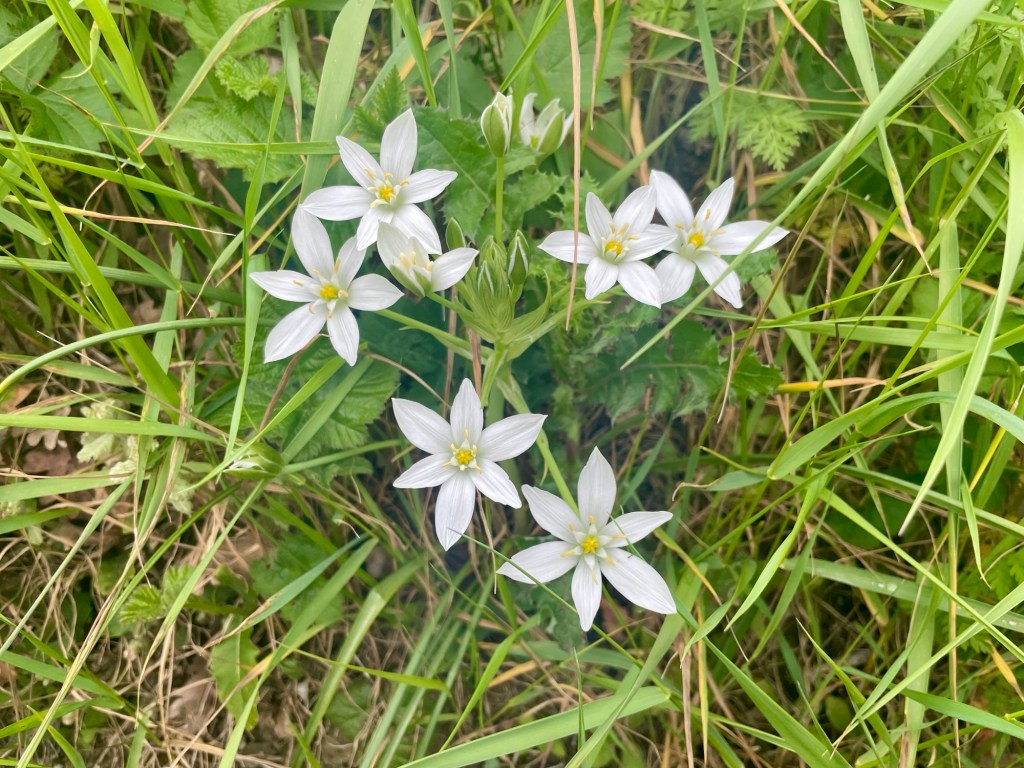
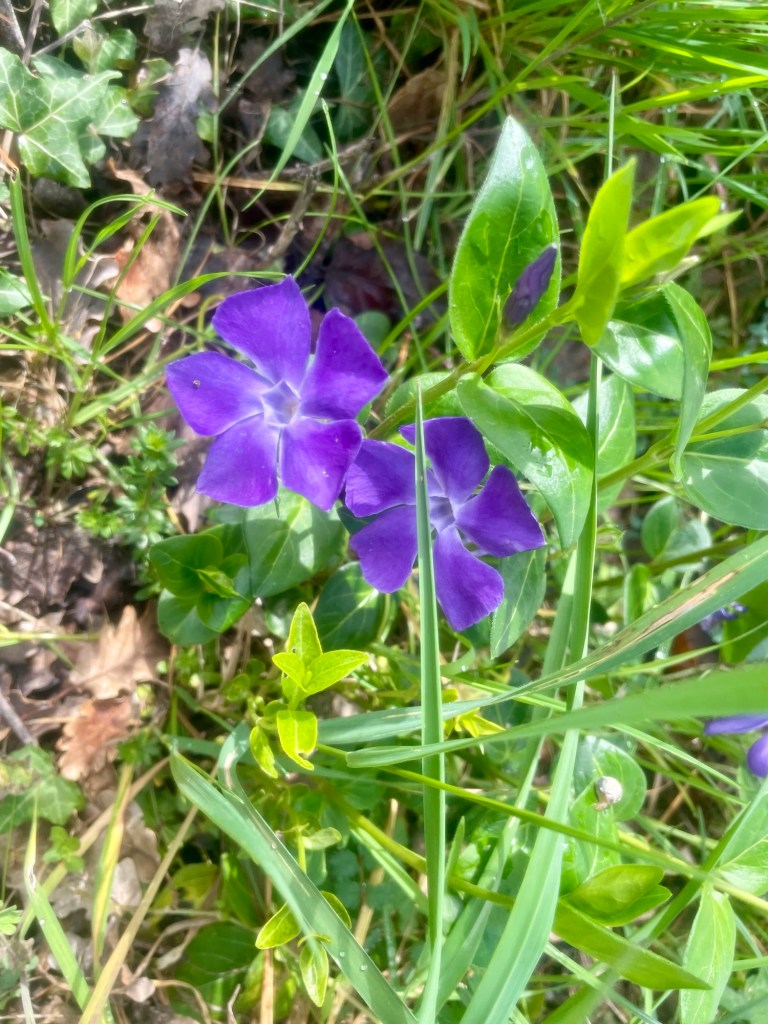
    Pink flowers had climbed through the centre of an abandoned traffic cone in the hedgerow and buttercups, cow parsley, and dandelions lined the verges of the road. I was glad to have a single path to follow so I couldn’t get lost. Here to my right were hexagonal, indigo flowers, and there, a mauve plant that looked a bit like lavender but without the smell.

    This image has an empty alt attribute; its file name is img_6994.jpg

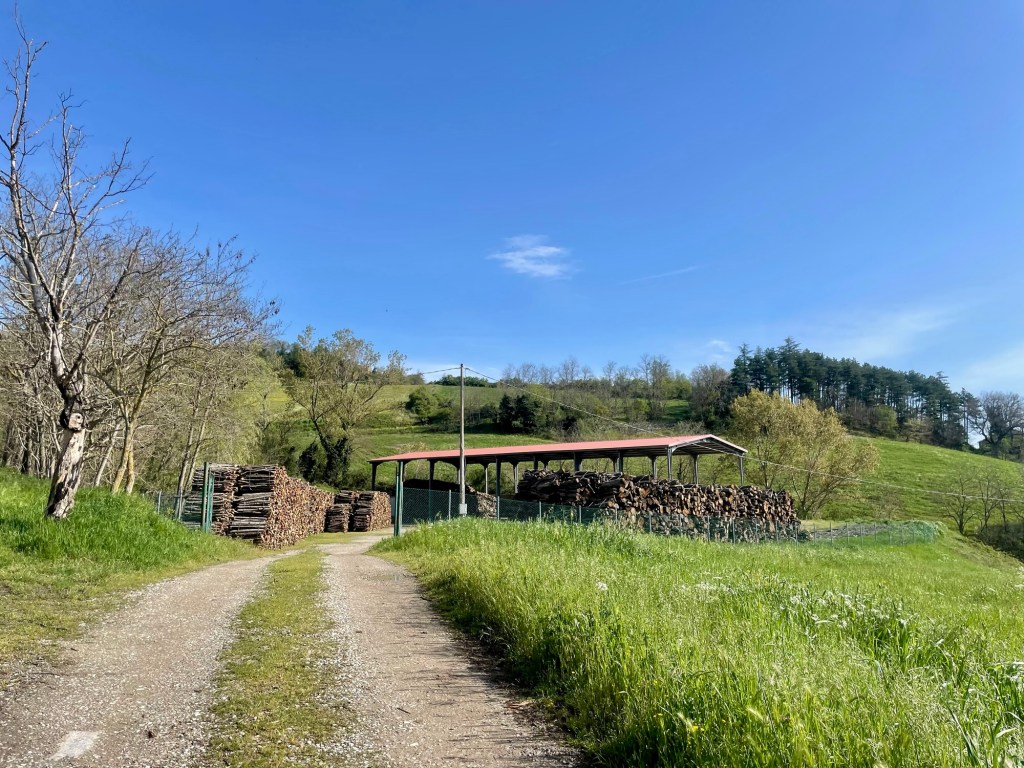
    Tractors were loading hay bales into a lorry and I passed more piles of wood and a fence weaved with sticks the way I’ve seen in Shining Cliff Woods near my house back home.

    The sweat was dripping down my forehead, but I resisted the temptation to put my cap on for fear I would fate the sun to disappear. 

    I passed by rosehip, the fruit of which we’d used at my primary school as a form of itching powder, and modesty, the seeds of which my brother and I used to shake out and use as money in pretend games of a summer. 

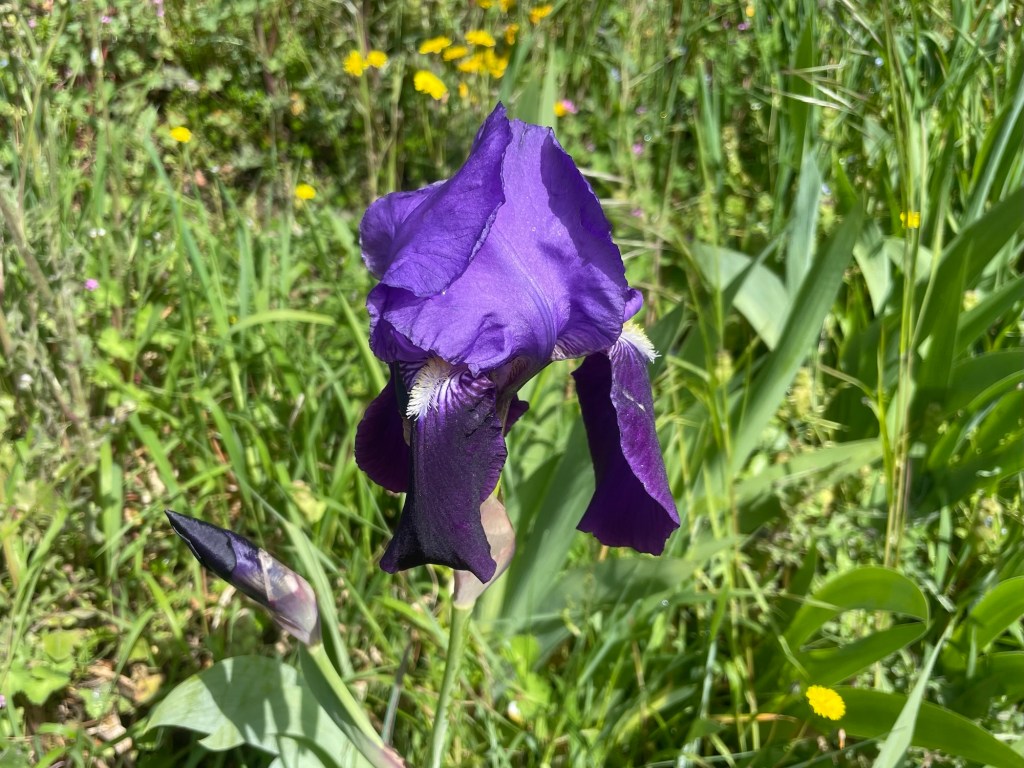
    A black goat bleated from behind an electric fence and out of the margins there emerged a wild iris, a vivid purple in the sun. A happy bee buzzed past and a couple of butterflies tentatively made their way back out into the sunlight after the rain

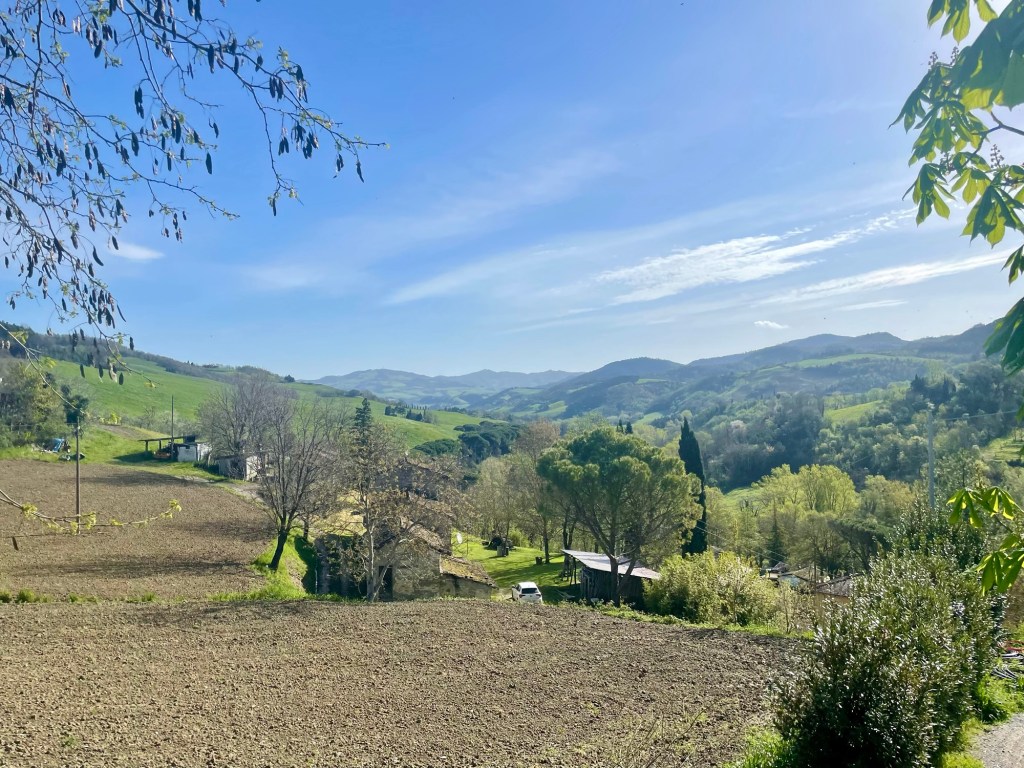
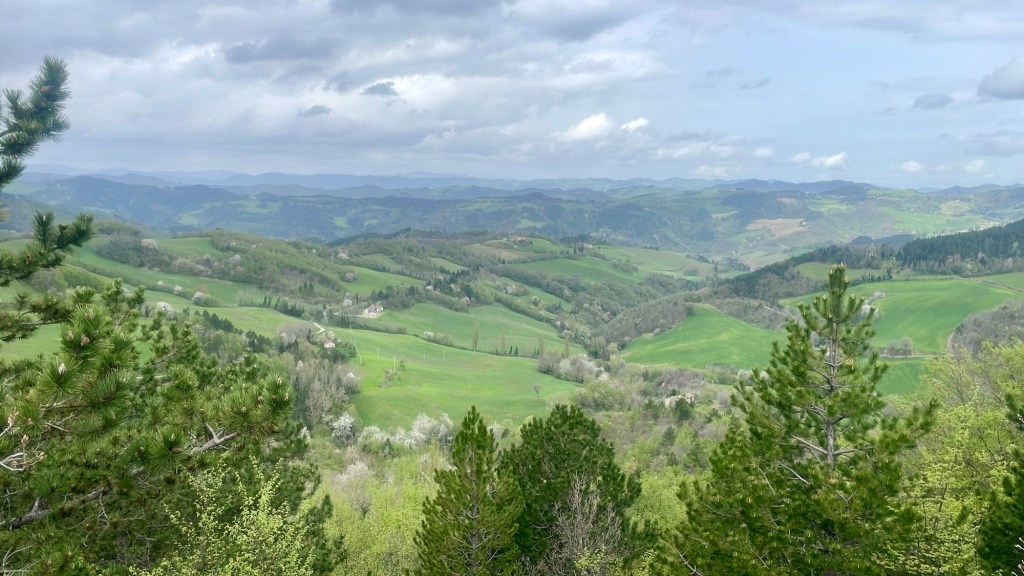
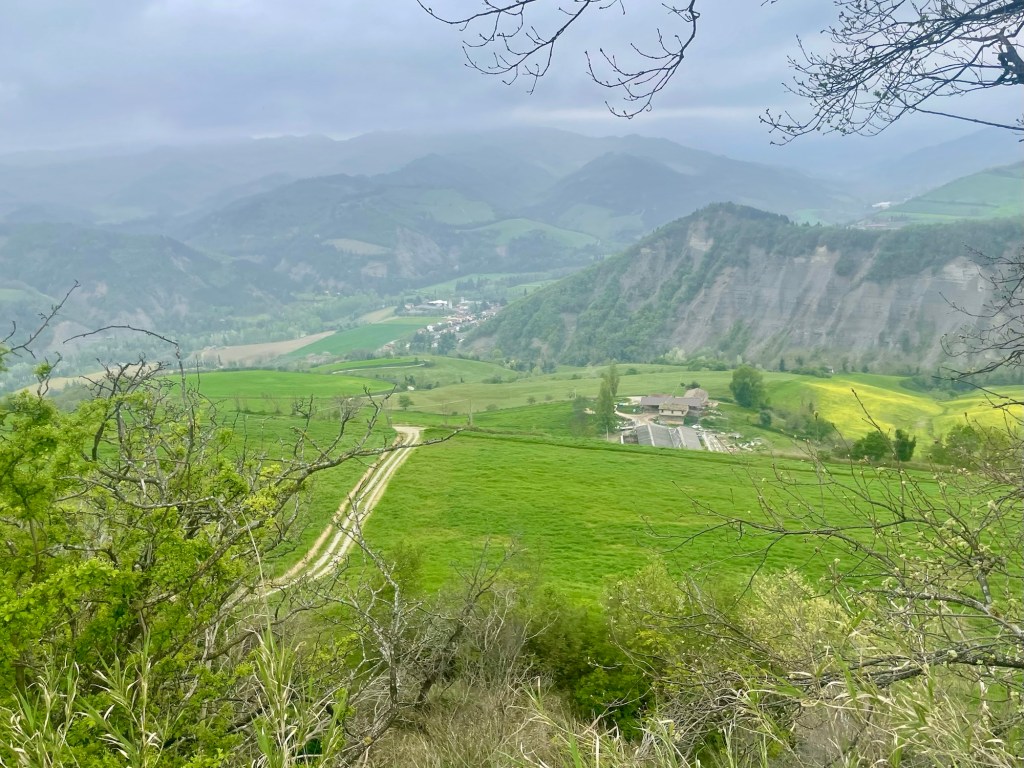
    It was a show and steady ascent with panoramic views of the town. Electric cables were strung across the landscape like fairy lights on a Christmas tree.

    A single stone house with a terra-cotta roof was nuzzled into the bosom of the rolling hills. 

    This image has an empty alt attribute; its file name is img_6971.jpg

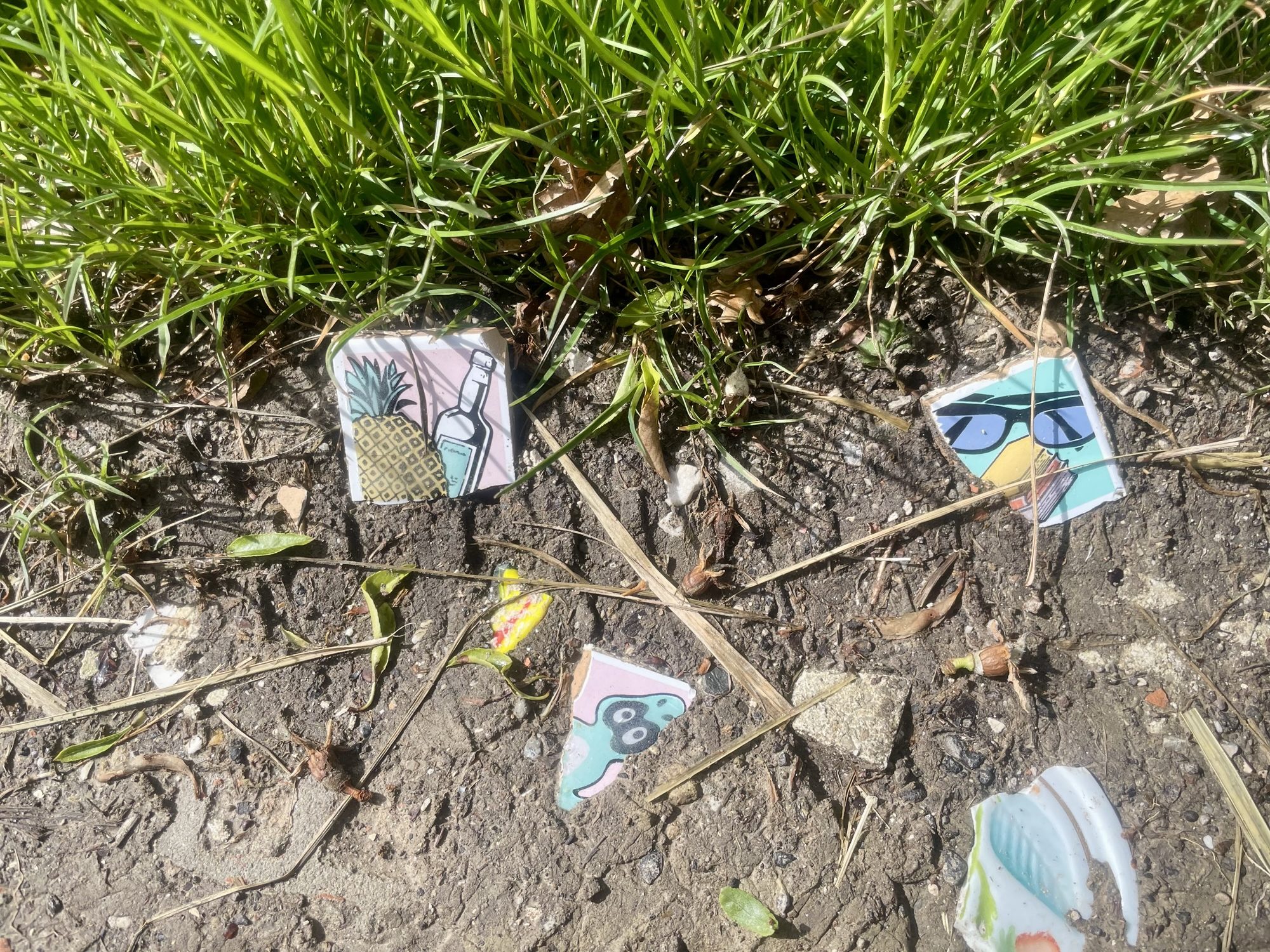
    The path was covered in more broken tiles that would have made for spectacular mosaic pieces had I only had the space in my bag: there was a flower, some sunglasses, a pineapple, pink, purple, yellow and green – perhaps we could adopt this method to fill the ubiquitous potholes in England. The Department for Transport had recently said that the local authorities’ road maintenance pot would be boosted by £500m from mid-April, but councils must publish annual reports detailing progress on potholes or lose a quarter of that extra funding.

    This image has an empty alt attribute; its file name is img_6983-edited.jpg

    I heard the familiar rustle of lizards and a frog jumped into the stream to the right of the road. But would the weather hold?

    I was making slow progress at about 4 kilometres an hour, unlike the cyclists who sped past me up the hill in their fifty shades of lycra. At one point the road was interrupted by a landslide, the asphalt shredded into black puzzle pieces. 

    My bag was definitely heavier than the recommended weight of 10 pounds and I was reminded of the proud penitents who carry heavy rocks on their backs in Purgatorio. The weight forces them to walk slowly, their bodies bent low to the ground. Dante compares the suffering of the hunched souls to the human figures (with knees to their chest and pained expressions) used in architecture to support a ceiling or roof. 

    ‘Just as one sees at times—as corbel for
    support of ceiling or of roof—a figure
    with knees drawn up into its chest (and this

    oppressiveness, unreal, gives rise to real
    distress in him who watches it): such was
    the state of those I saw when I looked hard.

    They were indeed bent down—some less, some more—
    according to the weights their backs now bore;
    and even he whose aspect showed most patience,

    in tears, appeared to say: “I can no more.

    Hairpin turn after hairpin turn, I proceeded up with my stash of coffee and a cachet of teabags. I was carrying two litres of water, Alina’s socks, my blue eyeliner, a Pokémon card and one tile fragment – the one with the pineapple – that I just hadn’t been able to resist picking up.

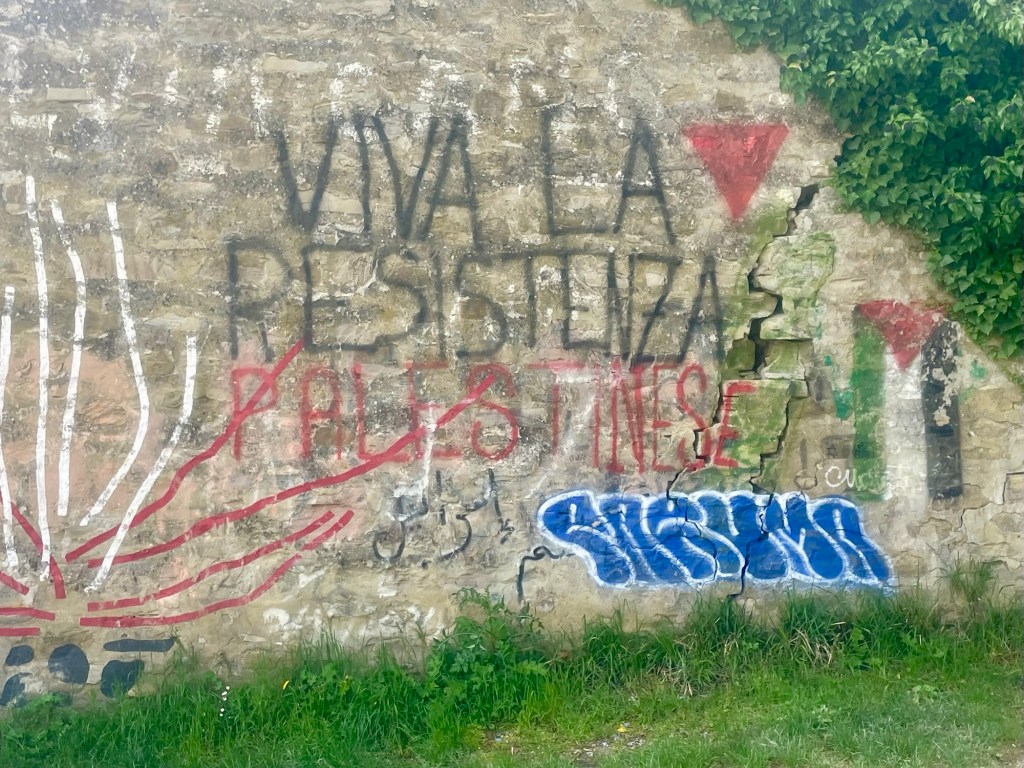
    On a wall there was graffitied ‘Viva la resistenza Palestinese‘ (long live the Palestine resistance).

    This image has an empty alt attribute; its file name is img_6996.jpg

    Unlike previous days where I’d been totally alone, today I passed a few individuals. I oscillated between ‘ciao,’ ‘salve’ and ‘buongiorno’ and people returned a friendly reply. 

    The village of Monte Busca announced itself by the sight of wheat and a display of orange flowers that did not appear wild. Here, potholes in the road had been filled with tarmac. A man sat outside a wood workshop eating a yoghurt next to a stack of abandoned crates. There were sweeping views on either side of the path.

    This image has an empty alt attribute; its file name is 3087a671-affa-4517-917a-7b8dbc498b38-1.jpg

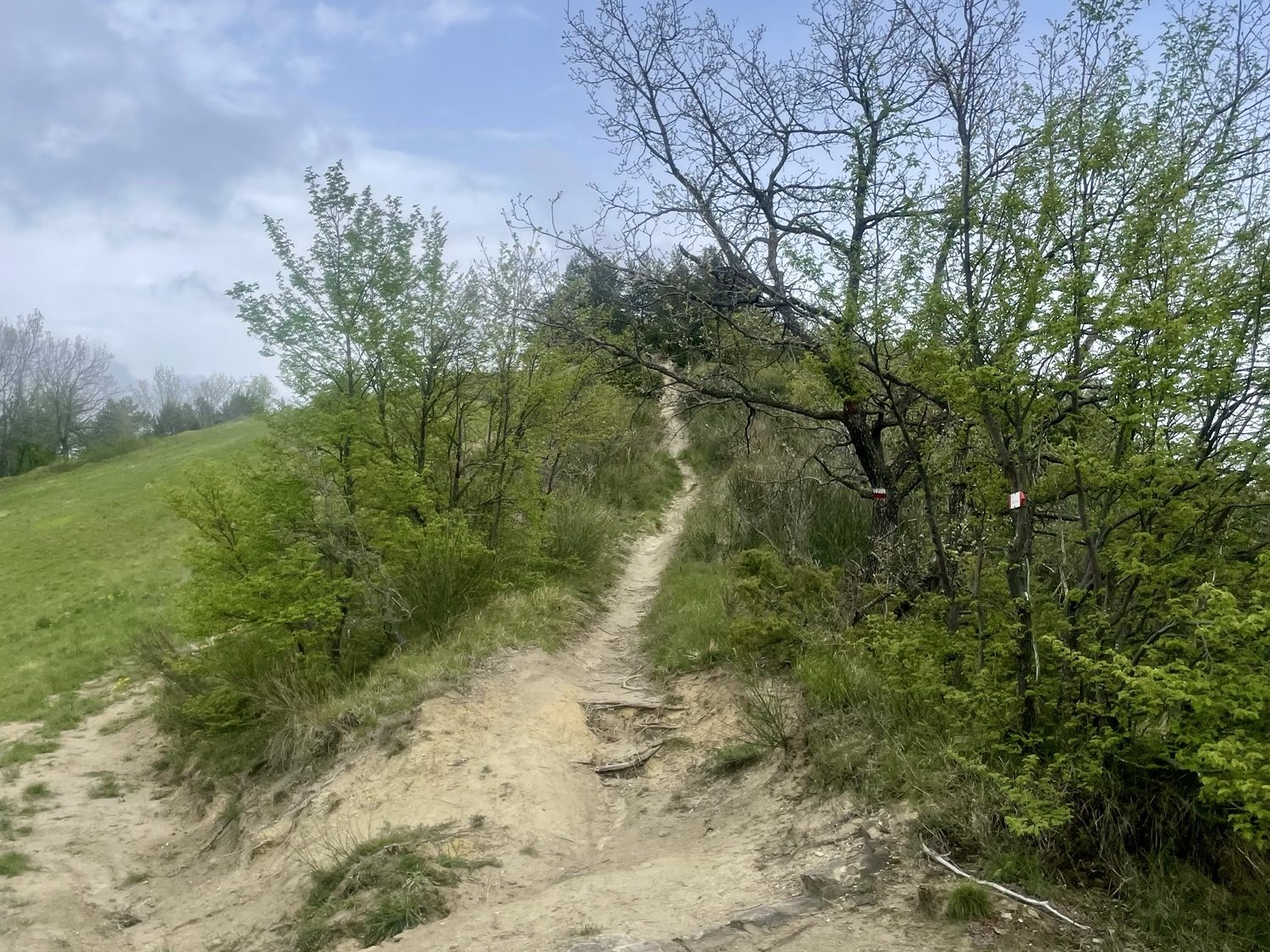
    Much thought has gone into this route so that, wherever possible, you are not walking on the road but it felt good to have my feet on solid ground. 

    The expansive green lawns that cascaded down the slopes reminded me of the quads of Oxford colleges, although these always came with a sign, ‘do not step on the grass.’ Here I could tread as I pleased. I thought back to the Wadham summer ball. At 6 in the morning a group of us had staggered out onto the quad in a rare opportunity to laze there for a while, hung over and cuddling one another for the fun of it all.

    The cloud started to hang heavy and I could smell the oncoming rain.

    By midday, I’d done 10 kilmetres. Since it was a long day, I was rationing my water intake. Thirsty, I bit into an apple and ate a cheese sandwich. As Dante writes also in canto 10 of Purgatorio, 

    ‘I was exhausted; with the two of us
    uncertain of our way, we halted on
    a plateau lonelier than desert paths.’

    Except now I was alone, walking with just the familiar sound of the cuckoo. It sounded like a child’s first notes on the recorder.

    My guidebook was still a little damp, though it had spent all night on the radiator.

    I snapped a nail heaving my bag back onto my shoulders. I hadn’t brought a nailfile and, though I’d gifted one to my twelve-year-old niece for her birthday, I didn’t have a Swiss army knife of my own.

    With my bag I was now also carrying a spider as a stowaway. 

    I disturbed a dandelion, sending the seeds into a little cloud.

    This image has an empty alt attribute; its file name is img_7047-edited.jpg

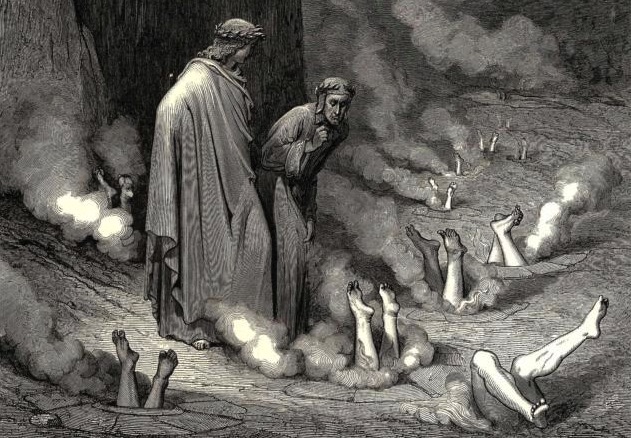
    The path went from asphalt to gravel to concrete to woodland. It was hard to walk past an agriturismo without stopping but I had to keep moving forwards. I stopped briefly to change my sodden socks for dry ones, a piece of advice my friend Craig from the local pub, Angel’s, had given me before I set off. My feet felt like they were on fire, bringing to mind the popes who are buried in holes by Dante with their feet in flames. 

    ‘Out from the mouth of each hole there emerged
    a sinner’s feet and so much of his legs
    up to the thigh; the rest remained within.

    Both soles of every sinner were on fire;
    their joints were writhing with such violence,
    they would have severed withes and ropes of grass.

    As flame on oily things will only stir
    along the outer surface, so there, too,
    that fire made its way from heels to toes.’

    This image has an empty alt attribute; its file name is the-inferno-canto-19.jpghalfhd.jpg

    Inferno 19 is the first full-fledged indictment of the Church in the Divine Comedy, picking up on some earlier indications that Dante associates the clerical establishment with the sin of avarice. He, like me, was not a fan of organized religion, or at least as it existed in its contemporary form.

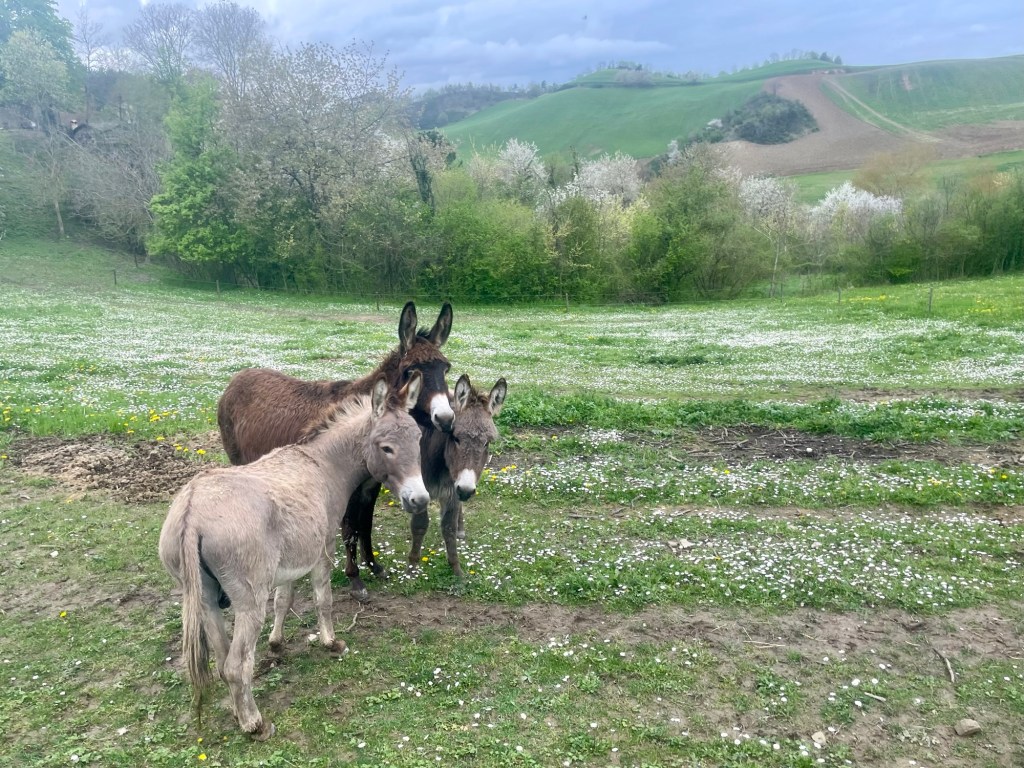
    I sat for a while and observed some baby donkeys. They had soft hair on their heads, fluffy like little chicks. I thought about the similarity of their hooves and my nail that had just snapped off and of how all things in nature are connected.

    The two calves hung close to their mother nuzzling her neck. One of them had a large penis that hung down. The other didn’t. One bit its mother’s mane playfully, and the mother nibbled the back knee of the lighter of the two which was coloured like ash.

    Mud stuck to their fur which was wavy, and their ears looked soft to the touch. They were pointing forward. Did that mean that they were happy or scared?

    This image has an empty alt attribute; its file name is img_7028.jpg

    I was reminded of a quote from Alice Walker’s novel, The Colour Purple, 

    ‘Whenever you trying to pray, and man plop himself on the other end of it, tell him to git lost, say Shug. Conjure up the flowers, wind, water, a big rock…The more I wonder, the more I love.’

    Tiny flies buzzed around puddles on the muddy woodland path which I tried to avoid in order to keep my feet some semblance of dry.

    Suddenly it became humid and I felt a twinge in my right buttock. I was tired from the uneven path and would be happy to get back on the road. Prickled by pines on the descent, I put one foot in front of the other on the narrow path like a tightrope walker. I got my foot caught in a bramble and nearly went tumbling

    I ate some almond cake and chocolate and worried that I hadn’t factored enough rest days to the return.

    At 2 o’clock the first rain came. I was counting the kilometers religiously on my phone, grateful for my solar powered phone charger. A beetle climbed onto my shoe. It was iridescent, despite the lack of sun.

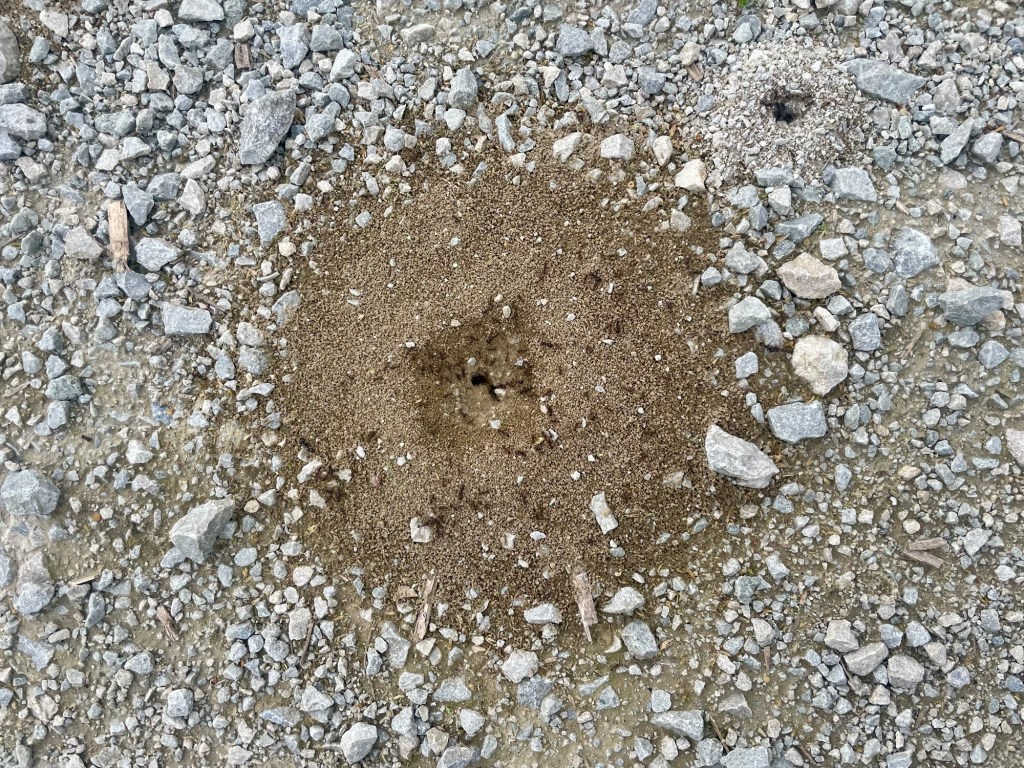
    Curious ants had burrowed minuscule holes in the ground and a yellow and black butterfly soared past me, the first I’ve seen of its kind. White and brown ones abound. 

    This image has an empty alt attribute; its file name is img_7317.jpg

    To the right, solar panels spilled over the landscape reflecting the light like strips of unraveled cassette tape. 

    I saw cows in a field which always reminded me of my dad and the game Spot It that we would play in the car as children. You had a series of cards with things to see on the road: a tractor, a yellow car, a phone box etc. Once my dad had taken a 2 kilometre detour via a fire station so that he could trump us with his fire engine card. 

    At 4 o’clock, the mist started to descend, and the top of the hills were obscured

    Haybales had been tucked up in tarpaulin and an abandoned piece of farming equipment was slowly rusting outside an old farmhouse.

    The cloud hung in heavy curtains, a blind folding down over the undulating hills.

    An bathtub containing water was propped up on the marsh by two pieces of wood. Daisies stretched out on their storks which were the length of a ruler.  

    This image has an empty alt attribute; its file name is img_7073.jpg

    I turned the corner and there it was, the village of Dovadola, with its winding path that would take me to shelter. The stark cliff faces were a mark of the ancient river that had forged the valley. Once again, the rocks were caged in to avoid landslides. As my earth sciences major mother had taught me, geology is the language of the land. 

    I heard the familiar sound of the church bell strike 5pm and felt a pang of hunger. I’d always liked the sound of church bells just like in Morocco and Syria I had so enjoyed the call to prayer. 

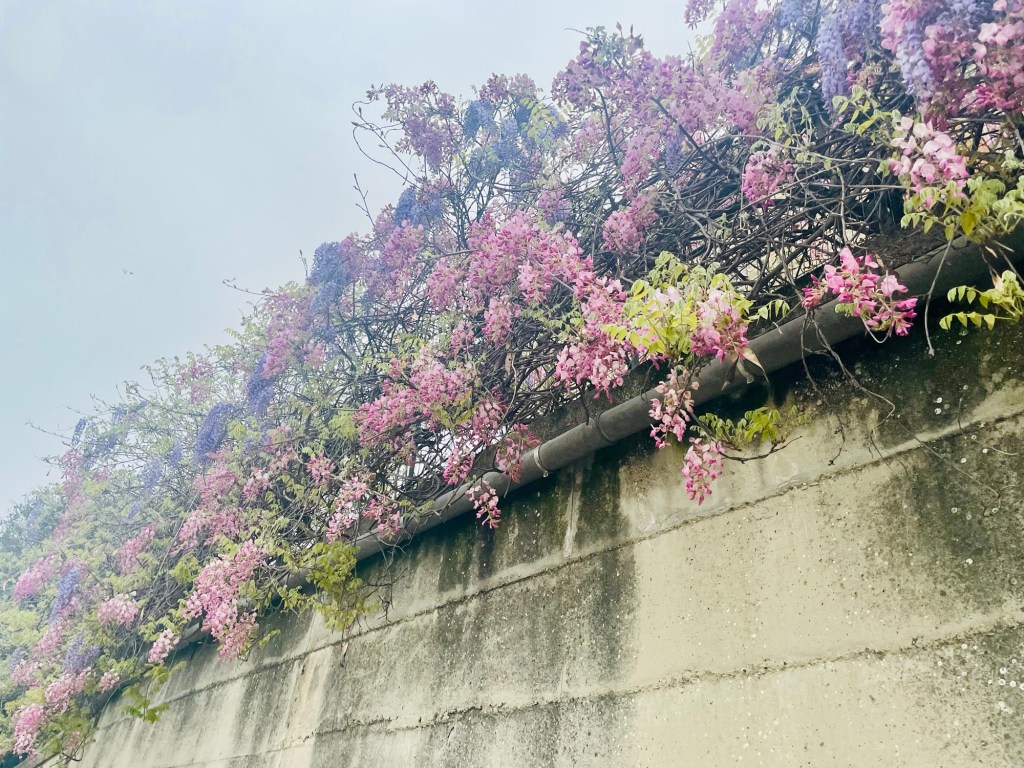
    Wisteria was hanging down from fences like bunches of grapes. The scent was something akin to the tiny round violet sweets that I would eat as a child. A three-wheel vehicle passed me. It was an emerald green. 

    This image has an empty alt attribute; its file name is img_7119.jpg

    I passed the FC Dovalda football ground and an older church in town with a medieval tower. Someone stopped to asked me if I was doing the cammino of Assisi but I explained that I was a secular pilgrim doing the Dante cammino. I was a pantheist and following nature as my guide.

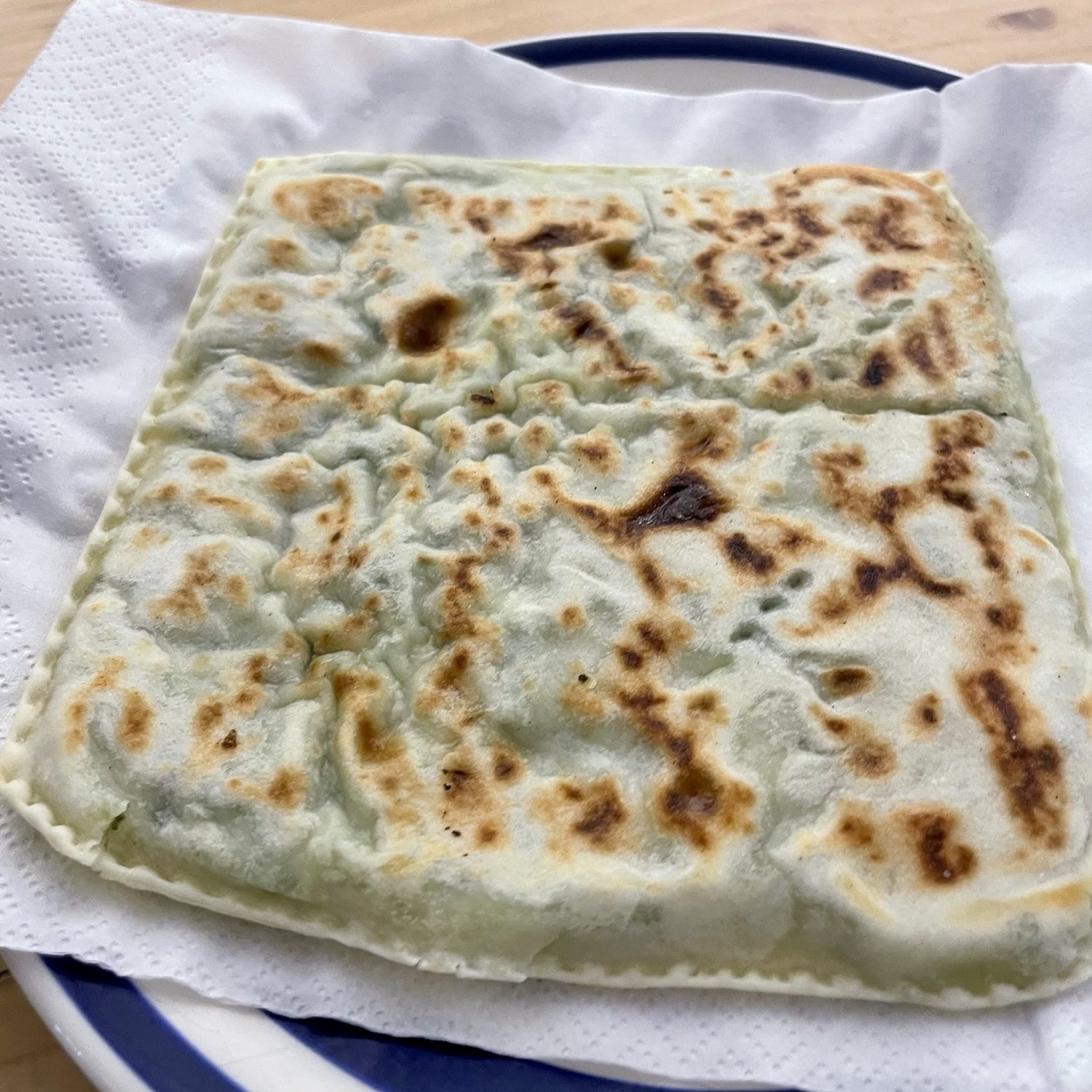
    I went into the to bar the Antica Osteria and had a delicious spinach and ricotta crecione. This regional plate is a folded piadina in the shape of a half-moon. It looks like one big piece of ravioli, or rather, a raviolo

    This image has an empty alt attribute; its file name is img_7084-edited.jpg

    I was self-conscious that I smelt but the atmosphere in the joint was intoxicating. An older lady sat in the corner peeling plastic labels off a new set of plates. A little girl called Lucia was dressed as Snow White and sat terrorizing a black cat. 

    ‘It’s from the Befana!’ she shrieked, alluding to the old witch who brings sweets on the epiphany according to Italian folklore.

    Another group of kids hung about in a gaggle around the ice cream freezer. Outside the adults were smoking. One of them had a beautiful wolf-like dog called Deni. After spending the day walking alone it was nice to be in company and I stayed and talked awhile.

    I brought some cheese, tomatoes, dates, a big apple, pistachio nuts and some much-needed hair conditioner from a local store and continued with the next 50 minutes down the busy road to my agriturismo. 

    I passed the sign to Loch Ness fishing zone and a petrol station. In Italy they put in the petrol for you, so you don’t even have to exit your car for a fill up. 

    This image has an empty alt attribute; its file name is img_6974.jpg

    I already missed being up in the hills with the wildflowers. I thought back again of Oxford and how I’d religiously learnt all their names in translation. We had had to learn an insane amount of very specific vocabulary in French and Italian. I still have a cushion my friend Caroline sewed for me with the opening phrase from our French translation exam,

    ‘You are the most wonderful hippogriff.’ 

    Now I’ve been here a week, I’ve started thinking in Italian.

    The final leg involved another steep ascent along a winding road. I tried to channel the spirt of Virgil as my guide. As Dante writes when he finally reaches the slopes of Mount Purgatory, leaving Hell behind: 

    ‘The climb had sapped my last strength when I cried:
    “Sweet Father, turn to me: unless you pause
    I shall be left here on the mountainside!”

    He pointed to a ledge a little ahead
    that wound around the whole face of the slope.
    “Pull yourself that much higher, my son,” he said.

    His words so spurred me that I forced myself
    to push on after him on hands and knees
    until at last my feet were on that shelf.’

    This image has an empty alt attribute; its file name is img_7131.jpg

    Thus I arrived in the Airbnb, Naturaliterre BnB – Microfattoria, a sweaty mess.

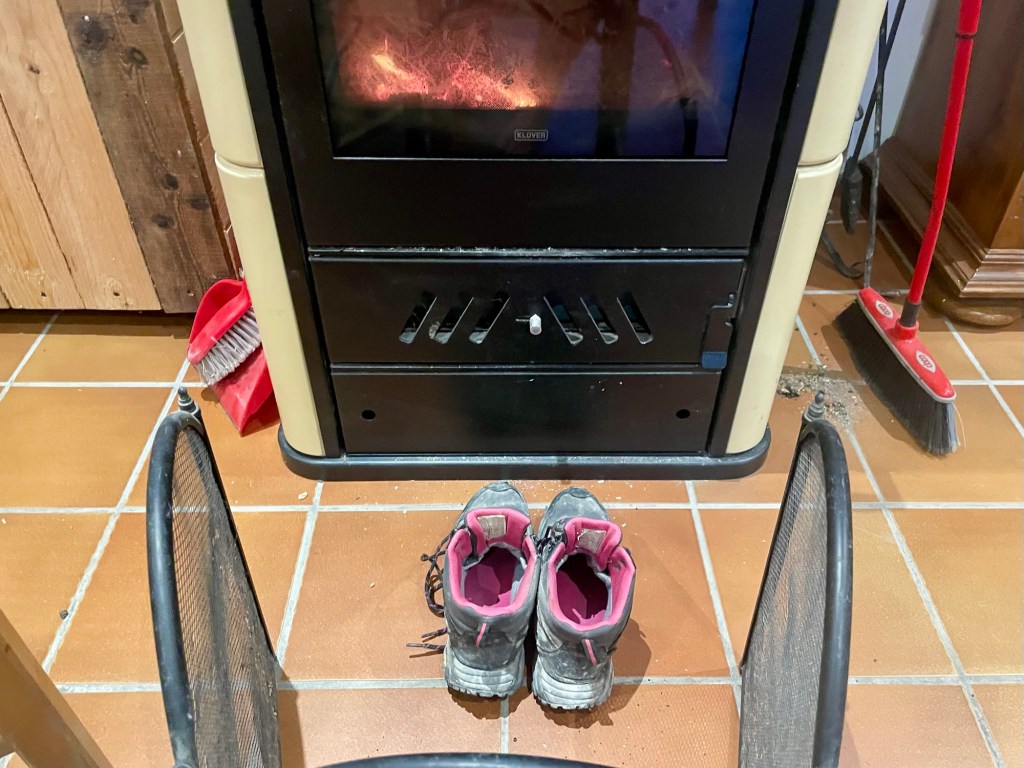
    I was greeted by Benjamin, a kind French host who ordered me a pizza and put my boots by the fire. I checked my email to see that I had received a beautiful note from Anna in Montemignaio. There is so much love on this cammino. I feel held by the path itself. 

    Another email to my work account reminded me to finish a funding application this week and for once I felt inspired and up to it. I’d been holding myself back because of confidence, but if I could do this hike, I could do anything.

  • Who will Guide Me on the Dante Trail? 

    Though it is my most prized possession, here’s why I will be leaving my copy of the Divine Comedy behind.

    On my training walk today, I experimented with carrying in my rucksack the contents I’ve been carefully curating for the Cammino di Dante

    It includes: a fistful of Compeed blister plasters, a bamboo toothbrush with the end sawed off (thanks Jess for that top tip), two changes of clothes, four pairs of socks and knickers, a solar powered power pack and my laptop. My indulgences include some Ayurvedic balm from Sri Lanka and a collapsible hairbrush. 

    I always fancied that if I was invited onto the BBC programme Desert Island Discs, I’d take some essential oils with me as my luxury item because smell has a huge Proustian impact on my disposition. It’s enough to sniff some Rose Herbal Essences shampoo and I’m back in Calcutta showering away a difficult day spent with street children at the age of 18. 

    The Ayurvedic balm, meanwhile, reminds me of turquoise waters and golden sands and the month I spent training to be a yoga teacher in Sri Lanka last year. The sense of peace that comes with the inhale and exhale of a perfectly realized ‘cat-cow’. I figure I’ll need some of that as I walk, not to mention the healing properties it will grant to aching limbs.

    When one of my favourite journalists, Lyse Doucet, the BBC Middle East war correspondent, featured on Desert Island Discs she also took essential oils as her luxury item. ‘Cool,’ I thought. I have something in common with Lyse Doucet. 

    But I’m avoiding a major dilemma. 

    I’ve been to-ing and fro-ing about whether to take with me on my hike my much thumbed and much annotated copy of the Divine Comedy.

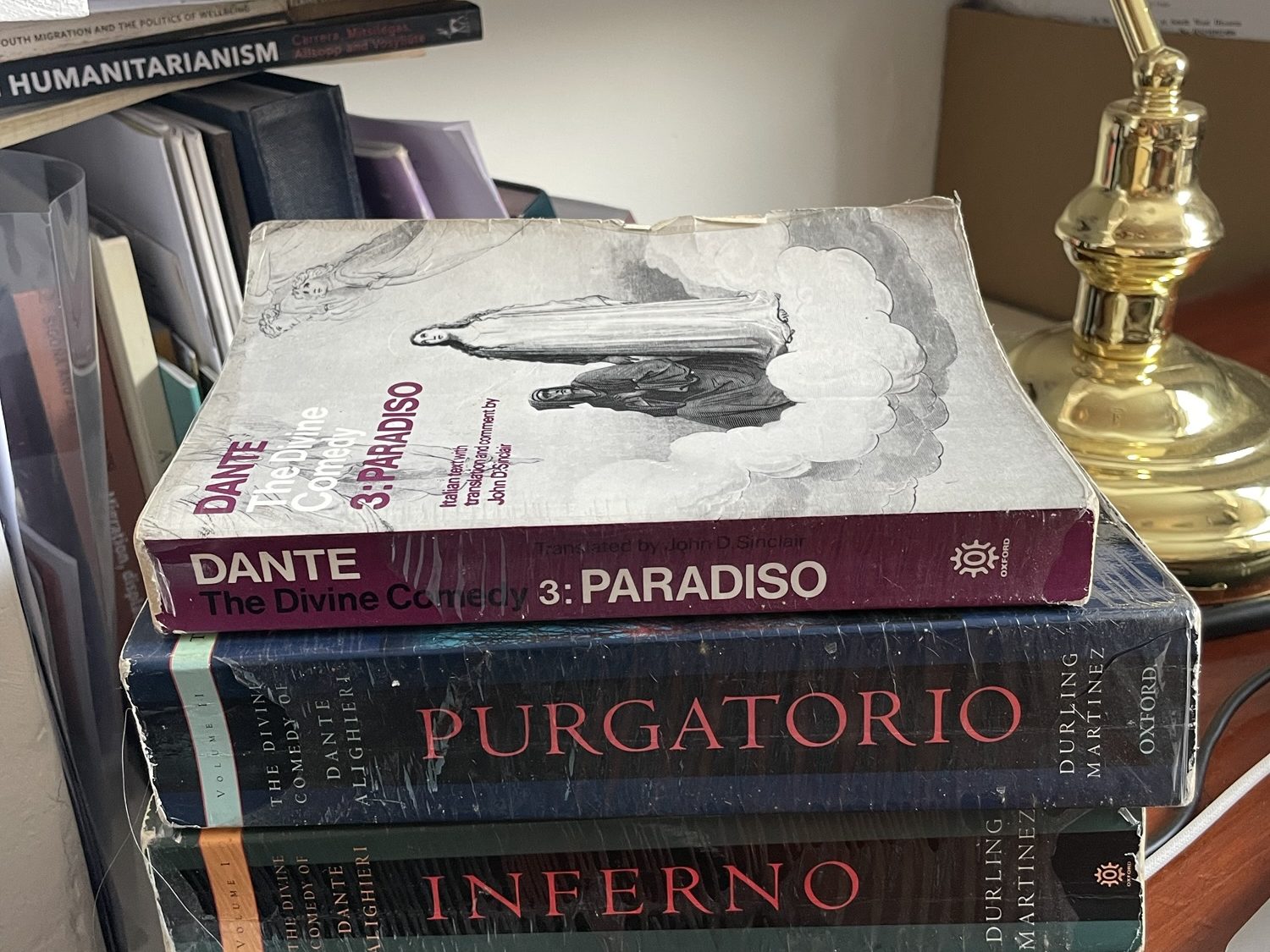
    It sits pride of place in my office in three heavy tomes. 2kg of magic. That’s  a lot for a pilgrimage of 235 miles through the mountains of Tuscany and Emilia Romagna. 

    On my travels, I’ve almost always taken these three books with me: Inferno, Purgatorio, Paradiso. While many people are fixated on Inferno – see the Dante’s Inferno video game which perversely sees Dante rescue Beatrice from Hell –  for me, Dante’s journey is definitively a comedy in three parts that traces a journey from darkness and stagnation to light and unfettered mobility.  

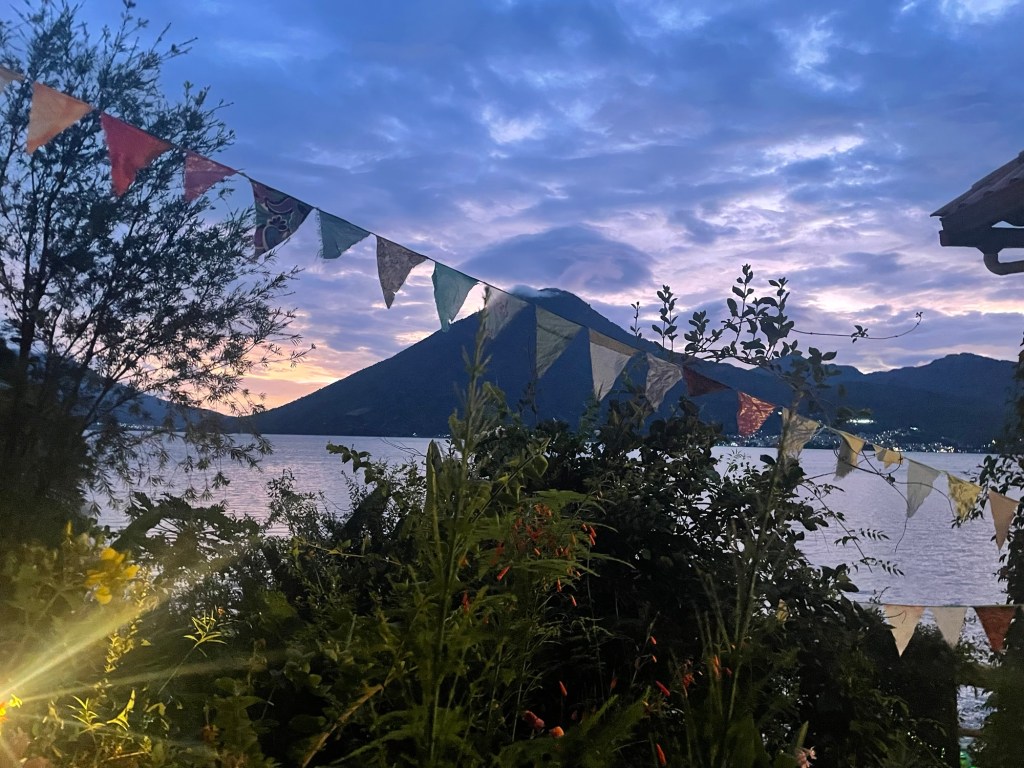
    When the pandemic hit, I got stuck in Guatemala for five months and luckily, I had the books to keep me company. I was living in the US at the time and had gone for a one week writing retreat. When Trump closed the border to foreigners like me, rather than return to England, I was invited to stay with the writer, Joyce Maynard, and pianist, Xiren Wang in a lakeside house. 

    One evening as the sun set I performed for them the canto of Ulysses with a volcano in the background for added dramatic effect. 

    ‘You were not made to live like beasts, but to follow virtue and knowledge!’ I decried, embodying all of Ulysses’ pride. 

    One of my annotations reads, ‘Ulysses is Dante’s alter-ego? Am I Ulysses!?’ 

    His tale of defiantly leading his sailors on past the straights of Gibraltar in the face of danger is a warning to all of us who seek to travel to stretch ourselves. I’m sure during my walk I will turn to this passage to push me on but also to ground and console myself when I reach my limits. 

    Dante writes of Ulysses:

    ‘neither the sweetness of a son, nor compassion for 

    my old father, nor the love owed to Penelope, which

    should have made her glad, 

    could conquer within me the ardor that I had 

    to gain experience of the world and of human vices and virtues’.

    (Canto 26, Inferno)

    I can relate to this desperate thirst for knowledge, this desire to ‘trapassar del segno’ – to push beyond the boundary. It’s a blessing and a curse. 

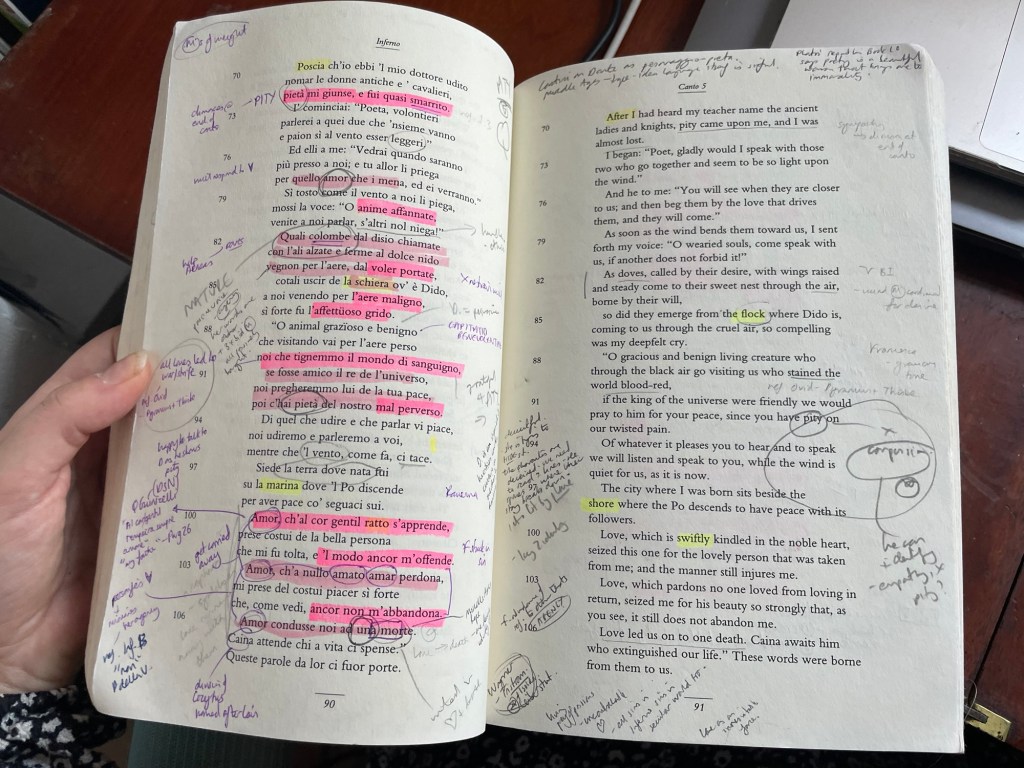
    There are at least six different rounds of annotations that I’ve made as I’ve read the Divine Comedy at various stages of my life which are revealed in different fonts and coloured inks.

    My first galloping foray through the pages was at the age of 15 when much was inaccessible to me. Still, I swooned at the love story between Paulo and Francesca who were banished to forever spin in a whirlwind of lust in Hell. Their crime: an illicit kiss inspired by their reading of the story of Guinevere and Lancelot. My pencil scrawl reads: ‘love and literature – you lose yourself if you read for pleasure’. 

    Next are the meticulously crafted notes and highlighted sections from lectures at Oxford where I studied Dante under the expert guidance of Manuele Gragnolati. In a recent article he writes, ‘what does my Europe look like? Like Dante’s: the dream of a more just world’. He speaks about the nomadism that captured him, much like it did me, and inspired an academic career that traversed the world. I had just enough time to lock up my bicycle and dash the steps of the grand Taylorian Library on my first day of lectures to hear him boldly state: 

    ‘Get ready because Dante is a whirlwind!’

    He wasn’t wrong.

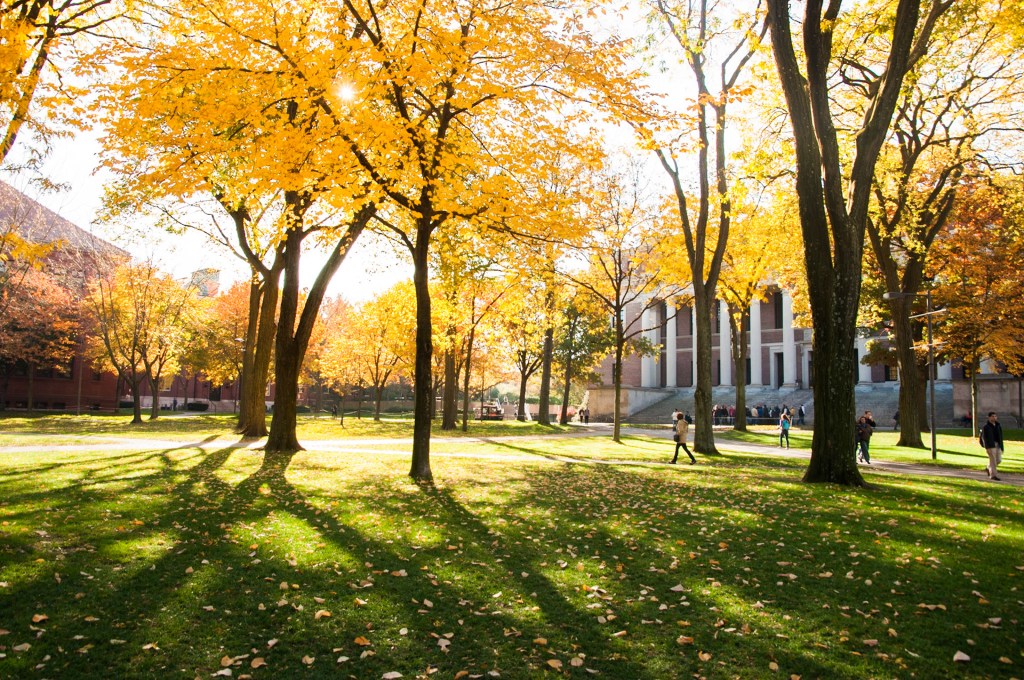
    The next round of annotations, in purple pen, comes from reading Dante in Harvard Yard with Ambrogio Camozzi Pistoja. Autumn leaves swept up in the wind would settle at our feet as we read cantos aloud together as tourists circled the Widener Library. ‘It was founded by a woman who lost her son on the Titanic’, the student guides would repeat as their cotton Harvard scarves flapped in the breeze. 

    I was based at Harvard to set up a new Immigration Initiative, but on Thursday afternoons I would sneak out of my office to audit seminars on the Divine Comedy. Ambrogio, like me, showed particular sensitivity to the plight of Virgil, Dante’s guide through Hell.

    You see, Virgil is swiftly abandoned as Dante moves through Purgatory. Dante is willed to continue his journey to Heaven, but as a non-Christian, Virgil is condemned to return to Limbo. 

    ‘But Virgil had left us deprived of himself –

    Virgil, most sweet father, Virgil, to whom I gave

    Myself for my salvation’

    (Purgatorio, canto 30)

    This reading made me sensitive to Dante’s liberal use of guides throughout his journey. The iconic literary figure of Virgil is to Dante as Dante is to me. But ought I not open myself up also to be led by other guides?

    In the poem, the pilgrim Dante is accompanied by three guides: Virgil, who represents human reason, and who guides him for all of Inferno and most of Purgatorio; Beatrice, who represents divine revelation in addition to theology, grace, and faith; and guides him from the end of Purgatorio onwards; and Saint Bernard of Clairvaux, who represents contemplative mysticism and devotion to Mary the Mother, guiding him in the final cantos of Paradiso.

    My annotations as Dante abandons his first guide, in no particular order, read, 

    1. ‘WHAT? What about Virgil?’
    2. ‘Dante cries as Virgil leaves – and he’s not the only one!’
    3. ‘The paternal authority of Virgil is replaced by the maternal authority of Beatrice. Dante feels intense emotions.’

    Dante’s intensity of emotions is just one of the reasons his text so resonates with me.

    I felt angry at Dante the author for abandoning his guide. Why could Virgil not have found the same repentance he does?

    In Purgatory, Dante works miracles so that Cato can be saved, arguing that the Roman political figure of the first century B.C.E. who committed suicide was a proto-Christian who wasn’t held accountable to Christian beliefs against suicide. While many who committed suicide are condemned to an eternity as gnarled trees in Hell, Cato gets a get out of jail free card. Why? Because Dante could. It was his narrative, just as this blog is mine.

    And thus, Virgil is condemned to return to Hell as Dante continues his journey under the tutelage of a new guide. 

    What can all of this tell me about my own reliance on guides as I walk in Dante’s footsteps? Who will guide me on the Dante trail?

    For one, though I am embarking on this journey largely alone, I will be joined at the start by a Ukrainian friend and former student Alina. Halfway through I will be briefly joined by an American marine biologist, Kelsey, who will meet me in Forli. So, I guess, I too, will dabble in the dealings of disposable guides. And who knows who else I will meet on my journey. I penned a list of ‘things I am scared of’ for my therapist Hugh, and among them was ‘I will meet someone annoying who insists on accompanying me’. 

    ‘But that’s great stuff,’ came Hugh’s mirthful reply. ‘well, I mean, it will make for compelling reading…’

    But the real guide for my pilgrimage is my text of the Divine Comedy itself. With 20 years of insight into both Dante and my developing mind in the form of annotations it is among my most prized possessions. 

    Once, in Florence, I had my bag stolen with my copy of Inferno inside. I cried my way through Florence’s multiple police stations until my bag finally emerged with the text still inside. Forget the 200 euros taken with my wallet. I heaved a huge sigh of relief that my copy of Inferno was found. The police were somewhat baffled as I hugged it to my chest. 

    ‘Dante means the world to me,’ I said. 

    One was amused and gave me a piece of apricot tart. 

    ‘Yes, Dante is pretty special. It’s unusual for a foreigner to realize it.’ 

    The reaction of most Italians to my obsession with Dante is bewildered appreciation and curiosity. 

    But alas. I have returned with aching shoulders from my hike today – cue Ayurvedic balm – and made the difficult decision that I will not be taking my precious copy of the Divine Comedy with me on Monday when I set off.

    The reason? Primarily, it is simply too heavy to carry 235 miles.

    And secondly, while I am curious about my annotations over the years, I want to re-discover Dante afresh now, as a 37-year-old woman who is in the ‘middle of the journey’ of her life.

    As I set off like Ulysses ‘to gain experience of the world and of human vices and virtues’, may I be open to be guided by something or someone new. 

    Recommended listening, Lyse Doucet, Desert Island Discs: https://www.bbc.co.uk/programmes/m0013yzs

    Recommended viewing, Lake Atitlan Writing Workshop | 8 Women in Lockdown in Guatemala: https://www.youtube.com/watch?v=9gfnZNnlvdk