The town of Castrocaro Terme offered interesting street art and engaging conversation, but a strange encounter with a dog left me melancholy.
In the night we’d been visited by a storm which had brought with it thunder, lightning and heavy rain and so, over a breakfast of delicious fresh yoghurt, apricot jam and honey, I talked with Benjamin and Michaela, his partner and co-host, about the perilous weather in the region.
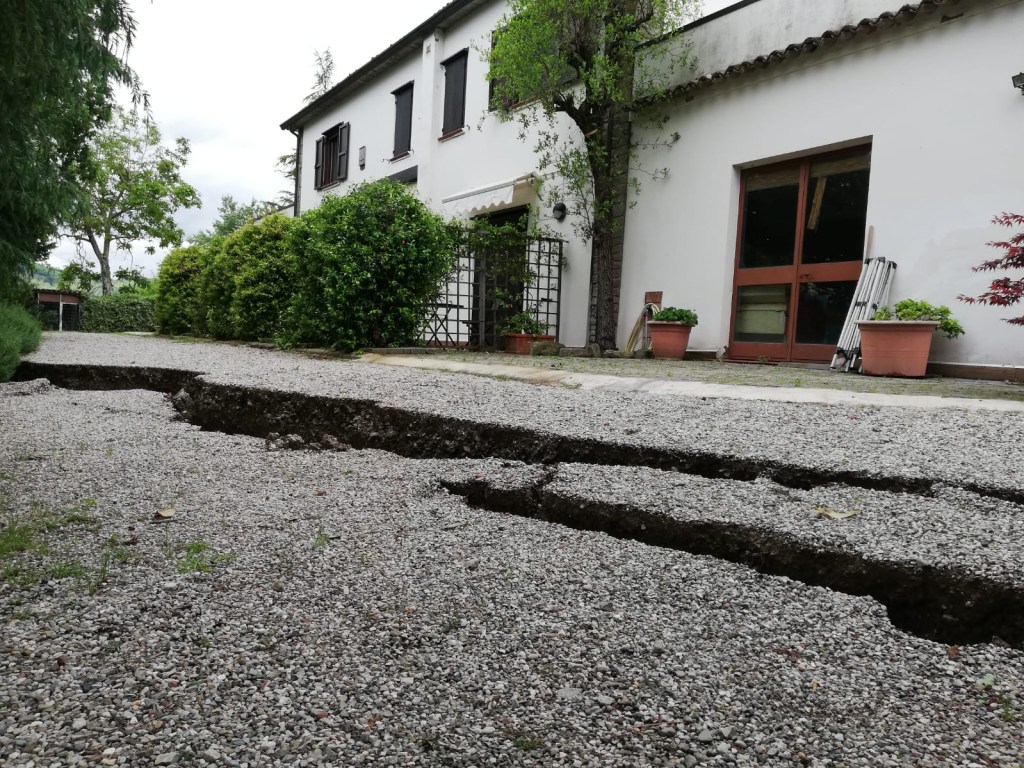
Mud slides and flooding had occurred in May of 2023 and an earthquake had struck in September of the same year. Their driveway had been split in two. In Faenza the river had broken its banks and Montemignaio had been cut off completely for 10 days. Two people had lost their lives.
Michaela showed me images on her phone – they were catastrophic.
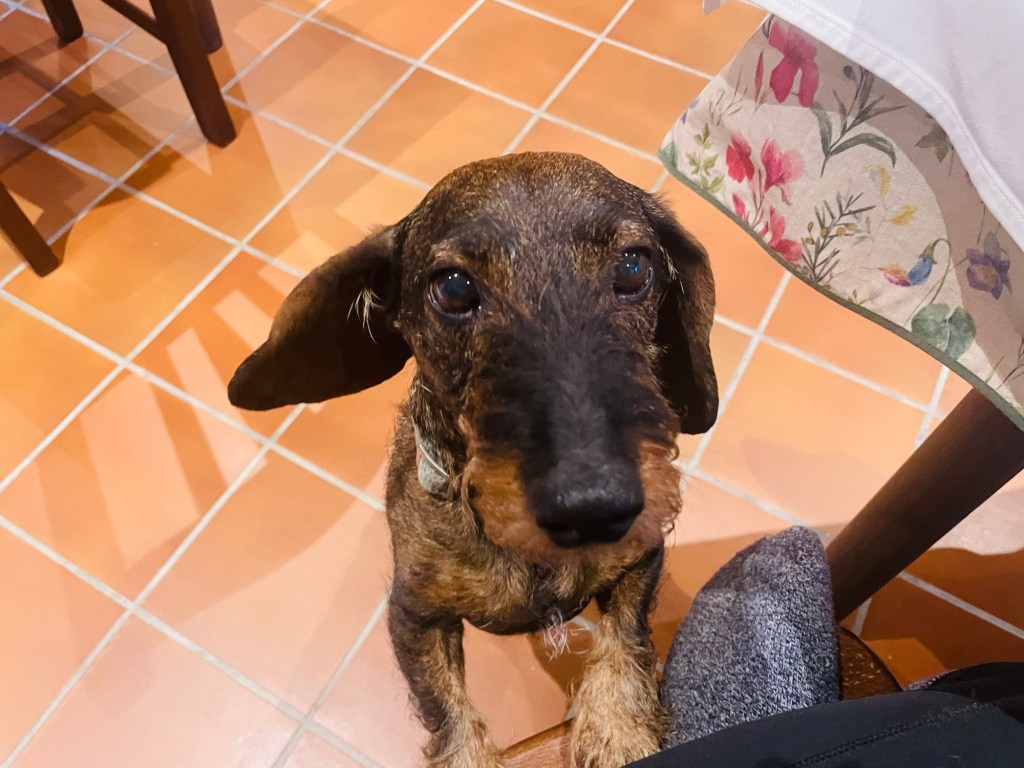
Pepe, their small black dog, licked my hand, insinuating that he would be thrilled to share my breakfast thank you very much.
I’m not a big dog person and during this cammino I have been quite scared on occasion at the ferocious barking that greets you when you pass by houses in town and country alike.
They have, affixed to their gates, the sign, ‘beware of the dog.’
Michaela who is an interpreter fluent in Italian, French and Spanish explained that her and Benjamin spoke to one another and their two female children in French but that the dog was Spanish.
‘Pepe, ven aquí!’
I felt comfortable in this plurilinguistic environment and spoke to the dog in an accented Spanish that I had learnt in Cuba at the age of 19.
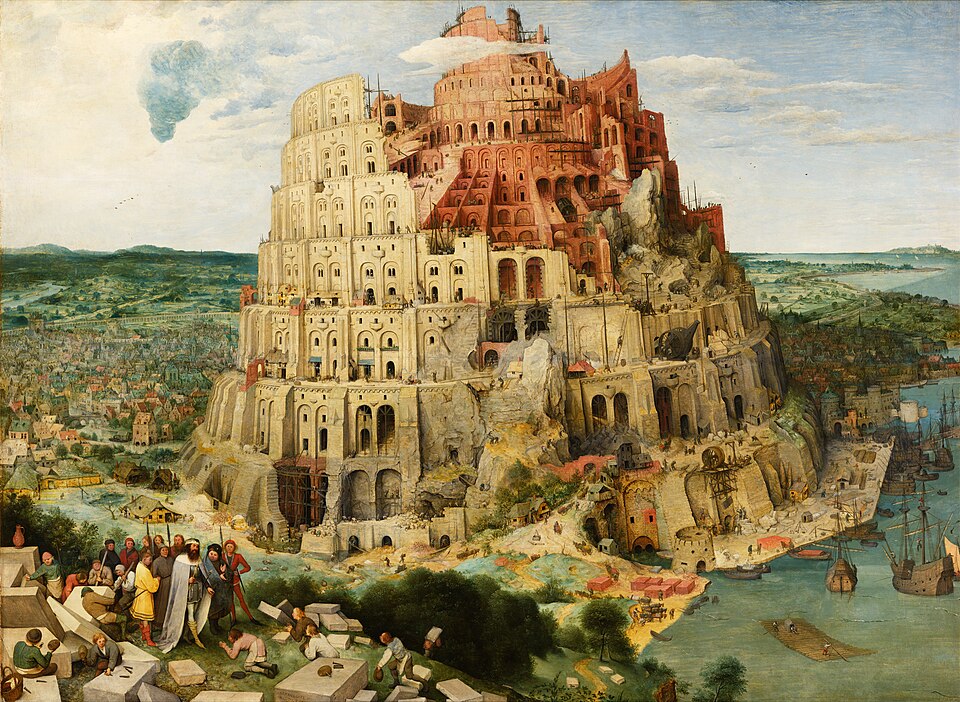
In canto 31 of Inferno, Dante offers an explanation for the world having multiple languages, or a ‘confusion of tongues.’ As was church doctrine at the time, he sees it as a punishment for the construction, by Nimrod the giant, of the Tower of the Babel through which he sought to reach God and glory.
‘He is his own accuser;
for this is Nimrod, through whose wicked thought
one single language cannot serve the world.Leave him alone—let’s not waste time in talk;
for every language is to him the same
as his to others—no one knows his tongue.’
It is said that this tower was destroyed by an earthquake,
‘No earthquake ever was so violent
when called to shake a tower so robust’
The Tower of Babel is the subject of three stunning paintings by the Dutch and Flemish Renaissance painter Pieter Bruegel the Elder.
According to the principle of contrapasso whereby the punishment is an inversion of the sin, Dante punishes Nimrod not with linguistic diversity, as in all previous versions of the story, but by assigning him a non-language that communicates non-sense.
As the Dante critic Teodolind Barolini explains, the social analogue to the linguistic fall is betrayal: the misuse and corrosion of the bonds that tie humans into social and familial consortia.
After the terrible weather events of 2023, Michaela and Benjamin had taken in two donkeys who had been displaced. Their names were Socrates and Augustine.
I passed them and saluted them as I set off on my way. Ducks were quaking in the reservoir as I descended the hill at 11:30am. The rain was spitting.
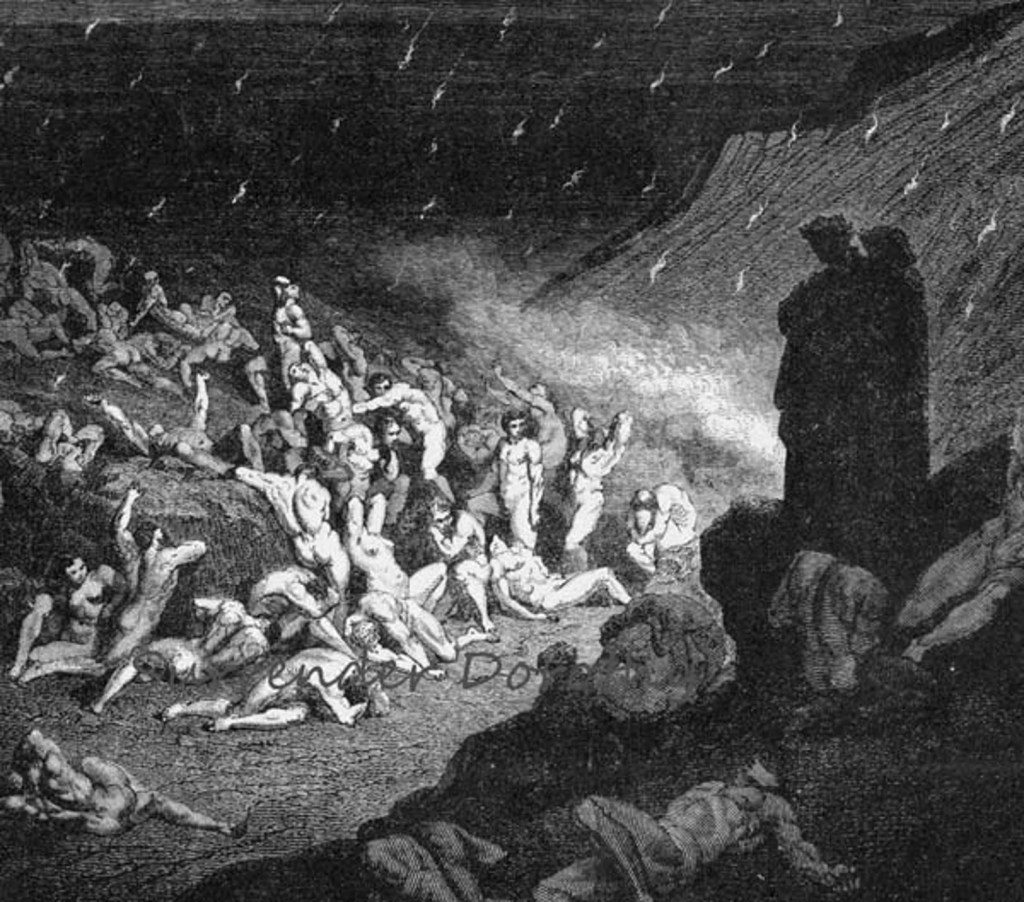
Dante includes rain among the punishments for the violent against God, nature and art in canto 14 of Inferno, although his is a rain of fire. The arid desert of the third ring of the seventh circle is compared to the African deserts trod by Roman Cato, and Alexander the Great is evoked as having experienced in India a similar rain of fire:
‘Above that plain of sand, distended flakes
of fire showered down; their fall was slow—
as snow descends on alps when no wind blows.Just like the flames that Alexander saw
in India’s hot zones, when fires fell,
intact and to the ground, on his battalions,for which—wisely—he had his soldiers tramp
the soil to see that every fire was spent
before new flames were added to the old;so did the never-ending heat descend;
with this, the sand was kindled just as tinder
on meeting flint will flame—doubling the pain.’
The rivers of Hell, meanwhile, Virgil informs Dante, are created by the tears of the Old Man of Crete.
It was cold and so I was wearing my yellow striped hoodie under my anorak, the only thing that I had left in my backpack that was dry.
I had washed my hair with the conditioner I’d purchased yesterday and tied it in two braids that hung down my neck. I’d put nardo oil on my feet before the plasters. I was getting short. I’d have to buy more in Forlì.
I walked along a road for 15 minutes feeling anxious of the speeding cars. The clouds were bulbous and pregnant with rain.
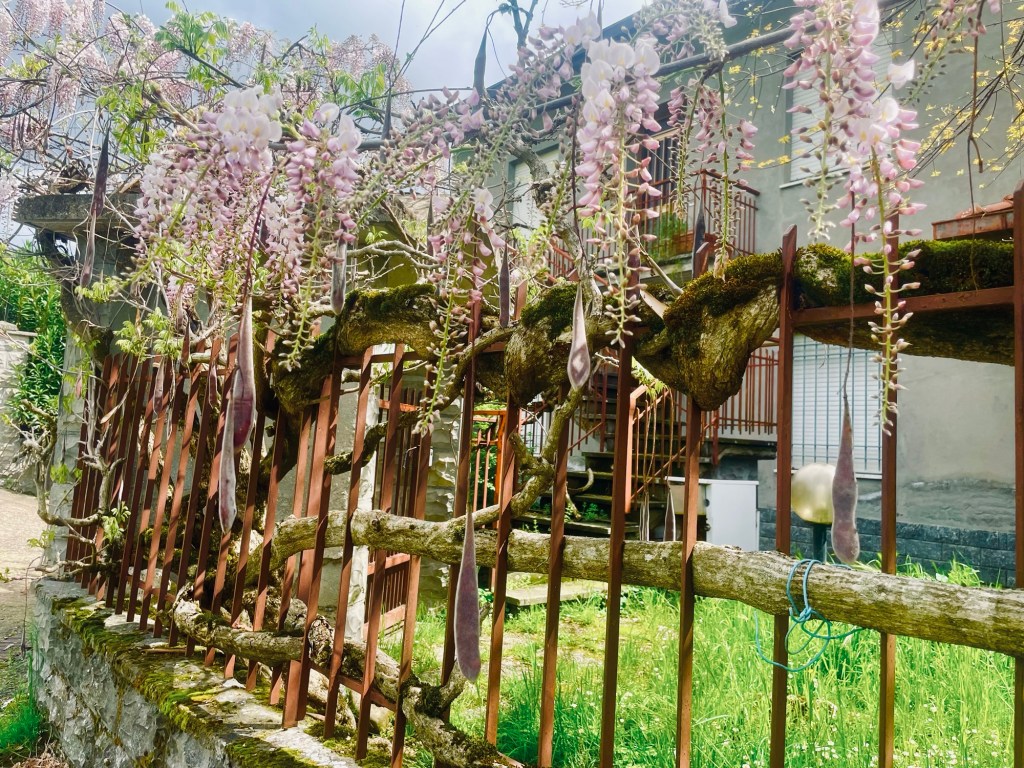
Soon the roar of the lorries was replaced by that of the river and I proceeded to a more tranquil trail. Wisteria pods hung off their stems like runner beans. They were soft to the touch like donkey ears.
I wondered why on earth I’d packed two pairs of shorts.
I passed by vines which were contorting their limbs on one side of the path and, to the other, olive trees were bunched together, a dusty green.
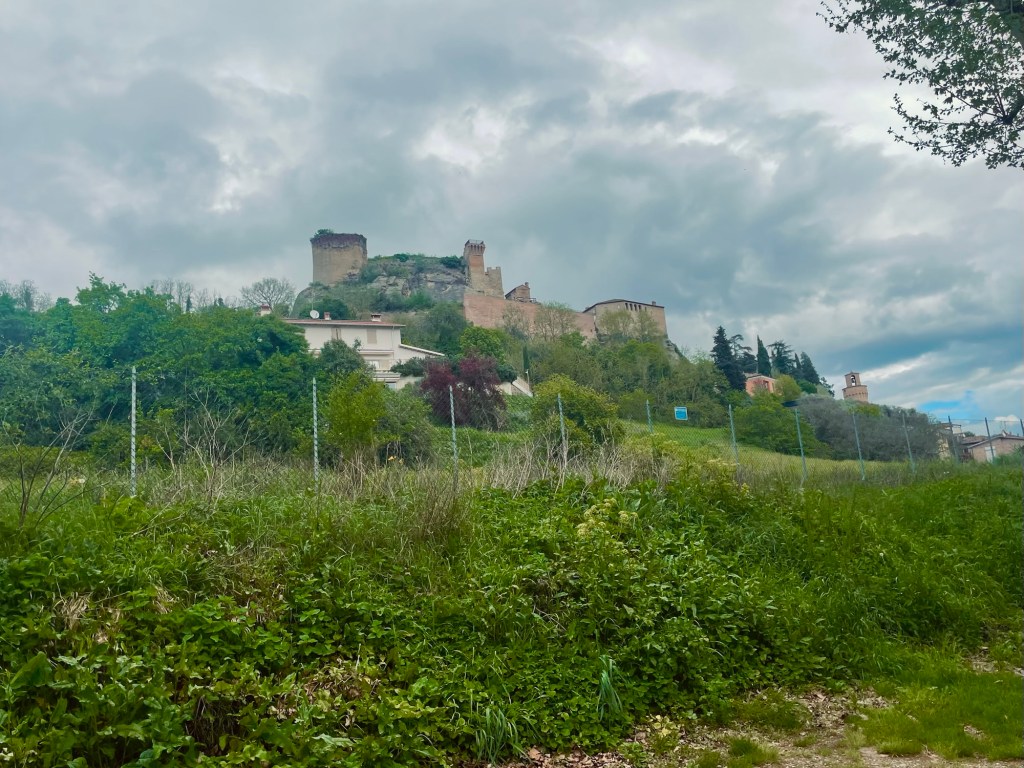
Soon I entered the town of Castrocaro Terme which is known for its healing thermal waters. The fortress towered over me. The greenery on its top looked like a toupee.
An acer tree thriving in the ground told me something of the composition of the soil. A DHL delivery driver in a yellow van was playing drum and bass.
The first café I tried for lunch was closed – of course, it was a Thursday? But in a little square I found a bar outside of which an elderly man was coughing over a thick cigar.
As I ate a mozzarella and rocket sandwich which had been freshly prepared, we got chatting. His name was Silvano which means ‘man of the woods.’ When I explained about my cammino he began citing canto 3 of Inferno where Dante crosses the river Acheron, guided by Charon.
‘here, advancing toward us, in a boat,
an aged man—his hair was white with years —
was shouting: “Woe to you, corrupted souls!… Charon, pilot of the livid marsh,
whose eyes were ringed about with wheels of flame.’The demon Charon, with his eyes like embers,
by signaling to them, has all embark;
his oar strikes anyone who stretches out.’
Although Dante’s verse doesn’t describe his crossing of the Acheron in Charon’s boat, since he faints with fear, his voyage has been imagined by several prominent painters including the Frenchman Delacroix.

Silvano and I discussed the Euro, Brexit and who had killed Princess Diana. He was impressed, as was I, that King Charles had given a short speech in Italian on a recent visit to Ravenna. When he complemented me on my Italian I replied,
‘The Italian language is logical. Well, the language is logical, but not always what people say.’
He chortled heartily. It felt good to be able to make a joke in a foreign language.
A rum and tea was two euros fifty.
I took my jumper off since the rain had stopped and the humidity returned. Some of the other men in the bar chuckled, one explaining that when he’d gone to a wedding in England, he had been the only own dressed in a jacket while all the other guests were practically nude. Us Brits like to expose ourselves at the first sign of Spring, whereas the Italians cautiously hang on to their feather jackets, or piumini until May at the very least.
Silvano who had owned a gift shop by the seaside prior to his retirement was struck by my lapis lazuli necklace. It was gift from my East German friend Susanna who does ecological activism in Guatemala.
‘She’s doing the Grand Tour!’ one patron cried. ‘You’re here to cultivarti – to culture yourself, no? Just like the British elite did in the 19th century?’
It turned out his name was Giovanni and he was a respiratory doctor who worked in the thermal baths.
I left Silvano and Giovanni with a ‘buon appetito’ after an hour of rich conversation and carried on my way. Because of the weather, I decided not to take advantage of the many gelaterie.
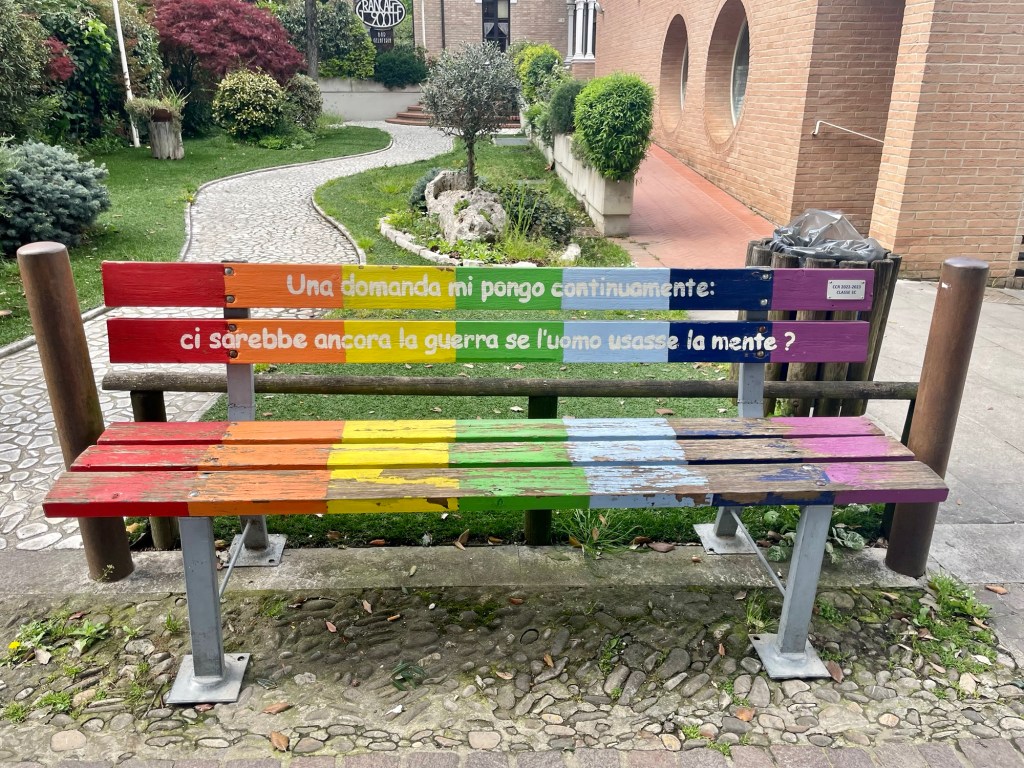
The town benches had been painted in different colours with messages that sought to bring hope to the local people. One read, ‘I keep asking myself, would there still be war if people used their brains?’ Another, ‘no to violence against women’ and another still, ‘one less piece of rubbish in the environment is a smile for the people’ – a phrase that rhymes in the original Italian.
There was a random photo booth in the street next to a Perspex bus stop. A school wall was painted with a mural depicting women from around the world and a garden contained a series of stone sculpture people.
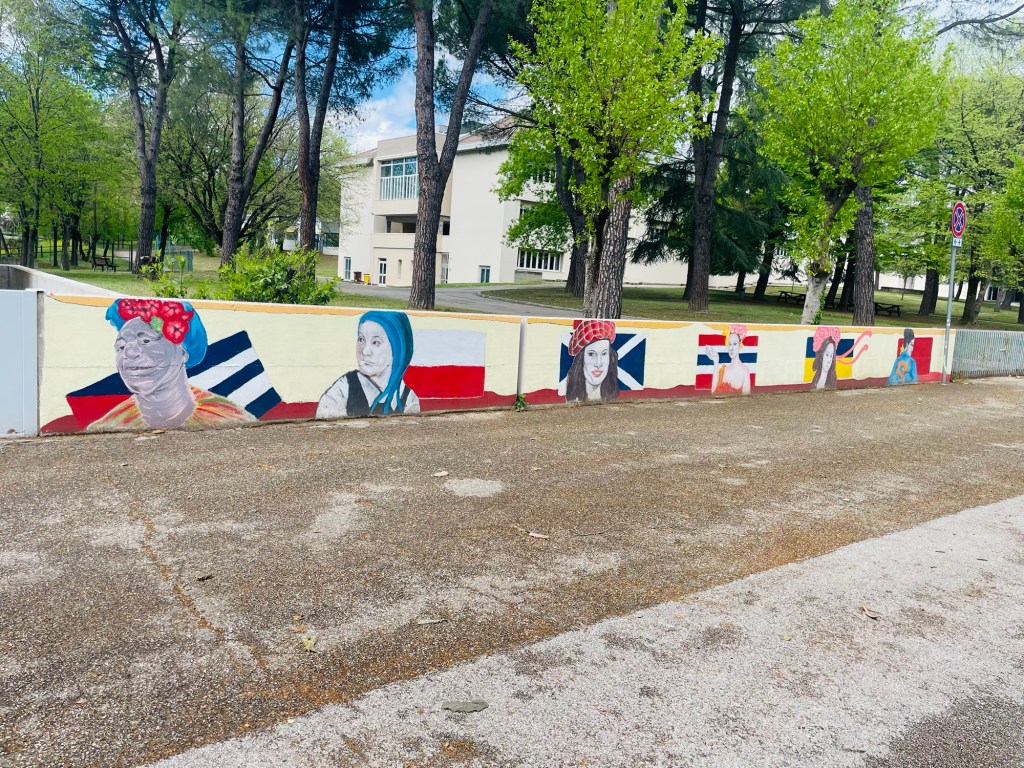
The town had a surplus of banks, and there was the fizzy water fountain, next to a defibrillator. A small park with fairground rides sat next to an ugly breeze block hotel. Someone had graffitied a rather accurate penis on a bin.
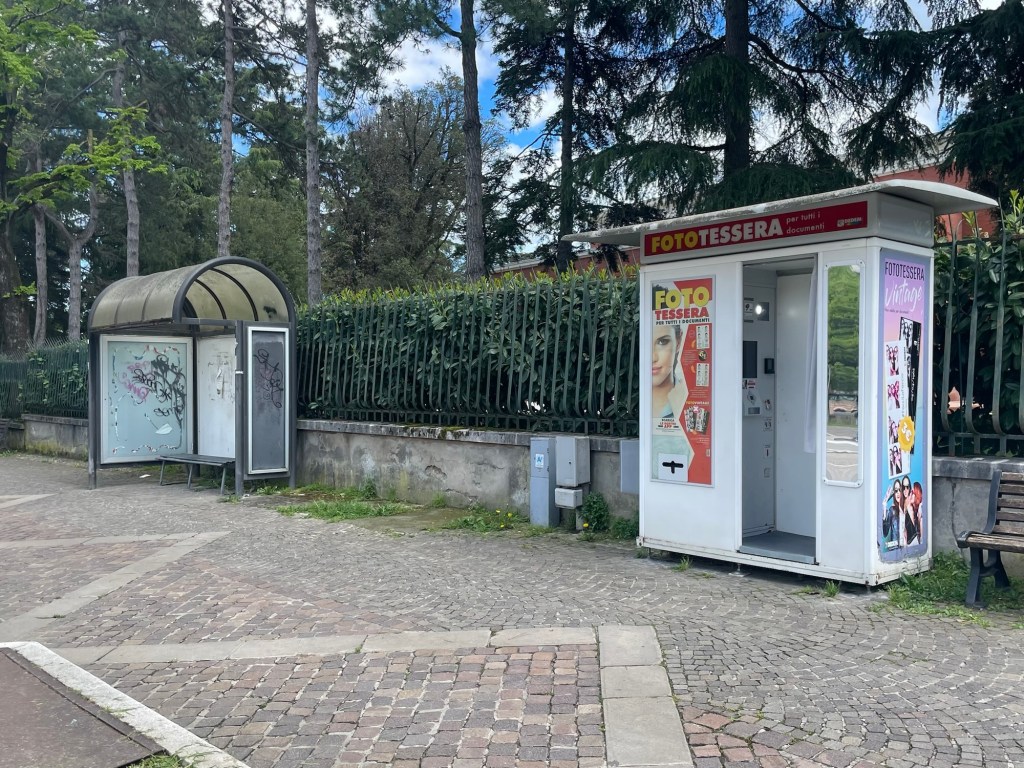
The town wouldn’t be a bad place to grow old, I contemplated. It reminded me of the spa town of Balneari Prats where I had spent time with my yoga guru Mary Paffard in Spain during multiple Springs.
I exited through the medieval walls of the city, the cobbled stones serving as a welcome massage for my feet. Two children’s bicycles had been discarded on a corner without locks. There was an unexpected little forest of bamboo to the right.
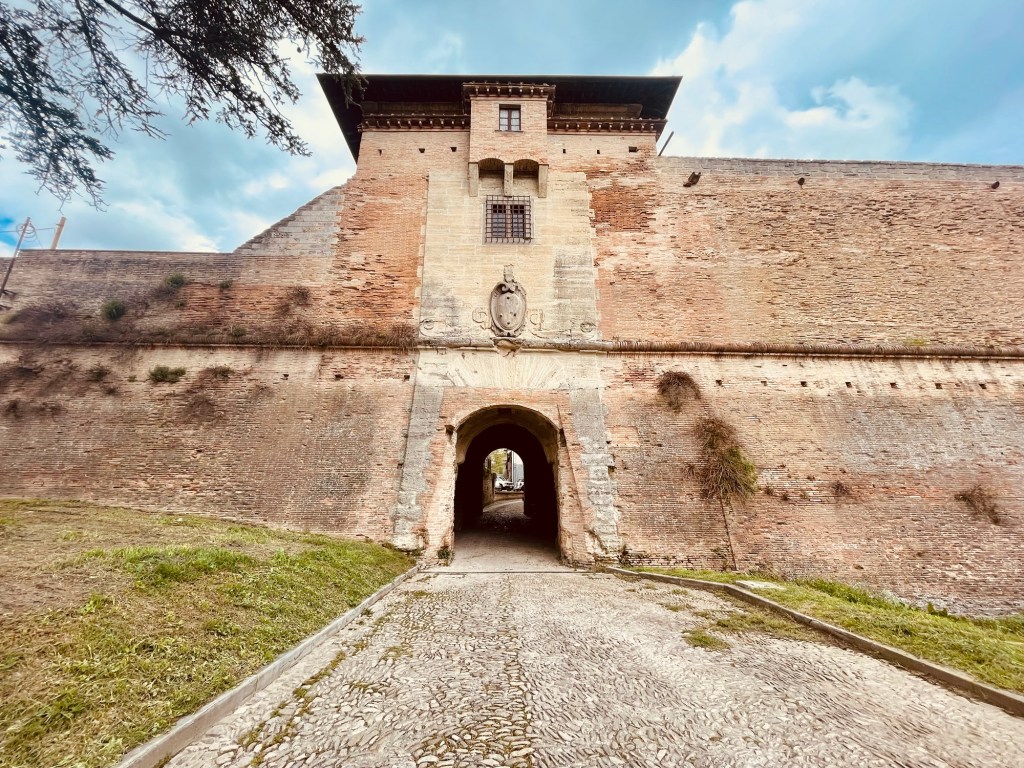
I stopped to explore the beautiful little church of Santa Reparata where there was a strong smell of bleach. Here too, women were cleaning in preparation for the Easter services. Outside, a lady was trying to entice two cats off the roof of her car.
As I proceeded to the off-road track that would take me all the way to Forlì beside the river, I met an Italian man with hiking poles.
‘Be careful,’ he said, ‘it’s super muddy.’
I thanked him and carried on. Mud? I could handle mud by now.
Upon reaching the riverbank, I disturbed a heron who flew – dinosaur like – into the grey air.
The path was poorly trodden and tall grasses obscured it here and there. I’d attached my hiking sticks to my backpack since the terrain was flat and, without knowing what to do with my hands, I tugged on my braids and ran my fingers through the flora.
Soon I arrived at an expansive mud flat which had the texture of quicksand on a beach.
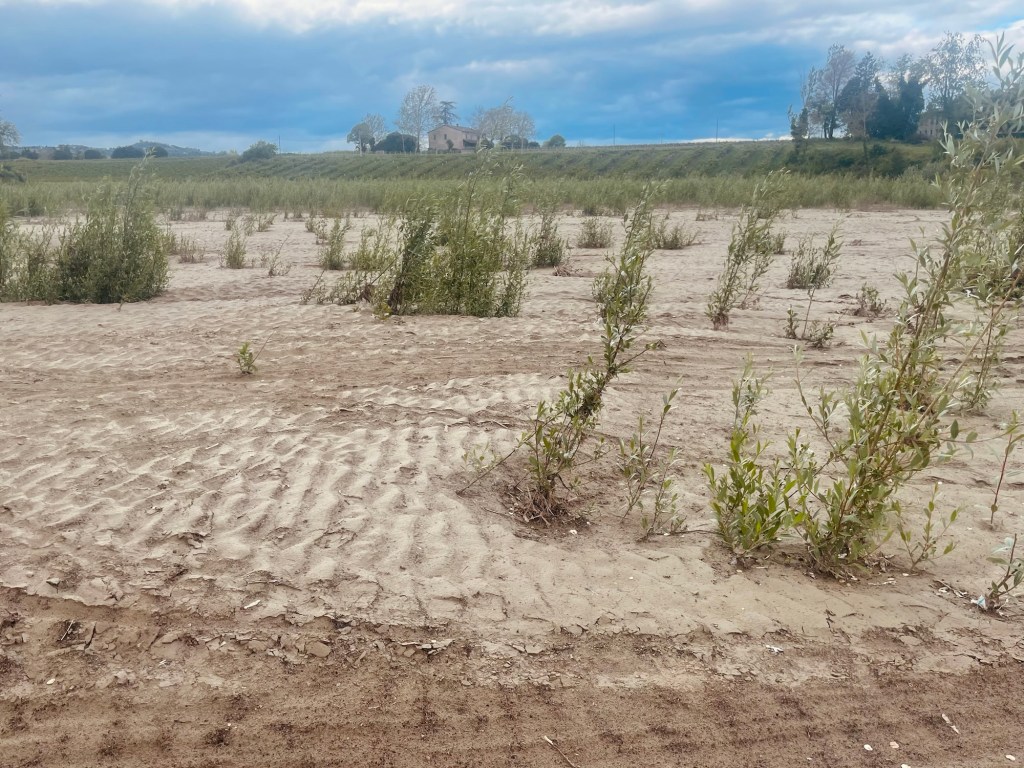
The Abominable Sands is a location in Dante’s Inferno. Indeed, it is the third and final region of the Seventh Circle of Hell.
I thought of Dante’s description:
‘The ground was made of sand, dry and compact,
a sand not different in kind from that
on which the feet of Cato had once tramped.’
In places, this sand was certainly far from dry and compact and the gentleman had certainly been right about the mud. I proceeded tentatively, one step at a time, managing to avoid submersion.
Red poppies clustered at the feet of vines to my left and an ugly piece of orange plastic netting blocked off a worksite.
Then I took a sharp left into the woods.
The brambles reminded me of home, however I was relieved that there were relatively few nettles. A man mowed a lawn behind a hedge and I observed a plastic red chair stuck in a tree.

Though the path was deserted, I took comfort in the dog prints that marked the path before me.
The cloud still hanged low but the sun was starting to break through. I removed my anorak and enjoyed the feel of the breeze and occasional sun on my skin. My bare arms were covered in bramble scratches from earlier in the hike when I’d got lost in the woods with Alina.
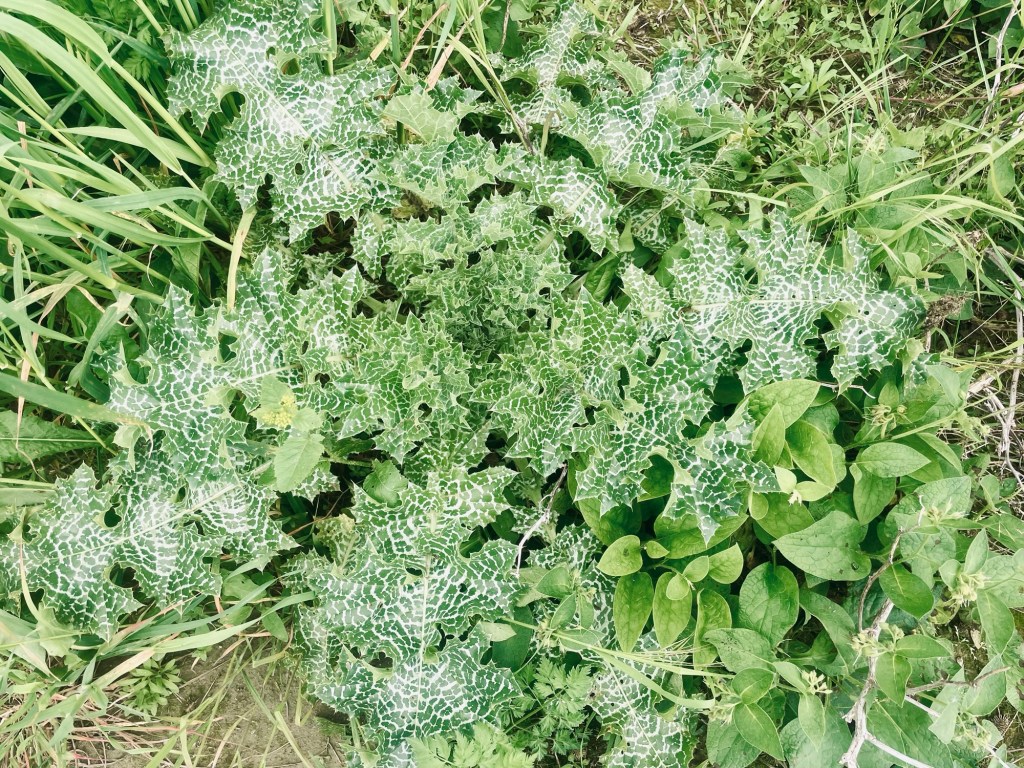
I noted the contrast between the wild grasses and the tidy vines. There was an abundance of a beautiful spiky, thistle-like plant that was streaked white and green.
Inspired by the morning’s conversation, I sent a voice note in French to my friend and former student Sahra from Afghanistan who had moved from Italy to Belgium a couple of months prior where she was applying for university. Her response came quickly in a mix of Italian and French.
‘You’re like a Sufi,’ she said. ‘Sufis walk and wonder.’
I recalled placing a basket bin on my head and spinning in my mum’s white silk dressing gown as a child after we returned from a holiday in Turkey.
‘I’m a whirling dervish,’ I had exclaimed.
And then there was the time I’d been to a global Sufi gathering on the Algerian border with my Moroccan friend Miriam. One woman had become so ecstatic she had collapsed in a fit of ecstasy. Some say Dante was influenced in writing the Divine Comedy by Sufi mysticism.

I passed a greenhouse with plants erupting through the roof and briefly conversed with two ladies who were hiking with a dog called Clifford. They agreed with me that Dante would have wanted me to do the walk this way, finishing in Florence and not Ravenna. Did I need anything?
Further ahead, I saw a family complete with a dog, toddler, bike and pram. The middle child was racing ahead on his cycle and circling back in a burst of freedom.
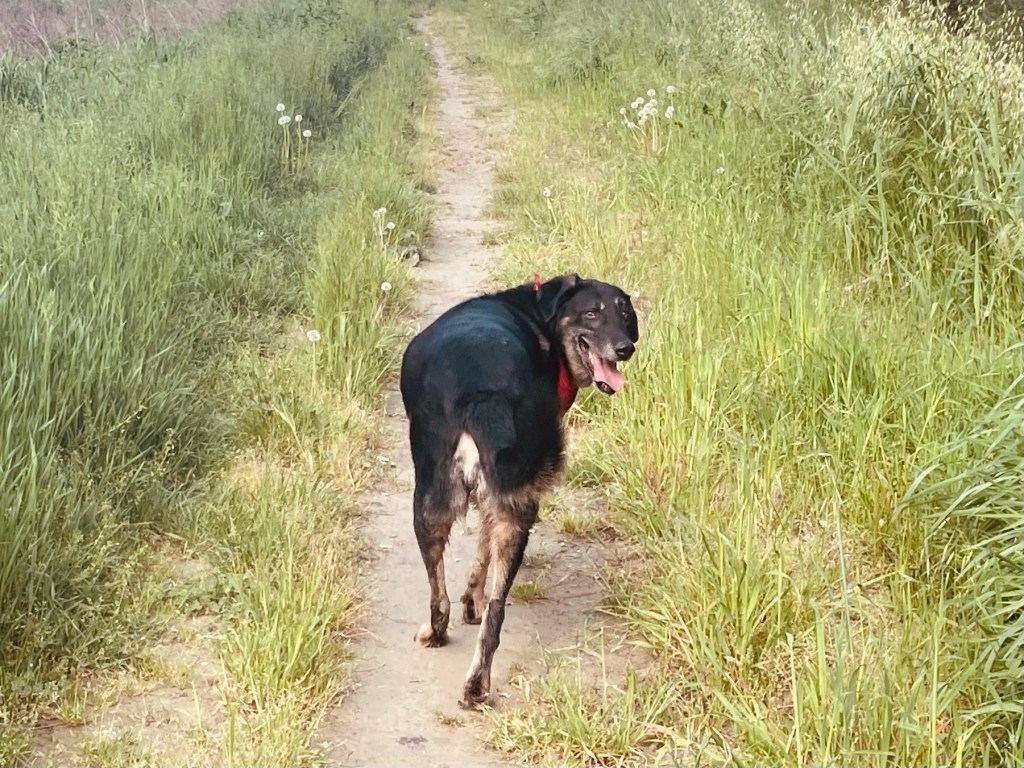
As I turned a corner, there appeared a black dog who was sporting a red bandana round his neck. Cautious at first, I pulled my hand into a fist to let it sniff me which it did tentatively. Then it looked at me as if to say, ‘are you coming?’ and trotted on.
For well over an hour, I followed the dog as it made its way alone along the Dante path. At each fork in the road, I wondered whether it might turn the other way. But on it went in the direction of Forlì. When I stopped to pee, drink or rest, so it stopped too. And mad as it sounds, it appeared to be smiling at me, lolling out its neon pink tongue and wagging its tail erect.
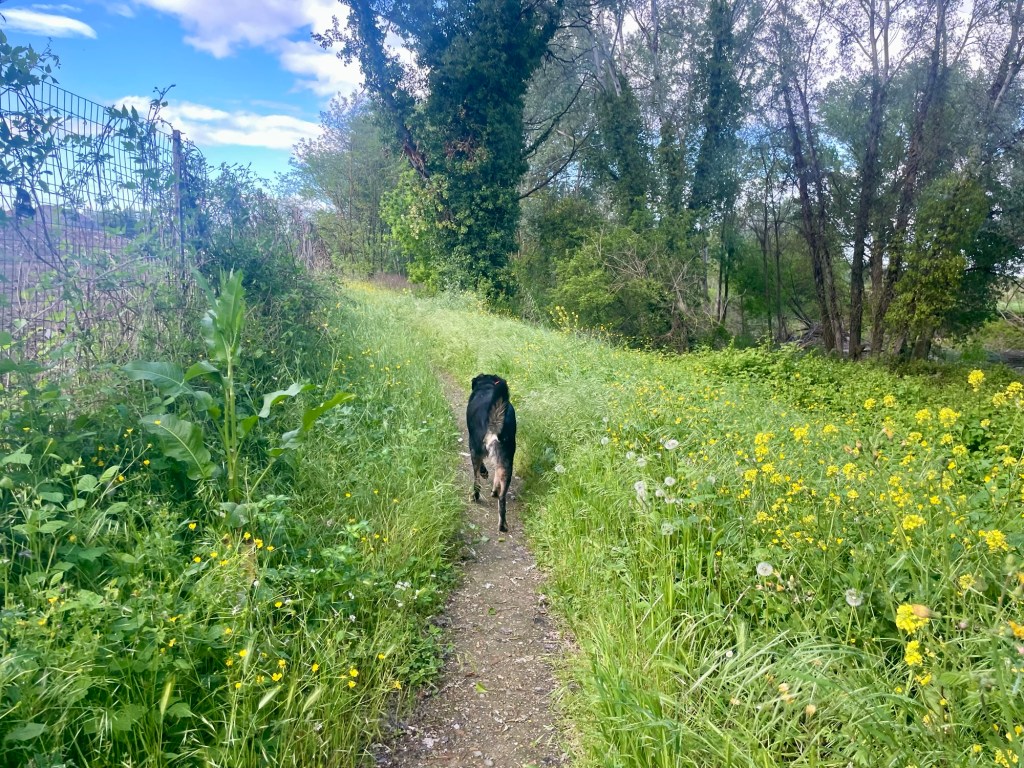
As I ducked under a surplus of ivy, I lost sight of it and felt a pang of sadness. But then there it was again. This part of the path was more well-trodden and I imagined it was a common recreational ground for the locals. Still, there was nobody around except me and my new guide.
All the while, he kept ahead at a distance of around three metres. Now the dog prints ahead of me made sense.
I felt my belly rumble and wanted to stop for a snack, but I was scared of losing this dog who I had by now nicknamed Virgil.
It stopped to defecate, yawning with his mouth wide open.
My leg had acquired a sprig of sticky weed. I blew a dandelion for no one else but myself. One obstinate seed stayed on the stem.
The river to my right gurgled like my stomach.
I wondered if the owner had dropped Virgil at Castrocaro Terme to let him take himself on a walk back to his home in Forlì. I tried to approach him to check his tag but he wouldn’t let me come close, only follow him.
He was quicker than me up the hill but when I turned the corner, there he was panting, still waiting for me.
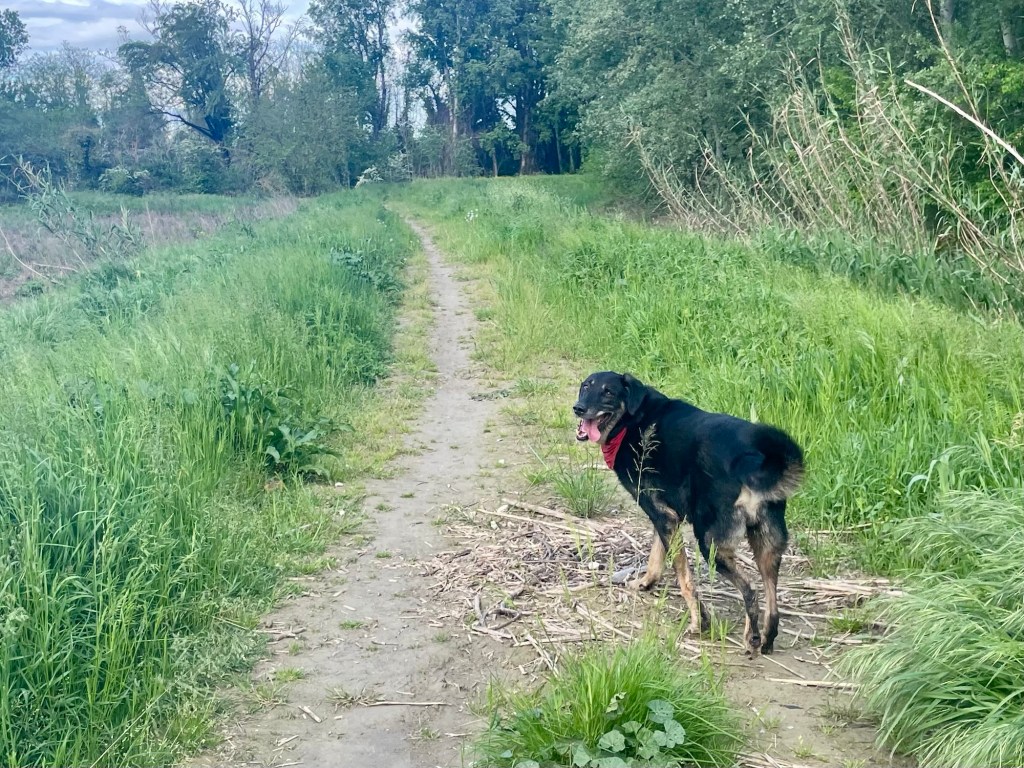
My shoes were rubbing and I would have stopped to rest and take some ibuprofen, but for the dog, I had to continue.
He kept peeking his head back to check I was still there. Where was he going?
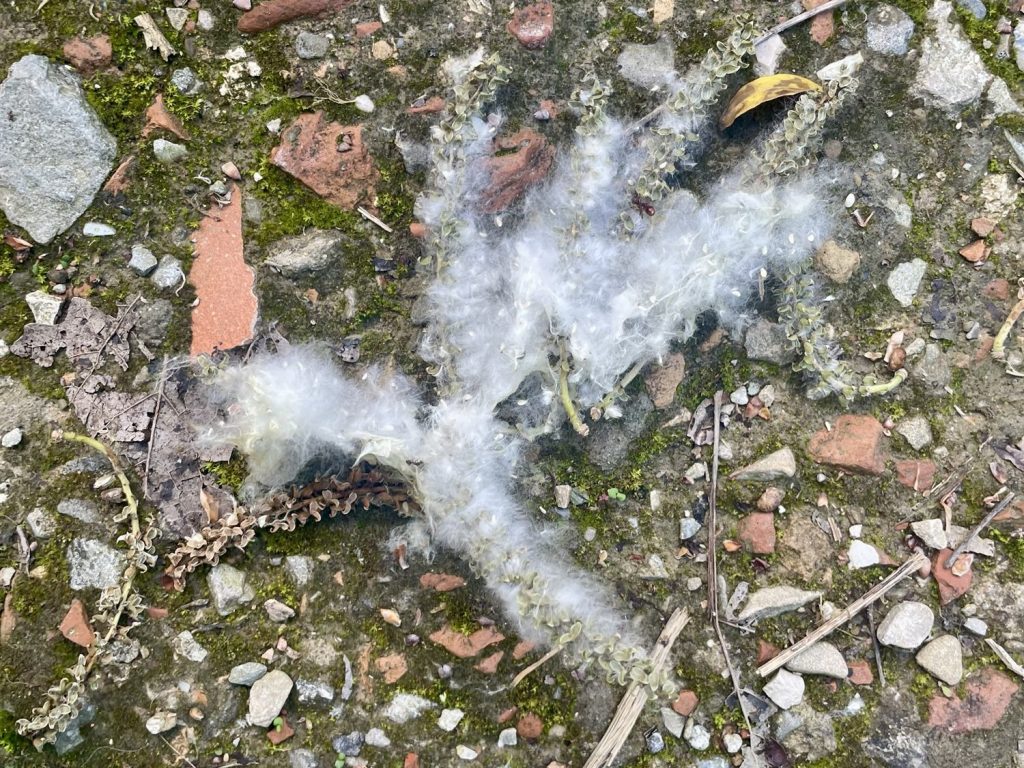
On the ground were fallen ivy leaves shaped like hearts and soon, as we passed through another prairie, Virgil’s back became covered in yellow petals from the flowers. A seed that looked like soft cotton on stems and another that resembled a caterpillar fell from the trees above me to my feet.
I thought we must be getting close to Forlì. There was some kind of industry that looked like a quarry on the left and pretty soon we hit a main road. Would Virgil now abandon me?
None of my friends had dogs and I was a cat person. I had a cat called Dante Alighi-‘hairy’ and, before that, I’d had Toffee, a rescue with anxiety issues. When I’d gone to the vet to put her down, my friend Danni accompanied me. I was so traumatized that I had vomited in the sink in the veterinary surgery. I still owe Danni 100 pounds for the procedure.
I was playing music on my iPhone which was tucked into my bra, the words of Talos rang out,
‘Your love is an island, I’m scorched in the sands of it.’
Virgil went under an underpass. I thought the way would be to the left, but I followed him. When I checked the map, he was right.

I wished I had some kind of treat to offer him, but the relationship was not reciprocal. He was leading me. Now, when he stopped to sniff something, I waited for him.
‘I’m here. Don’t worry I’m here,’ I said.
I could suddenly understand how people got so attached to their dogs. He was so loyal.
I think this was the longest I’d walked without taking a break. It was coming up to ninty minutes.
It was 5 o’clock and the sun now definitively occupied the sky having won the battle with the rain clouds. Virgil drank from a clear puddle in the path that hugged a ploughed field to the left.
When we came back to the river where I was supposed to cross, he jumped in for a swim and waited for me on the opposite bank. The current was strong and, lo and behold, there was no bridge. I would later learn that it had been washed away in the recent heavy rainfall. For now, I was quite literally stuck in the mud.
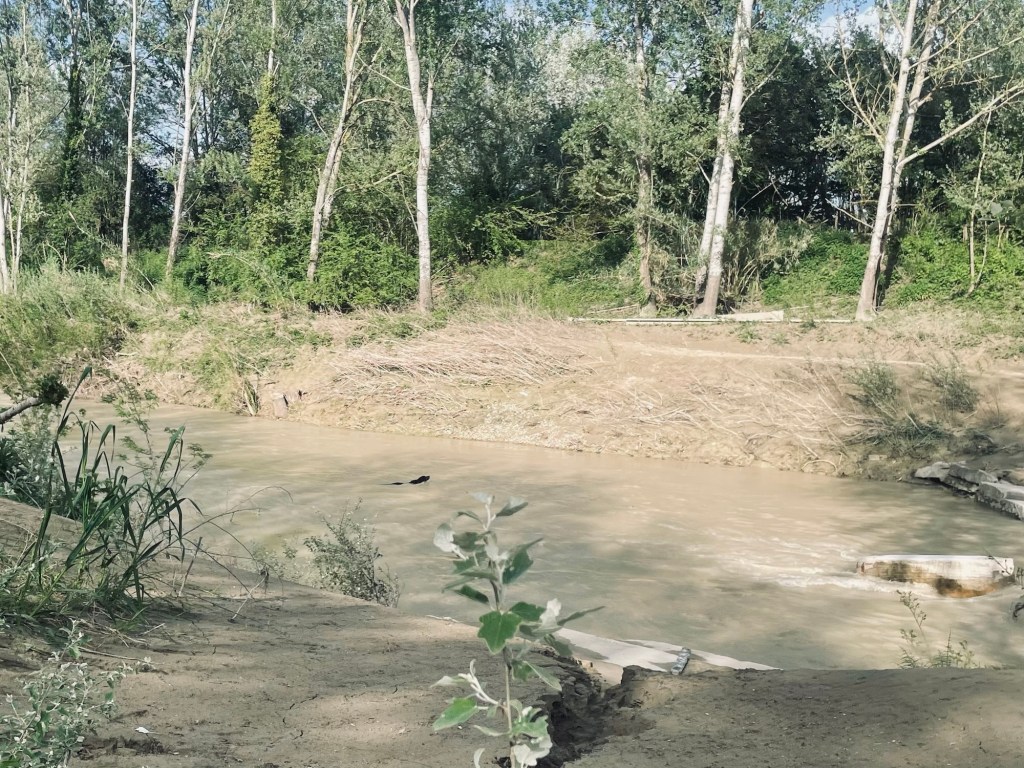
Five minutes passed as I tried to work out a solution. We locked eye contact. I couldn’t cross the river but to turn back to the road would mean to leave him.
I thought about taking my leggings off and trying to wade over but the water looked deep and the current spooked me.
I stood there on the shore feeling tears prick at my eyes and the muddy water soaked once more into my boots. My feet ached and I wanted to sit down and consider my options, but I couldn’t: the riverbank was a swamp of ash-coloured mud. My feet were slowly sinking down above the ankle.
A jogger ran past Virgil on the other side of the bank. I contemplated calling out to her.
I turned to wade back onto solid ground and when I looked back, Virgil was gone.
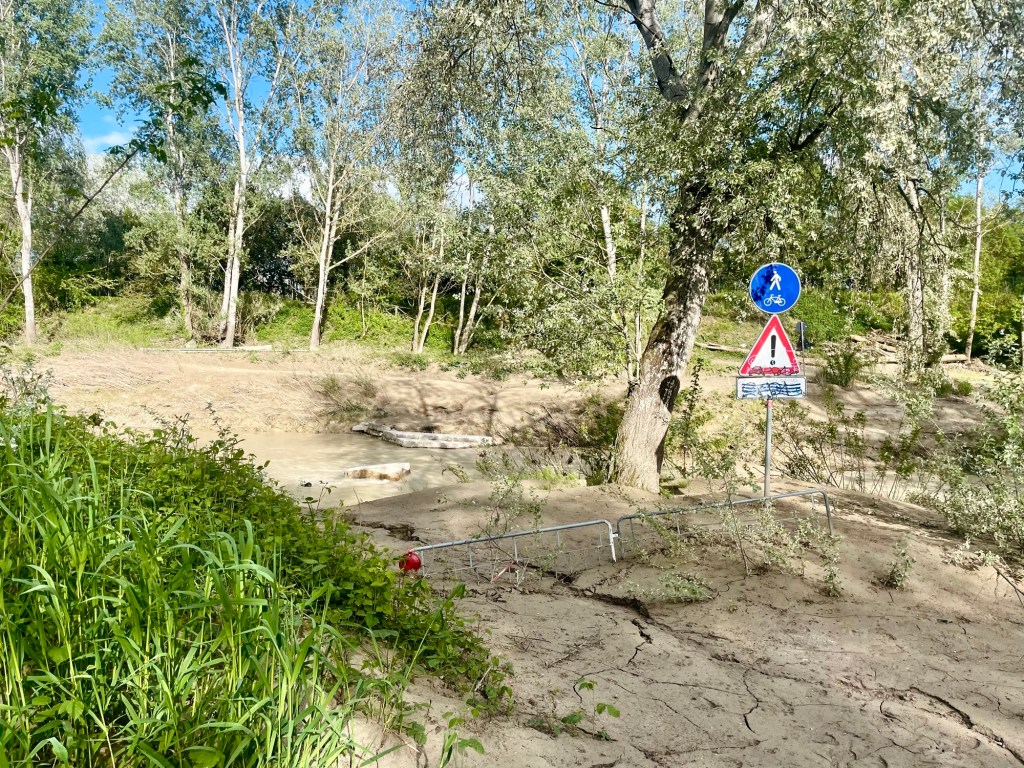
I walked five minutes to a bench and was just quiet for a while, listening to the sound of bird song. I noticed a little mushroom underneath the bench which was like a nipple in shape and size. I bit into an apple I had bought yesterday. It was the size of a fist, red and yellow.
I had a video of Virgil swimming across the river which I now watched obsessively on repeat.
I picked some grass out of the zip of my anorak with my hands and put it back on. A large pigeon flew through the trees. Finally, I took some ibuprofen for my feet.
I was riddled with a melancholy I found hard to understand. Virgil had crossed the river Acheron and I had not.
I headed back to the main road to take an alternative route into Forlì with a sigh.
