Tag: florence

  • ‘New Life’: From Pontassieve to Florence

    On my final day, I met a lovely couple who invited me for lunch and felt the warm embrace of the sun and of friends which filled me with new life. 

    I slept badly, waking up every two hours. I was worried about my broken toes and how they’d manage the 21 kilometres I would have to face to make it back to Florence and complete the ring of the Dante trail. The very prospect had seemed near impossible when I had shared my wish with Massimo Kyo and Alina in the tranquil oasis of San Pietro a Romena two weeks ago, and then again two days ago in the Hermitage of Santa Maria. Now I was so close and the end was in sight. Yes, I was doing it.

    I tried to summon up Virgil’s words of encouragement to Dante in canto 24 of Inferno when he becomes weary as they pass through the bolgia of the thieves:

    ‘“Now you must cast aside your laziness,”
    my master said, “for he who rests on down
    or under covers cannot come to fame;

    and he who spends his life without renown
    leaves such a vestige of himself on earth
    as smoke bequeaths to air or foam to water.

    Therefore, get up; defeat your breathlessness
    with spirit that can win all battles if
    the body’s heaviness does not deter it.

    A longer ladder still is to be climbed;
    it’s not enough to have left them behind;
    if you have understood, now profit from it.”’

    I would rise up like Dante and take on the steep climb up to the Convento dell’Incontro:

    ‘Then I arose and showed myself far better
    equipped with breath than I had been before:
    “Go on, for I am strong and confident.”’

    On my way out of the town at around 9am I stopped momentarily to watch a tall man pruning an olive tree on a ladder. It was a sunny day, perhaps the sunniest so far on the cammino. Despite this, I wore my long-sleeved black top in order to protect my new tattoo from the rays. The purple stencil had already started to disintegrate rendering the terracotta outline clearer. I loved it. 

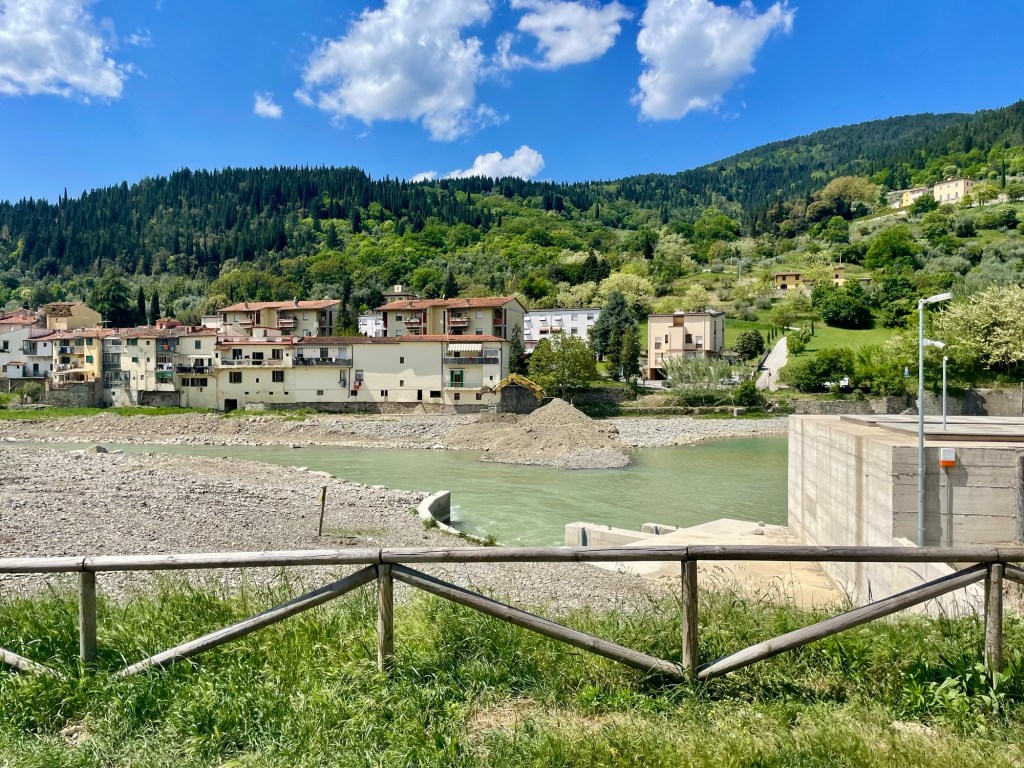
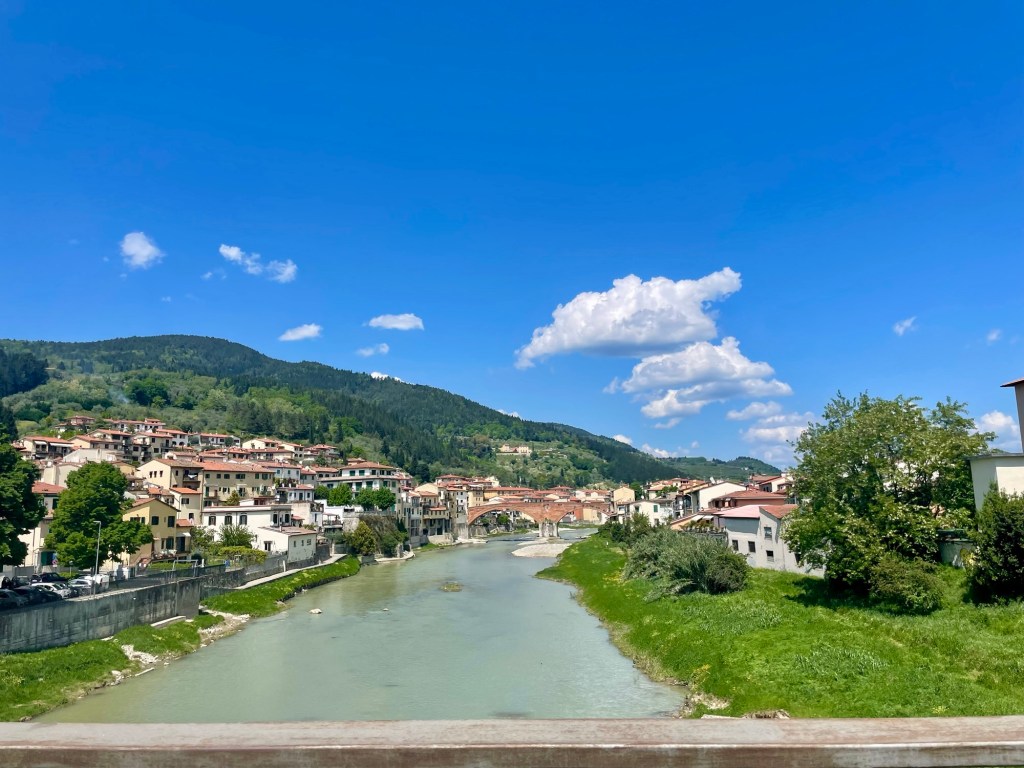
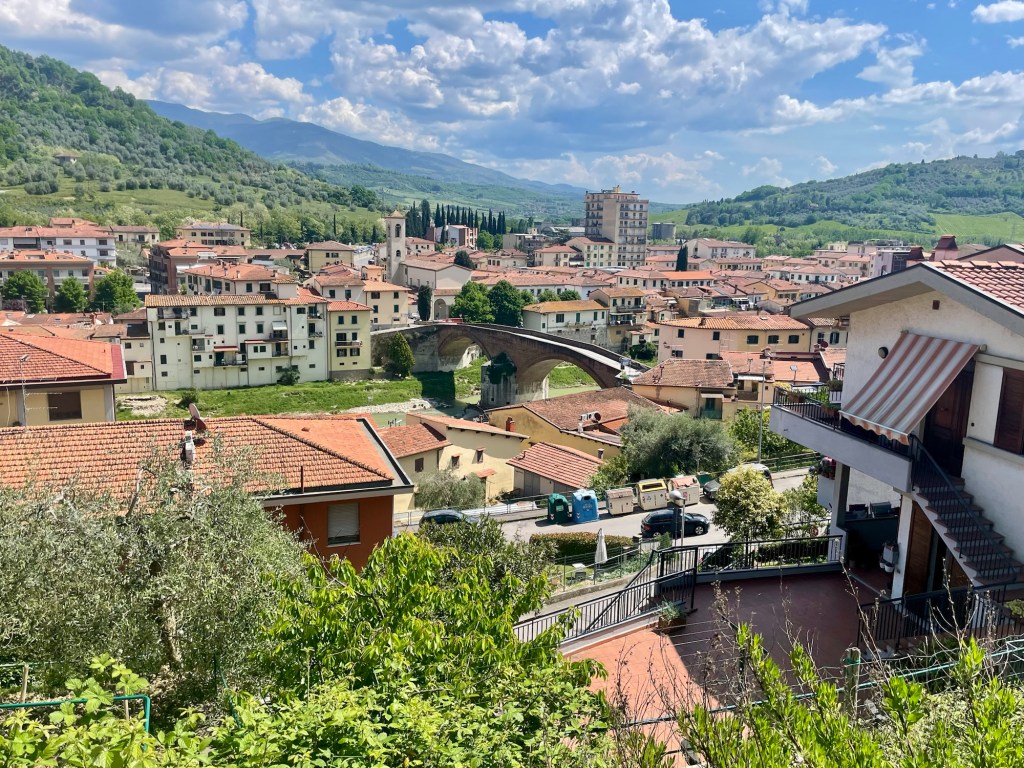
    I went down the hill past the beautiful medieval bridge that had been damaged in the recent floods and stopped at an old bakery to purchase some pizza and fizzy water. The streets were bustling with people and, despite my fatigue, I found myself whistling in good cheer. 

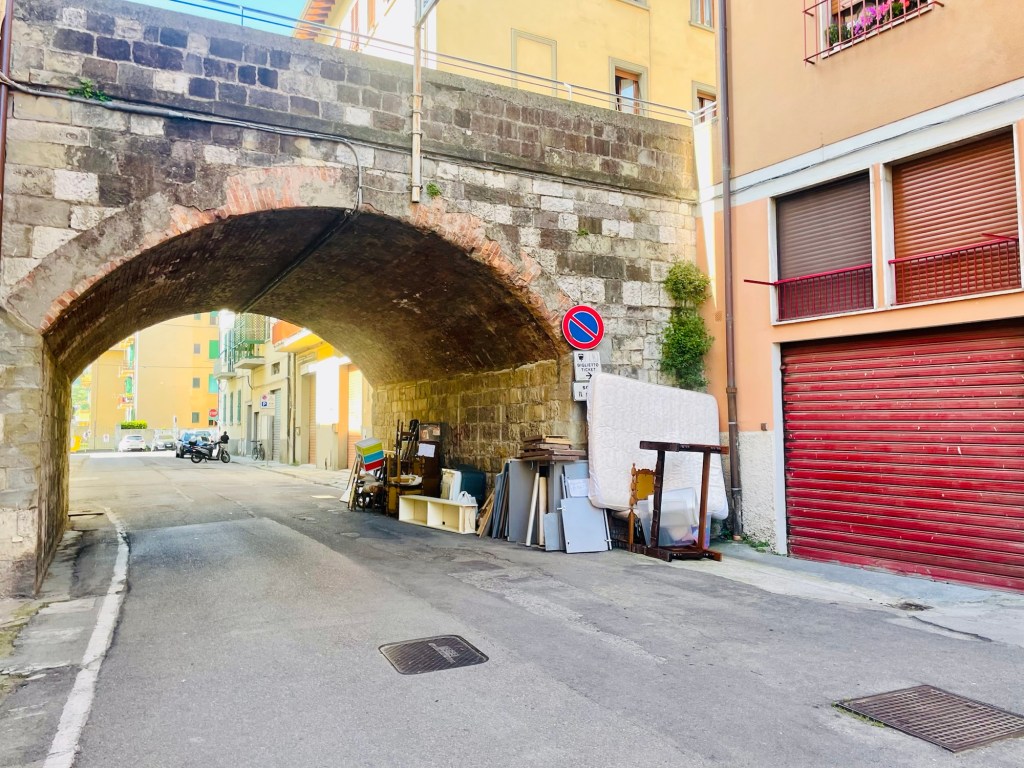
    I passed a police officer who was giving a black man a car ticket and saluted Asia who I had met the previous evening in the tattoo parlour. A swallow flew inches from my face as I passed under the bridge which was cluttered with antique furniture. It looked like everybody was spring cleaning. There were up turned stools, desks devoid of drawers. Two sagging single mattresses framed the display on either side like columns.  
    It was nice to be walking along the river. The fresh graffiti contrasted with the muted tones of the brick walls. A man passed with a shopping trolly and a flight of joggers zig-zagged along the narrow path. I thought back fondly of running along the river Charles when I had lived in Cambridge, Massachusetts, and hoped that my foot wouldn’t give me too much bother so that I could be up and running myself again soon.
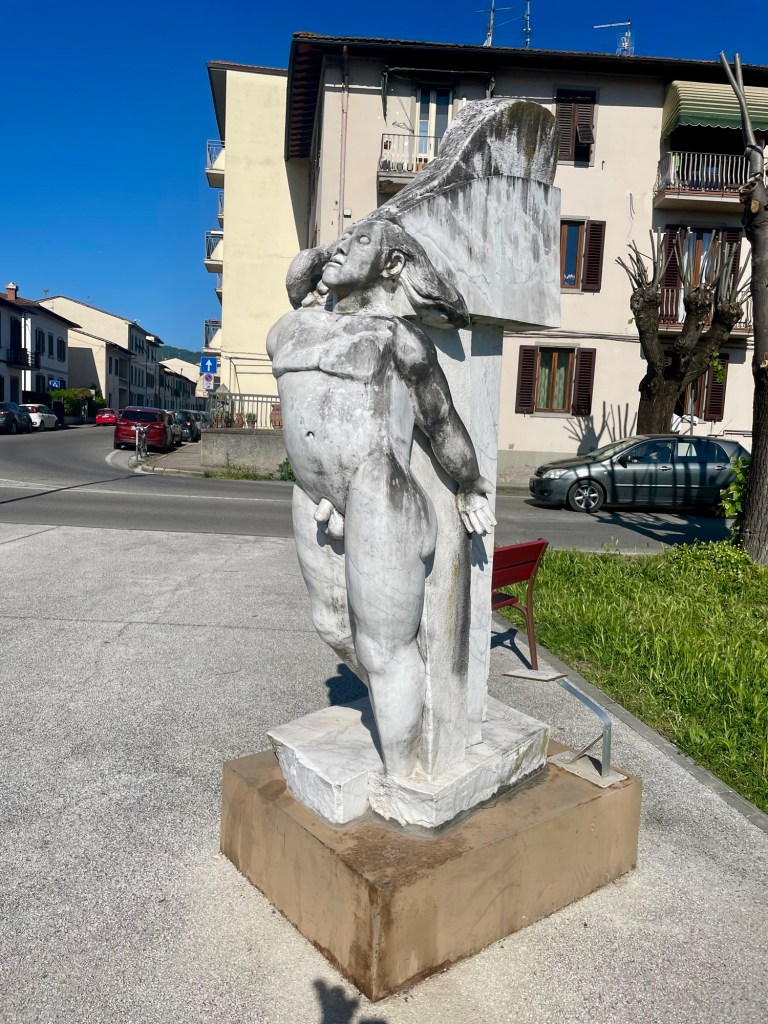
    To the right of the path was a sculpture of a man striding forth from a rock. I was reminded of the engravings that Dante sees on the terrace of the proud in canto 10 of Purgatory which are so lifelike that they seem to speak to him of acts of humility:

    ‘There we had yet to let our feet advance
    when I discovered that the bordering bank—
    less sheer than banks of other terraces—

    was of white marble and adorned with carvings
    so accurate—not only Polycletus
    but even Nature, there, would feel defeated…

    This was the speech made visible by One
    within whose sight no thing is new—but we,
    who lack its likeness here, find novelty.’

    Thus was the power of great art. 

    A sign said ‘no fishing’.

    Two men were fishing. 

    The water ran aquamarine. 

    I was saluting everyone on the path, including a new mother who was stroking her baby’s fine hair on a picnic blanket beside the river. The hawthorn petals were a perfect white and exuded an almond-like perfume. 
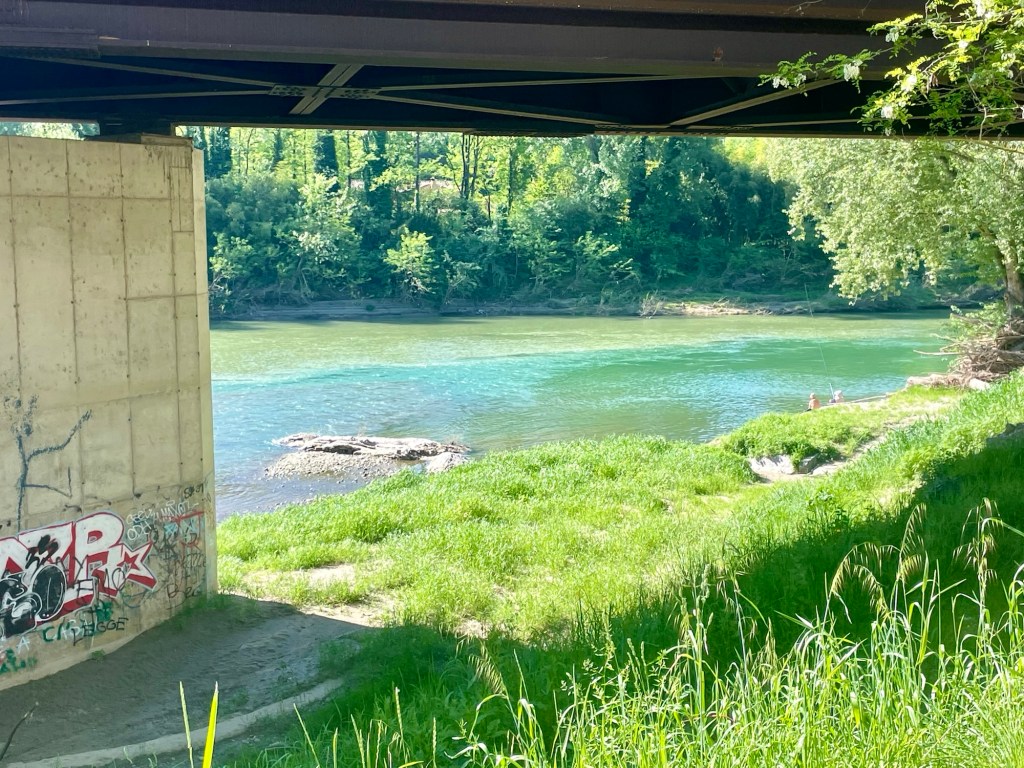
    The recreational path soon gave way to allotments which featured a variety of vegetables and flowers that were being carefully attended to by a diverse group of local citizens. It was the first time I’d seen yellow irises, and here was a line of Romagnolo artichokes in their characteristic bruised purple and green. 

    I crossed the river over an iron bridge. The pathway was perforated with little holes so that you felt you might fall down at any point. It reminded me of being scared, as a child, that I would slip between the staggered metal stairs at the council flats where my school friends had lived back in Milton Keynes.  

    I was slightly haunted by the size of the hill ahead of me and though it was only 10:15am, I was already hot.

    I stopped to check directions with a man who was cutting grass. It looked like he’d put henna on his hair the way some older Indian men do. It was a livid orange.

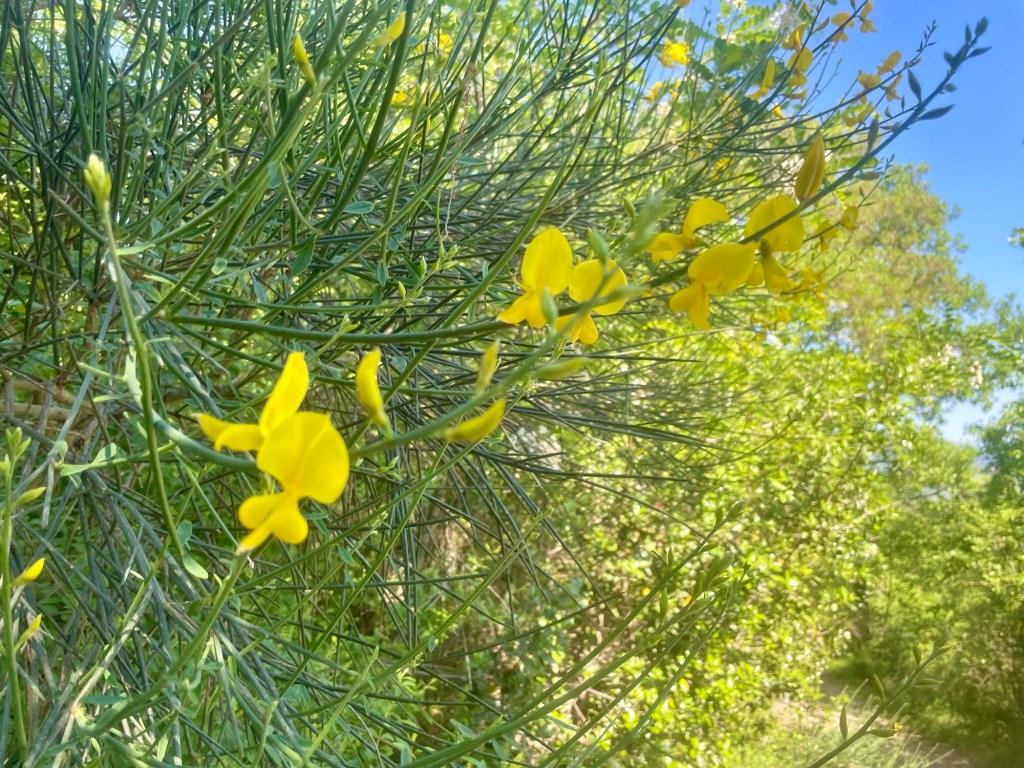
    The yellow broom smelt buttery and delicious.
    I passed a church on the right and took a wrong turn which afforded a beautiful view back over the city. I then retraced my steps to take the steep climb of the wooden bank off to the left of the road. The foliage was intruding onto the path in thick tendrils causing me to duck and dive. A spider web was suspended in the sunlight, diaphanous. 

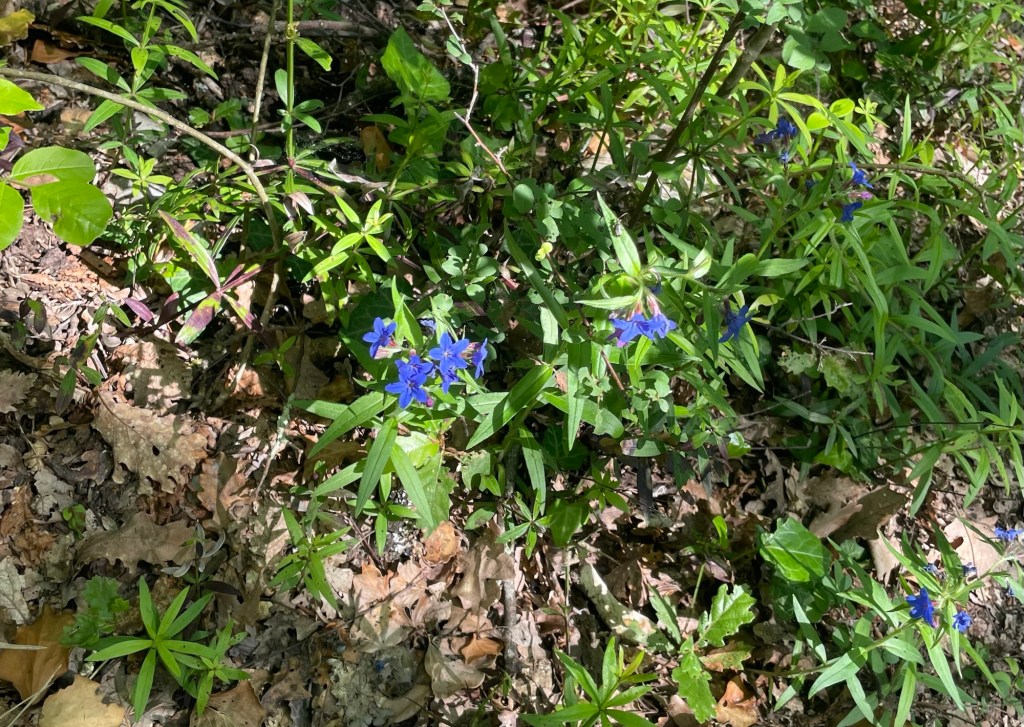
    I could feel the weight of not having slept with every step up the woodland pass but the shadow of the trees was merciful. I was rewarded by the sight of a kaleidoscope of tiny flowers. Here some purple gromwell creeped along the ground, sending out long trails of dark green matt leaves sprinkled with gentian-blue flowers. And there were pink prongs of common sainfoin. I recalled how Dante described being drawn to beauty in Purgatorio, canto 18:

    ‘The soul, which is created quick to love,
    responds to everything that pleases, just
    as soon as beauty wakens it to act.

    Your apprehension draws an image from
    a real object and expands upon
    that object until soul has turned toward it;

    and if, so turned, the soul tends steadfastly,
    then that propensity is love—it’s nature
    that joins the soul in you, anew, through beauty.’
    As I exited the woods, I passed a tennis court which seemed unusually located on the rocky terrain. Two men were working out how to get a van along the path. The one who seemed to be in the more authoritative position was wearing blue overalls. Now it was nearly 12 o’clock and the sun was beating down on me. Soon I’d stop for my lunch of the remaining pizza. 

    But I didn’t have pizza for lunch after all. Instead, I chanced upon Matthew, an English man from Derby, near where I live, who was outside his house performing chores. His sweet dog Paloma had come to greet me and when I’d saluted her back in English, Matthew asked me if I’d like some water. 

    I gratefully accepted. 

    And this wasn’t just water, it was fizzy water – ice cold and from a Soda Stream.

    We soon got deep into conversation about all things Oxford where he’d also studied, and rowing, which I had not, and, with that, conversation turned into lunch. 
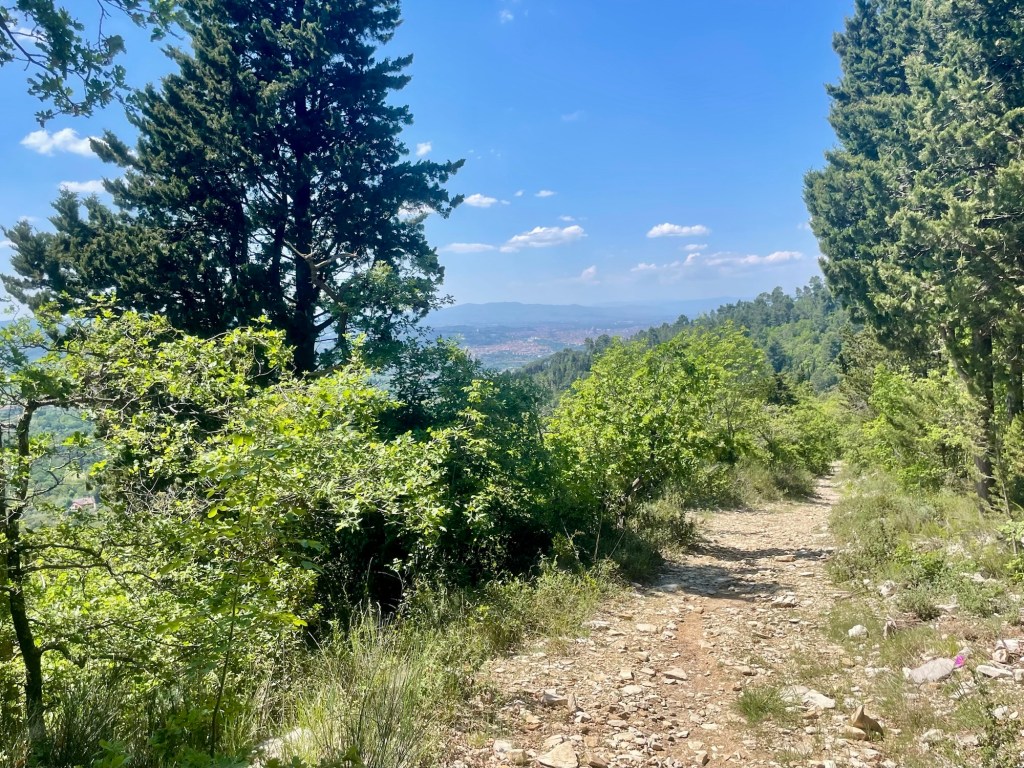
    Matthew was an environmental engineer while his Italian wife, Nicoletta, who he’d met at language school, worked in fashion. Florence in the summer was too busy for them with tourists, they said; they liked their hillside retreat. I was reminded of summers in Oxford when I would angrily ping my bell as foreign exchange students would stray into the cycle lane. I had been so lucky to live in Florence during the winter when the whole city had felt manageable and somehow my own. 

    Nicoletta had prepared a delicious quiche and focaccia which we ate with a salad and local pecorino cheese.

    ‘I’d offer you chedder, but that seems unfitting,’ Matthew quipped. 

    As I told them about my journey, I noticed that Nicoletta had tears in her eyes. She was a fellow Dante aficionado and was deeply moved by the fact that I had embarked on this pilgrimage. We began citing Lorenzo di Medici’s famous poems, finishing the sentences of one another:

    ‘How wondrous beautiful is youth, 

    yet fleeting, so soon gone, in truth!

    He who will, let happy be, 

    The morrow has no certainty.’

    I told her how instead of the Backstreet Boys I’d had a poster of Lorenzo di Medici on my wall as a teenager. She could relate. She explained that she’d just got round to unpacking a box of books including a compendium of Italian verse which she was devouring.

    There was a princess crown in a bowl with walnuts that belonged to their daughter who was named Florence Rose. They had lived in the house three and a half years and done a spectacular job of restoring it. It even had a bathtub! How very unItalian, came my immediate thought.

    Their ample garden was rich with almonds, walnuts, figs and cherry sized plums. There was a peach tree that Matthew had just planted beside their pool and rows upon rows of olive trees from which they harvested their own oil. The key to pruning them, Matthew explained, is to hollow out the inside so that the tree looks like a donut. I thought about my own short-lived time as an apple tree pruner on a farm in California. How I had romanticized and then so quickly come to detest that slow labour.
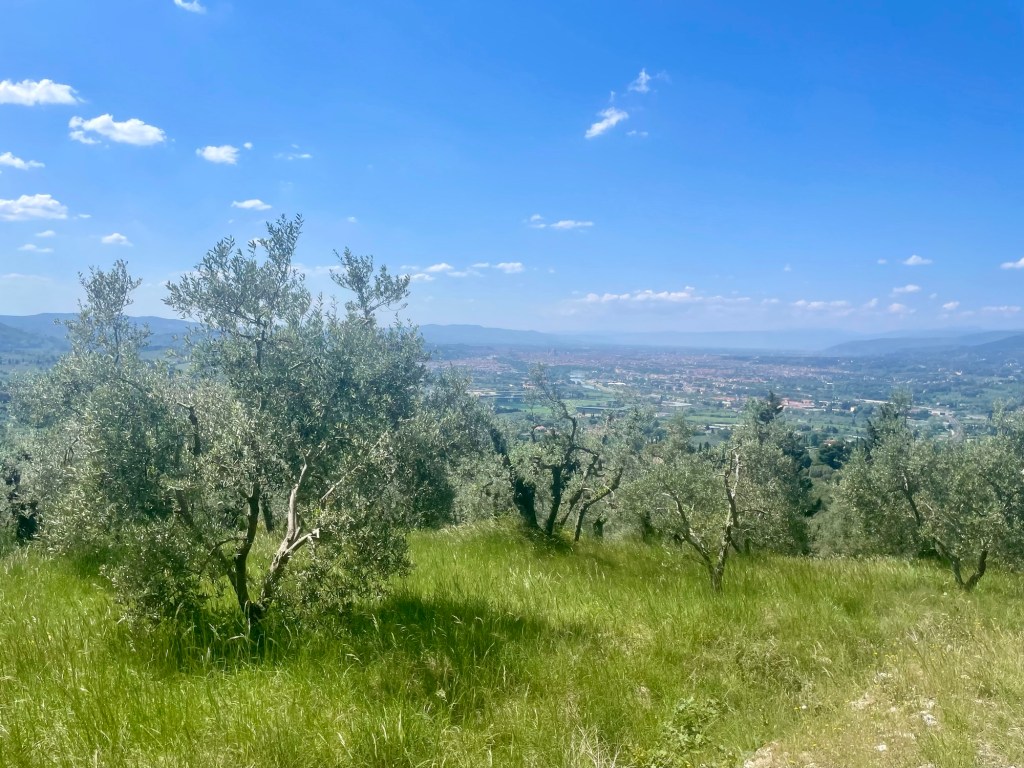
    I spent about an hour with Mathew and Nicoletta sitting on sunbeds by their pool chatting leisurely. Then, I took my leave, explaining that I had friends who would be waiting for me in Florence that evening. 

    ‘You must come back!’ said Nicoletta as I heaved back on my rucksack and headed down the dusty drive. I very much hoped I would.

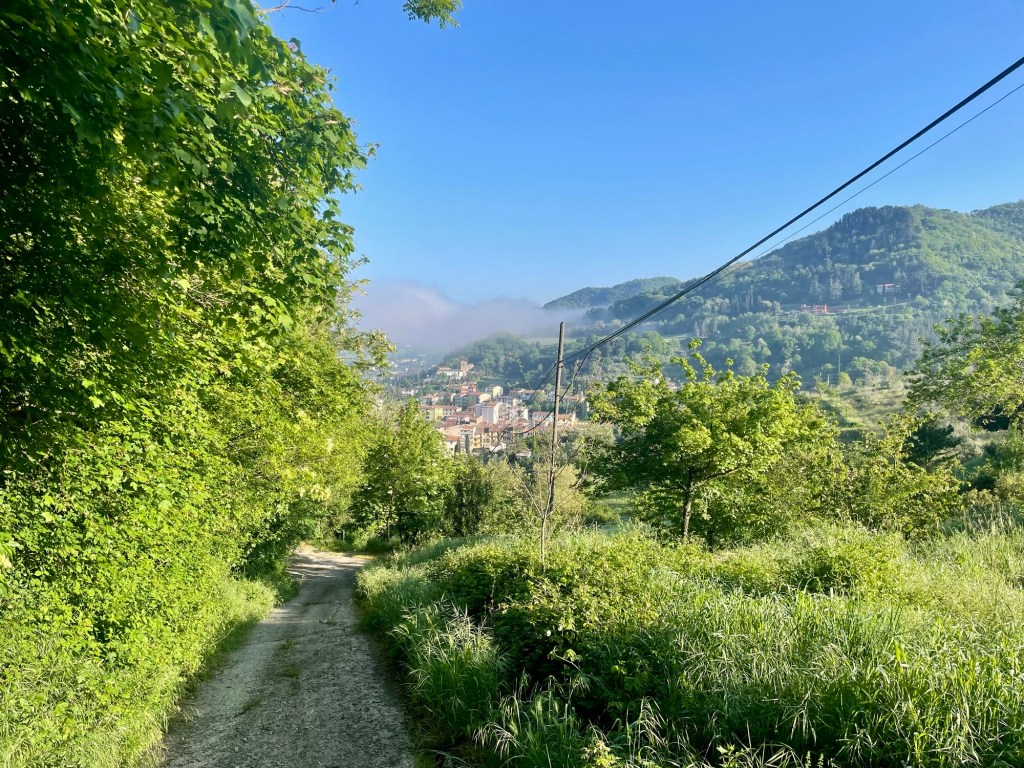
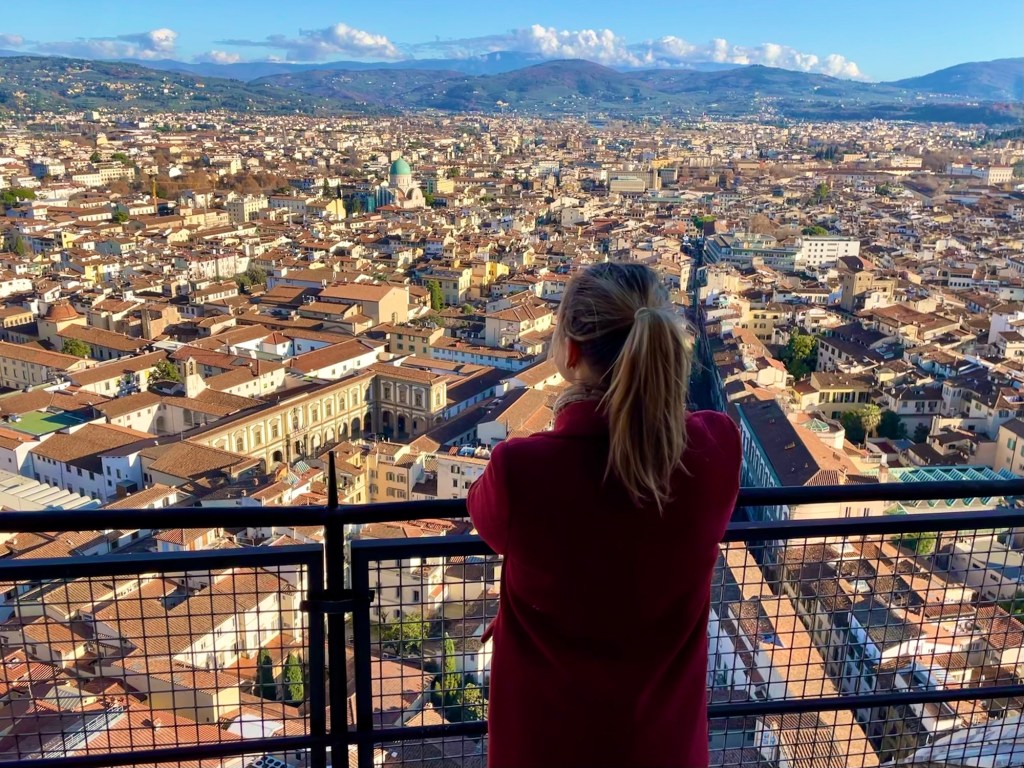
    After a steep ascent up to the Convento dell’Incontro, I got my first sight of her. There she was before me once more with a skyline woven in orange thread: Florence, the most beautiful city in the world. There was the Duomo, San Lorenzo and Giotto’s tower. And there, somewhere in the hazy distance, were Alina and Kelsey who had travelled specially to Florence to meet me at the end of my cammino. 
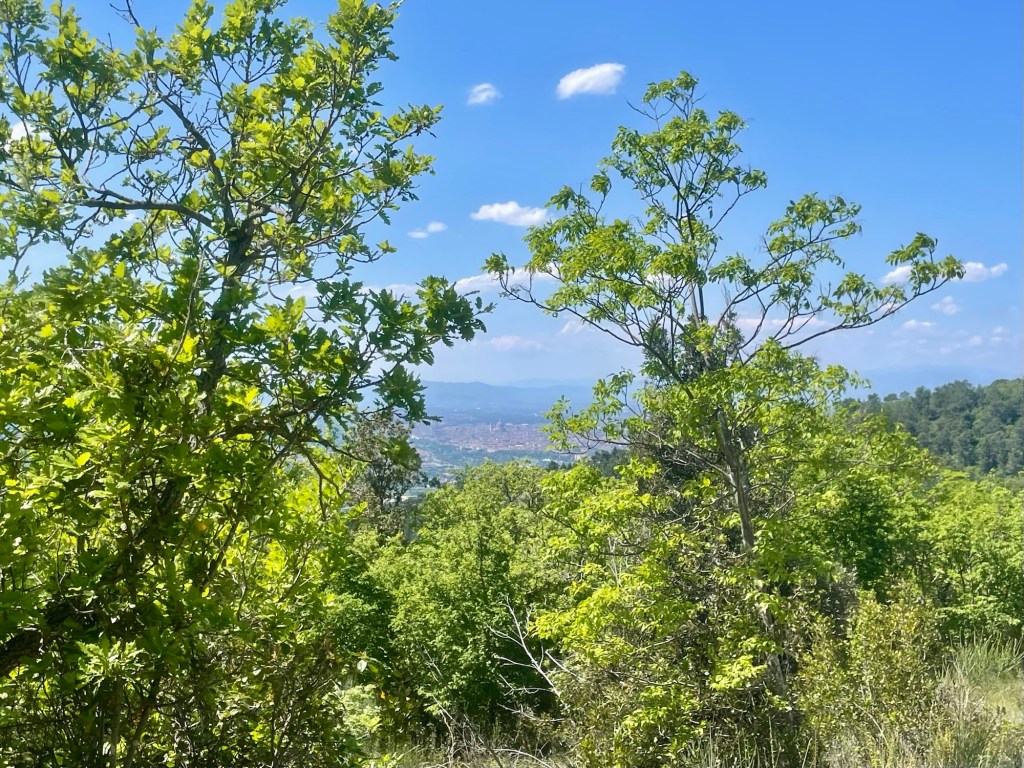
    I thought I’d better get a move on, but at the same time something about today made me cherish each individual step. I was slower on foot not because of my broken toes, but because this was my last day of a three week long cammino and I knew how much I’d miss the tread. 

    I didn’t put on an audiobook or music, I just wanted to be at one with my thoughts and reflect on what I had achieved: the highs and the lows, literally and metaphorically. 

    A fellow hiker who looked North American was walking the other way. I saluted her – she was as pink as I was in the afternoon sun. I noted that one of the cuts on my hand might be infected and applied some ayurvedic balm. A bright green caterpillar dangled on a thread.

    The descent was without shadow, a combination of brushland and road. I breathed in the sweet scent of wild sage as sweat accumulated in my philtrum and then spilled over onto my lips. I could hear the blood pumping in my ears. I couldn’t imagine doing this hike in the summer months.

    I was trying to walk on my heels as much as I could as the pain in my toes grew more insistent. 

    With each corner, Florence emerged again in all her splendor, framed by a variety of species of trees. I thought of Dante’s poem ‘Three women have come round my heart’ which he wrote from exile, longing for a view as close as this. 

    ‘They each seem sorrowful and dismayed, 

    like those driven from home and weary, 

    abandoned by all, their virtue and beauty 

    being of no avail. 

    For though we are wounded now, we shall 

    yet live on, and a people will return 

    that will keep this arrow bright. 


     And I who listen to such noble exiles 

    taking comfort and telling their grief 

    in divine speech, I count as an honour 

    the exile imposed on me; for if judgement 

    or force of destiny does indeed desire 

    that the world turn the white flowers 

    into dark, it is still praiseworthy to fall 

    with the good. And were it not that the fair 

    goal of my eyes is removed by distance 

    from my sight – and this has set me on fire –

    I would count as light that which weighs on me.’

    With each careful step I was just that bit closer to San Giovanni where I would lay my rose from Ravenna at Dante’s place of imagined return. It had gone a bit moldy in my bag if truth be told but it was the thought that counted. And over the last three weeks I had given this important step of my literary pilgrimage a lot of thought indeed. I was nothing if not a terrible romantic. 

    I had prepared well for the trip, but had I prepared myself for it to end? What would I do without that familiar sound of the cuckoo and the butterflies dancing before me along the path? The pretty purple wildflowers and all those hundreds of barking dogs?

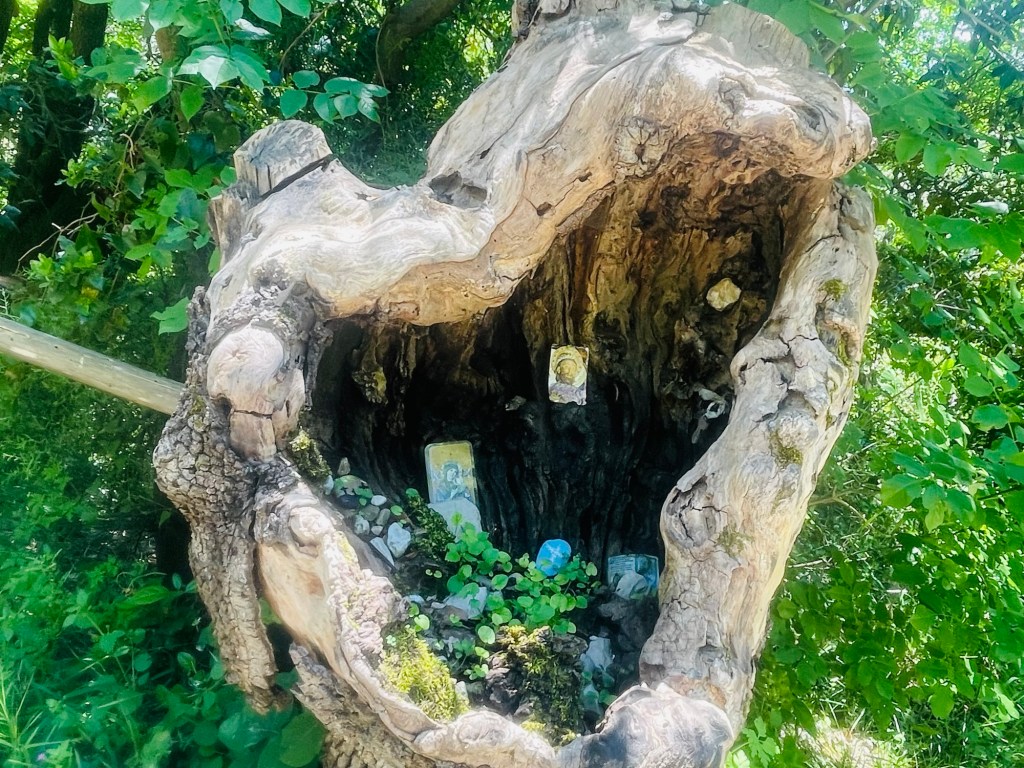
    Florence felt so near that it was as if I could reach out and touch her, but she was still 10 kilometres away. I passed a shrine that someone had embedded in a tree and took a moment to make a wish before spontaneously embracing it. Then I stopped for a little rest. 
    I reached the first open bar at around 3pm and delighted in downing some more fizzy water. 

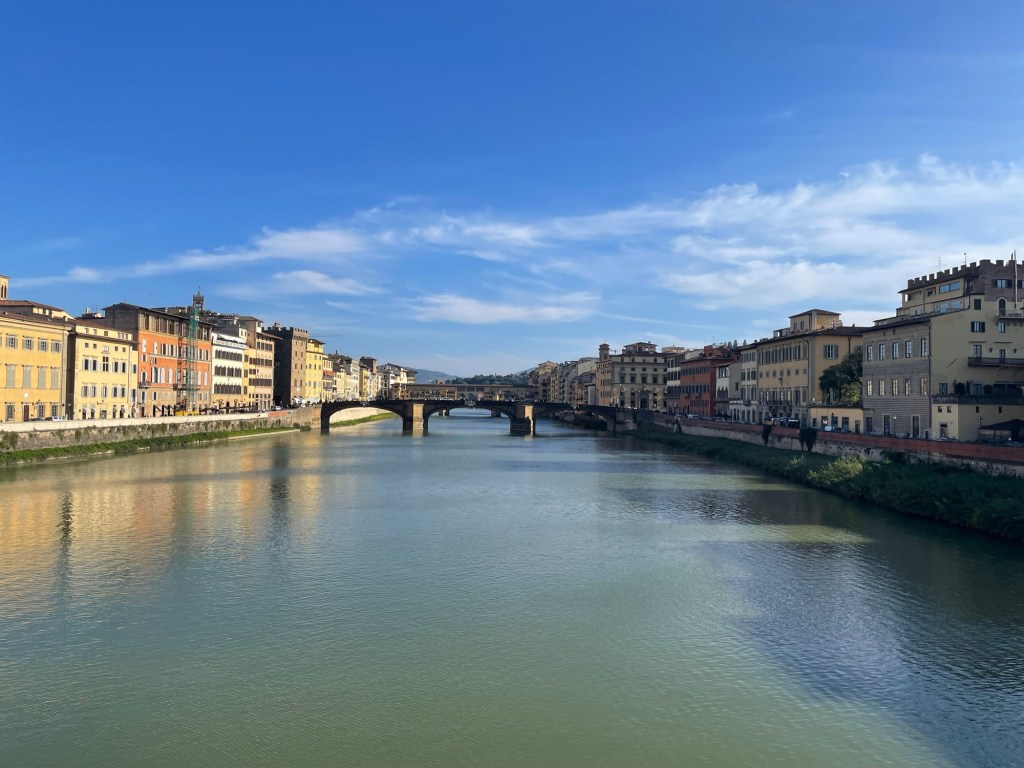
    Then, after half an hour more, I’d reached the river Arno. It looked like reflective glass. I thought about Giordano and his Monet Lake made out of mirrors. Anna, Massimo Kyo, Rossella, Enrico, Oliver, Paulo – what people I had met on my way!

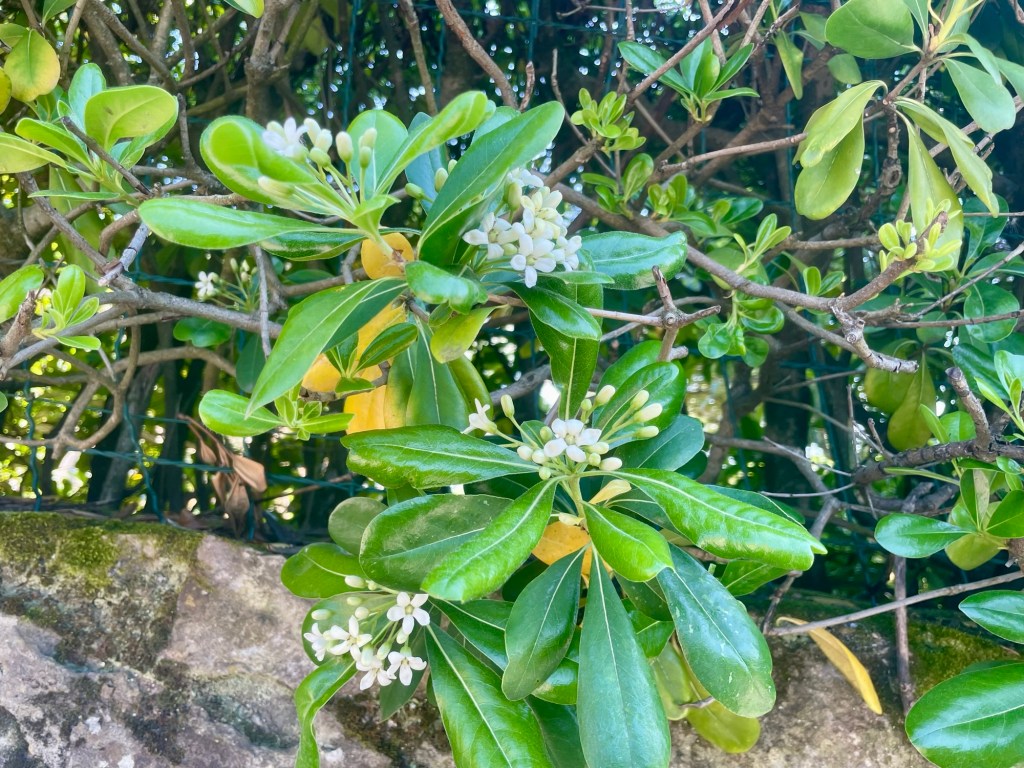
    I passed a hedge of Japanese cheesewood whose flowers smelt citrusy and vibrant. I took a sprig and held it to my nose, inhaling every last hint of perfume. I picked some wild garlic and smelled the oil heavy on my hands. There was so much here you could make a whole batch of pesto, I thought. 
    I was getting into the suburbs now. I passed the Florentine Equine School and a Business Centre for Young Doctors which had a crest decorated with half of the Florentine lily and half of the Medici shield.  

    The landscape had flattened out and I heard children playing in a schoolyard. It was strange to use a zebra crossing and be amongst so many cars. I was now just over 90 minutes away and would reach the baptistry by five. 

    I caught sight of myself in one of the corner mirrors on the road. I hadn’t washed my hair in five days and my braids were fraying at the edges. But I looked well. I looked really well. As Dante had written over 700 years ago, this was a ‘vita nuova’, a ‘new life’!

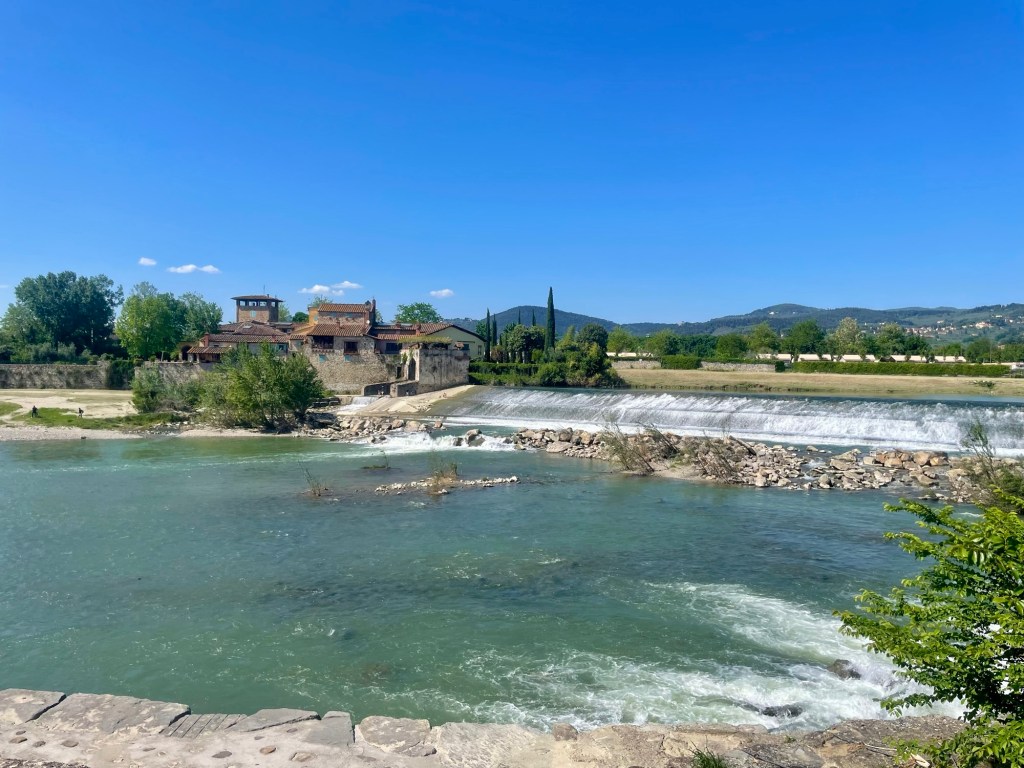
    As I traced the path along the Arno, a form of blossom like sheep’s wool collected at my feet, causing me to sneeze. Some people were sunbathing next to the weir. I remembered running up there in those precious three months I had spent in Florence as a Visiting Professor. Someone was sitting on a plastic chair in the middle of the water, of course. A lone woman was kayaking down the river.
    I kept my eyes peeled, recalling the time I’d taken the group of refugee students to Florence and my co-facilitator, Mortezza, had spotted an otter in the bullrushes. 

    ‘It looks just like the emoji!’ Mihal from Venezuala had exclaimed.  

    I’d also spotted kingfishers several times.

    I retraced the path of the beginning of the cammino which I’d hiked with Alina at my side, recalling the same beehives, hens and the same random upturned table in the middle of a lawn. 

    My inner world had changed profoundly and my outer body too – I had thick calves and my behind seemed to have moved up an inch. But here much was the same. A young woman in fashionable sunglasses walked past me with a Calvin Klein bag; another woman with neon pink lightening earrings rode by on an electric scooter. Two female lovers sat opposite one another on a bench with their legs intertwined.
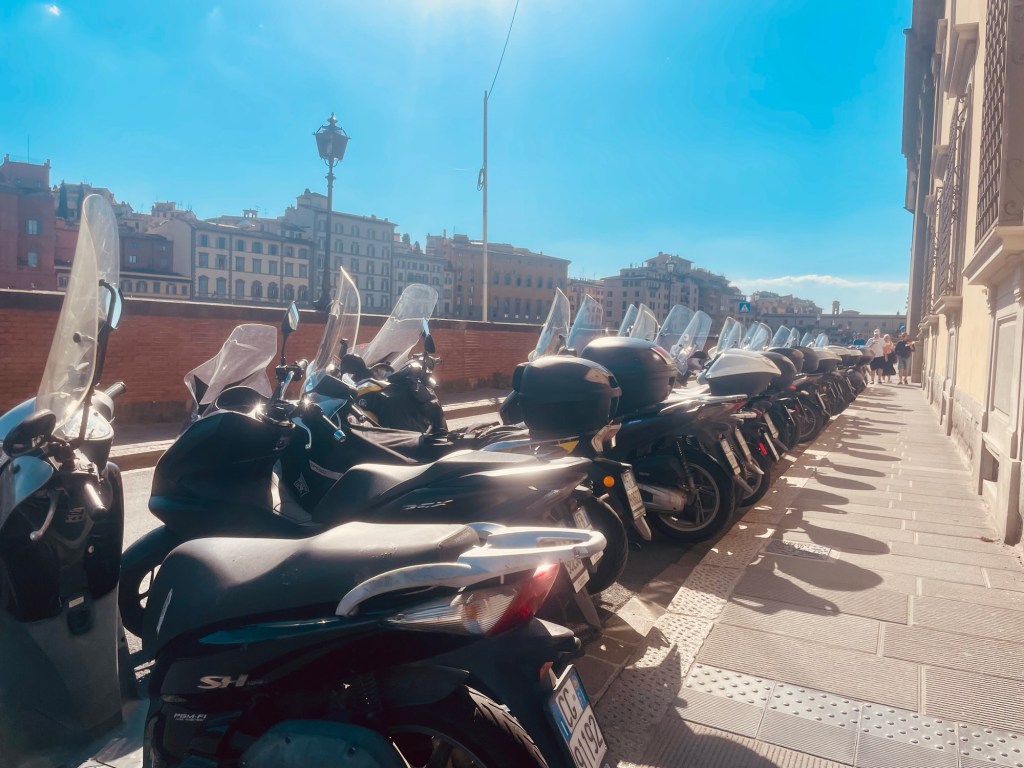
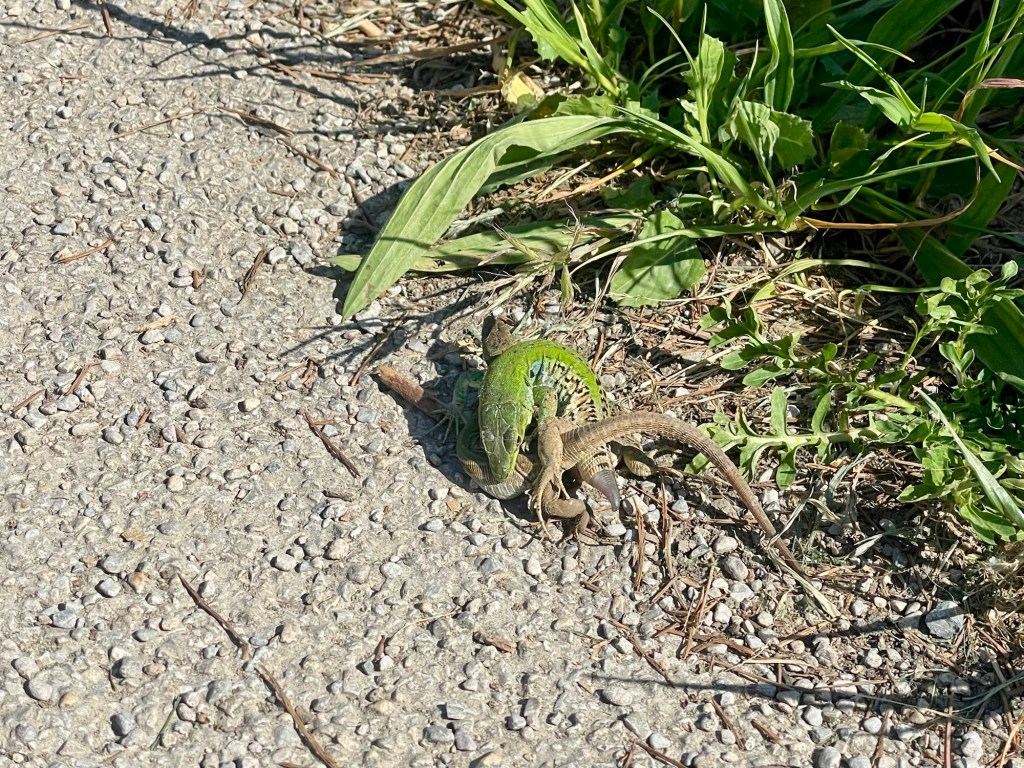
    And now I was in the city in earnest. The dum dum dum of music with a heavy base played out from somewhere to my right and several joggers ran topless in the sun. Tour coaches lined the streets with signs reading promises such as ,’Experience Pisa and Florence in a Day.’ I stopped to observe a lizard biting another’s tail.
    ‘Have you come far?’ asked an elderly gentleman.

    I had, I replied. 

    ‘Porca puttana miseria’ came his response, ‘good for you!’

    I passed the canoe club and the bridge off to Piazza Michelangelo from where, on several occasions, it had been a delight to watch the sunset. I passed through the remnants of the old city walls. 

    Florence had always seemed like such a small city to me, but suddenly it seemed so big.

    Here and there were grids covered by the familiar ugly orange netting. But now it didn’t mean that there had been a landslide, it meant roadworks.

    Two people walking with audio guides around their neck nearly walked into an open drain as they passed a stall selling suggestive aprons stamped with the statue of David. 

    I didn’t need a map now. I was on home turf.
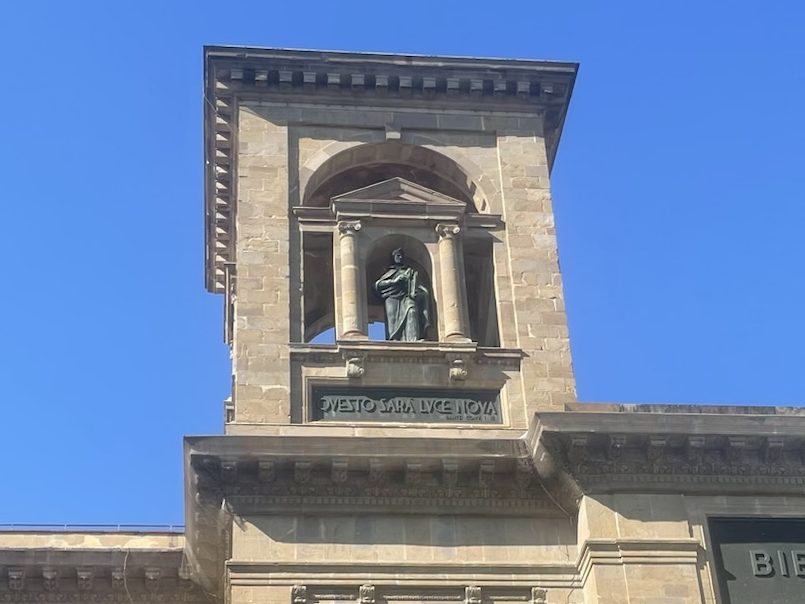
    I passed the national library with its Dante sculpture and quote from his political treatise Convivio, ‘let this be new light’. Then came the Galileo Museum, shortly after which I turned right at the Uffizi galleries. Over the heads of all the eager street artists, I spied a second Dante sculpture which depicts him pointing at himself in a gesture of self-importance and pride. Here in stone, he has been bequeathed the laurel crown of poet that he so desperately wanted to return to wear in person before he had died, aged 56, in exile. I thought of his bones, lying in Ravenna. 

    From Palazzo Vecchio I weaved in and out of guide groups who were following umbrellas of every neon hue. Three people were eating the special Florentine schiacciata on the move. A little Canadian girl was playing with a wooden sword.

    ‘Whoosh,’ she cried out, ‘off with their head!’

    Under the stone arches, it was nice and cool. But I’d never been here when it had been so busy. It was heaving.

    The smell of leather hit me as I passed down the main street and I resisted the temptation to pop into my favourite lingerie stores. I couldn’t believe I was in reach of the baptistry, my final stop. 

    I was glad to have this final moment on my own. The last three weeks had tested me beyond what I thought I could endure physically and mentally and I felt happy and restored. 

    And with that, I turned the corner and there she was, the baptistry in her green and white marble.

    She stood simple and sublime.

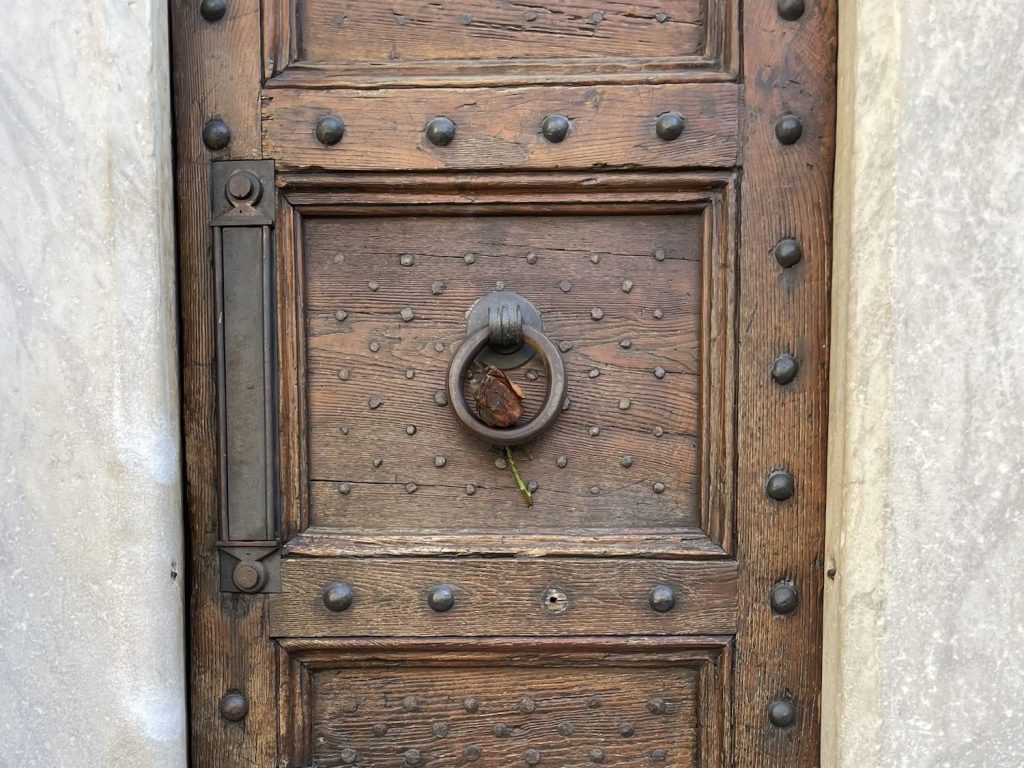
    I thought of how struck I had been at the age of 15 when I had first seen the mosaics inside and of the copy of Christ’s head that I had rendered that was likely still situated in the paving of my old secondary school. I thought about the first time I had read the words of Dante and felt seen and understood in my sense of being lost. The sobs immediately came. I placed my hands upon the flank of San Giovanni and tucked the rose I had brought from Ravenna in the doorknob. Dante’s dream had been to return as a poet and now, in some ways, symbolically, I had brought him back.
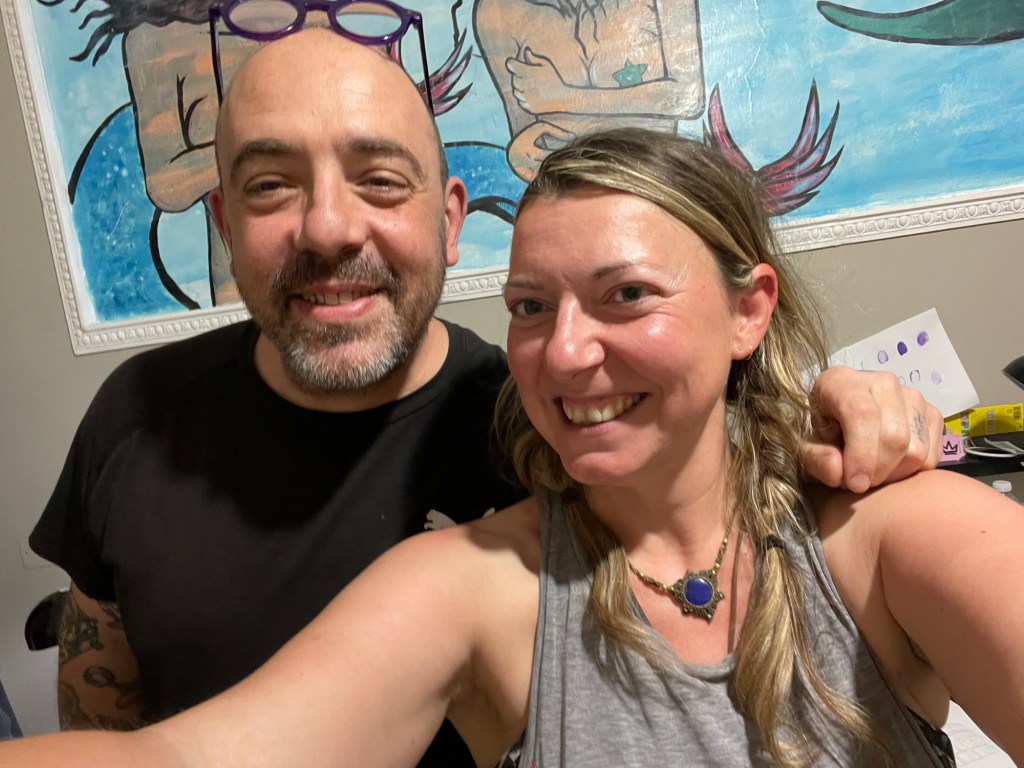
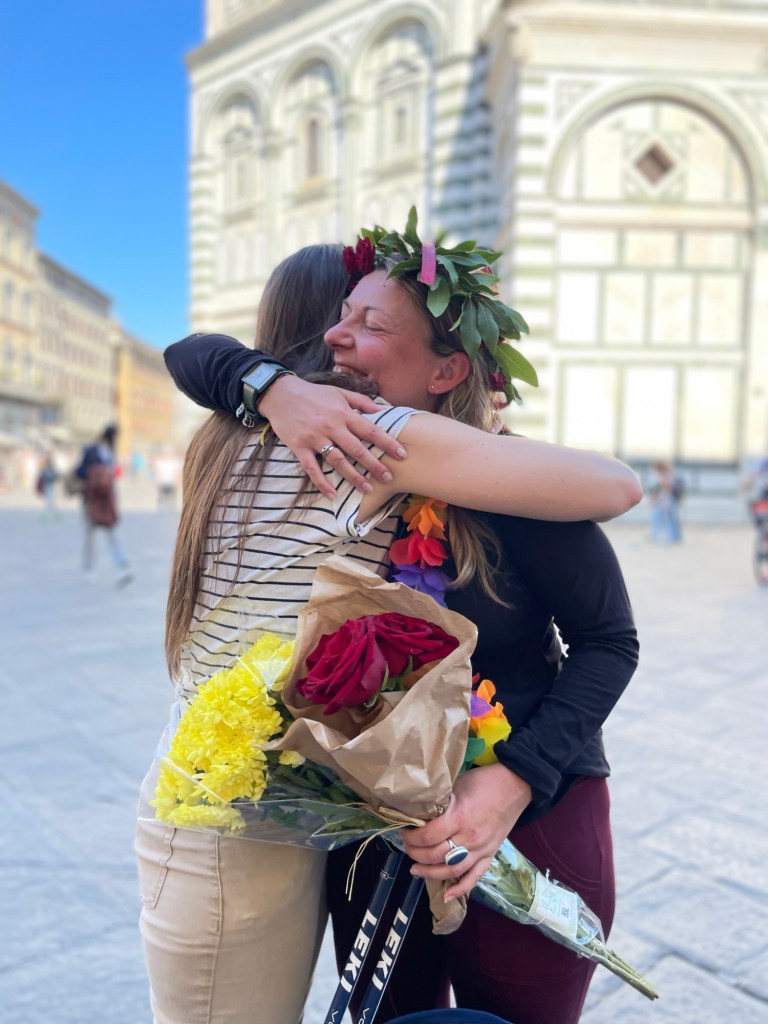
    Turning the corner, Kelsey and Alina with whom I’d shared parts of the cammino were there to greet me with a huge hug. Kelsey had made me a laurel crown with roses which she placed upon my head – they smelt magnificent. Alina who was wearing characteristically fashionable unmatching earrings squirted at me with champagne in the traditional fashion of Italian graduations. I sent a picture to Giordano, the founder of the trail. 

    ‘Consider yourself a graduate of poetic passages in Tuscany and Emilia Romagna,’ he replied with a smiley face emoji.

    That word passages had come to mean so many things to me. Passages of the Divine Comedy, passages through place and time; the many passengers who had travelled with me.

    As I melted into Kelsey and Alina’s embrace I thought of canto 21 of Purgatorio when Virgil meets with his beloved mentor Statius and realizes that he is unable to hold him because he is but a shade. He says, in one of the most moving passages of the entire Divine Comedy,

    ‘“Now you can understand
    how much love burns in me for you, when I
    forget our insubstantiality,

    treating the shades as one treats solid things.”’

    I had been gone three long weeks, much of which I’d spent alone in the wilderness, and as I hugged my friends, I felt my body return to life. I thought of all the times I had been to visit friends in detention centres where we’d been banned from touching; I thought of the borders that divided us; of Tagore’s ‘narrow domestic walls’.  
    Alina untangled her face from my hair. 

    ‘A question’, she asserted.

    ‘Do you think, after all this, that Dante would have written the Divine Comedy had he never been a refugee like me?’
  • ‘Visible Speech’: From Dicomano to Pontassieve

    The sun shone strongly on the rolling hills and I reflected on great art’s ability to speak in indelible ink.  

    I woke at 7am and ate breakfast with the construction worker from Udine and a colleague of his who was also staying at the B&B, Pino del Capitano. Coffee was served in a chipped teapot.

    We discussed Italian TV and the phenomenon of the velinas who are attractive women who serve at props in news and current affairs shows – showgirls, if you will. When I had started studying Italian in my teenage years, I had been struck by the sexism that dominated much of the culture, but I reflected that on my cammino I had encountered nothing but respect and chivalry. 

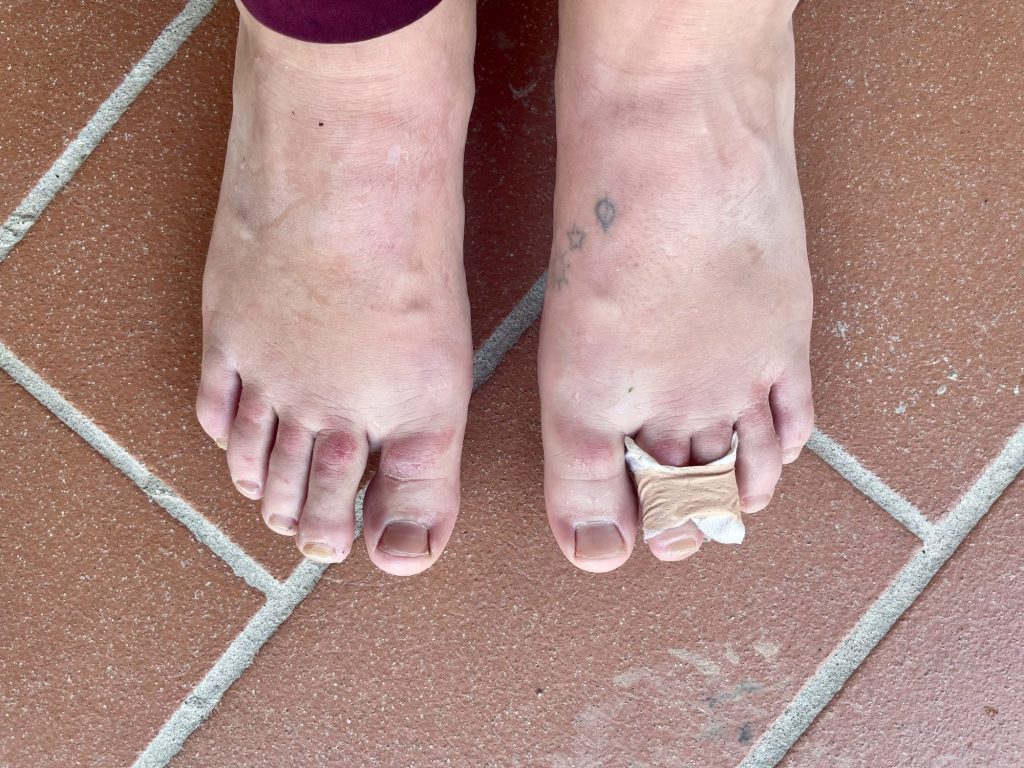
    I was worried about my toes which were swollen and painful from yesterday’s fall and so I bound them together once more with some tape and plasters that had been left to me in a first aid kit by Alina. Today I would walk tentatively and see how far I got. It was going to be a case of mind over matter, for sure.

    Ivan proudly showed me the lemons he had picked from his own tree. They smelt sweet and tangy at the same time. I was reminded of the citrus house in Oxford’s botanical gardens where I would sit and read as a student. 

    As I departed back up the valley, a line of mist like an airplane trail hung lightly in the sky. It was sunny but the air was fresh, or rather ‘frescino’.

    I love Italian suffixes such as ‘ino’ and ‘etto’ which denote something as small. ‘One’ renders its subject big and ‘accio’ makes it wicked. My Italian exchange partner Maurizio had called me ‘Jennina’ – little Jenny.

    I would miss speaking Italian on my return. Speaking a foreign language is like playing a musical instrument through which you get to express a different part of yourself. In French, I go by Jennifer; in Italian I am Jenny; and in Arabic I am Jen which means ‘ghost’.

    Kelsey, picking up on my international mindedness and desire to incorporate all my different linguistic personalities called me ‘Jenny-Jennifer-Jen.’

    As I passed down Via Garibaldi, there was a church on my left and an elderly gentleman attending to his roses. One of the gardens that lined the little path featured a tree decorated with easter egg wrappers and outside one house was an exercise bike. ‘Free to anyone who loves the planet,’ read the paper note.

    As I crossed the beautiful river, I realized I was limping. The pharmacy wasn’t open for another hour so I made do with Ibroprofen and carried on my way. On the road there were shards of a car’s wing mirror that glittered in the dawn light.

    I entered a café in Dicomano’s centre to grab a second coffee and got talking to three men in bright yellow nurses’ uniforms. I asked one of them about my foot. He said the same as my mum had, to lance my toes together, put my foot up with ice and rest. I told him that this wasn’t a possibility and that I had to continue. 

    ‘I see,’ he responded with a smile. ‘So, you grind your teeth and carry on, girl!’

    The gaggle of men sitting smoking outside could have been intimidating, but I wasn’t self-conscious at all. On the contrary, I felt welcome. There was a self-service laundromat and a shop called Meat Matters, both of which were yet to open. 

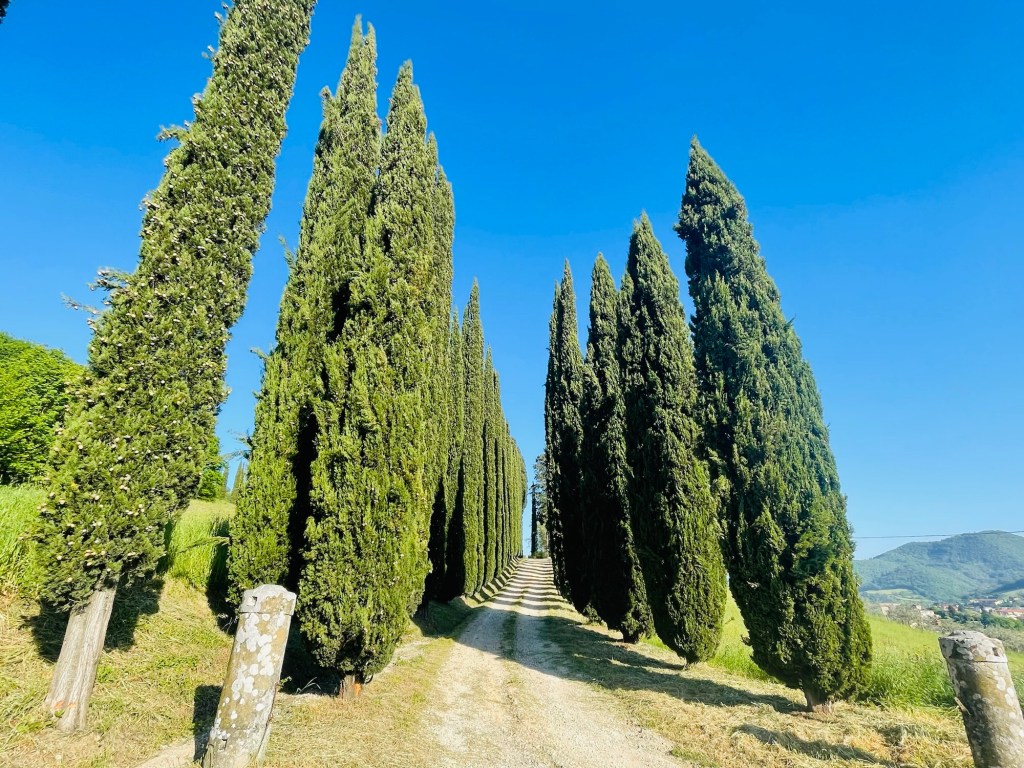
    I walked alongside the river for around 20 minutes. Some graffiti said, ‘all cops are bastards.’ There was a beautiful little allotment on the left and an avenue of cypress trees to the right. I crossed beneath a short railway bridge which even touched my head at five foot two. 

    A man was walking a ridiculously small dog in a gilet.

    I read a sign alerting me that I was on the Path of the Powerful Arno, also known as the ‘Path of Partisans’. In the Spring of 1944, the resistance to the Nazis had grouped together near here and walked to Florence which they would finally liberate on August 11th. I thought of one of my favourite Italian writers, Elsa Morante and her novel La Storia, which means both story and history. It narrates the life of a single mother living under Nazi occupied Rome:

    ‘Freedoms are not given,’ she writes, ‘They are taken.’ 

    It was hot and I was sweating as I left the river and mounted the rise out of the town. A school bus went up the hill and down again. I’d really come to appreciate nicely ploughed agricultural land; the brown earth was spilling up its guts, vulnerably awaiting new crops.  Someone had a boxing bag hanging in their garden.

    Today I felt like walking in silence. I was nearing the end of the cammino and every second was important. Every now and again a stone would get caught just under the front pad of my left foot, sending a shooting pain up my leg. But I was on the way of the partisan. What did I have to worry about, really? It hurt, but I could still walk and walk I did.  My right calf twinged. Perhaps I was overcompensating for my left foot?

    After yesterday’s multiple diversions, I kept religiously checking that I was on the right path. I saluted the town as a train chugged by, turning the corner into a silver cobweb that broke upon impact with my nose. 

    A flurry of flowers, a kind of sage I think, were covered in ‘cuckoo spit’. The phenomena actually has nothing to do with cuckoos or spit at all. The foamy liquid is caused by a type of bug called a froghopper nymph, also known as a spittlebug.  The insect feeds on sap found in plant stems and leaves behind blobs of this spit-like goo. 

    I saw a new type of butterfly – yellow and black in the middle, its wings became translucent at the ends. 

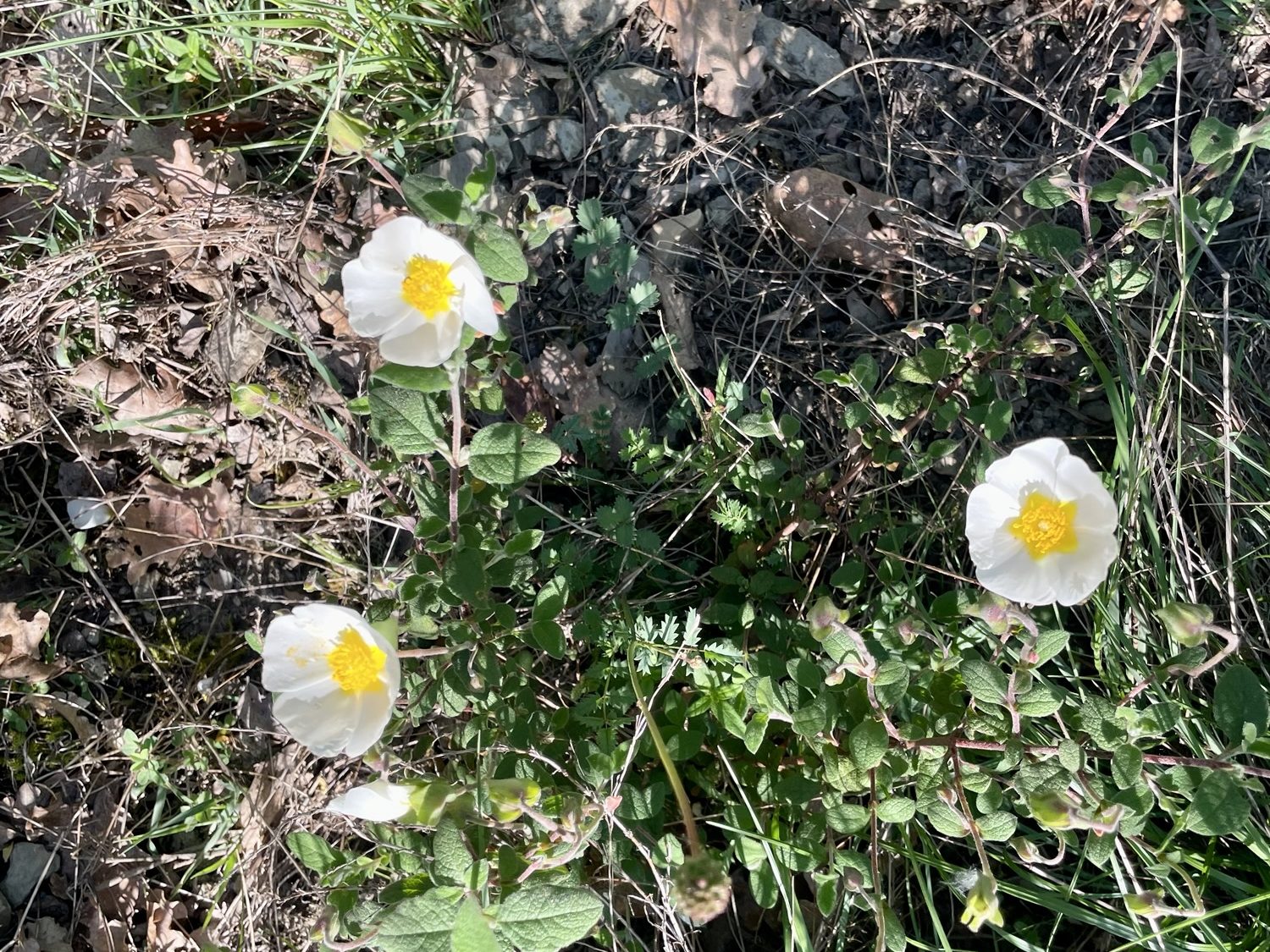
    There were white flowers with yellow middles, pregnant with pollen and I was happy to see the bees enjoying it. The shadow from the trees was merciful as I made my way up a steep uphill path. The sedimentary rock crumbled in clumps beneath my feet.

    I followed the navigator on my phone down a little path where the grass was really tall, stopping to pet two golden retrievers who accompanied me for a short while. One licked my hand which was salty from the sweat.

    A stack of abandoned beehives looked like filing cabinets on the hill.

    Though the sun was maturing in the sky, I resisted wearing sunglasses as I wanted to enjoy every bit of the view. I wished I hadn’t left my sunscreen behind and trusted that my cap would offer sufficient protection.

    A man was sat reading in a field of chickens. A tabby cat crossed the path in front of me, reminding me of my own cat, Dante, back home. 

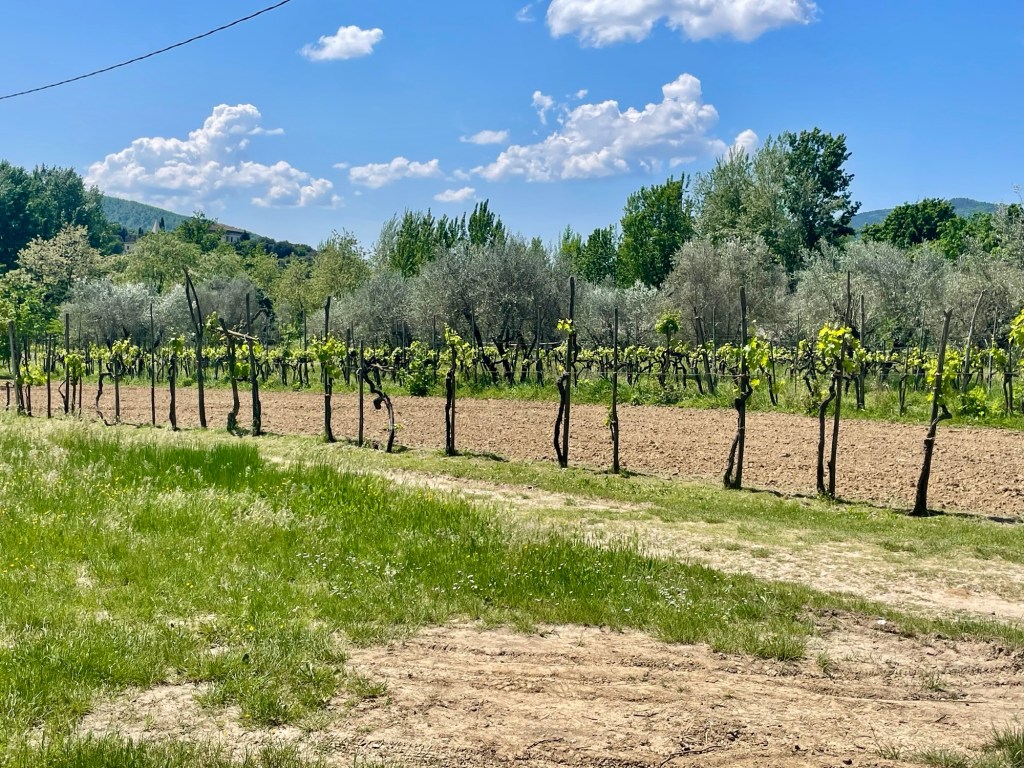
    As I passed a vineyard, I realized something momentous. The vines which I had identified at the start of my walk as tortured souls from Dante’s wood of suicides now appeared to me as yogis mindfully stretching their limbs towards the sun.

    My depression had lifted and I felt quite transformed in body and spirit. 

    All the nettles of the region seemed to have assembled here from where they stung me through my leggings as I crossed the overgrown field. My boots were snagging on sticky weed and there was a landslide. Then the overgrown foliage transformed into a perfect lawn.

    I stepped in something only to release that it was the entrails of a dead deer. The back half of its carcass was a little further up the path. Flies were making a feast of it. What could have got it, a wolf?

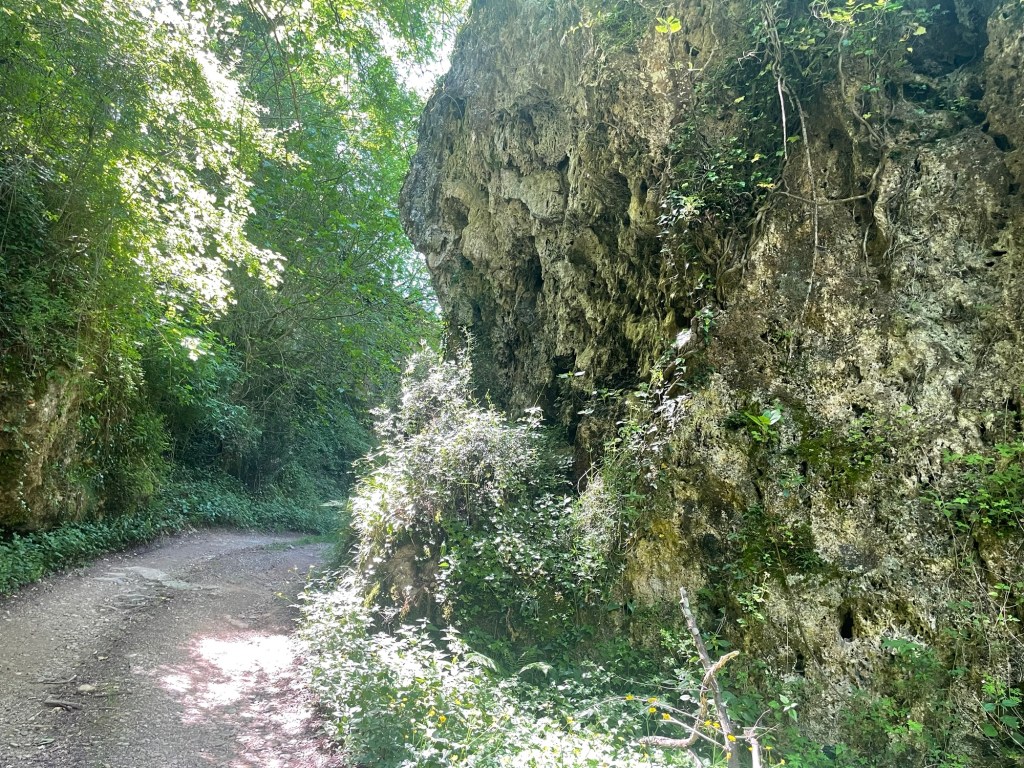
    As I passed a series of small waterfalls, I noted the ferns that sprung up in fans like toilet brushes. The landscape felt almost tropical. A pock marked cliff face protruded onto the road.

    I crossed a rickety wooden bridge and a sign that led to the Poet Hotel. What I assumed to be a father and son were playing in the stream. 

    Three hours had passed since I had left and so I stopped to take some more pain killers, observing a plastic unicorn rocker and succulents on the wall.

    Accompanied by the sound of the stream I felt like listening to Neil Young’s Harvest, one of the few CDs I had bought with me aged 18 as I trekked through India and Nepal. 

    ‘Will I see you give more than I can take?
    Will I only harvest some?
    As the days fly past will we lose our grasp
    Or fuse it in the sun?’
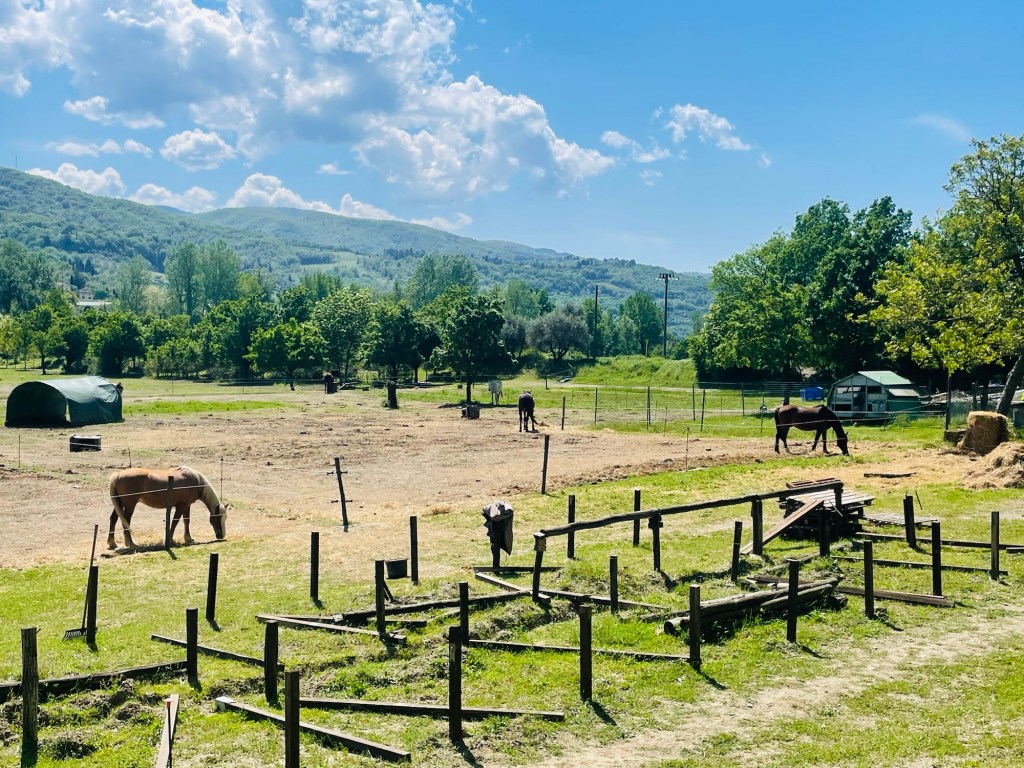
    Silverlake Ranch emerged and I greeted 12 horses who were each stationed in their own field by a reservoir. 

    The church bell sounded out at 11.58am, two minutes early. A spider had caught a fly in its web and it was slowly disintegrating. And there sat the spider proudly on the top of the grass.

    I was about half-way to Pontassieve and my broken toes were feeling it. I would stop in the next village and assess the situation.

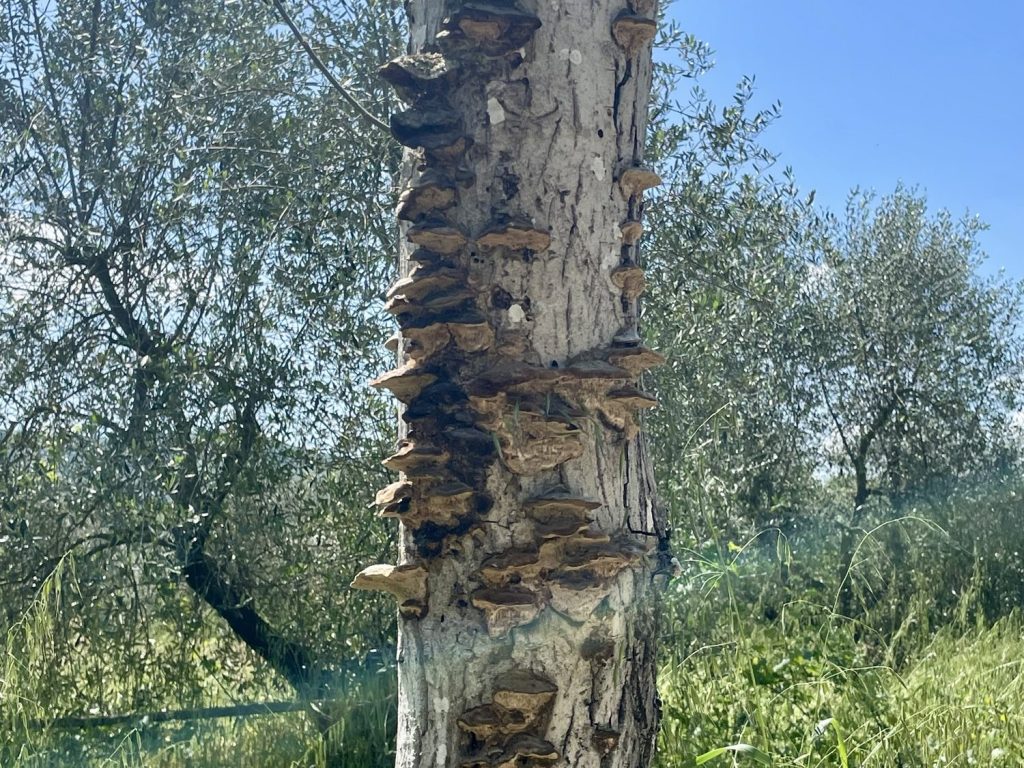
    I arrived in Galardo to the smell of woodsmoke and strings of drying laundry that lined the narrow streets. Someone had decorated the front of their house with purple and orange snapdragons. I took one between my fingers and made the familiar mouth shape: snap! Some mushrooms were colonising a tree. 

    I stopped at a bar overlooking the river and ordered a coke zero and tuna and tomato stracciata. The type of bread  salty and delicious – suggested I was getting near to Florence. I knew better this time than to ask for cheese, and it tasted all the better for it.

    The owner, Sofian, was from Tunisia and so we exchanged a few words in Arabic. He had turquoise eyes that were quite captivating. 

    ‘We get a lot of pilgrims who stop here on the cammino di Dante but also the Via Francesco. But you’re the only person I’ve met who has gone it alone. It must be tough, especially for a woman.’
    ‘Not really,’ I replied. 

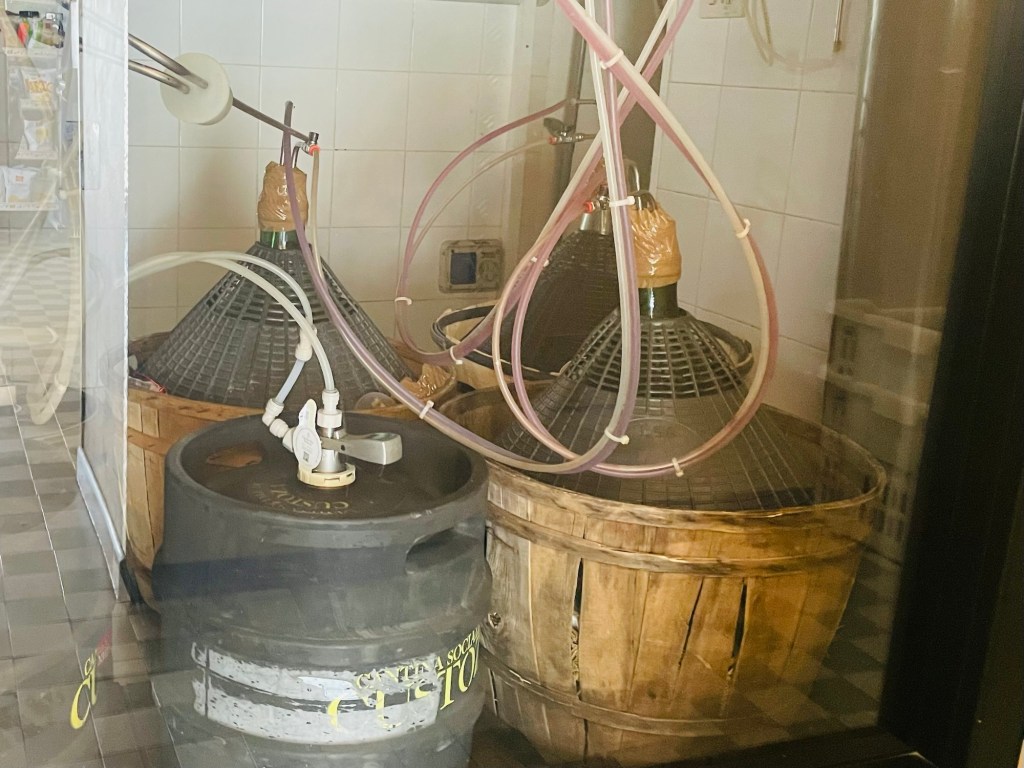
    I explained to him about my broken toes and he suggested I take a lift to Pontassieve with a local guy who would be passing by shortly to pick up some wine. The wine was made in house. Next to the bar there stood a heavy metal corking machine.

    It was tempting. I was determined to walk the full way back to Florence tomorrow and I’d already done 15km today and climbed 75 floors. I could wash my clothes, catch up on my blog and be ready for tomorrow which would undoubtedly be a day full of emotion. Kelsey and Alina were going to meet me in Florence along with Professor Alberto Tonnini from the University where I’d taken up a visiting professorship in 2023.

    Otherwise, there was the train or the bus, counselled Sofian. I heard him on the phone explaining that there was a ‘pretty blonde girl who wanted a lift’.

    Within ten minutes, Maurizio had arrived. He was a gentle older man with a solid grey moustache who drove a green jeep. 

    ‘Sorry for the mess,’ he offered. ‘For me a car is a way to get from A to B and nothing more.’

    I offered him a drink and, with speed he downed a glass of rose. 

    I thought of Virgil seeking out a shortcut from him and Dante in canto 11 of Purgatorio,

     ‘to reach the stairs; if there is more than one
     passage, then show us that which is less steep; 

     for he who comes with me, because he wears
     the weight of Adam’s flesh as dress, despite
     his ready will, is slow in his ascent.’

    See, even Dante had taken it easy sometimes.

    In the car, Radio Capital, a Roman station, played out a solid mix of 90’s tunes. Maurizio explained to me that he was retired but still repaired cars with his son for a living. But today was May 1st, workers day, and so he was having a day off.

    As we passed the medieval bridge, he explained that a ‘bomb of water’, or flood, had hit the town on March 15th, causing damage to its foundations and inundating the football field. There were logs that had been carried by the surge still deserted on the banks of the river.

    ‘Luckily no one here was hurt,’ Maurizio sighed. ‘You hear the sound of water and you can’t do anything.’

    I thought back to Rossella and her animals, not all of whom had survived the floods of 2023. 

    Maurizio left me by the town hall in the old city and wished me well,

    ‘Be careful in Florence,’ he advised me, ‘the political rivalry of Dante’s day continues there today.’ 

    ‘Oh, there’s the local major,’ he said, waving, and then he sped on.

    I felt vindicated in my decision to dye my hair blonde which had clearly played a role in me getting a lift.

    I strolled around the old city walls and was surprised at the decent size of the town. There was a United Colours of Benetton and a shop that sold nothing but sewing machines. A man’s barbershop was full of beautiful antique equipment. I saw my reflection in the window – the top of my shoulders were red with sunburn.

    I climbed up a little side street that smelled of soap and up a very steep hill to the apartment where I would be staying that night, La Taverna di Caterina. There were orange trees on the terrace and a sweeping view of the city. 

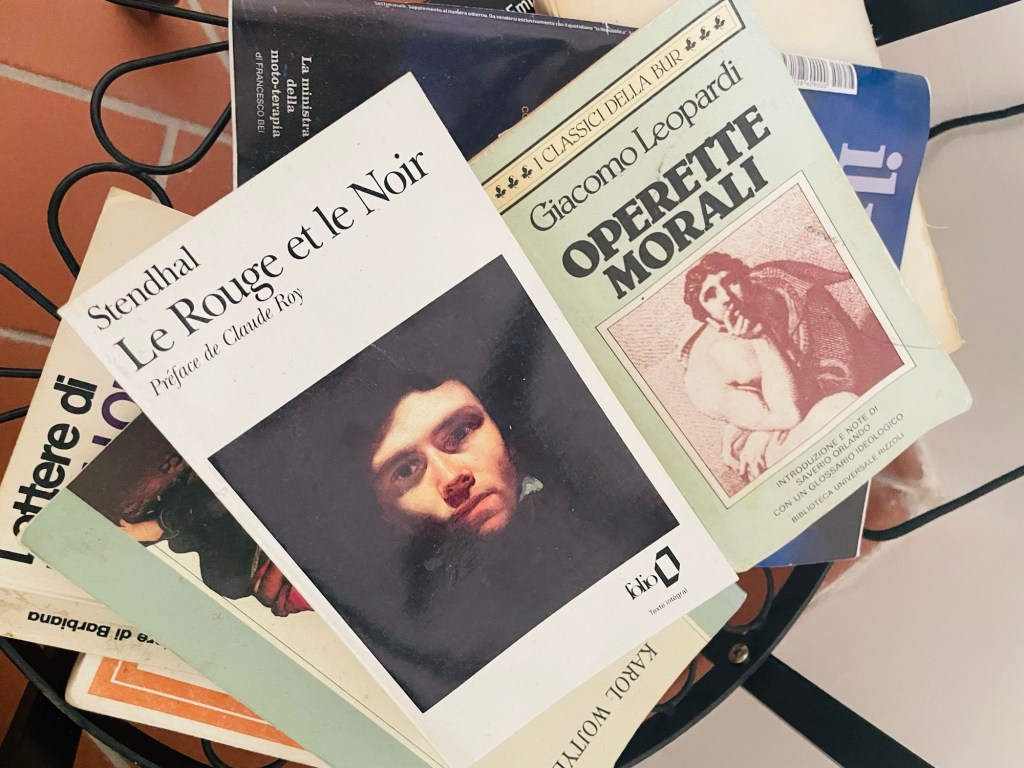
    Caterina’s daughter Anna showed me the lovely flat which had a round table outside for writing. Inside there was an amazing selection of books including The Red and the Black by Stendhal and verses by Leopardi.

    I thought back to Stendhal’s romantic novel. 

    ‘A good book is an event in my life,’ he had written. 

    As I washed my face in the sink, I realized I had come out in spots from the constant sweating. There was a heatwave back in England my mum messaged me to say and I wondered if she had caught the sun too. 

    I did some writing, caught up on work emails and then wondered back into the town. 

    Since the start of my cammino, I had wanted to do something permanent to mark the adventure and my relationship with Dante, so as I passed a tattoo studio I tentatively walked in and inquired if they had any spaces.

    They did.

    I spoke with Massimiliano, the lead tattoo artist and explained something of my journey and intention. Then, as if by magic, out he whipped a copy of the Divine Comedy from his backpack.

    ‘I always carry it with me,’ he said, ‘here and there I read a verse or two.’

    It felt meant to be. 

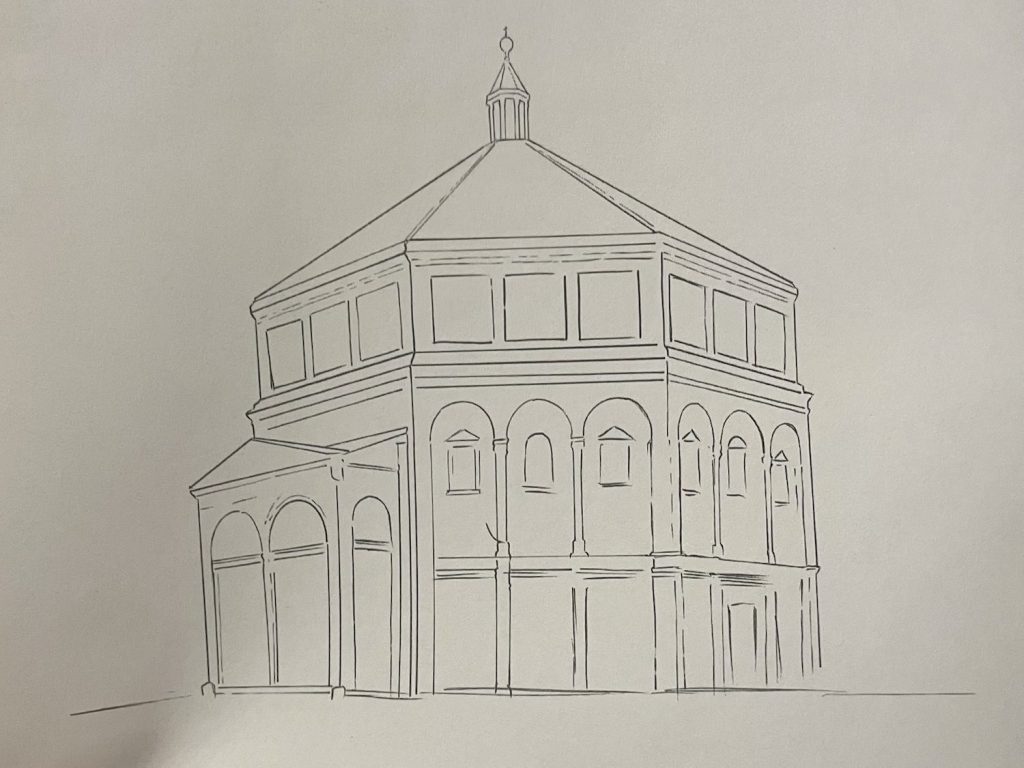
    Together on an iPad we designed a simple outline of the baptistry where Dante had been baptized and where he had wished to return a poet and assume the laurel crown. It was more original that getting a tattoo of the Duomo which was very popular in these parts, Massimiliano said. His dad was from Florence. This was the first time he’d tattooed an English person. 

    Two other female tattooists, Asia and Claudia, were working and they were chatty and curious to hear about my walk and my blog. 

    Massimiliano had to go and collect his daughter and so I sat with Claudia who realized my tattoo. She inked the small design in a subtle terracotta colour that I associated with Florence.

    ‘You’re not thinking of your feet anymore,’ she said, as the needle buzzed across my arm.

    And then it was finished.

    ‘Now you’re more Florentine than me!’ Claudia announced. 

    I was thrilled with the finished product and celebrated by going to a sushi bar where I necked a platter of dragon rolls. 

    Underneath my jacket I stroked my new tattoo. It was a work of art, a testament to what Dante calls ‘visibile parlare’ or visible speech. A picture could say a thousand words. 

    ‘I see you,’ this tattoo seemed to say. 

    ‘I see the pain of exiles and I am committed to documenting it.’

    ‘I have walked 400 kilometres and more to re-see the beauty of Florence and there, tomorrow, may I find peace.’

  • The Art of Exile: From San Benedetto in Alpe to San Godenzo 

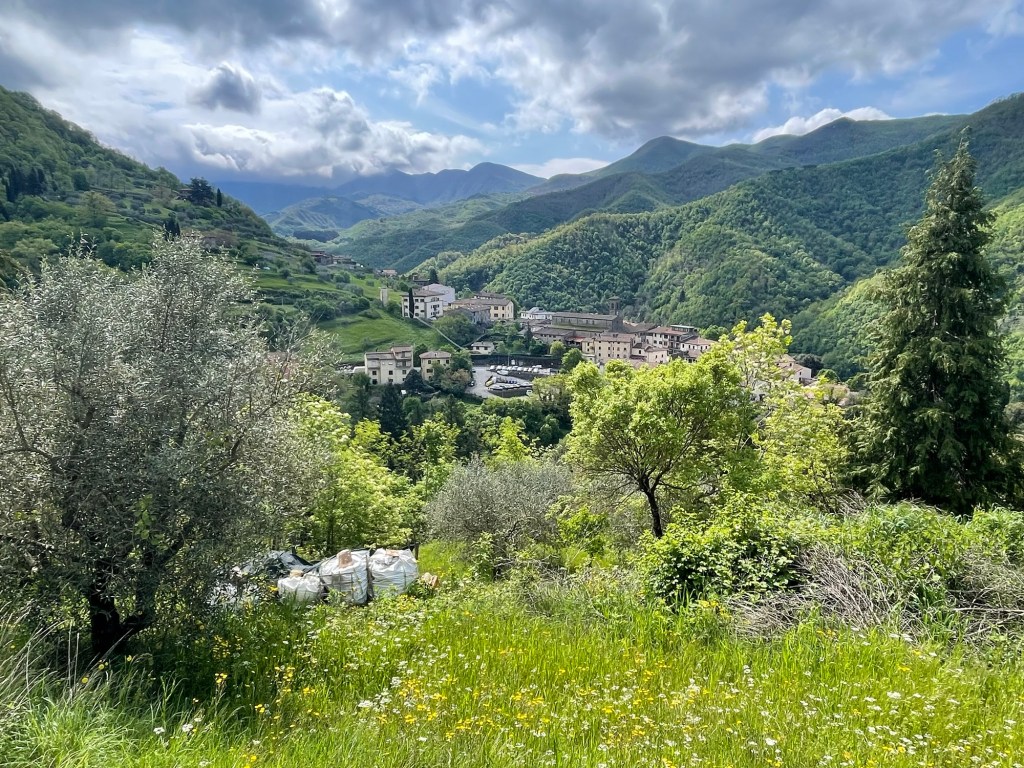
    I had an easy day, retracing Dante’s footsteps as a political exile who had a tumultuous relationship with his native Florence.

    My sleep was disturbed and, as I was sharing the dorm with an Italian couple from Bologna, Giuliana and Vittorio who had arrived late the night before, I finally made use of my pink EarPods to listen to some sleep hypnosis meditations.

    I had fevered dreams and was reminded of Dante who in canto 27 of Purgatorio passes through the wall of flames to Paradise, only to collapse with sleep with his guides, Virgil and Statius at his side:

    ‘Before one color came to occupy
    that sky in all of its immensity
    and night was free to summon all its darkness,

    each of us made one of those stairs his bed:
    the nature of the mountain had so weakened
    our power and desire to climb ahead…

    From there, one saw but little of the sky,
    but in that little, I could see the stars
    brighter and larger than they usually are.

    But while I watched the stars, in reverie,
    sleep overcame me—sleep, which often sees,
    before it happens, what is yet to be.’

    But as Dante wakes eager for the journey ahead, writing, 

    ‘my will on will to climb above was such
    that at each step I took I felt the force
    within my wings was growing for the flight’

    I, on the other hand, was exhausted.

    Because of a landslide, I would have to retrace yesterday’s steps and take a longer improvised route round to San Godenzo. 

    Over a breakfast of sweet pastries, the hostel owner Gian Luca suggested I miss the first part and start back on the trail from after the landslide. 

    I didn’t need much convincing, so when Vittorio offered to take me halfway in their car, I agreed. 

    It would give me more time to catch up with work, specifically, a funding application I was developing to read Tagore with refugees in India. In one of his most beautiful poems in the collection Gitanjali, he describes a world undivided by borders:

    ‘Where the mind is without fear and the head is held high;

    Where knowledge is free;

    Where the world has not been broken up into fragments by narrow domestic walls;

     Where words come out from the depth of truth;

     Where tireless striving stretches its arms towards perfection;

     Where the clear stream of reason has not lost its way into the dreary desert sand of dead habit;

    Where the mind is led forward by thee into ever-widening thought and action

    Into that heaven of freedom, my Father, let my country awake.’

    It would be fascinating to see what refugees made of the world of this cosmopolitan Nobel Prize winning author. After Dante, Tagore was one of my favourite poets. 

    ‘Many people take public transport as they don’t manage after yesterday’, said Gian Luca reassuringly before he headed to the kitchen to make pasta for that day’s meal.  

    In the car, Giuliana and Vittorio told me a little of their work in music and events. 

    Soon we had arrived at Passo da Muraglione where Gian Luca had indicated to them to drop me but it turned out it was the wrong spot and I was completely off the Dante trail. I couldn’t ask the couple to drive me back another 30 minutes, and so I graciously accepted their offer to drop me directly in San Godenzo where they were passing through instead. From there it would be a three kilmetre walk up to the Agriturismo I had booked. I’d get a few steps in but the day would be my own to rest and recuperate.

    The car sounded out gospel tunes and many motorcyclists sped past on the road.

    ‘It’s the Spotify algorithm’ explained Vittorio. He’d liked one hymn and now the internet had decided he was religious. 

    In San Godenzo, I invited my hosts for a coffee and I had a slice of pizza, unsatisfied, once more, with my sweet breakfast. It was 10.30am. 

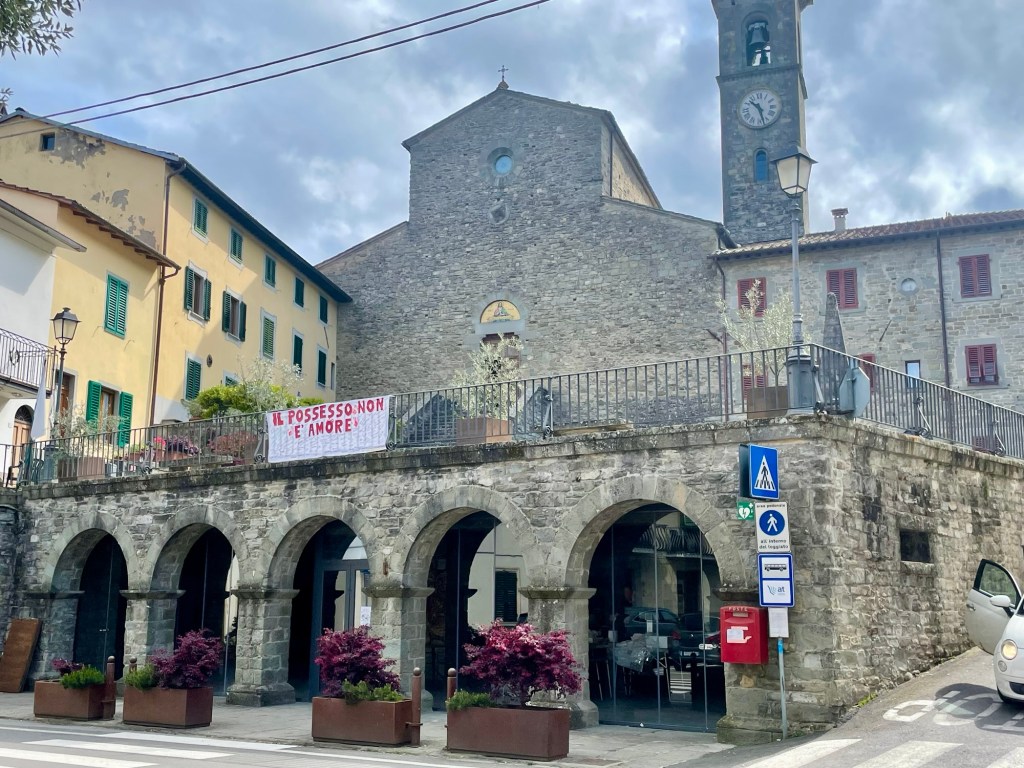
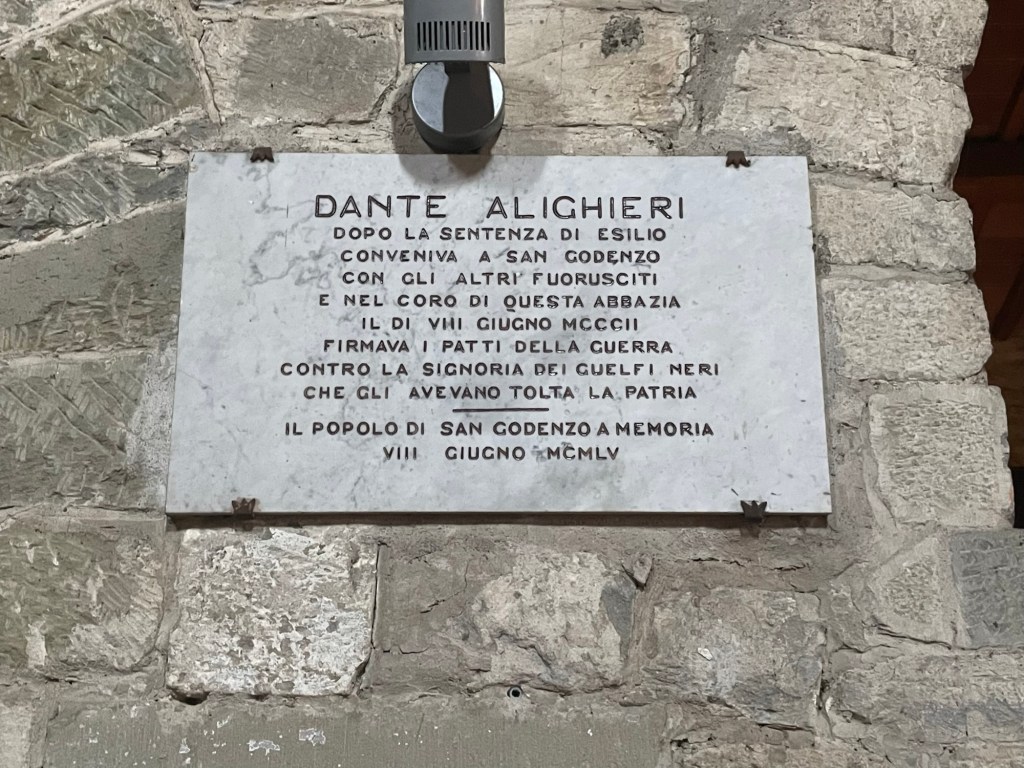
    I saluted the friendly couple and made my way to the abbey of San Godenzo in Piazza Dante Alighieri where the poet-politician had met with Ghibellines and White Guelfs in his first months of exile in June 1302 to try to forge an alliance against the Black Guelfs who had expelled him from the city.

    The convention brought together the noble families who were expelled from Florence and wanted to plan their return to the city by meditating on revenge. Dante’s name is signed in the attendance list.

    Walking around the abbey, I felt Dante’s political presence. I thought of all the refugees I knew who were committed to activism across borders. My friend Javid campaigned for women’s education in Afghanistan while an Albanian youth group I had worked with had started a campaign against blood feuds. 

    Although the 1302 convention did not lead to action, for more than 30 years, San Godenzo has commemorated this event during the ‘Dante Ghibellino’ festival, with a historical procession through the town streets. The celebrations culminate in awarding the homonymous prize to citizens who, during the year, have distinguished themselves for their civic commitment to San Godenzo, its territory and its community.

    As a political exile, Dante was excluded from a Florentine pardon in 1311, but another amnesty in 1315 would have allowed him to return. Unwilling to comply with the terms of the offer—admission of guilt and payment of a fine—Dante was again sentenced to death, this time by beheading rather than fire, the penalty now also applying to his sons, Pietro and Jacopo. 

    An additional provision stated that anyone had permission ‘to harm them in property and person, freely and with impunity.’ 

    Dante’s refusal reflected not only his great pride but also his better living conditions. While the first years of his exile had been brutal, by 1316 he was now residing in Verona as a guest of the Ghibelline ruler Cangrande della Scala. Having cut ties with his native city, he declared himself ‘Florentine by birth, not by disposition.’ Dante had learned how bread outside Florence ‘tastes of salt,’ but such bread was also not lacking as he sought out more abundant hospitality towards the end of his life. 

    Dante’s ‘overswollen pride’ is reflected in the significant time he spends with the proud in Hell and on the terrace of the proud in Purgatorio. Indeed, Dante presents pride as the foundation of sin by situating it at the base of Mount Purgatory. 

    In Purgatory, he walks alongside the proud souls who are forced to carry heavy loads:

    ‘I, completely hunched, walked on with them….for such pride, here one pays the penalty’

    Dante then reflects on the fleetingness of reputation and fame:

    ‘O empty glory of the powers of humans!
     How briefly green endures upon the peak-
     unless an age of dullness follows it…

     Worldly renown is nothing other than
     a breath of wind that blows now here, now there,
     and changes name when it has changed its course.’

    There is an irony here, since Dante is also explicit about his desire to bolster his reputation through the written word. 

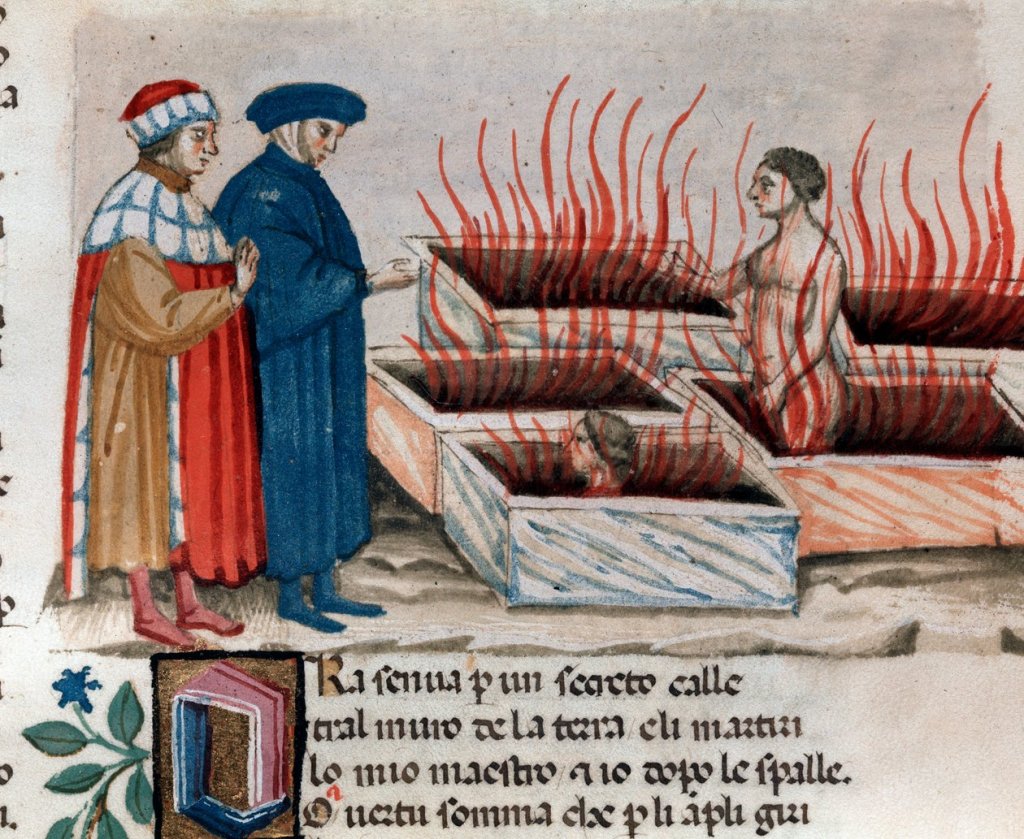
    In Inferno, meanwhile, one of the most realistic conversational exchanges occurs between Dante and Farinata degli Uberti, the great Ghibelline leader in the battle of Montaperti, who died the year before Dante’s birth. Farinata is depicted in ‘the cemetery of Epicurus and his followers, all those who say the soul dies with the body.’ However, he is also guilty of the sin of pride, something we see through his rising out of a burning coffin, stubborn and defiant.

    ‘My eyes already were intent on his;
    and up he rose—his forehead and his chest-
    as if he had tremendous scorn for Hell.’

    Dante uses the meeting to discuss Florentine politics, engaging in vocal sparring. Farinata immediately recognizes Dante as a Florentine citizen from his accent: 

    ‘Your accent makes it clear that you belong
    among the natives of the noble city
    I may have dealt with too vindictively.’

    He then goes on to explain how he was responsible for the exile of many of Dante’s ancestors`:

    ‘When I’d drawn closer to his sepulcher,
    he glanced at me, and as if in disdain,
    he asked of me: “Who were your ancestors?”

    Because I wanted so to be compliant,
    I hid no thing from him: I told him all.
    At this he lifted up his brows a bit,

    then said: “They were ferocious enemies
    of mine and of my parents and my party,
    so that I had to scatter them twice over.”’

    While there is certainly no love lost between Dante and Farinata, there is a measure of respect. Farinata, called magnanimo, ‘great-hearted’, put Florence above politics when he stood up to his victorious colleagues and argued against destroying the city completely.

    ‘But where I was alone was there where all
    the rest would have annihilated Florence,
    had I not interceded forcefully’

    As the literary critic Auerbach has noted, Dante’s realistic and somewhat flattering depiction of Farinata shows his willingness to admire and work alongside his adversaries, something he did by uniting with the Ghibellines during the 1302 convention in San Godenzo. 

    Dante rebuffs Farinata’s insults by boasting that on both occasions when his ancestors were exiled, they returned:

    ‘“If they were driven out,” I answered him,
    “they still returned, both times, from every quarter;
    but yours were never quick to learn that art.”’

    The art referred to here is the art of exile. As Barolini explains, the above conversation references four cataclysmic events in Florentine politics of the thirteenth century, as Florence oscillated between Guelph and Ghibelline control until the ultimate defeat of Farinata and the Ghibellines at the battle of Benevento of 1266. 

    In effect, the dialogue lays out two sets of factional routes and returns. The first set of route and return comprises the 1248 defeat of the Guelphs by the Ghibellines, with the help of Emperor Frederic II, followed by the return of the Guelphs in 1251, after the death of the Emperor.

    The second set comprises the 1260 defeat of the Guelphs by the Ghibellines at the battle of Montaperti, where Farinata led the Ghibellines to victory with the help of the Sienese and Manfredi, Frederic’s successor, and then the subsequent defeat of the Ghibellines and return of the Guelphs following the battle of Benevento and the death of Manfredi in 1266.

    The abbey where Dante convened with Ghibellines of his own day featured a plaque to honour him and some stunning mosaics that had been added some time after he had congregated there.

    Outside the church someone had hung a banner saying, ‘possesion isn’t love.’

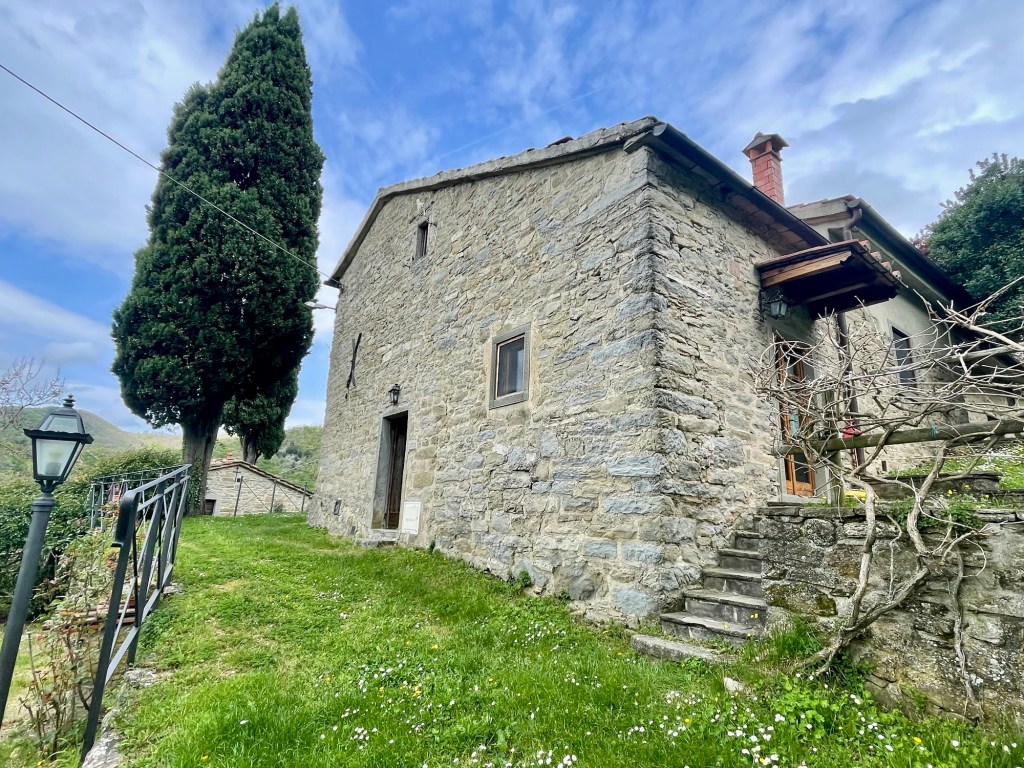
    I walked for half an hour up a hill to the Agriturismo Tenuta Mazzini where I was met by Filippo, the son of the owners who was out foraging for strigoli. He was walking alongside a woman carrying a wicker basket. Strigoli, or stridoli, are a spontaneous grass typical of the Tuscan-Romagna territory. The name comes from the screeches that two leaves emit if rubbed together. It is edible and often used in risotto or salads. It’s especially tender at this time of year, explained Filippo.

    There was a sign forbidding people from collecting mushrooms and chestnuts between the 1st of September and 31st of October but there was no mention of harvesting grasses. What’s more, the seasonal ban had yet to come into force.

    Filippo showed me where there was a local restaurant that served lunch, but the owners had provided spaghetti, tuna and tomato sauce so I made myself a meal that would serve as both lunch and dinner.

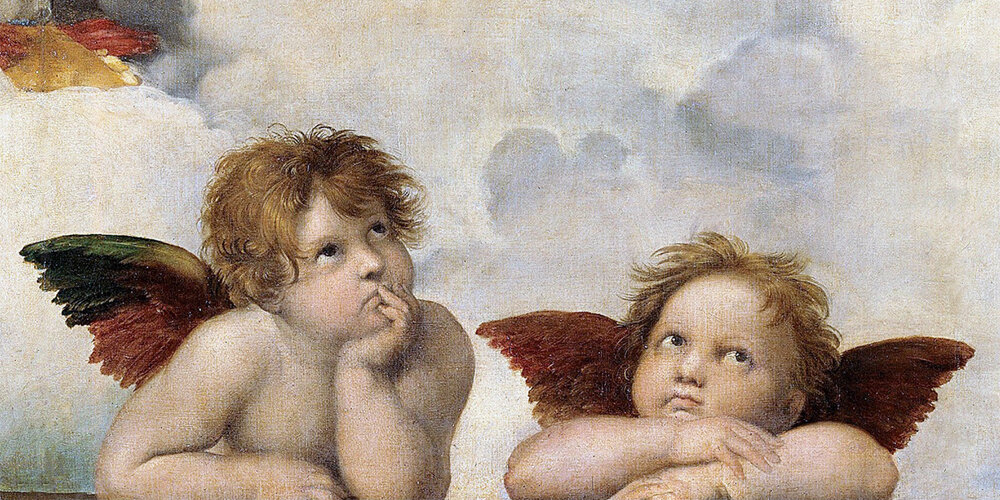
    The apartment was spacious with a comfy double bed, quite a welcome contrast from yesterday’s basic amenities and a total bargain at just 45 Euros a night. There was a poster by Matisse and a copy of The Two Cherubs by Rafael from 1513. The latter is part of a bigger painting that features the Madonna holding the Christ Child, flanked by two saints. The figures are placed among the clouds, suggesting that it is a scene from heaven. At the base of the painting are the two winged cherubs, looking up at the scene from below.

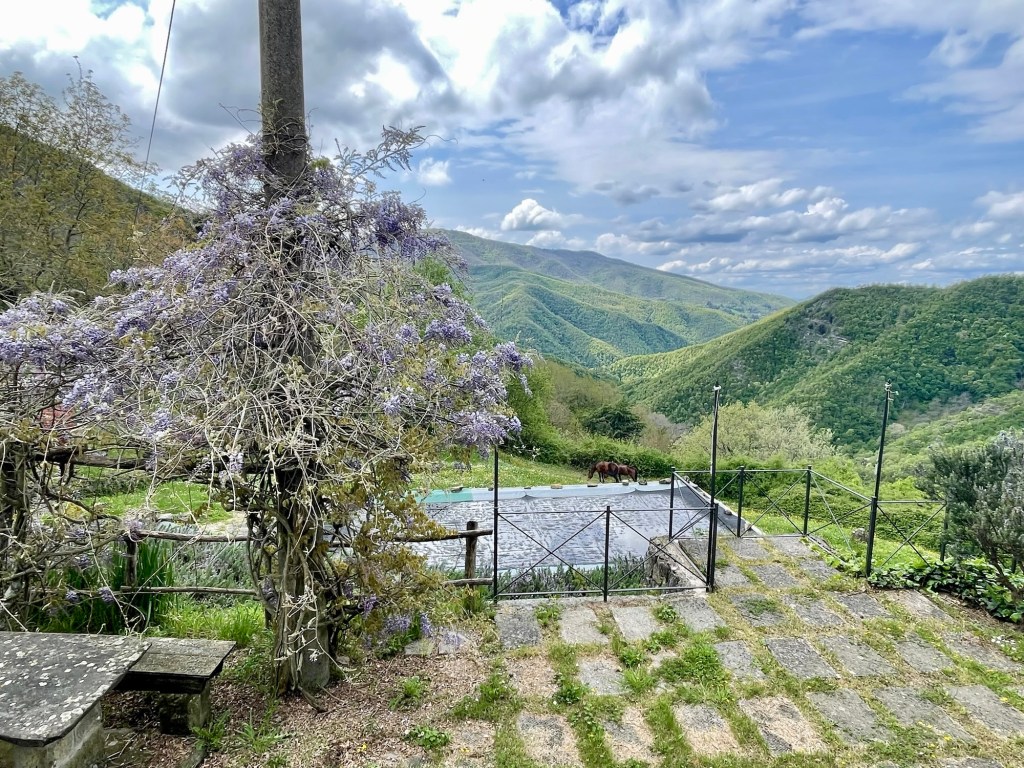
    Outside there was a swimming pool that was overhung with wisteria. It boasted a view of the rolling hills. I watched as a nuthatch flitted from branch to branch then disappeared into the distance. 

    A lady staying in the flat next door, Cristina, had brought six cats with her and took them each out for a wonder on a lead. Milu was among the friendliest and we shared caresses on the grass.

    As I caught up on work, including meeting online with my PhD student Olivia who was doing research on asylum seekers’ reception in UK hotels, I recalled Dante’s words about how writing is a way to ‘make oneself immortal.’

  • My Florence, the anti-Milton Keynes

    Florence feels like my home, though the city I grew up in couldn’t be more different.

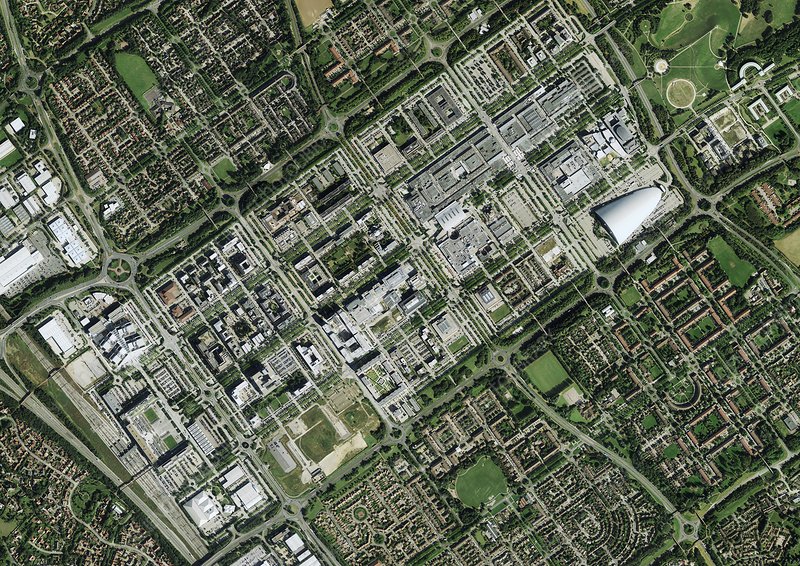
    Coming to Florence has always felt like coming home to me. It’s peculiar since I grew up in Milton Keynes which is known as England’s ‘best new city’. It’s a capitalist paradise with grid roads based on San Francisco and dozens of roundabouts. It has a city centre founded on a shopping centre and an indoor ski slope that looks like a slug.

    It’s quite the contrast to Brunelleschi’s famous Duomo, but then I suppose Florence was also built on the accumulation of new capital. Somehow I find the aesthetic of the latter more appealing.

    I cried as I spent a Christmas mass there overwhelmed by how at home I felt. Duomo does not mean dome as many might suppose. Rather it stems from the Latin Domus, for home. In one of my favourite Italian books, La luna e I falò (The Moon and the Bonfires) Pavese writes, ‘we all need a home town, if not only for the chance to leave it’ (Un paese ci vuole, non fosse che per il gusto di andarsene via.)  

    I got the tram into the city centre from the airport as I have so many times before, living in Florence as a Visiting Professor at the University and returning a number of times to give talks about my work reading Dante with refugees in the last two years.

    I smiled at the little ‘tss tss’ of my ticket at it registered in the little yellow machine. I’d had to wait about an hour at arrivals listening to banal conversation in the non-EU passport queue – thanks Brexit! I got chatting to one family visiting Florence for the first time.

    ‘You’re going to be blown away,’ I assured them.

    When they asked me what I did I told them, and as usual I was greeted with an opinionated diatribe about what the UK needs to do to solve it’s ‘refugee problem’ and stop the scourge of ‘boat people’. 

    ‘If we are a country that had a navy that could colonize the world we have the capacity to save refugees from drowning in a stretch of water the size of Scotland,’ came my reply. ‘It’s a question of political will’.

    Sometimes I lie and say that I’m a hairdresser, but I felt like the fight.

    By the time we had passed the 20 minutes to Santa Maria Novella I’d made some headway in talking them down from a Reform stance, but in my experience it takes about 45 minutes or a long taxi ride to genuinely ‘change hearts and minds’. I felt a little less guilty about taking this time as work leave – as academics who care about the subject of our endeavors we are in some ways always working. 

    On arrival in the centre, I was greeted with the familiar sites of the Yamamay lingerie shop where I’ve spent way too much money in recent years and groups of black faces sitting on the steps outside the train station. 

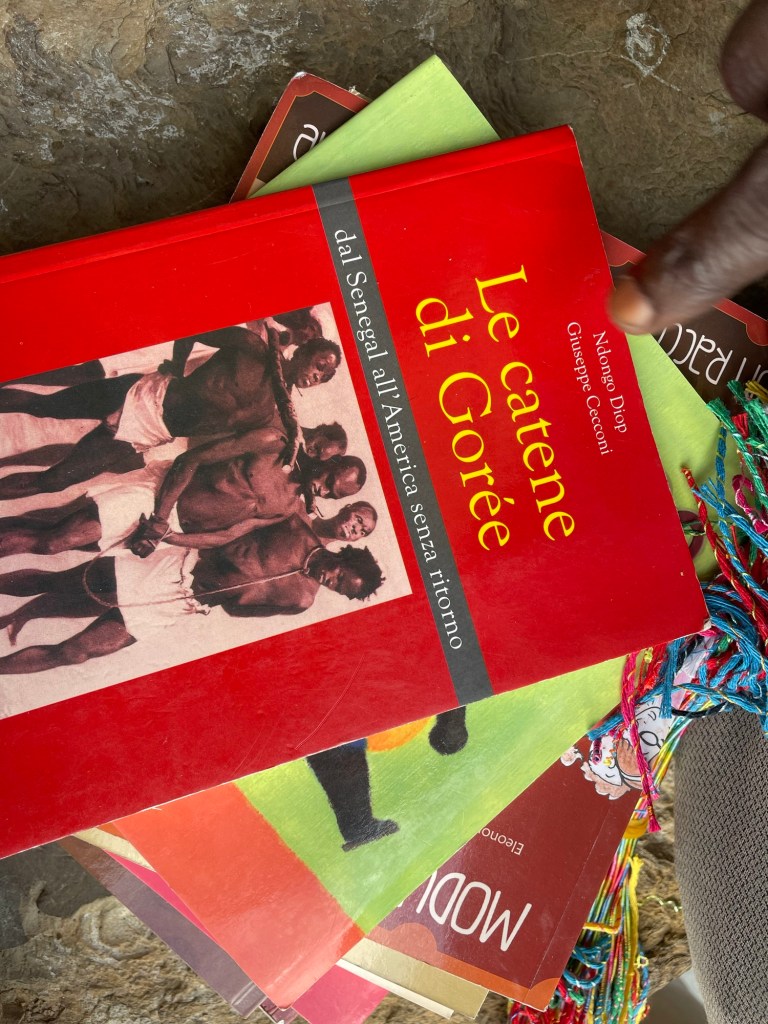
    ‘Kenya, Senegal?’ I asked one friendly face. He carried over his arm a brocade of African bracelets and under his other arm some books in Italian and English about slavery. It’s a smart business I’ve observed across Italy. When I was living in Rome it was rare to leave a bookshop without encountering an African face who sought to sell you something of their violent history.

    ‘Senegal!’ Came the reply. And we continued to discuss in French how his life was progressing in Florence; how business had been that day.

    I asked him about the war in Casamance providence, the longest running conflict in Africa, where I’d worked with women peace activists as a journalist at openDemocracy 50.50.

    ‘It’s hard,’ he said, ‘but in Italy life is a little easier’.

    We parted ways after our brief chat – I didn’t want to distract him from his business – and he gave me one of dozens of friendship bracelets I’ve accumulated in my discussions with the African street sellers.

    I knew from experience to take it and that, unlike in many situations with migrant sellers, my receipt of the gift wouldn’t be followed by a request for money. A relationship – however fleeting – not a transaction had been established.

    ‘Au revoir, Madi, bonne chance!’ I offered as I heaved my backpack back onto my shoulders and made my way to the Santa Maria Novella Square. Maybe I should put in a funding application to do an ethnography of African street sellers, I mused. 

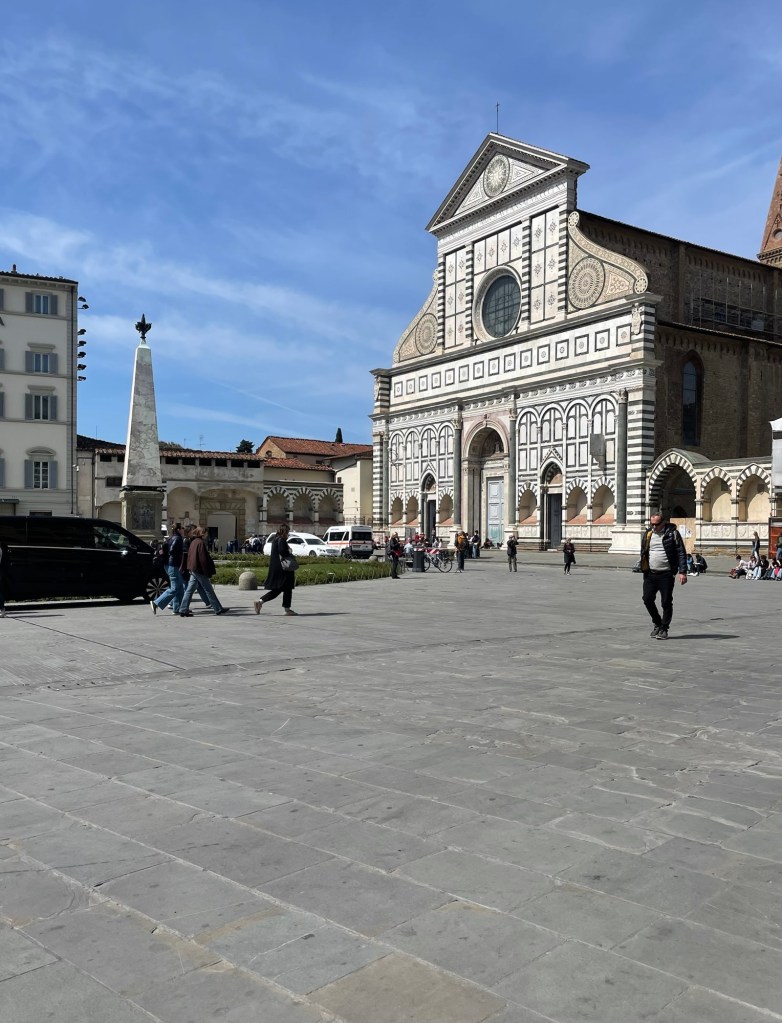
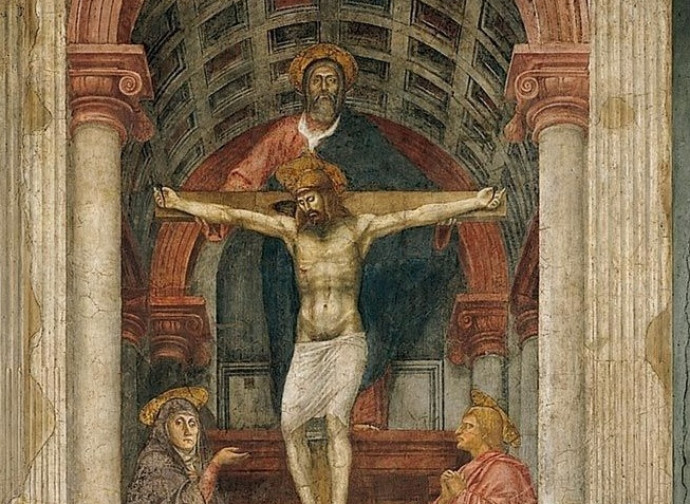
    In Santa Maria Novella I headed straight to the church where I wanted to pay my respects to one of my favourite paintings in the city, the Trinità by Masaccio. It’s known as the first painting in Western art that uses the principles of perspective. I’d need that if I was to spend 20 days hiking the 235 miles of the Cammino di Dante through central Italy.

    I remember first seeing it when I came to Florence as an eager 15-year-old art lover. I’d studied it in school and even done some sketches from a post on Wikipedia before Google was a font of unlimited images. I think back then I’d asked Yahoo or Jeeves. 

    ‘Can you see mum, all the lines point backwards into an invisible vanishing point. This is no ordinary depiction of Christ’.  

    She was suitably impressed and then, as now, a chance to process the monument of Masaccio’s revolution in European painting was proceeded in the form of a strong coffee in one of the colourful cafes that line the square like lace.

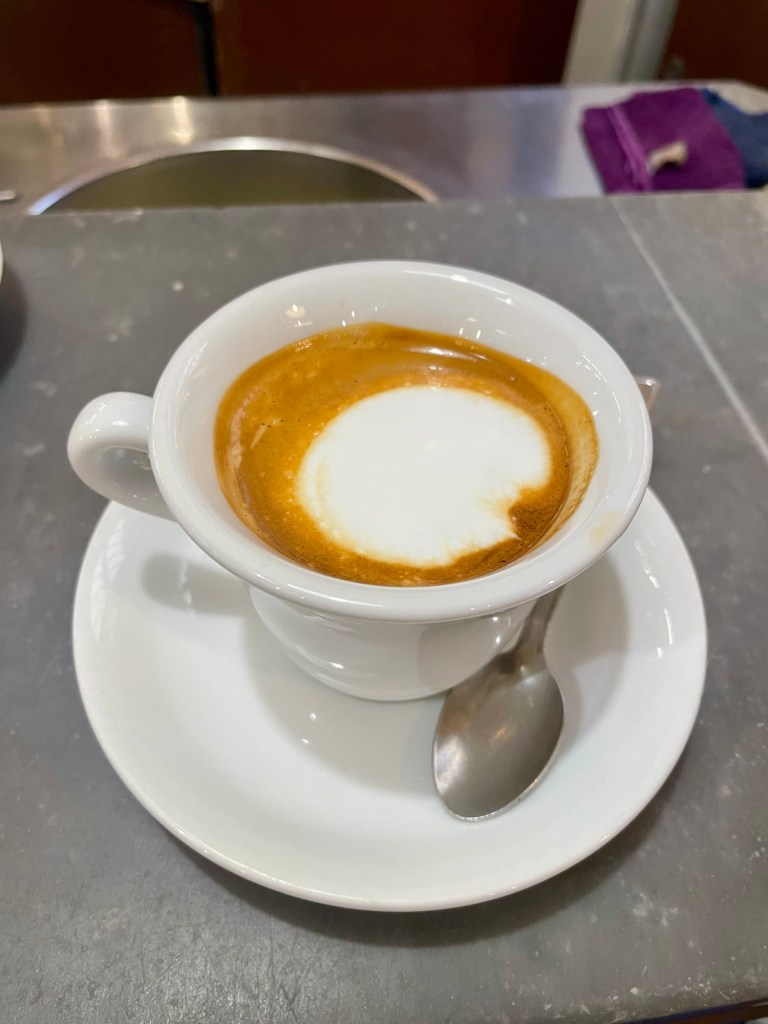
    I knew that even though I had hardly slept that at 2pm, I would be chastised for ordering a cappuccino – this is a breakfast drink in Italy not to be taken after midday. I took a double espresso macchiato and turned my face into the Spring sun awhile.

    The term cappuccino comes from the capuchin monks who resemble in their brown habits and shaved heads the caramel colouring of the cup’s rim and the dollop of foamed milk in the middle. You don’t get a sprinkle of chocolate or nutmeg here in Italy unless you ask for it, this is a foreign invention.

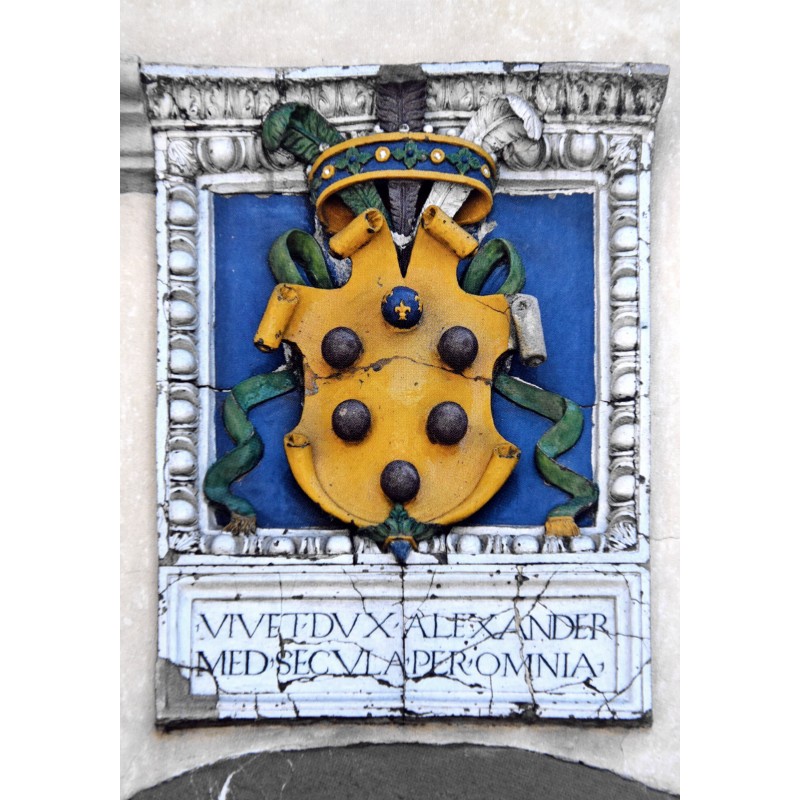
    From Santa Maria Novella I spent the afternoon trotting happily through the narrow streets, observing the signs detailing which famous figures had occupied said building. Galileo. Leonardo da Vinci. There were all the greats, it was enough to look up. And on the street corners, known as cantos, like the sections that make up Dante’s Divine Comedy, there appeared the all too familiar Medici crest.

    The six balls that make up the shield are disputed as to their origin. Some say they represent medical compresses – pills were yet to be discovered in the Renaissance – harking back to the Medici name which means doctors in Italian. Still others claim they depict oranges – also good for your health and a frequent feature in frescos depicting the family. 

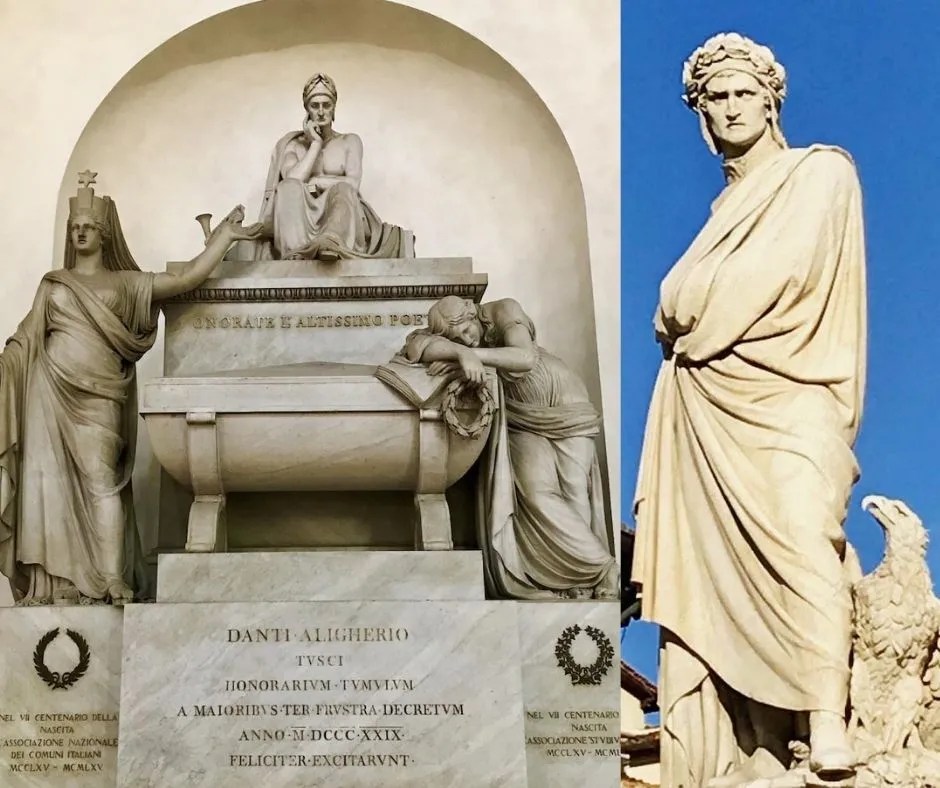
    From Santa Croce the colossal statue of Dante constructed by Enrico Pazzi to mark the 600th anniversary of Dante’s birth glared down at me. Though I knew better than to seek to procure a ticket last minute in tourist season, I knew that inside the walls of the church sat the tomb of Dante erected by Stefano Ricci in 1830.

    In it, he appears topless and macho, symbolic of the newly unified Italy and all things nationalism. Though he dreamed of and wrote at length about a unified Italy and glorified the Holy Roman Empire, Dante’s own stance on nationalism was more nuanced and I felt he’d be somewhat miffed to see himself depicted in that rather uncouth way, tits out, topless without his classic red cape, hood and white ear flaps. 

    More to the point, unlike the tombs of Galileo and Machiavelli, his was empty.

    And here comes the whole point of my pilgrimage, his bones lie in Ravenna, my destination, where he died in exile.

    His grave in Florence is a reminder of the vicious battle that still continues between the two cities about where Dante’s remains and his legacy should reside.

    On a fieldtrip with a group of refugee students back in Spring 2023 responses were mixed. Some felt it was desperately sad that Dante hadn’t been able to return to Florence but that as the place that has hosted him, Ravenna was entitled and duty bound to be the custodian of his remains. Others felt that Dante would have wanted his bones to be returned to his beloved home town in recognition of the fact that he had, as he had prophesied in the Divine Comedy, ‘returned as a poet’.

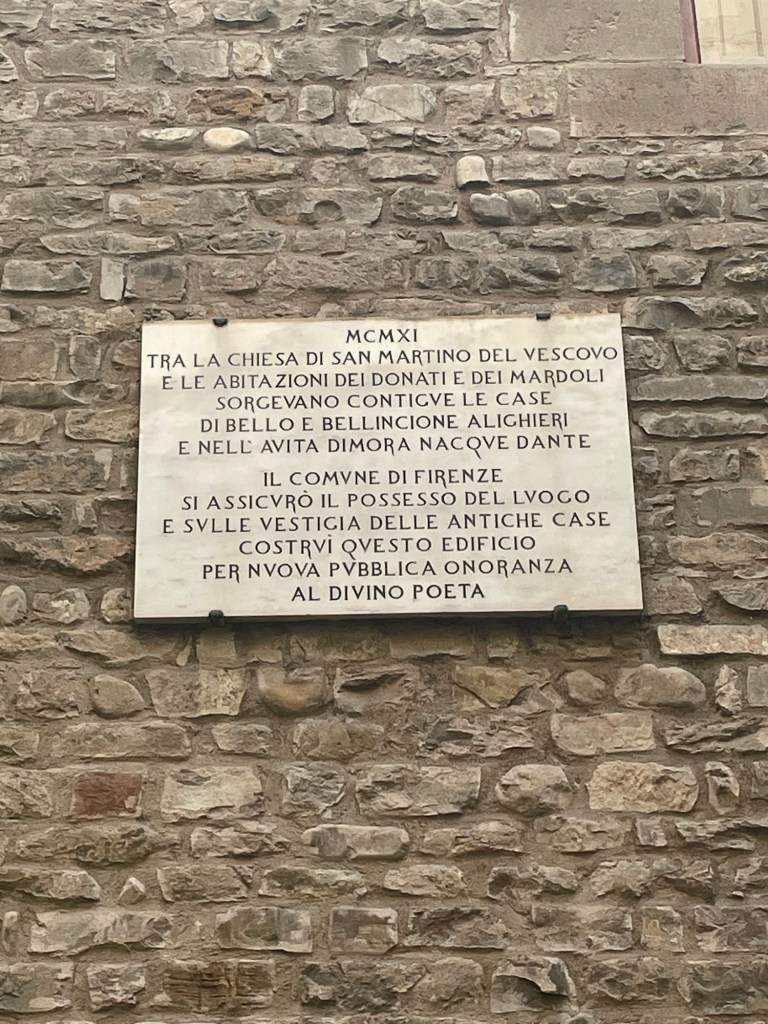
    There’s no mistaking the fact the Florence and Ravenna tourist boards seek to cash in on his legacy. In Florence many streets bare engravings from the Divine Comedy and there is now the Dante House Museum on a site estimated to be near his home, though the exact location remains unclear.

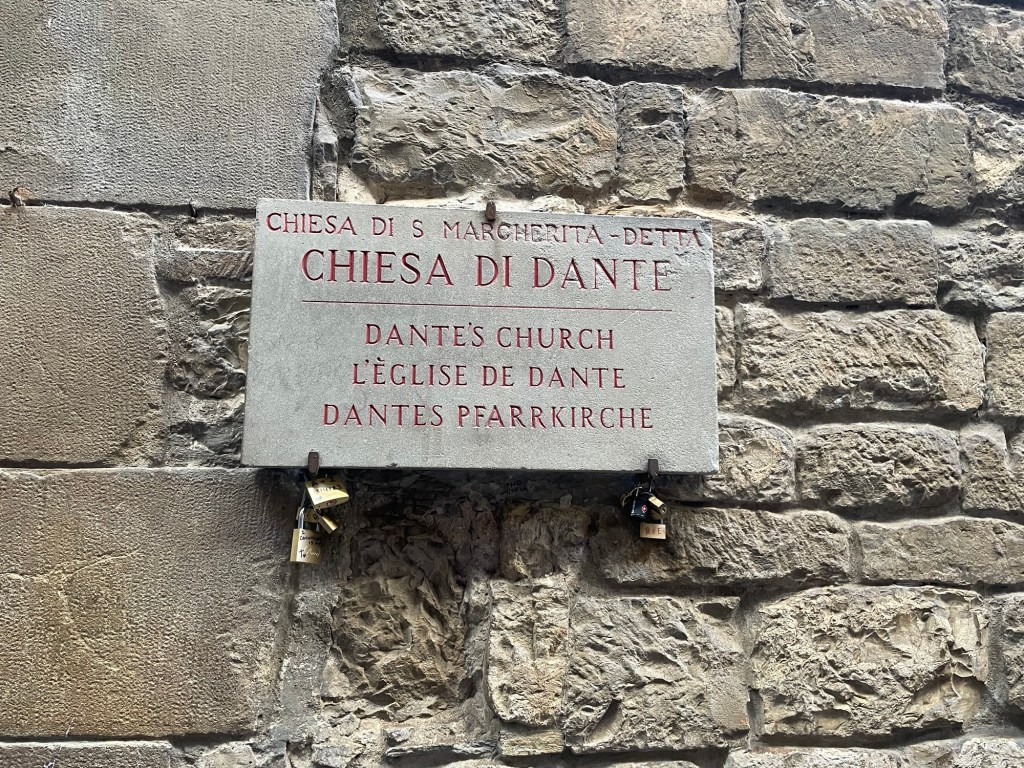
    Opposite the museum is the Church of Dante which belonged to the Portinari family where his unrequited love, Beatrice, was married to another man.

    Today, lovers tie love locks and tuck heartfelt pleas and into the folds of the doorway wishing for a love that would take them to the stars and back, as Dante’s did.

    As I trace Dante’s steps to Ravenna this question of the location of his remains will be in my mind.

    I avoided the busy central Piazza del Duomo because I wanted to preserve my impressions for when I would meet Alina, my former Ukrainian student, tomorrow to start the Dante trail.

    At a bar by Ponte Vecchio I got chatting to a charismatic English woman who had also travelled to Florence on her own for a get away between jobs. We quickly struck up a rapport and discussed all things ‘being in our 30’s and not having kids’, the wave of our friends who had bought up town houses in Tottenham to start their families while we indulged in our freedom to sip on a glass of something bubbly at 4pm in the sun and contemplate the relative physiological merits of the stream of tourists who passed.

    ‘Oh if you’re looking for Italian men you’re on the wrong spot.’ The waitress informed us as she used her tea towel to chase away the pigeons. One, she informed us, was called ‘stumpy’ because he’d lost his feet perching on one of the many anti-pidgeon contraptions that line the city’s window ledges. The real Florentines live across the river, she continued. 

    It was across the river I proceeded to the British Institute in Florence. It was Monday night and I knew instinctively upon my arrival that I was to spend the evening indulging in a familiar past time of life drawing at Sotto Il British. The class is lead by Tom J. Byrne, a friendly Irish man with a walking stick. He remarked that I looked familiar.

    ‘I used to come here all the time when I lived in Florence,’ I reminded him.

    The British Institute is a magnificent building that houses a speculator Oxfordian library with comfy chairs that point out towards the river. 

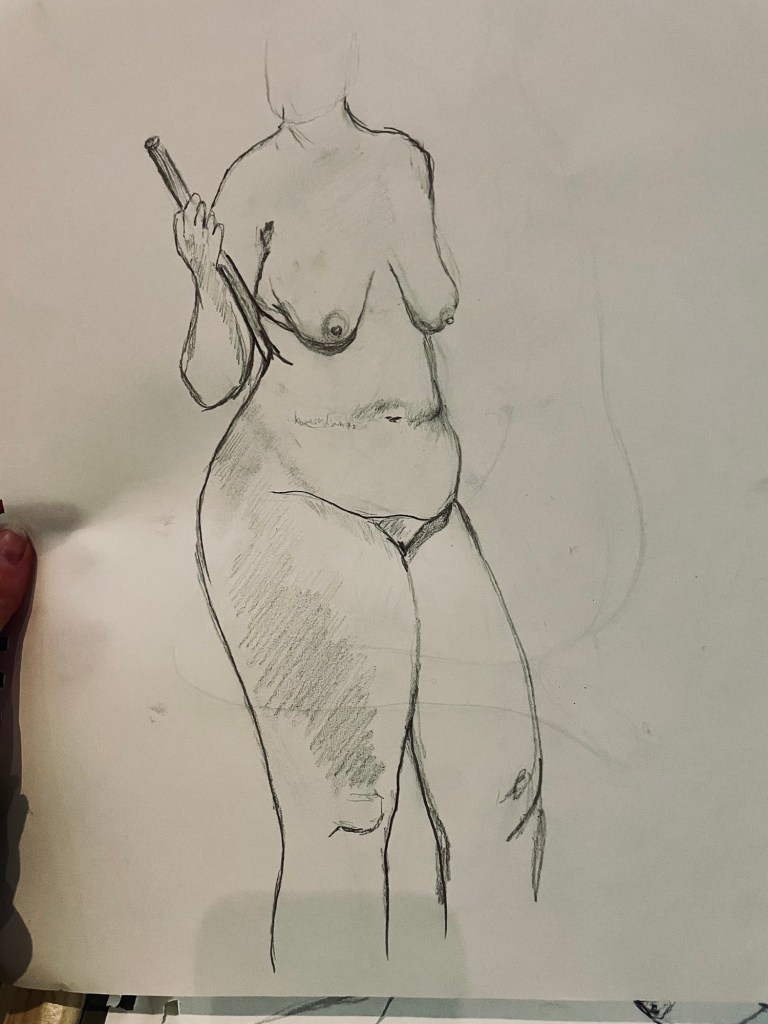
    The model was a beautiful young woman who took to the various 5 minute and 15-minute poses with ease. A well-dressed lady of middle age – you know the type, flowing fabrics and a well sized pendant on an embellished chain –  sat opposite me with her small brown dog at her feet using watercolour and ink to capture the model’s Rubenesque curves.

    As always, the talent of the artists was at once intimidating and deeply compelling and I took pleasure in sketching my own humble contribution. Drawing together it felt like we were part of an orchestra.

    The model rewrapped herself in a pastel blue robe and I took leave of the nibbles and wines and headed back to Santo Spirito where I was to spend the night with Anna, a Finnish-British jewelry maker who has made her home in Florence for most of her adult life.

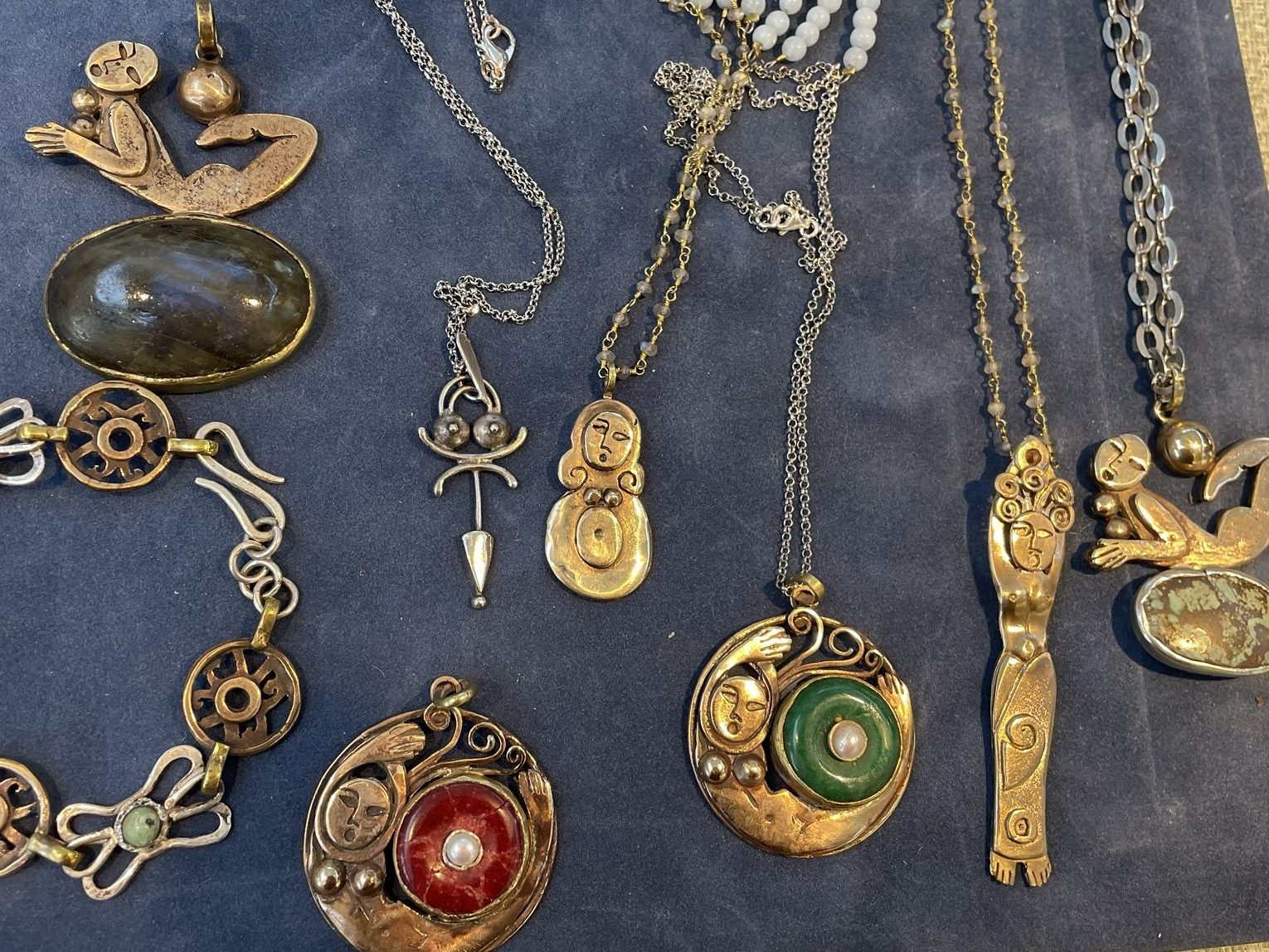
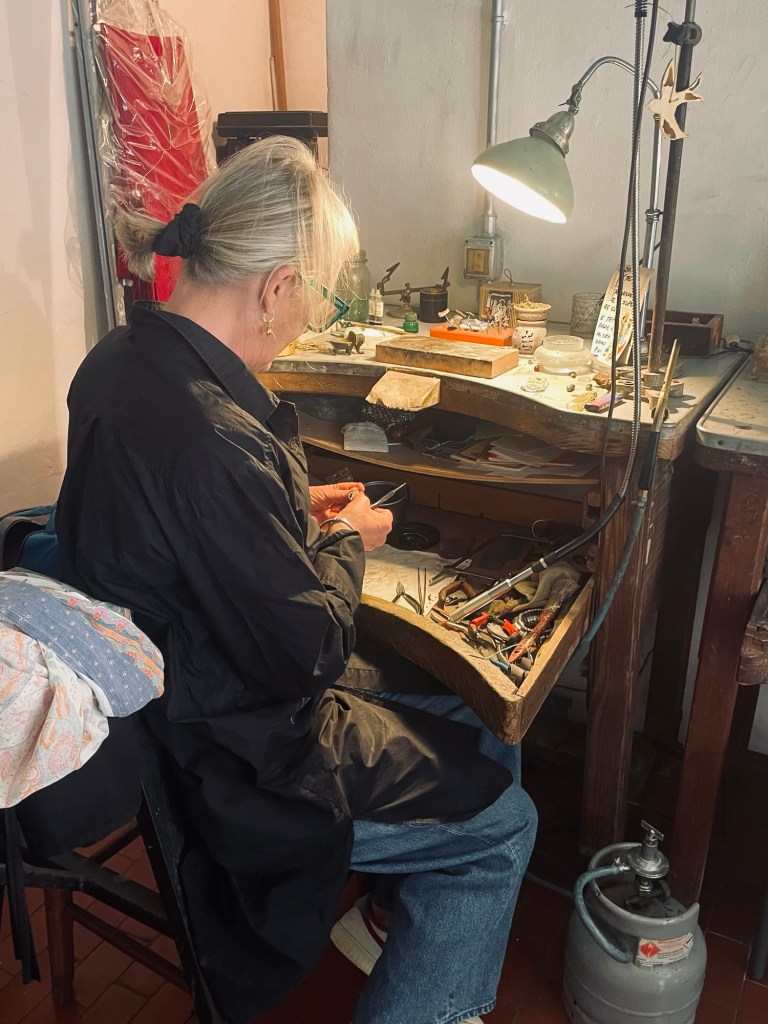
    I had met her when I was living in Florence at the Santo Spirito market where she was selling her stunning range of goddess themed amulets and earrings. Citronella, garnets, emeralds, all crafted into a range of designs in bronze and silver. Mermaids, the sun goddess, Durga. I immediately fell in love with her work and also her friendly demeanor.

    Anna had that beauty about her that many women in their 60’s do – natural hair tied loosely into a bun and a velvet shawl. She introduced me to her daughter Elena who was wearing a stunning lapis lazuli pendant her mother had made for her in the same way my mum makes quilts for me.

    The goddess’ sinuous body was curved round into a circle with her breasts gilded in silver. Elena was a beautiful as the necklace. Long blonde hair to her waist and bright blue eyes to match the pendant.

    Lapis lazuli has been my favourite stone since I went to India at the age of 15 and purchased my first piece with my pocket money. I was mesmerized by the deep sea blue and iridescent gold mottled together in a divine harmony –  to gaze into a piece of lapis lazuli is akin to gazing into the night sky. It is infinite. 

    Lapis lazuli comes largely from Afghanistan. An Afghan friend once told me that there is a piece of Afghanistan in every Renaissance painting in the veil of the virgin Mary who is often depicted in blue pigment – the most expensive at the time. For my part I carry a stone on my finger gifted to me during lockdown by my dear friend, Xiren. It’s a big as my thumb and dominates my hand. I enjoy watching it sparkle as I type. 

    I dined that evening with Anna, her husband and daughter, a simple but delicious fare of broccoli pasta with chilli and pink salt from Bhutan from where Anna and Elena had recently returned impressed by the state of calm afforded by the Buddhist majority. I was a bit late due to my art class so I ate at a beautiful table set up by Anna in their jewelry workshop with a candle and a table cloth – in Italy all meals must be enjoyed with a table cloth. 

    We discussed all things alternative medicine – Anna has recently published a book which I edited on the divine herb Artemisia which has healing properties and is revered around the world. 

    We slept together in the small studio which was decorated with lapis blue walls and depictions of goddesses in various states of trance, Anna, her husband and daughter on sleeping mats and me on the sofa. Anna slept in a stunning Moroccan jellaba the colour of the deep green sea. 

    Recommended Reading: The Divine Artemisia by Anna Lord: https://www.amazon.co.uk/divina-artemisia-Anna-Lord/dp/B0D329DQJV

    Recommended Watching: Reading Dante with Refugees: An Introductory video: https://www.youtube.com/watch?v=iHOeh2w9FdI

    Recommended Reading: OpenDemocracy 50.50 Our Africa: https://www.opendemocracy.net/en/tagged/5050-our-africa/