Tag: books

  • The Art of Exile: From San Benedetto in Alpe to San Godenzo 

    I had an easy day, retracing Dante’s footsteps as a political exile who had a tumultuous relationship with his native Florence.
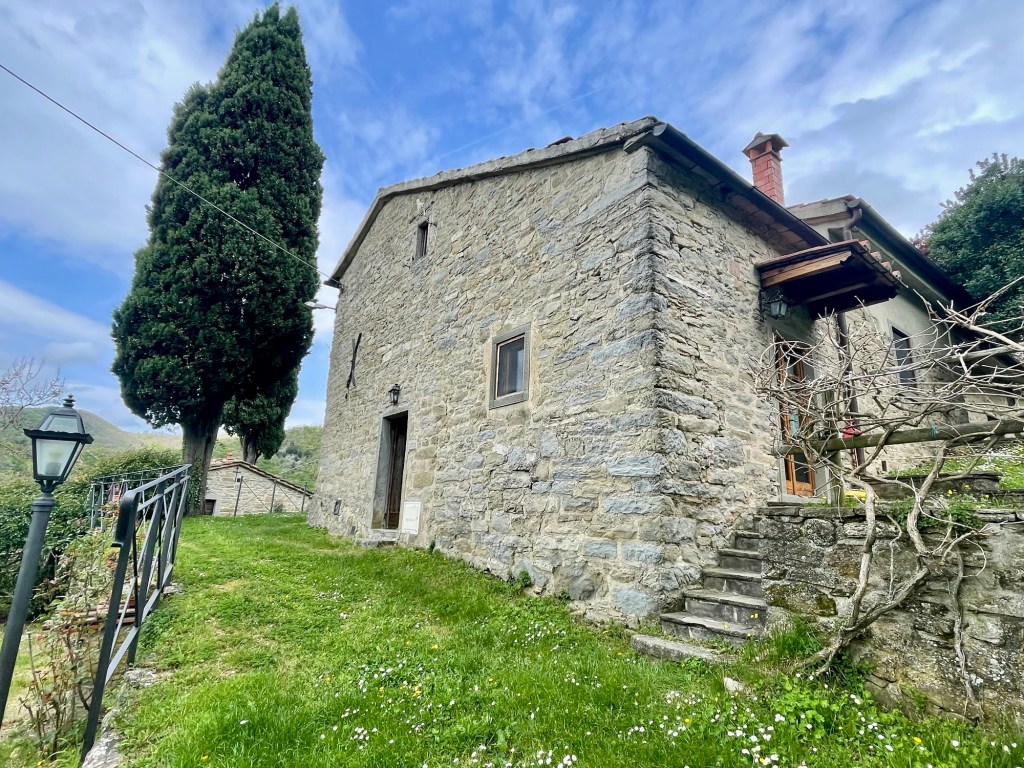
    My sleep was disturbed and, as I was sharing the dorm with an Italian couple from Bologna, Giuliana and Vittorio who had arrived late the night before, I finally made use of my pink EarPods to listen to some sleep hypnosis meditations.

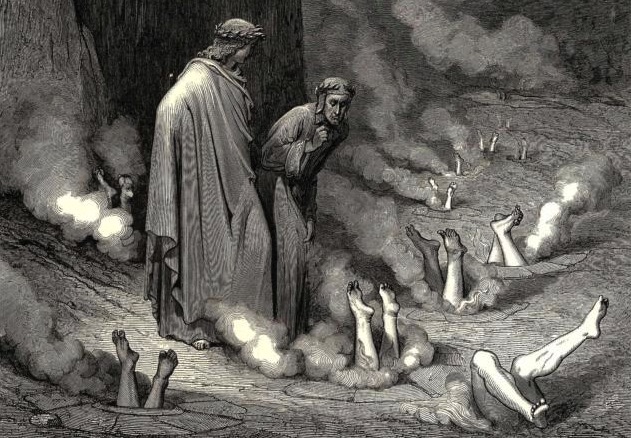
    I had fevered dreams and was reminded of Dante who in canto 27 of Purgatorio passes through the wall of flames to Paradise, only to collapse with sleep with his guides, Virgil and Statius at his side:

    ‘Before one color came to occupy
    that sky in all of its immensity
    and night was free to summon all its darkness,

    each of us made one of those stairs his bed:
    the nature of the mountain had so weakened
    our power and desire to climb ahead…

    From there, one saw but little of the sky,
    but in that little, I could see the stars
    brighter and larger than they usually are.

    But while I watched the stars, in reverie,
    sleep overcame me—sleep, which often sees,
    before it happens, what is yet to be.’

    But as Dante wakes eager for the journey ahead, writing, 

    ‘my will on will to climb above was such
    that at each step I took I felt the force
    within my wings was growing for the flight’

    I, on the other hand, was exhausted.

    Because of a landslide, I would have to retrace yesterday’s steps and take a longer improvised route round to San Godenzo. 
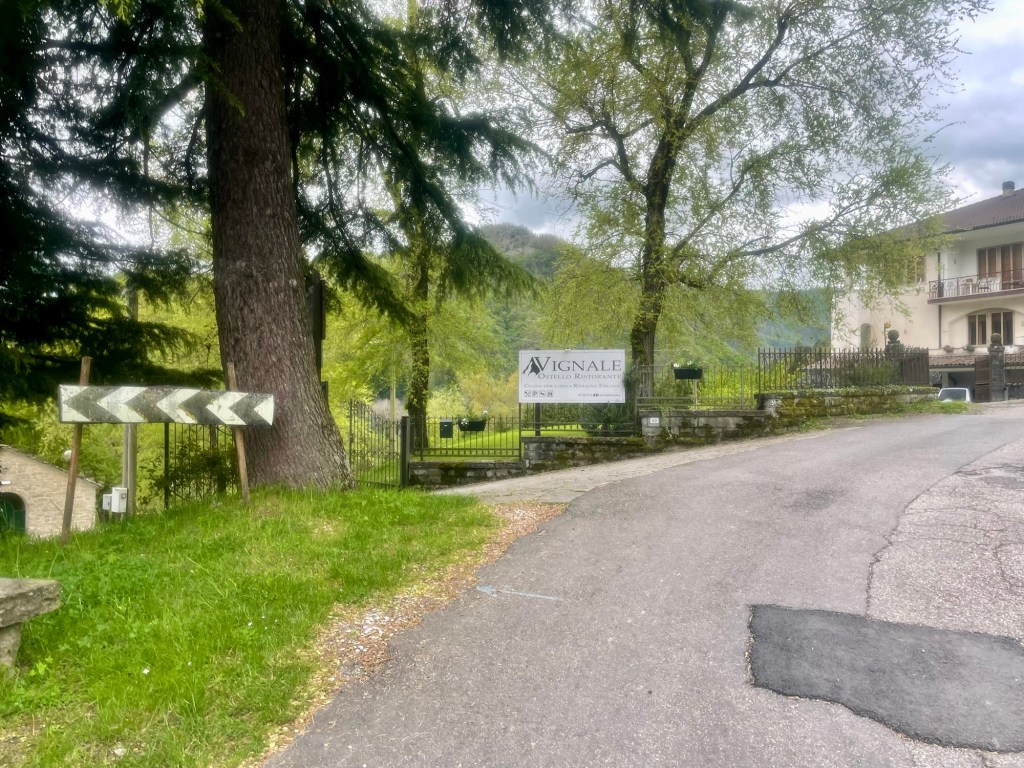
    Over a breakfast of sweet pastries, the hostel owner Gian Luca suggested I miss the first part and start back on the trail from after the landslide. 

    I didn’t need much convincing, so when Vittorio offered to take me halfway in their car, I agreed. 

    It would give me more time to catch up with work, specifically, a funding application I was developing to read Tagore with refugees in India. In one of his most beautiful poems in the collection Gitanjali, he describes a world undivided by borders:

    ‘Where the mind is without fear and the head is held high;

    Where knowledge is free;

    Where the world has not been broken up into fragments by narrow domestic walls;

     Where words come out from the depth of truth;

     Where tireless striving stretches its arms towards perfection;

     Where the clear stream of reason has not lost its way into the dreary desert sand of dead habit;

    Where the mind is led forward by thee into ever-widening thought and action

    Into that heaven of freedom, my Father, let my country awake.’

    It would be fascinating to see what refugees made of the world of this cosmopolitan Nobel Prize winning author. After Dante, Tagore was one of my favourite poets. 

    ‘Many people take public transport as they don’t manage after yesterday’, said Gian Luca reassuringly before he headed to the kitchen to make pasta for that day’s meal.  

    In the car, Giuliana and Vittorio told me a little of their work in music and events. 

    Soon we had arrived at Passo da Muraglione where Gian Luca had indicated to them to drop me but it turned out it was the wrong spot and I was completely off the Dante trail. I couldn’t ask the couple to drive me back another 30 minutes, and so I graciously accepted their offer to drop me directly in San Godenzo where they were passing through instead. From there it would be a three kilmetre walk up to the Agriturismo I had booked. I’d get a few steps in but the day would be my own to rest and recuperate.
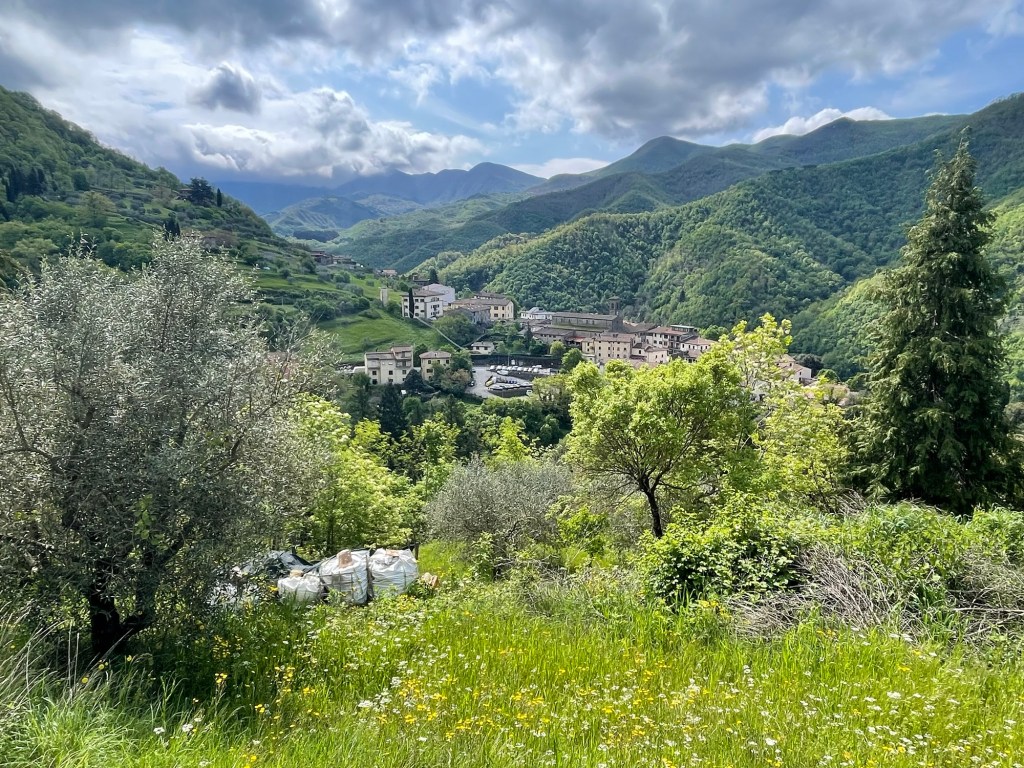
    The car sounded out gospel tunes and many motorcyclists sped past on the road.

    ‘It’s the Spotify algorithm’ explained Vittorio. He’d liked one hymn and now the internet had decided he was religious. 

    In San Godenzo, I invited my hosts for a coffee and I had a slice of pizza, unsatisfied, once more, with my sweet breakfast. It was 10.30am. 

    I saluted the friendly couple and made my way to the abbey of San Godenzo in Piazza Dante Alighieri where the poet-politician had met with Ghibellines and White Guelfs in his first months of exile in June 1302 to try to forge an alliance against the Black Guelfs who had expelled him from the city.

    The convention brought together the noble families who were expelled from Florence and wanted to plan their return to the city by meditating on revenge. Dante’s name is signed in the attendance list.
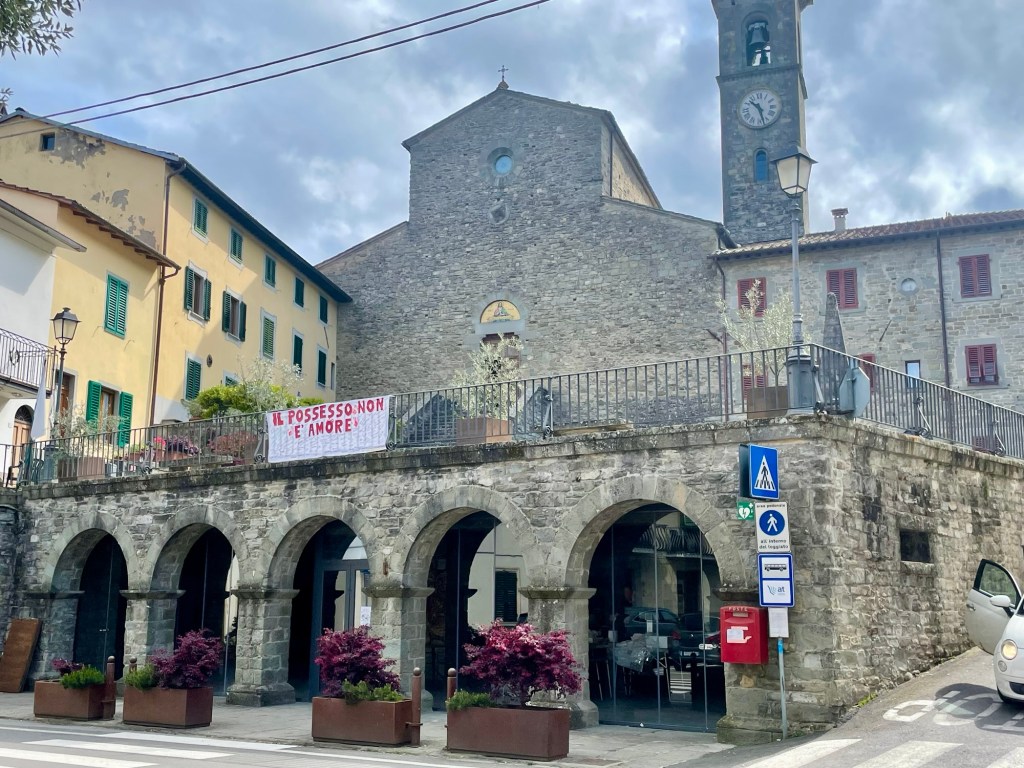
    Walking around the abbey, I felt Dante’s political presence. I thought of all the refugees I knew who were committed to activism across borders. My friend Javid campaigned for women’s education in Afghanistan while an Albanian youth group I had worked with had started a campaign against blood feuds. 

    Although the 1302 convention did not lead to action, for more than 30 years, San Godenzo has commemorated this event during the ‘Dante Ghibellino’ festival, with a historical procession through the town streets. The celebrations culminate in awarding the homonymous prize to citizens who, during the year, have distinguished themselves for their civic commitment to San Godenzo, its territory and its community.

    As a political exile, Dante was excluded from a Florentine pardon in 1311, but another amnesty in 1315 would have allowed him to return. Unwilling to comply with the terms of the offer—admission of guilt and payment of a fine—Dante was again sentenced to death, this time by beheading rather than fire, the penalty now also applying to his sons, Pietro and Jacopo. 

    An additional provision stated that anyone had permission ‘to harm them in property and person, freely and with impunity.’ 

    Dante’s refusal reflected not only his great pride but also his better living conditions. While the first years of his exile had been brutal, by 1316 he was now residing in Verona as a guest of the Ghibelline ruler Cangrande della Scala. Having cut ties with his native city, he declared himself ‘Florentine by birth, not by disposition.’ Dante had learned how bread outside Florence ‘tastes of salt,’ but such bread was also not lacking as he sought out more abundant hospitality towards the end of his life. 

    Dante’s ‘overswollen pride’ is reflected in the significant time he spends with the proud in Hell and on the terrace of the proud in Purgatorio. Indeed, Dante presents pride as the foundation of sin by situating it at the base of Mount Purgatory. 

    In Purgatory, he walks alongside the proud souls who are forced to carry heavy loads:

    ‘I, completely hunched, walked on with them….for such pride, here one pays the penalty’

    Dante then reflects on the fleetingness of reputation and fame:

    ‘O empty glory of the powers of humans!
     How briefly green endures upon the peak-
     unless an age of dullness follows it…

     Worldly renown is nothing other than
     a breath of wind that blows now here, now there,
     and changes name when it has changed its course.’

    There is an irony here, since Dante is also explicit about his desire to bolster his reputation through the written word. 

    In Inferno, meanwhile, one of the most realistic conversational exchanges occurs between Dante and Farinata degli Uberti, the great Ghibelline leader in the battle of Montaperti, who died the year before Dante’s birth. Farinata is depicted in ‘the cemetery of Epicurus and his followers, all those who say the soul dies with the body.’ However, he is also guilty of the sin of pride, something we see through his rising out of a burning coffin, stubborn and defiant.

    ‘My eyes already were intent on his;
    and up he rose—his forehead and his chest-
    as if he had tremendous scorn for Hell.’

    Dante uses the meeting to discuss Florentine politics, engaging in vocal sparring. Farinata immediately recognizes Dante as a Florentine citizen from his accent: 

    ‘Your accent makes it clear that you belong
    among the natives of the noble city
    I may have dealt with too vindictively.’

    He then goes on to explain how he was responsible for the exile of many of Dante’s ancestors`:

    ‘When I’d drawn closer to his sepulcher,
    he glanced at me, and as if in disdain,
    he asked of me: “Who were your ancestors?”

    Because I wanted so to be compliant,
    I hid no thing from him: I told him all.
    At this he lifted up his brows a bit,

    then said: “They were ferocious enemies
    of mine and of my parents and my party,
    so that I had to scatter them twice over.”’
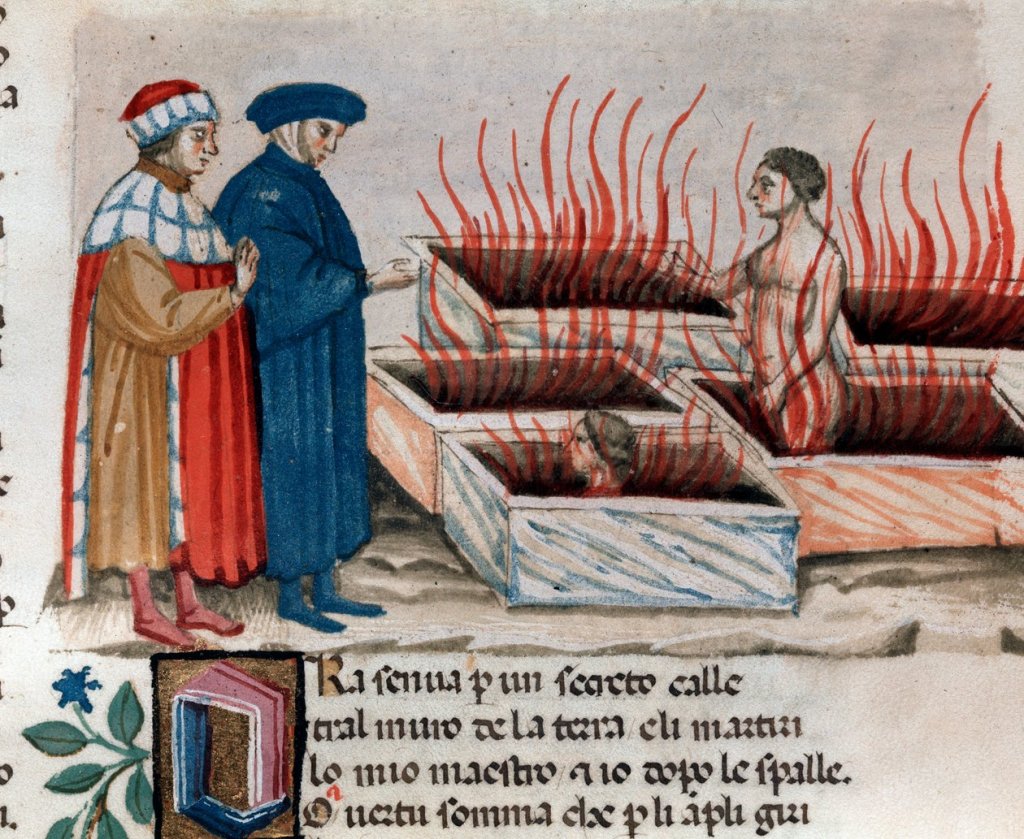
    While there is certainly no love lost between Dante and Farinata, there is a measure of respect. Farinata, called magnanimo, ‘great-hearted’, put Florence above politics when he stood up to his victorious colleagues and argued against destroying the city completely.

    ‘But where I was alone was there where all
    the rest would have annihilated Florence,
    had I not interceded forcefully’

    As the literary critic Auerbach has noted, Dante’s realistic and somewhat flattering depiction of Farinata shows his willingness to admire and work alongside his adversaries, something he did by uniting with the Ghibellines during the 1302 convention in San Godenzo. 

    Dante rebuffs Farinata’s insults by boasting that on both occasions when his ancestors were exiled, they returned:

    ‘“If they were driven out,” I answered him,
    “they still returned, both times, from every quarter;
    but yours were never quick to learn that art.”’

    The art referred to here is the art of exile. As Barolini explains, the above conversation references four cataclysmic events in Florentine politics of the thirteenth century, as Florence oscillated between Guelph and Ghibelline control until the ultimate defeat of Farinata and the Ghibellines at the battle of Benevento of 1266. 

    In effect, the dialogue lays out two sets of factional routes and returns. The first set of route and return comprises the 1248 defeat of the Guelphs by the Ghibellines, with the help of Emperor Frederic II, followed by the return of the Guelphs in 1251, after the death of the Emperor.

    The second set comprises the 1260 defeat of the Guelphs by the Ghibellines at the battle of Montaperti, where Farinata led the Ghibellines to victory with the help of the Sienese and Manfredi, Frederic’s successor, and then the subsequent defeat of the Ghibellines and return of the Guelphs following the battle of Benevento and the death of Manfredi in 1266.
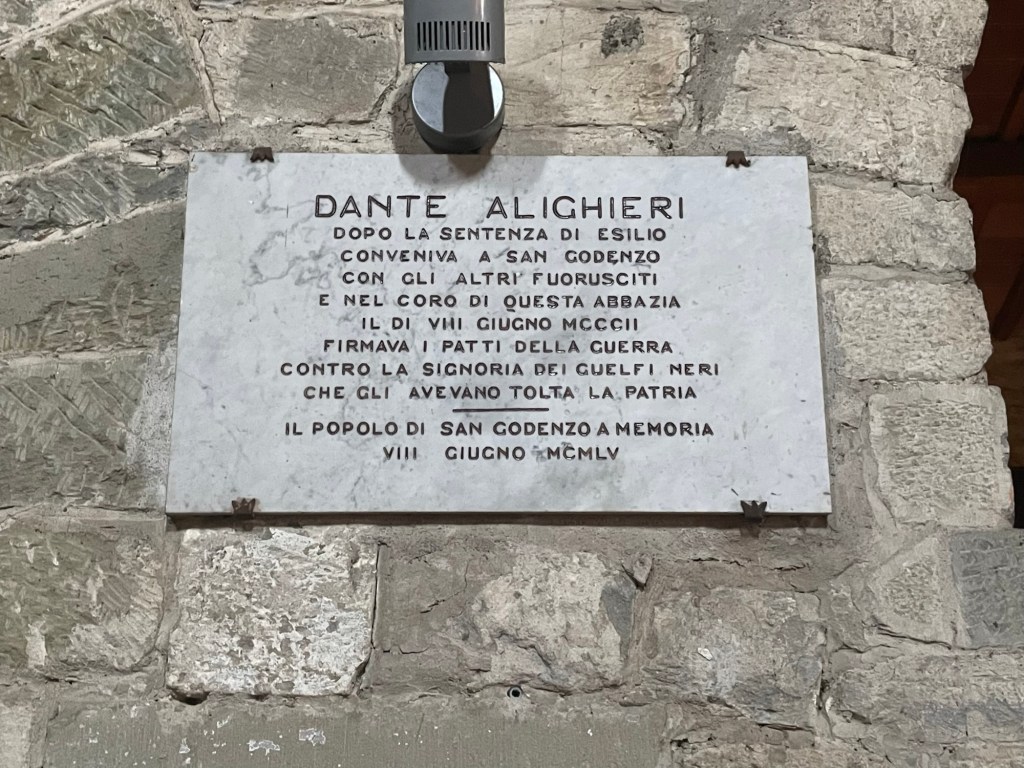
    The abbey where Dante convened with Ghibellines of his own day featured a plaque to honour him and some stunning mosaics that had been added some time after he had congregated there.

    Outside the church someone had hung a banner saying, ‘possesion isn’t love.’

    I walked for half an hour up a hill to the Agriturismo Tenuta Mazzini where I was met by Filippo, the son of the owners who was out foraging for strigoli. He was walking alongside a woman carrying a wicker basket. Strigoli, or stridoli, are a spontaneous grass typical of the Tuscan-Romagna territory. The name comes from the screeches that two leaves emit if rubbed together. It is edible and often used in risotto or salads. It’s especially tender at this time of year, explained Filippo.
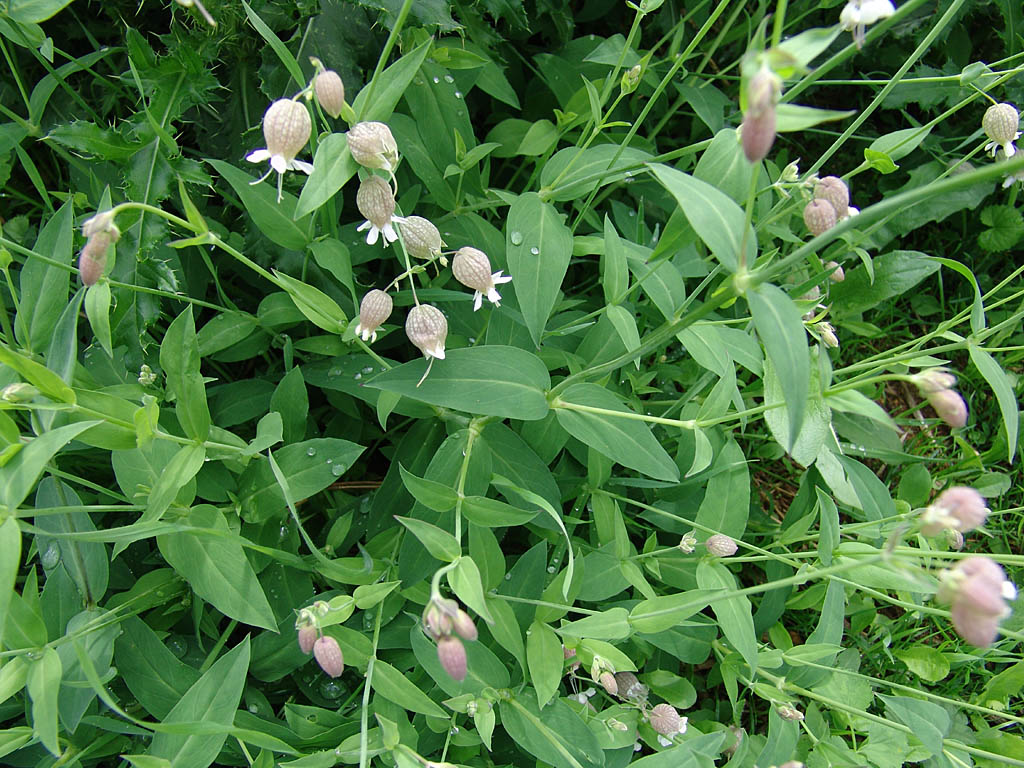
    There was a sign forbidding people from collecting mushrooms and chestnuts between the 1st of September and 31st of October but there was no mention of harvesting grasses. What’s more, the seasonal ban had yet to come into force.

    Filippo showed me where there was a local restaurant that served lunch, but the owners had provided spaghetti, tuna and tomato sauce so I made myself a meal that would serve as both lunch and dinner.
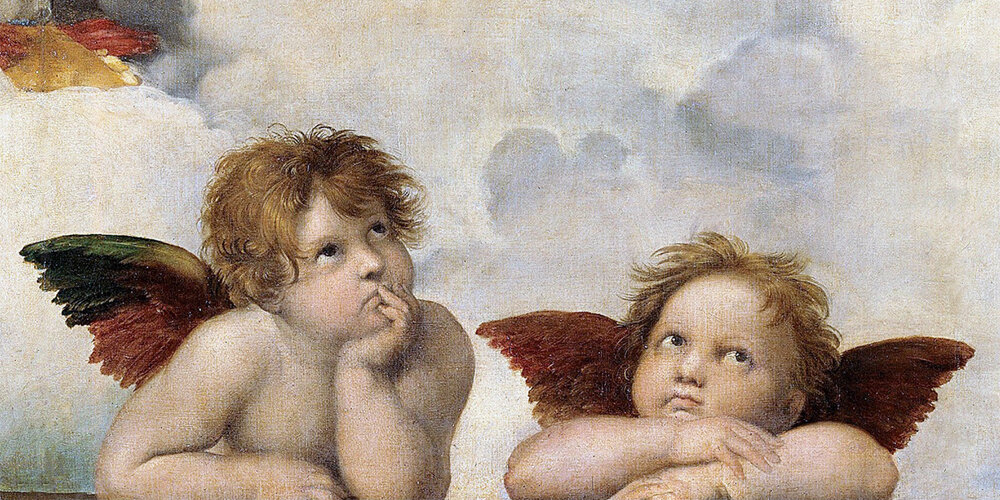
    The apartment was spacious with a comfy double bed, quite a welcome contrast from yesterday’s basic amenities and a total bargain at just 45 Euros a night. There was a poster by Matisse and a copy of The Two Cherubs by Rafael from 1513. The latter is part of a bigger painting that features the Madonna holding the Christ Child, flanked by two saints. The figures are placed among the clouds, suggesting that it is a scene from heaven. At the base of the painting are the two winged cherubs, looking up at the scene from below.

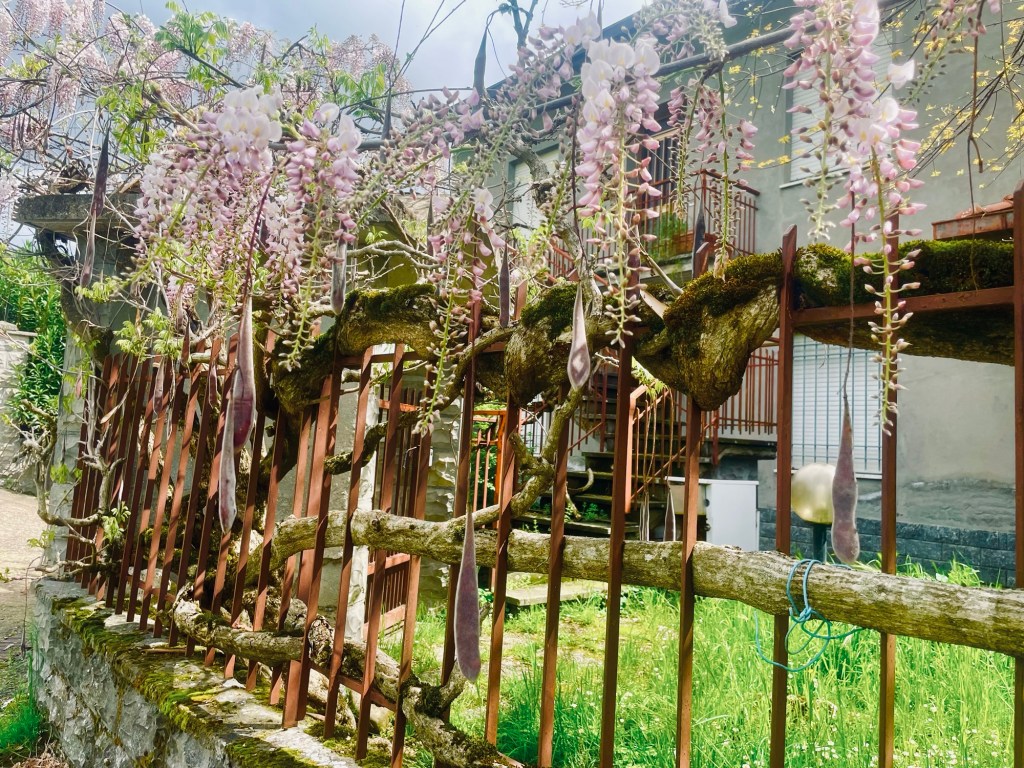
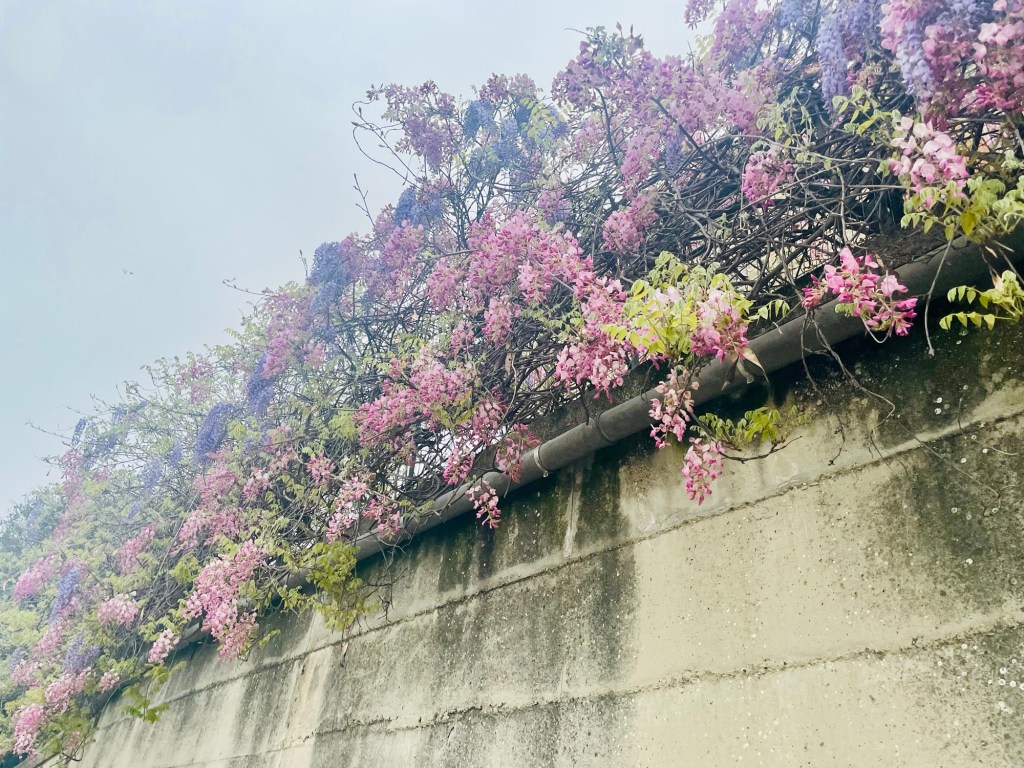
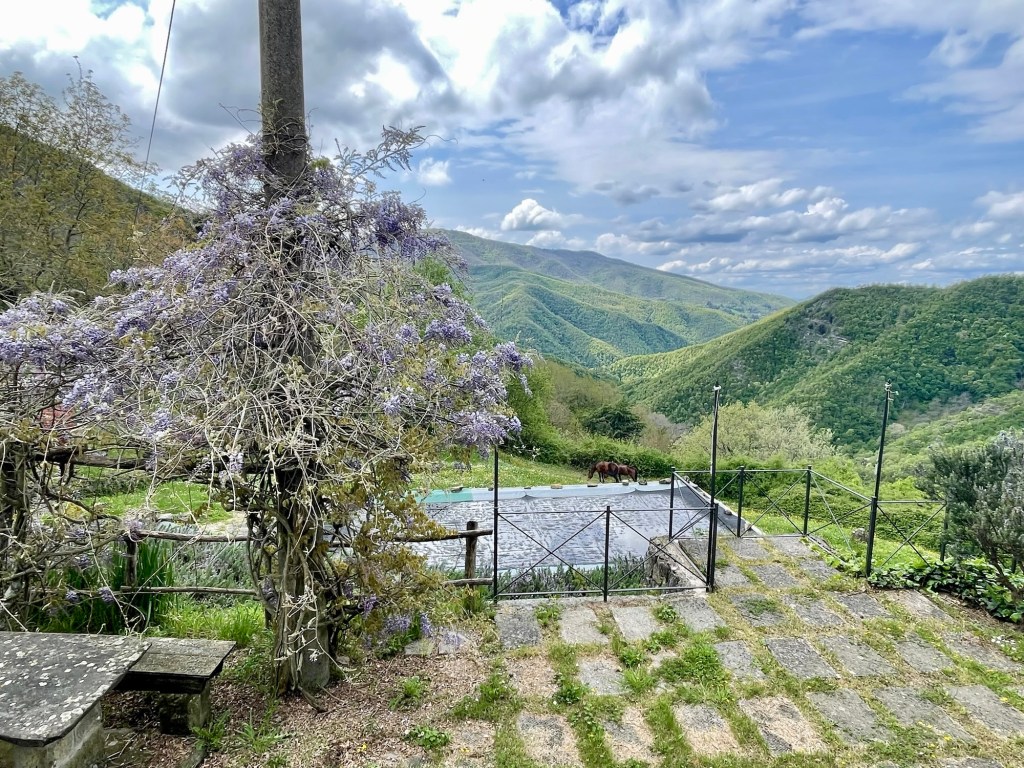
    Outside there was a swimming pool that was overhung with wisteria. It boasted a view of the rolling hills. I watched as a nuthatch flitted from branch to branch then disappeared into the distance. 
    A lady staying in the flat next door, Cristina, had brought six cats with her and took them each out for a wonder on a lead. Milu was among the friendliest and we shared caresses on the grass.

    As I caught up on work, including meeting online with my PhD student Olivia who was doing research on asylum seekers’ reception in UK hotels, I recalled Dante’s words about how writing is a way to ‘make oneself immortal.’
  • Emergency: From Passo Vico to Bologna to Oriolo dei Fichi

    A last-minute invitation to Bologna came with some unexpected drama where I witnessed the strength of Italian family life and was impressed by the Italian health service.

    Although the Cammino di Dante is mostly a circular trail, the first day back from Ravenna required retracing the steps of day one. Since I’d already done that leg and I was in need of a rest day, after we dropped Kelsey at Ravenna train station, Oliver dropped me back at Fattoria Chiocce Romagnole where I was all too happy to stay with Rossella and her animals once more.

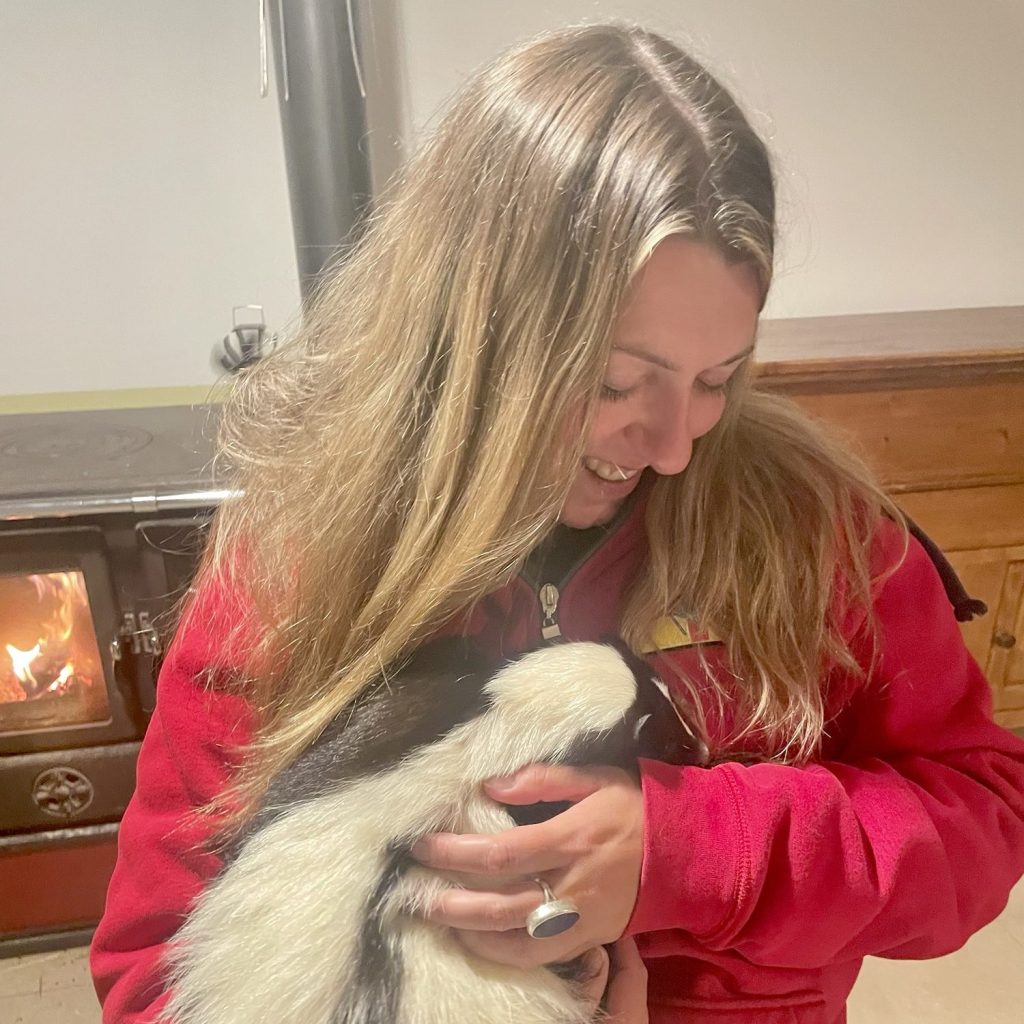
    I finally managed to wash my clothes and we spent a lovely evening together with her friends eating pizza and playing with the brood. I got to cuddle Margherita the skunk and a recently born pigeon. Rossella also introduced me to two chicks who had hatched from eggs just that day who were being cared for in an incubator. I was amazed to discover that as well as managing the farm she had an office job in Forlì  – this woman was a powerhouse!

    I had been among the first pilgrims of the year and there was a tangible sense of excitement that the season was starting. Spring was on its way which would be marked by a party to celebrate Rossella’s birthday. Kelsey would come from Rome. If only I could pop over from England!

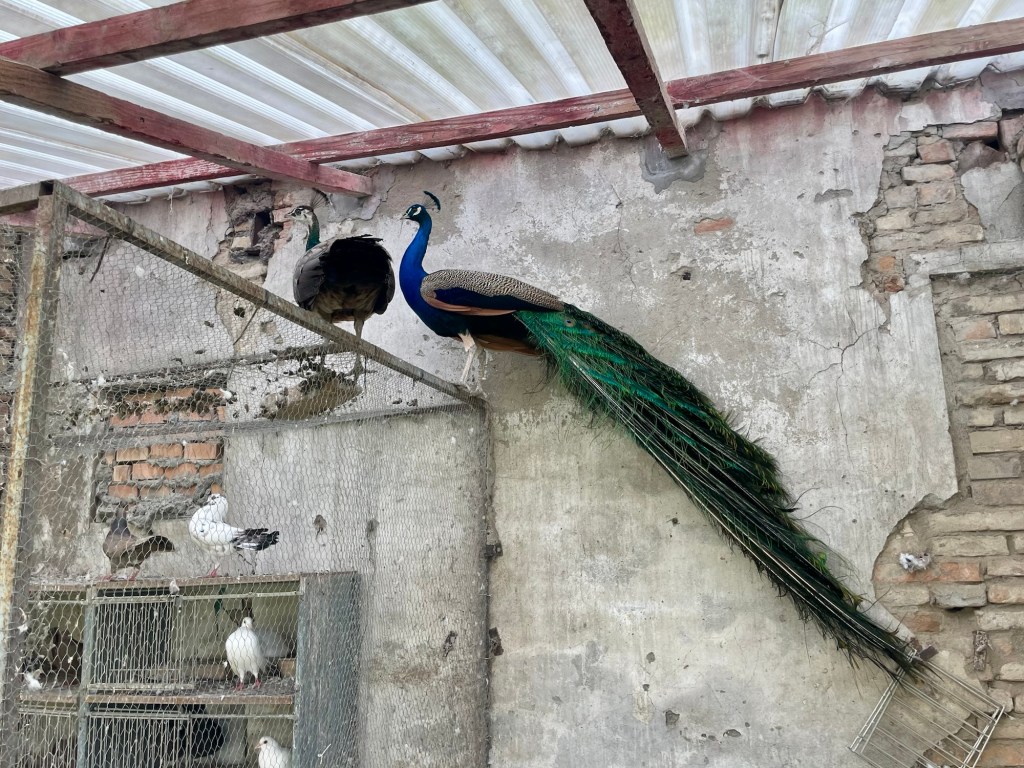
    I saluted Blu the African gray parrot and Raul the smaller red one. I was also introduced, to my delight, to Dante and Beatrice, the pair of peacocks who merrily cavorted on the lawn in a frenzy of colour as we ate crisps and chatted among ourselves.

    Kelsey had brought me a nail file from her ample collection of hotel goodies – thus is the life of a UN employee – and I filed my nails neatly into ovals. 

    Oliver had invited me to the regional meeting for walking trails the next morning and, given that I’d be showing up in my rather pungent by now hiking wear, the least I could do was this small gesture of civility.

    I took a shower – with hair conditioner Kelsey had also provided that came in a miniature bottle – and looked at myself in the mirror of the wardrobe. Perhaps I had lost a few kilos. I noticed a large bruise on my right buttock where I had fallen in the Apennines on my way to Ravenna. It was the size and colour of a Victoria plum. 

    Despite my painful foot blisters, I felt in shape and ready to tackle the backwards leg of the cammino. An email arrived from Anna sharing much good will, an invitation to come and stay with her and write, and a reflection that perhaps next time I could consider spending more than one night in each place. She was right. It was saddening this constant stream of hellos and goodbyes; hence I was so happy to be back at Rossella’s farm. 

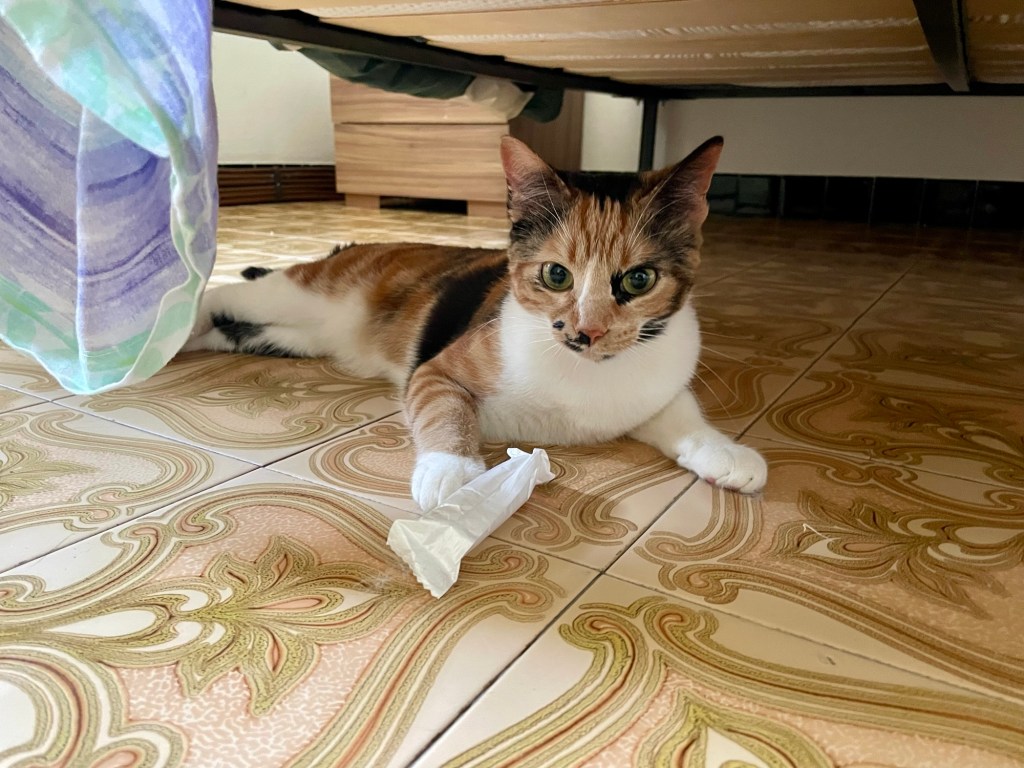
    One of the kittens batted a tampon underneath the bed. The other toyed with my shoelaces. This place had become like a second home and I wrote as much in the little guest book. 

    Oliver picked me up the next day in his large grey car and off we went to Bologna for the regional meeting of trail heads. There would be some 30 different walks represented including religious pilgrimages, such as the cammino of Assisi, and also the relatively new but expanding phenomenon of cycle trails. 

    Though it is not part of the official route, it felt right to visit Bologna on the Dante trail since he was known to have spent time there, probably teaching at what is one of the world’s oldest universities. I had visited the city on two previous occasions, once with my mum and once to visit my former partner who had procured a prestigious visiting professorship. 

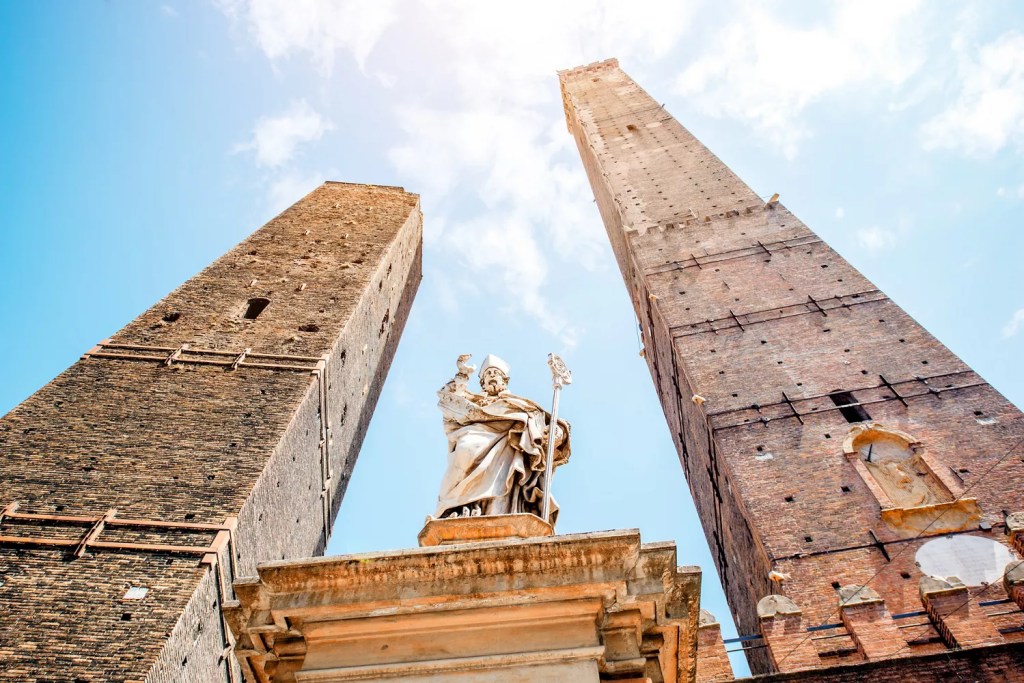
    Unlike Florence where the medieval towers had mostly been flattened, here in Bologna the towers rise up in a phalanx, representing the phallic wealth and status of families who fought for power there. One such tower, the Garisenda tower, is mentioned at the end of canto 31 of Inferno to describe the staggering stature of Antaeus, one of the giants who are punished for opposing God, between the eighth and ninth circles of Hell. 

    ‘Just as the Garisenda seems when seen
    beneath the leaning side, when clouds run past
    and it hangs down as if about to crash,

    so did Antaeus seem to me as I
    watched him bend over me—a moment when
    I’d have preferred to take some other road.

    But gently—on the deep that swallows up
    both Lucifer and Judas—he placed us;
    nor did he, so bent over, stay there long,

    but, like a mast above a ship, he rose.’

    Antaeus transports Dante and Virgil to the deepest part of Hell, the frozen lake where he is to meet Satan himself.

    We don’t know precisely when Dante arrived in Bologna, but the details in his writings make it clear that he knew the city well. After Florence, Bologna is the most cited city in the Divine Comedy.

    On the way to the meeting, Oliver explained to me something of the politics of running a cammino. You had to make sure you had official permission for all the signs, and individual communes would lobby you to have you include them in the itinerary in order to boost the footfall of tourists there. As it was, the Dante trail had been divided into two rings, each providing a separate circular trail for the Tuscany and Emilia Romagna regions. After some gentle persuasion, they had also included an optional detour to include the city of Faenza.

    I felt at home talking bureaucracy and politics. I had worked at the European Parliament before Brexit, after all. 

    ‘Corruption was the biggest sin during Dante’s time and so it remains now,’ cautioned Oliver.

    As he mapped out the complicated process of fundraising to maintain the trail – putting up signs and information boards, cutting back brush, running the website, welcoming pilgrims –  I thought of Dante’s portrayal of the money lenders in Hell who have their heads bowed forwards for the weight of the money bags around their necks. The Cammino di Dante wasn’t all daisies and dandelions after all. 

    ‘That’s politics,’ sighed Oliver.

    Oliver had become involved in the trail a few years ago after re-reading Dante following a heart attack,

    ‘It was like opening a new book,’ he said. To read Dante was to ‘enter into a new world.’

    On the way to the meeting, Oliver spoke fondly of his wife, Donatella,

    ‘When you’re old, you need someone. She’s my soul mate.’ 

    I thought of my dad and his girlfriend to whom I’d sometimes been too harsh. Love was love after all. 

    Once arrived in Bologna, we parked the car on a street on the fringes of the city and Oliver covered my backpack with a patterned cloth:

    ‘Ochio non vede, cuore non vuole’ he said.

    What the eye doesn’t see, the heart doesn’t grieve. 

    It was a fifteen-minute walk to the towering palace where the meeting would be held and we stopped in a bar for a quick coffee en route. Oliver had a decaffeinated one – I had my usual, a double espresso macchiato. Yes, I was addicted to caffeine. 

    The district was business like and very contrary to the medieval city centre. 

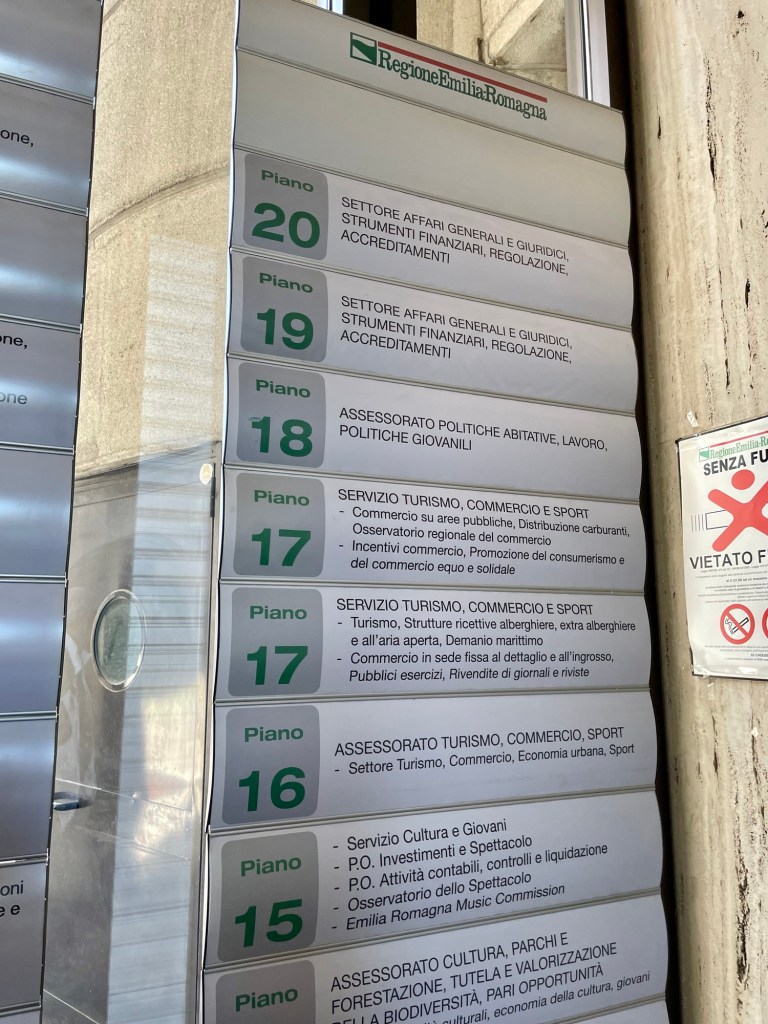
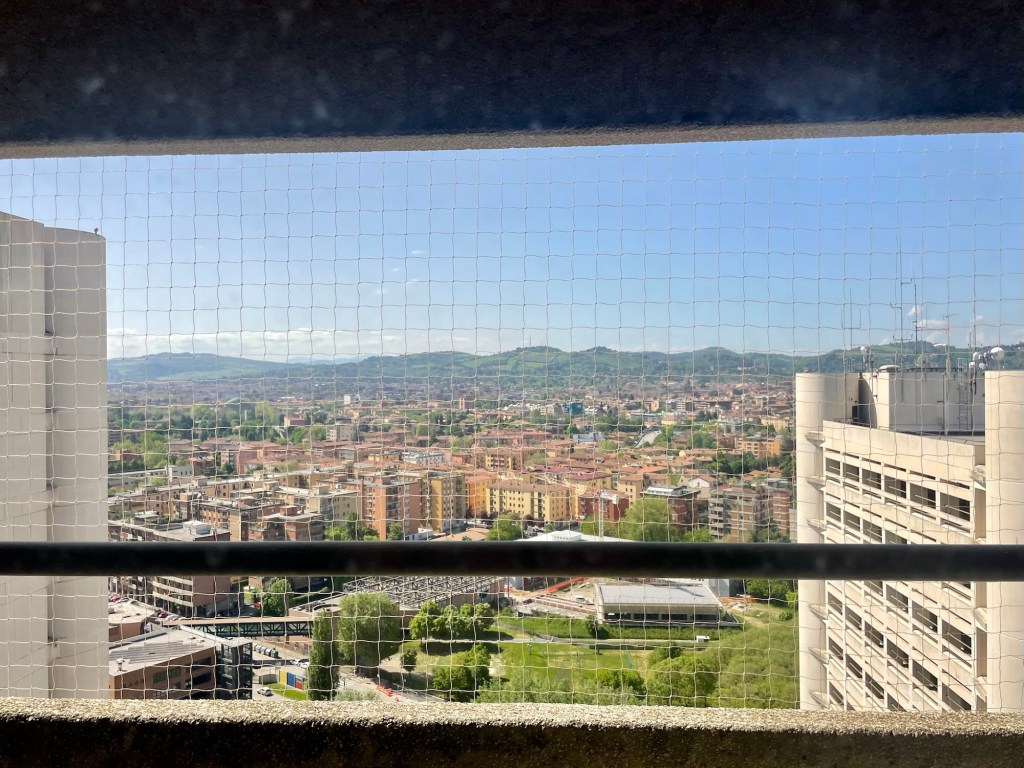
    We located the building and shot up in the dizzying elevator to the 20th floor from where we exited into a meeting room. Some people had already arrived, and Oliver introduced me as a pilgrim and student of camminos.

    There followed a 90-minute meeting in which the different trail organizers each contributed thoughts on issues and opportunities to the regional office executive, a smart woman who greeted me in English and informed me that she had studied at Leeds University. It was highly formal. Everyone rose when she arrived. She was dressed in thick white glasses and a perfectly matched necklace. Business cards were flicked around like tiddledywinks. 

    I felt somewhat self-conscious not to be dressed in a suit and was relieved that at least I’d been able to wear clean clothes.

    Some of the trail organisers joined on Zoom, including someone who was walking as they spoke. This made me feel like less of an imposter. There was Via San Francesco, the Cammino di Saint Antonio, Via degli Abati, Via Romea Germanica, Via Misericordia, Via San Colombano…I’d have to come back to try them all.

    The window afforded a panoramic view of the city.

    We went round in a circle and when it was my turn to speak, I deferred to Oliver. I was there to give witness to the reality of the cammino, he offered.

    The discussion centered on the difference between ‘slow tourism’ and ‘active holidays’ and how the region could attract more tourists from both Italy and abroad. 

    ‘A path doesn’t exist if it isn’t maintained,’ someone said, and thus came a discussion of the floods of 2023 and 2024 and the ongoing damage to many of the pathways. Other topics included the facility of arriving at trailheads via public transport and different types of accommodation, including licenses for people to pitch tents. People appealed for more resources and someone raised the topic of climate change. 

    The region should leave a margin of wild trees on the edges of the pathways and invest in more accommodation in remote areas. There was an issue of hotels only wanting to give rooms to people who would stay for a week, not one night, in July and August – there were pilgrims and then there were tourists – it was important to make the distinction. 

    I felt proud to be representing the Dante trail. The King of England had recently mentioned Dante in a speech, someone pointed out with a hint of envy, so there would be a boom in foreign interest in our trail. 

    The meeting overran and people were hurried in their contributions. The gentleman next to me was taking notes in minuscule script, using a mechanical pencil on squared paper. The lady next to him drew a mind map. I noticed that Oliver didn’t seem to be taking any notes at all. 

    At the end of the meeting, the regional deputy offered some feedback and then proceedings were formally brought to a close.

    I turned to Oliver who, I noted, was wearing a Cammino di Dante jacket. 

    ‘That’s a wrap!’ I said.

    ‘Whose bag is that?’ he replied, pointing to his rucksack. 

    I was confused.

    ‘It’s yours.’

    By the time we had exited the lift, I had started to realize that something was seriously wrong. Oliver had asked me where we were and if I remembered where we’d parked the car. Had we come in a car?

    Physically he seemed fine and so I retraced our steps in the direction of the vehicle taking note of his behaviour. Was it just a funny turn?

    I managed to locate the car, my navigational skills no doubt seasoned by the trail, but, by that point, the gravity of the situation had hit me. Oliver was not ok. 

    ‘I think we need to go to a hospital,’ I said. 

    ‘Could I drive the car?’ Oliver suggested, admitting that his head felt ‘a little funny’. But I didn’t trust myself on the Italian roads. 

    I checked to see if Uber was operational – it wasn’t – then I asked a man who was passing if he knew of any taxi services.  

    ‘You’ll be quicker calling an ambulance,’ he said. And so call an ambulance I did.

    They instructed me to illuminate the car’s emergency lights to aid them in finding our location and gave the coordinates of the street. I was preparing for a long wait and instructed Oliver to sit tight inside the vehicle. 

    ‘Where are we?’ he kept repeating. 

    Much to my astonishment, the ambulance came in five minutes. Yes, five minutes. When my Dad had had a similar episode some years back we had had to wait five hours! It was ten points for the Italian health service from me.

    The paramedics were highly skilled. They checked to see what medication Oliver was taking and got him to say some tongue twisters. Could he raise his arms?

    In my head I tried to stay positive, but I also feared the worst. Surely he couldn’t have had a stroke, right here, right now, with me?

    I accompanied Oliver to hospital in the ambulance, sitting up front beside a paramedic called Samantha who had extravagant gel nails. She was curious to hear about the appalling state of the British National Health Service from which multiple governments had cut funding in recent years.

    Five minutes.

    I still couldn’t believe the speed at which they’d come.

    Once at the hospital, they took Oliver in for treatment and I was ushered into the waiting room. Was I family? I was not. We’d called his wife from the ambulance and she was on her way.

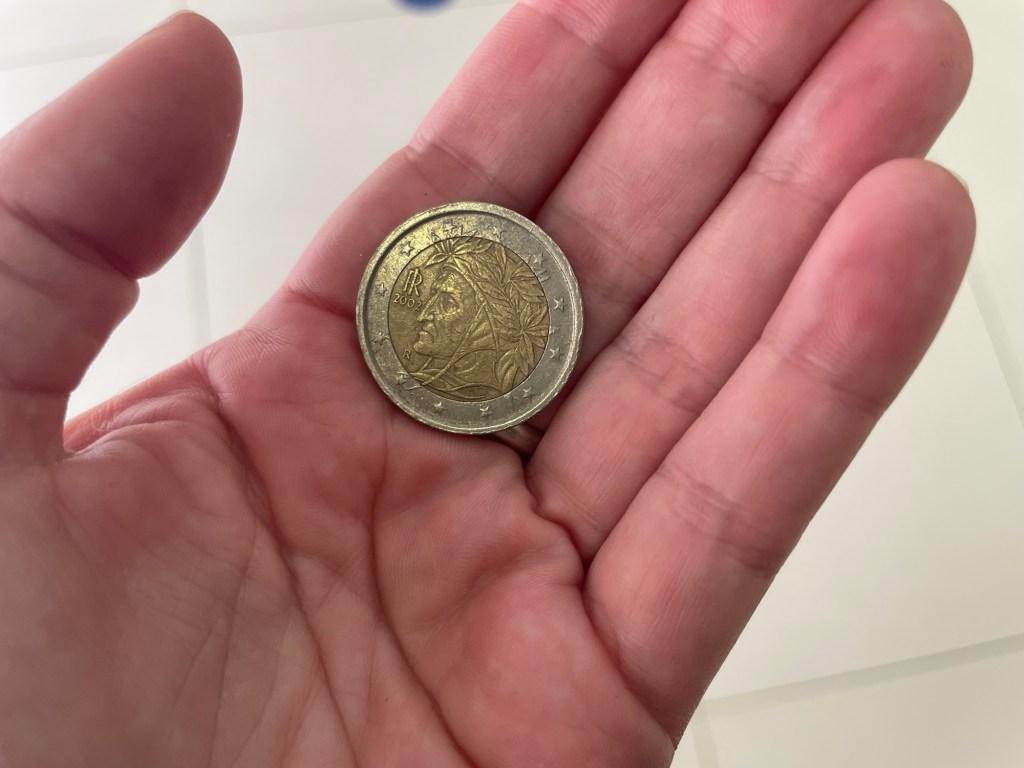
    I bought some fizzy water from a vending machine with a one Euro coin which had Dante’s face on it.

    There followed two long hours of waiting until I finally convinced the receptionist to let me go and see him. He was sat in a wheelchair in the moderate care unit ‘under observation’. He asked me where he was and I tried to see if he could remember me.

    ‘Allsopp?’ he tentatively offered. 

    But he remembered nothing when I showed him photos of the time we had spent together over the last three days. 

    As he repeatedly asked me the same questions, I thought of the thieves in canto 25 of Inferno who are punished by being metamorphosized, time and time again, from souls into serpents in some hideous version of Nietzsche’s Eternal Return.

    Like Dante, I was in shock,

    ‘If, reader, you are slow now to believe

    what I shall tell, that is no cause for wonder,

    for I who saw it hardly can accept it.’

    I also reflected that while Dante’s shades lose their bodies but not their minds, here was Oliver in the very opposite state. 

    Finally, his wife Donatella arrived. She was as lovely as Oliver had described her. Accompanying her was their son Stefano and his wife, Sara, who was five months pregnant with Oliver’s grandson. He had been euphoric when he had told me of the future arrival in the car that morning but now, he recalled not a thing.

    Upon seeing Sara, he burst into tears, 

    ‘What a wonder!’ he remarked.

    Over the next two hours, this was to happen time and time again.

    ‘But what news! What wonderful news!’

    ‘How many times have you become a grandfather today,’ Sara would later gest.

    We had to gest. There was nothing to be done but wait, instructed the doctors, and the whole situation was absurd. 

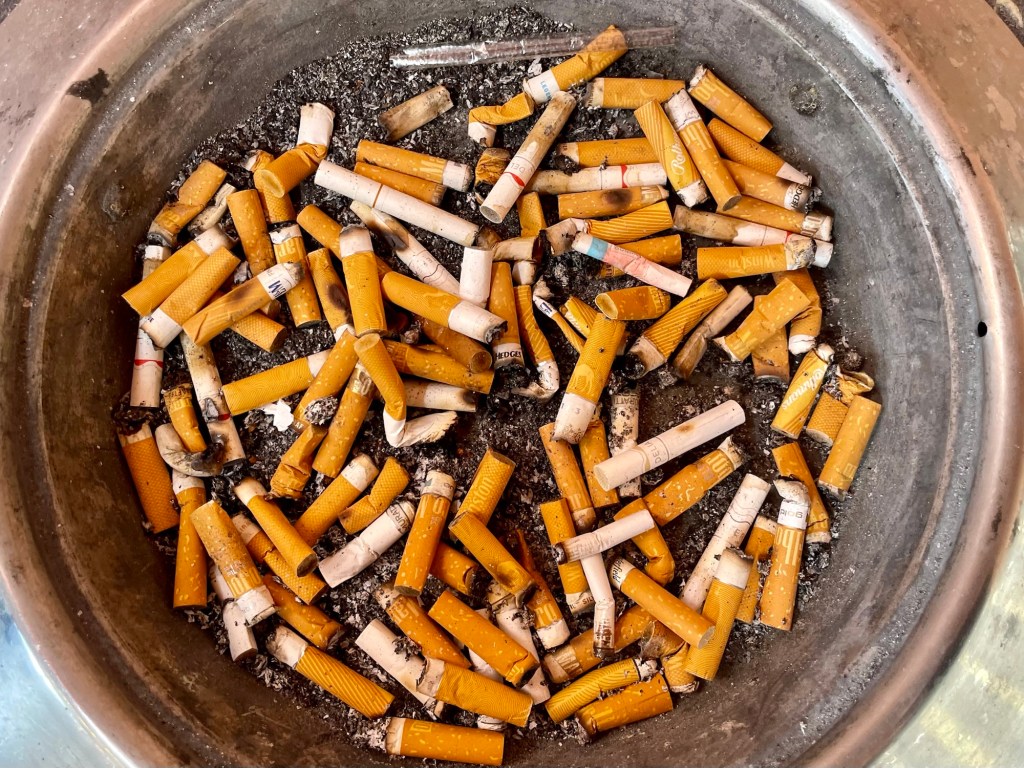
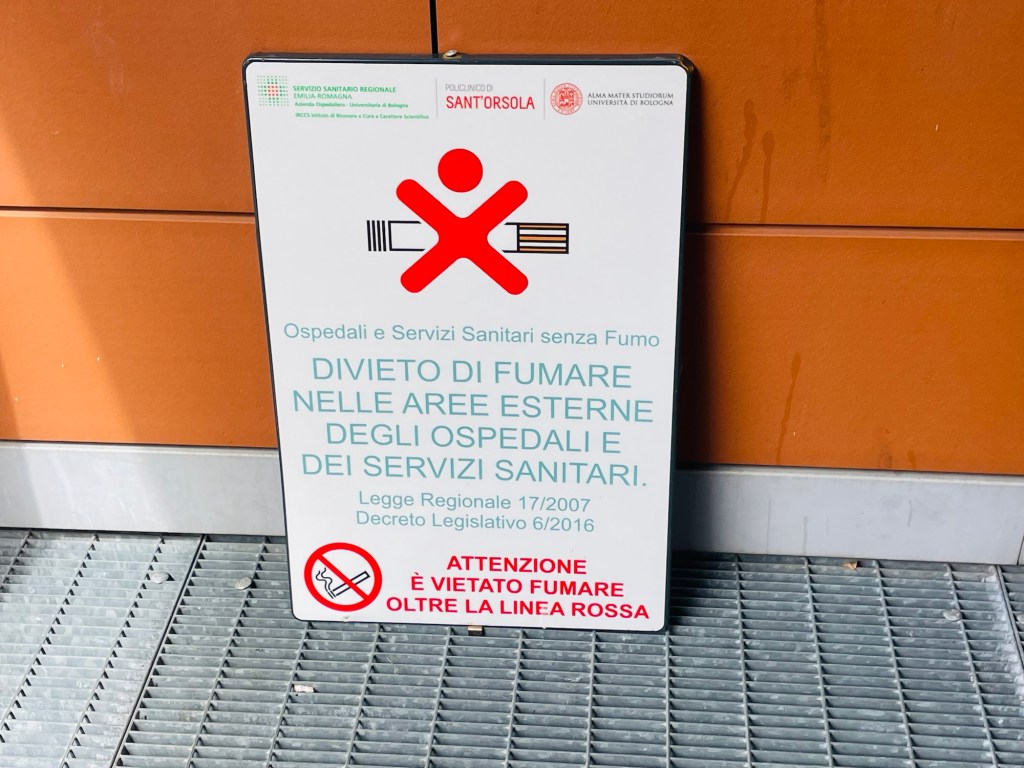
    Outside were huge signs reading ‘No smoking.’ 

    Everyone was smoking. Even I was smoking. 

    After a while, Oliver came to join us outside. He had a canular in his arm from where they had taken blood but otherwise he seemed physically in form. He asked where we were, re-discovered he was to become a grandfather once more, and, much to our astonishment, joked about his condition.

    ‘It seems I’ve had a sfarfallamento,’ he offered. This was a word to describe a funny turn that comes from the Italian for butterfly. 

    But then he would forget it all over again. 

    The Pope died several times. I got to know him repeatedly and he was moved to tears when I told him I had bought a rose in Ravenna that I would carry back to Florence with me in Dante’s honour.

    Ma che bella cosa!’

    He was thrilled I was doing the cammino and offered me sound advice. His long-term memory was locked in, but short term he could not recall a thing. 

    ‘Allsopp?’

    His niece, Martina, joined us. We swapped power banks to charge phones and it was agreed that Donatella would stay with Oliver while Stefano and Sara attended to the dogs. And then there was me. 

    I was conscious of impinging on the family’s space, but each time I attempted to leave, offering to get a taxi, they insisted I stay. Kelsey had offered to come and meet me. Rossella had offered to come and collect me. There was so much love on the trail. But Oliver’s family insisted that they would take me where I needed to go. It was ‘the least we can do,’ they repeated.

    I knew better, being in Italy, than to reject this offer. 

    I had become somehow an addition of the family and I also deeply cared for Oliver. The last three days we’d spent together had been a riot. I had had the feeling of meeting a kindred soul, even though he now did not recall a thing.

    Luckily, I’d had the sense to pin the location of the car and take some photos, and so Stefano went to fetch it while we stayed with Oliver. It seemed to distract and reassure him, talking about the trail.

    The doctors insisted it was likely just a temporary memory loss: a transient ischaemic attack (TIA) or ‘mini stroke’ caused by a temporary disruption in the blood supply to part of the brain.

    Could it have been caused by the dizzying elevator that had even caught me out of breath?

    I was sad to leave Oliver but, in a moment of lucidity, after I’d reminded him who I was for the umpteenth time, he had encouraged me to continue with the cammino, chastising me with it for the big size of my backpack which I’d taken in the ambulance from the car. 

    ‘Could you have packed any more stuff?’ he joked.

    We shared a hug. His body seemed to remember the bond we shared, even if his mind currently didn’t. 

    Thus I climbed into the car with Stefano and Martina, moving some Cammino di Dante signs from the back seat to make space for us. 

    Who would put them up now?

    Stefano was clearly terrified for his father. The whole family had come out in a display of love and support which had moved me deeply. No wonder he had spoken so fondly of these special people.

    Night had fallen and so Stefano insisted on dropping me at the end of that day’s leg of the trail which was an agriturismo in Oriolo dei Fichi. I had called to warn them I was running late. He used my power bank to charge his phone and we discussed his dear relationship with his father and what it would mean to bring a son into this crazy world.

    After finding love at 37, within one year Stefano and Sara had got married and made a baby. 

    ‘When it’s the one, you know,’ he councelled.

    There was hope for me yet.

    As an only child, Stefano had the responsibility of both his parents on his shoulders. I felt grateful for my brother and grateful for my own family.

    The scent of wisteria hit me in the car park and the sound of the birdsong clashed with the disquiet in my heart. I hugged Stefano goodbye and he promised to keep me posted. 

    I sat in my room which had brick walls and a wooden beam ceiling. A beautiful antique wardrobe faced the bed. I knelt on it and did something I had rarely done in my 37 years, I prayed. I prayed for Oliver and I prayed for his family. 

    He was my Virgil, my ‘master and my author.’

    Without him to guide me, I felt lost.

  • A Mosaic of Colour: Ravenna

    I felt immediately at home in Dante’s city of exile, but the most special encounter came in the form of the hospitality of Oliver, our new guide.

    I had had the fortune to visit Ravenna on two previous occasions, once on a road trip with my University friends Tor, Martin and Will, and once to give a lecture at the University of Bologna. Ravenna is known as the city of mosaics and, as a mosaic artist myself, I had felt immediately at home in the city. This personal feeling of sanctuary came flooding back as I wondered the streets.

    On every corner are little mosaic plaques that depict flowers and announce,

    ‘Ravenna, city friend of women’. 

    Though they are never explicitly cited, it is said that the Byzantine mosaics in the church complex in Ravenna (Ravenna has some 200 churches) inspired Dante’s Paradiso which he completed in exile here.

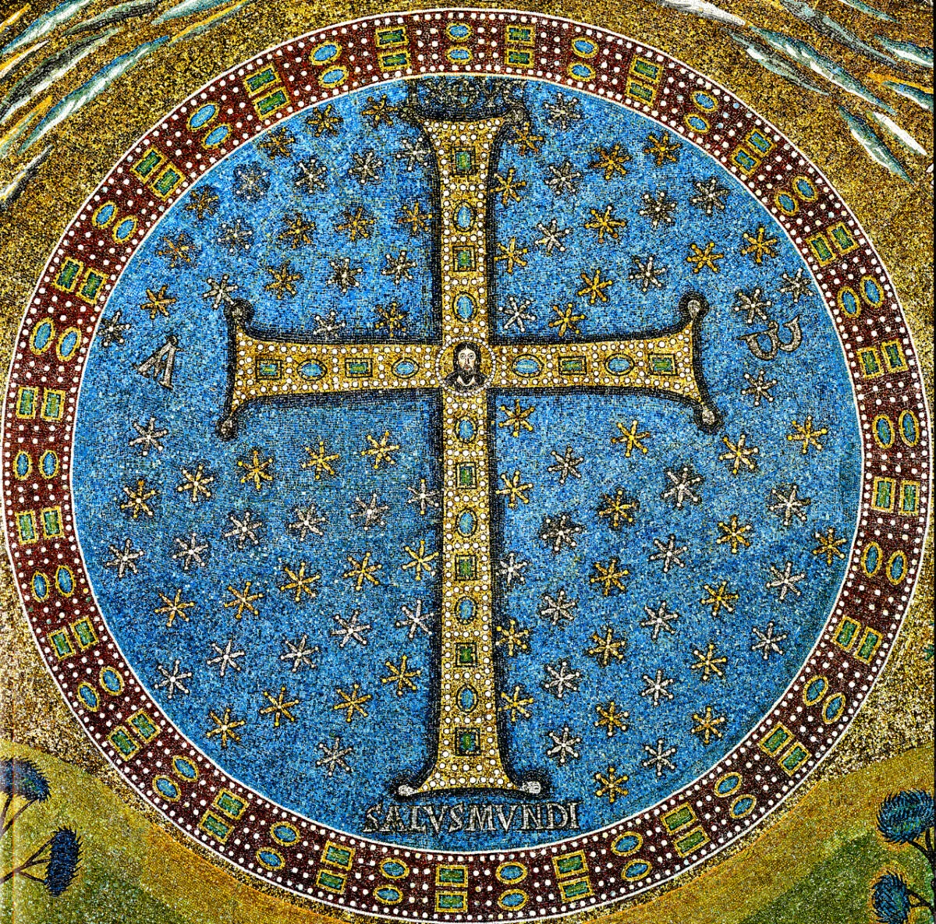
    Among the depictions that one can most easily recognize in the Dantean text is the mosaic in the apse of Sant’Apollinare in Classe which contains a sky dotted with 99 golden stars and a gem cross, in the center of which it is possible to see the face of Christ. In the 14th canto of Paradiso, the souls who welcome Dante arrange themselves in the form of a cross, with Christ placed in the centre:

    ‘As, graced with lesser and with larger lights
    between the poles of the world, the Galaxy
    gleams so that even sages are perplexed;

    so, constellated in the depth of Mars,
    those rays described the venerable sign
    a circle’s quadrants form where they are joined.

    And here my memory defeats my wit:
    Christ’s flaming from that cross was such that I
    can find no fit similitude for it.

    But he who takes his cross and follows Christ
    will pardon me again for my omission—
    my seeing Christ flash forth undid my force.’

    In the 10th canto of Paradiso, meanwhile, Dante encounters a group of blessed souls who surround him and his celestial guide, Beatrice, forming a crown of twelve. A second crown of twelve souls joins them in canto 12, which moves in coordination with the first.

    And I saw many lights, alive, most bright;
    we formed the center, they became a crown,
    their voices even sweeter than their splendor.’

    It is said that this image could recall the two domes of the Neonian and the Arian baptisteries, where the twelve apostles are depicted in a circle.

    It is also possible to imagine that Dante was inspired by the beautiful portrait of the Emperor in the Basilica of San Vitale. Paradiso 6 tells the history of the Roman Empire which Dante viewed as part of the divine plan of Christianity. Justinian has a prominent role. Indeed, the political sixth canto is dedicated to him:

    ‘Caesar I was and am Justinian,
    who, through the will of Primal Love I feel,
    removed the vain and needless from the laws.’

    The Procession of Virgins and Saints depicted in Sant’Apollinare Nuovo may also have informed his description of the grand procession that heralds the arrival of his Beatrice in the Earthly Paradise. 

    I left Kelsey to explore the mosaics and caught up with some work during the day before meeting with the current president of the Association of the Cammino di Dante, Oliviero Resta, known to friends as Oliver. We had an appointment outside the tomb of Dante at 5pm. 

    Oliver is unassuming with his bushy moustache and two pairs of glasses, a contrast to the exuberant personality of Giordano, the founder of the trail, with whom who we had had the honour to spend the previous evening.

    His quiet presence is fatherly and reassuring and, once again, I had the feeling that I had met a kindred spirit.

    That evening and the next day, Oliver was a host with the most.

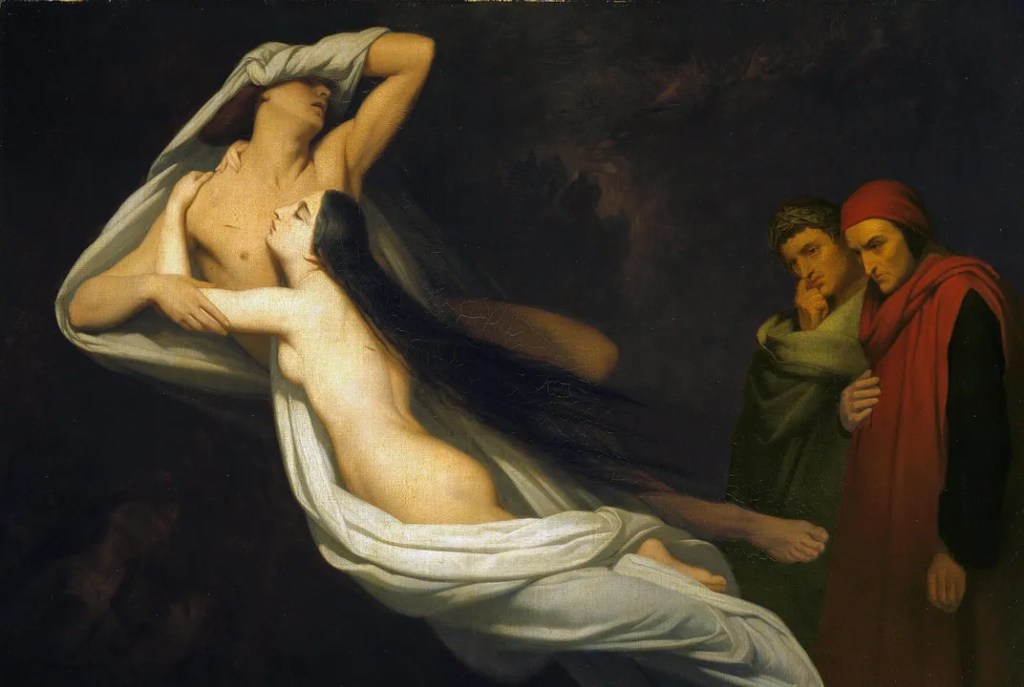
    The first evening he showed us the house said to be home to Francesca di Rimini who is memorably depicted with her lover, Paulo, in a whirlwind of lust in canto 5 of Inferno. She is accompanied by Helen of Troy and Cleopatra. Her lyrical lament is among one of the most beautiful parts of the Divine Comedy,

    ‘Love, that releases no beloved from loving,
    took hold of me so strongly through his beauty
    that, as you see, it has not left me yet.’

    I recalled how when I had given my lecture on young refugees in Ravenna, two students in the front row had cried at the love story of Alim who, after being deported to Afghanistan from Leicester at the age of 18, had returned two years later only to find that his beloved had moved on and shacked up with his best friend. 

    As Dante says,

     ‘Alas, how many gentle thoughts, how deep a longing,
    had led them to the agonizing pass!’

    The emotional and relational lives of refugees is a topic long ignored in contemporary scholarship. Dante helps to set the record straight that refugeehood can be a sight of lust and longing. 

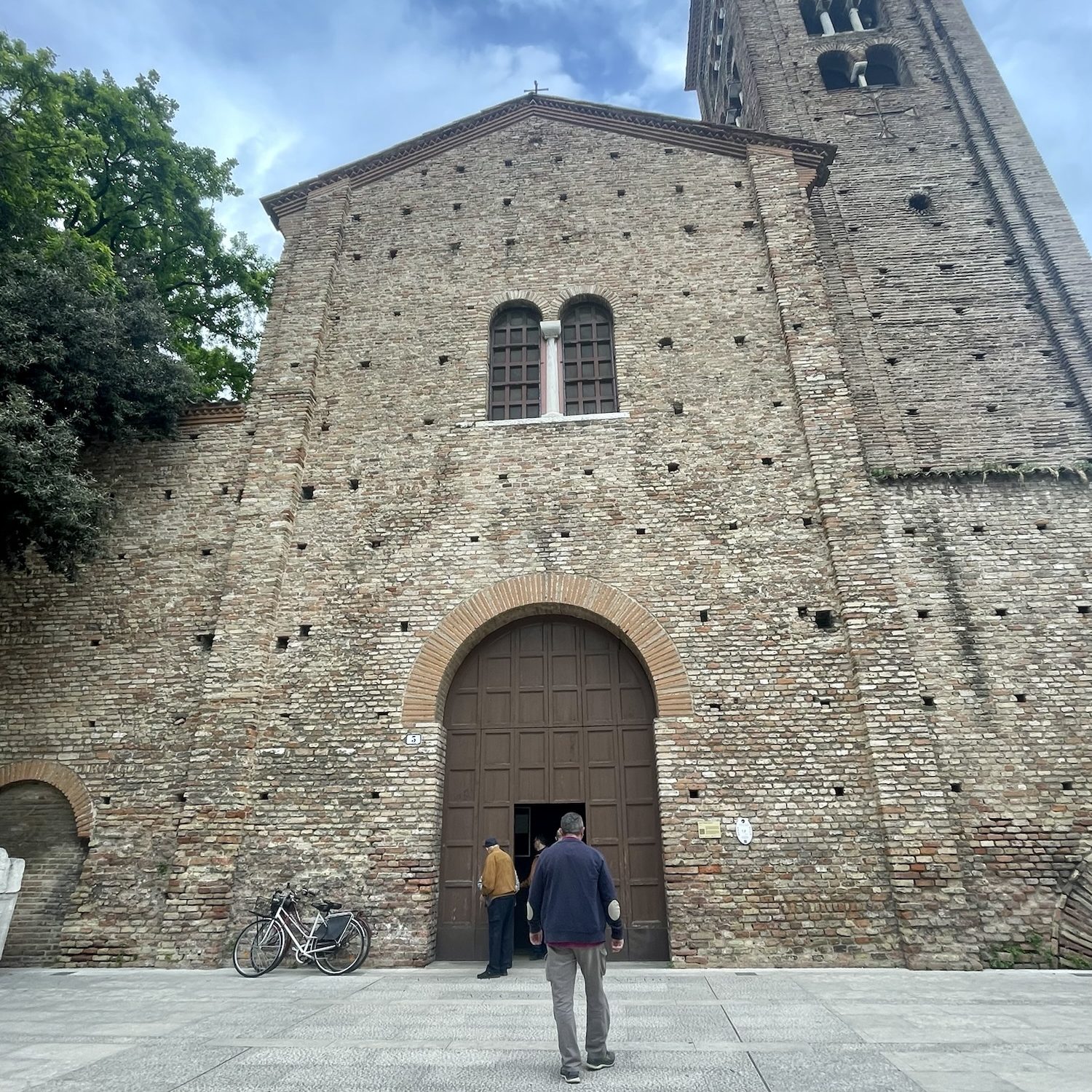
    Oliver took us through the winding streets to see the Basilica which hosted Dante’s funeral. There were signs of the spectacular mosaic floor of the ancient church beneath the foundations which now, quite strikingly, housed a shoal of goldfish. 

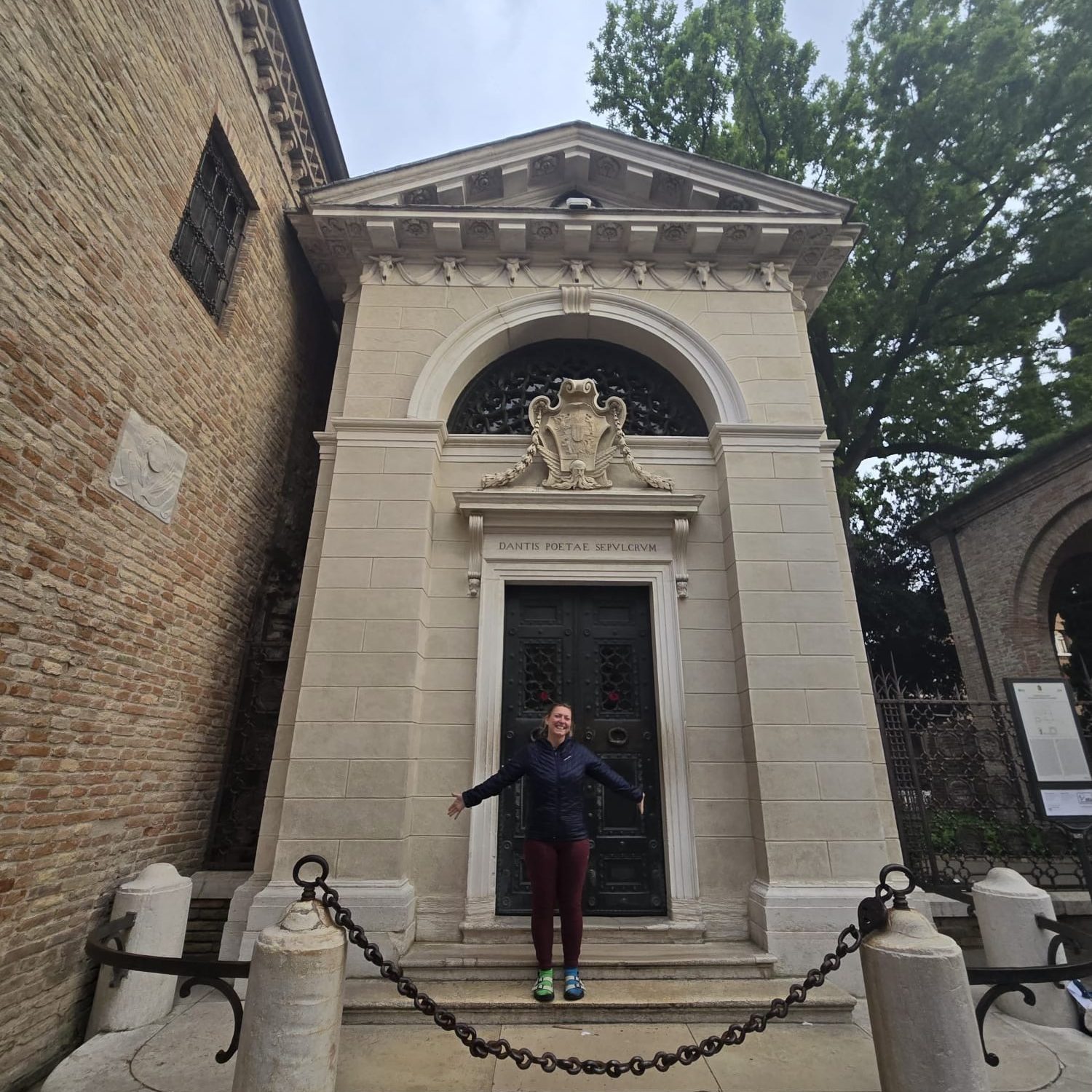
    At 6pm we returned to Dante’s tomb where there takes place, every day, a reading from the Divine Comedy. A crowd of about 50 people had assembled there to hear two women recite a canto from Purgatory. The tomb itself was constructed by Camillo Morigia between 1780 and 1782.

    We saw the hole in the wall where Dante’s bones had been hidden by Franciscan monks in 1810 to prevent them being claimed back by Florence. They were found by chance in 1865 and returned.

    Dante’s bones were once again buried in a secret place during the Second World Rar to protect them from bombardment by the Nazis. A plaque memorializes this event.

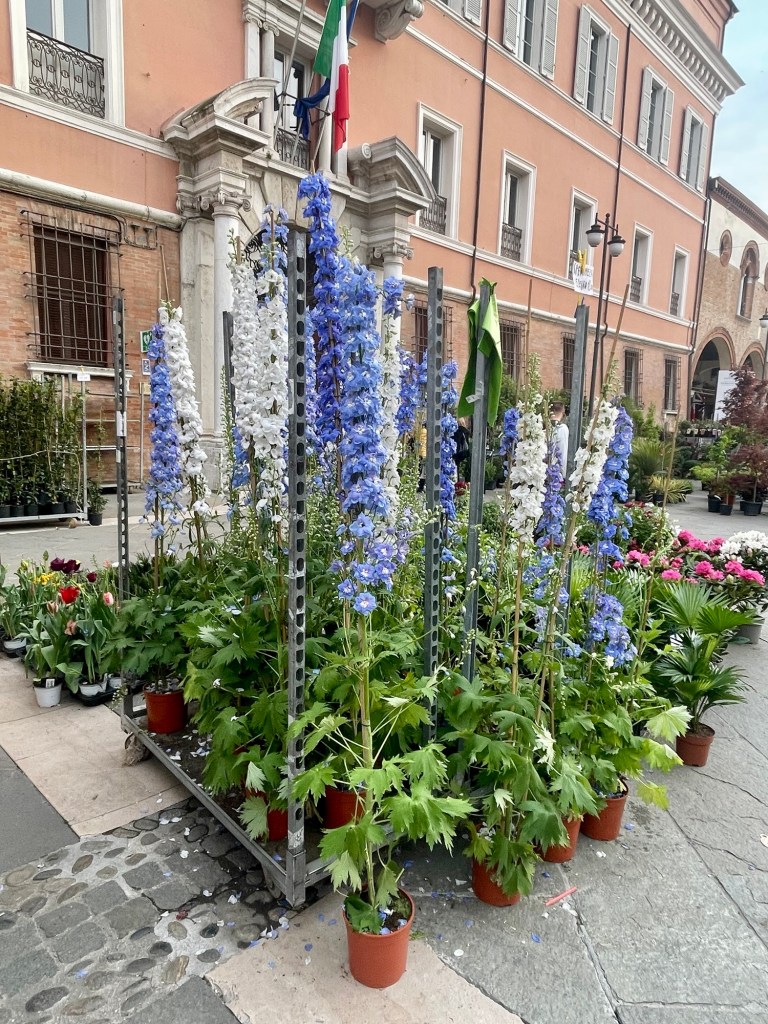
    In a pretty market in the square there was an exuberance of flowers and artisanal wares. I bought Kelsey a hand-whittled honey scooper.

    ‘I’ll think of you when I eat my honey,’ she said. 

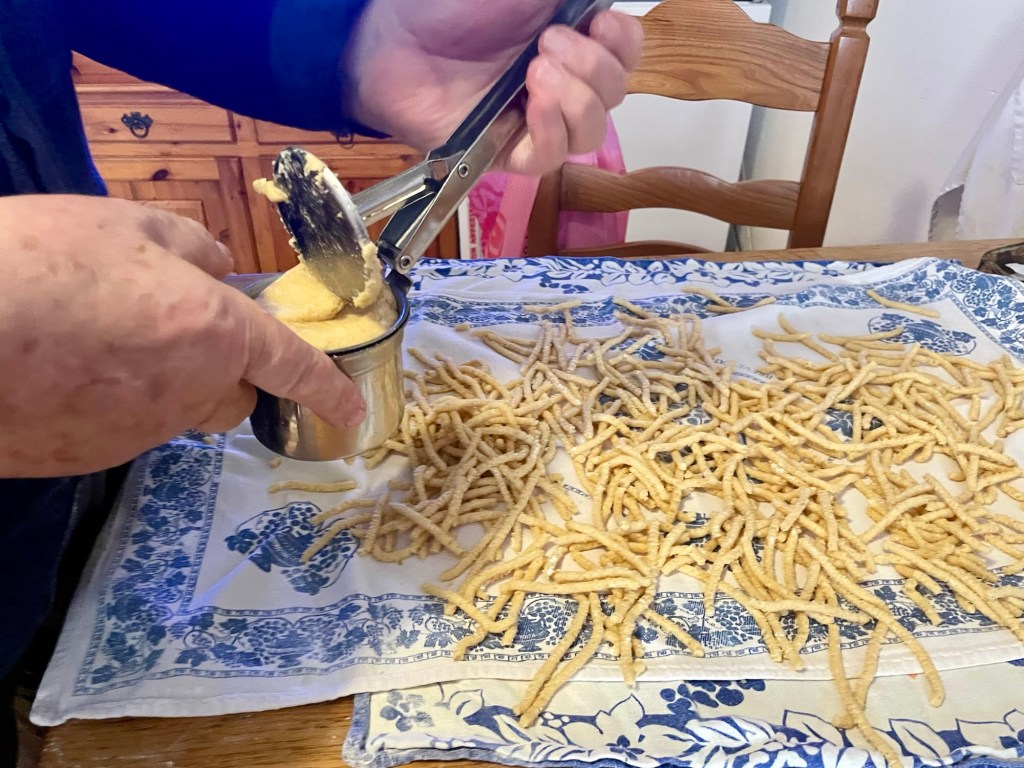
    That night we dined at Passatelli  which since 1962 has been serving delicious local fare in a converted old cinema. We ate all local food including passatelli, a thick pasta that resembles a maggot but tastes anything but.

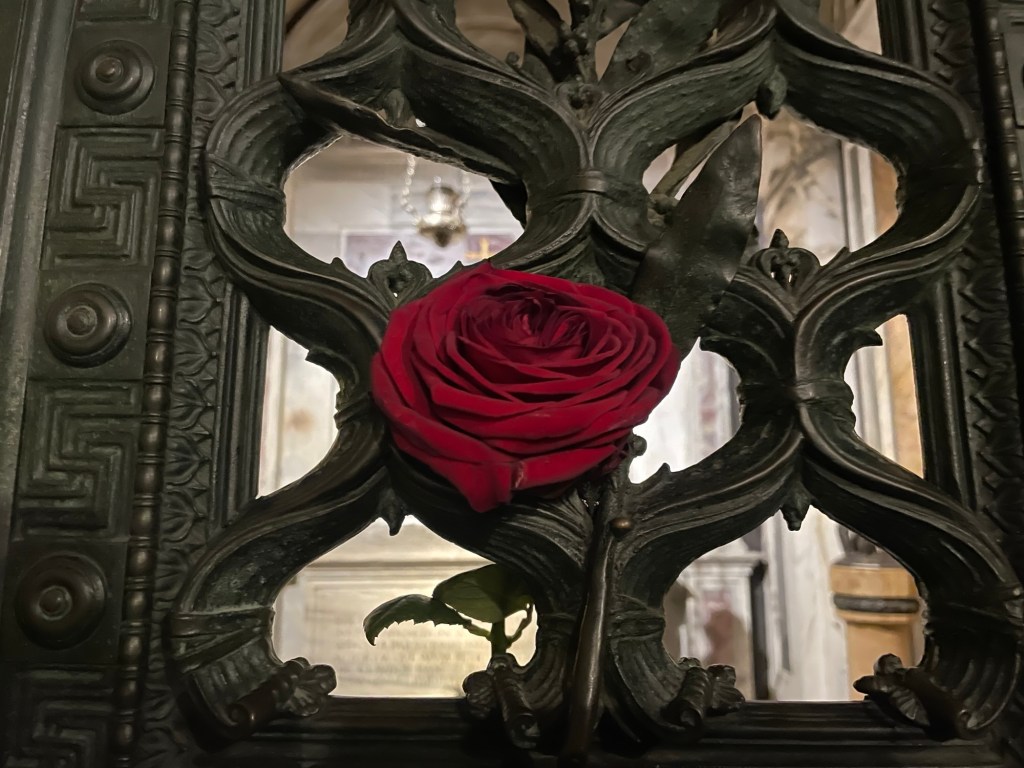
    We purchased more roses from Mashalim which we weaved into the doors of Dante’s grave. It was touching to see that the roses we had devoted to him the night before were still there, embellishing the tombsite. 

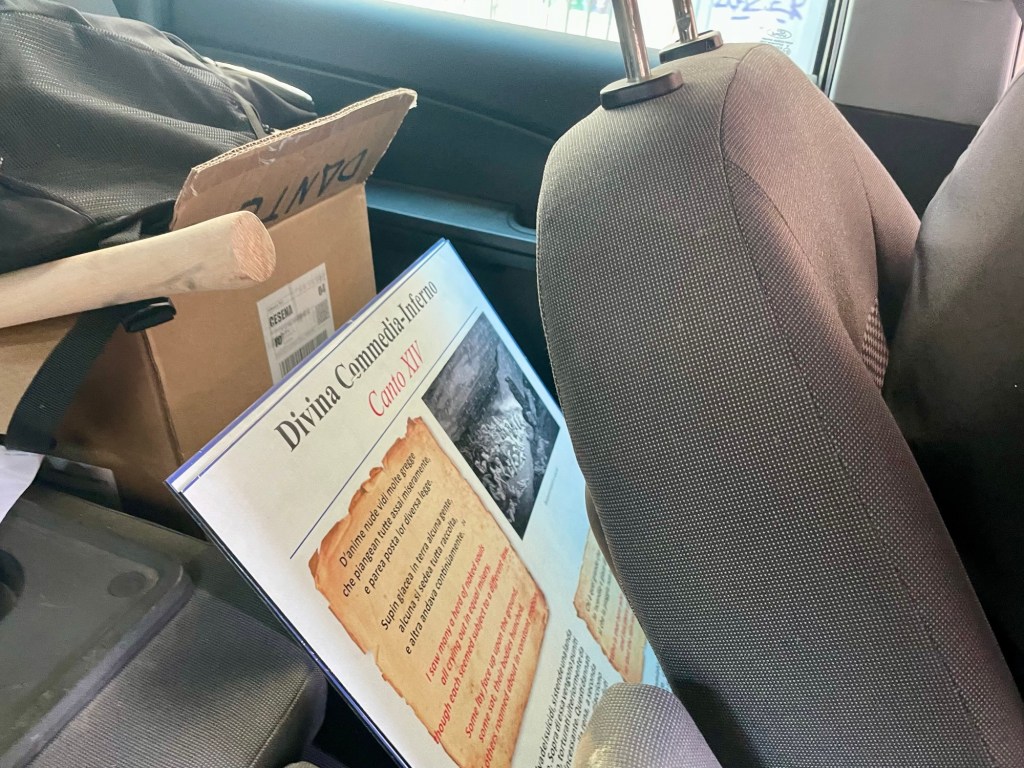
    The next day Oliver picked us up in his battered old car that had Dante information boards stored in the backseats that he would put on the trail in the coming days with the help of Giordano’s son, Marcello. Together they maintained every detail of the cammino meticulously. 

    We passed by the convent where Dante’s daughter had become a nun, taking the name of Beatrice, and visited the lido which had formerly been the port from which Dante had set off on his last perilous diplomatic mission to Venice to negotiate salt taxes. 

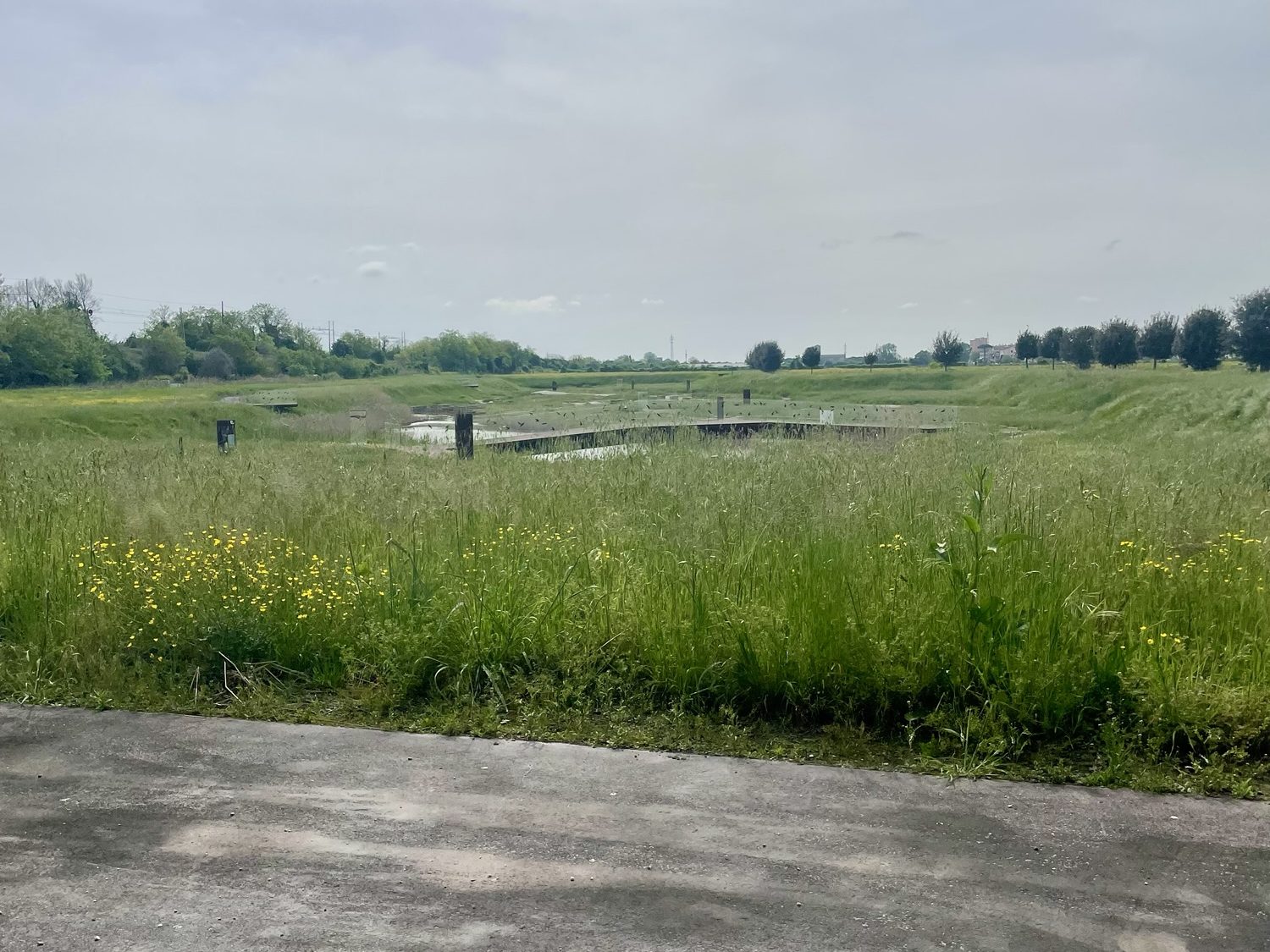
    Though the sea had now retreated some distance from the spot to create a wetland abundant with birdlife, you could imagine the scene. Though he arrived via water he returned from Venice on foot where he caught the malaria that would kill him on the night of the 13th of September, 1321. He was 56 when he died. 

    Oliver explained that a river used to run through the heart of the city but it had been diverted to prevent flooding. The Ravenna of Dante’s day would have looked familiar but also different. 

    ‘Every pilgrim has his way,’ he said.

    Ironically, at 71, Oliver himself isn’t a fan of walking. Some years ago, he’d had a heart attack and had four stents fitted, just like my own father.

    Kelsey had a train to catch at 1.40pm which gave us just enough time to check out the Pine forest of Classe, located a few kilometers south of Ravenna, which inspired Dante in his representation of the ‘thick and vibrant’ woods of the terrestrial Paradise, which receives Dante and Virgil along their path in the 28th Canto of Purgatory.

    ‘A gentle breeze, which did not seem to vary
    within itself, was striking at my brow
    but with no greater force than a kind wind’s,

    a wind that made the trembling boughs—they all
    bent eagerly—incline in the direction
    of morning shadows from the holy mountain;

    but they were not deflected with such force
    as to disturb the little birds upon
    the branches in the practice of their arts;

    for to the leaves, with song, birds welcomed those
    first hours of the morning joyously,
    and leaves supplied the burden to their rhymes—

    just like the wind that sounds from branch to branch
    along the shore of Classe, through the pines
    when Aeolus has set Sirocco loose.’

    The forest was full of life. Wild asparagus sprouted in tall stalks and pines shot up like towers. They had been harvested to make boats in the medieval period.

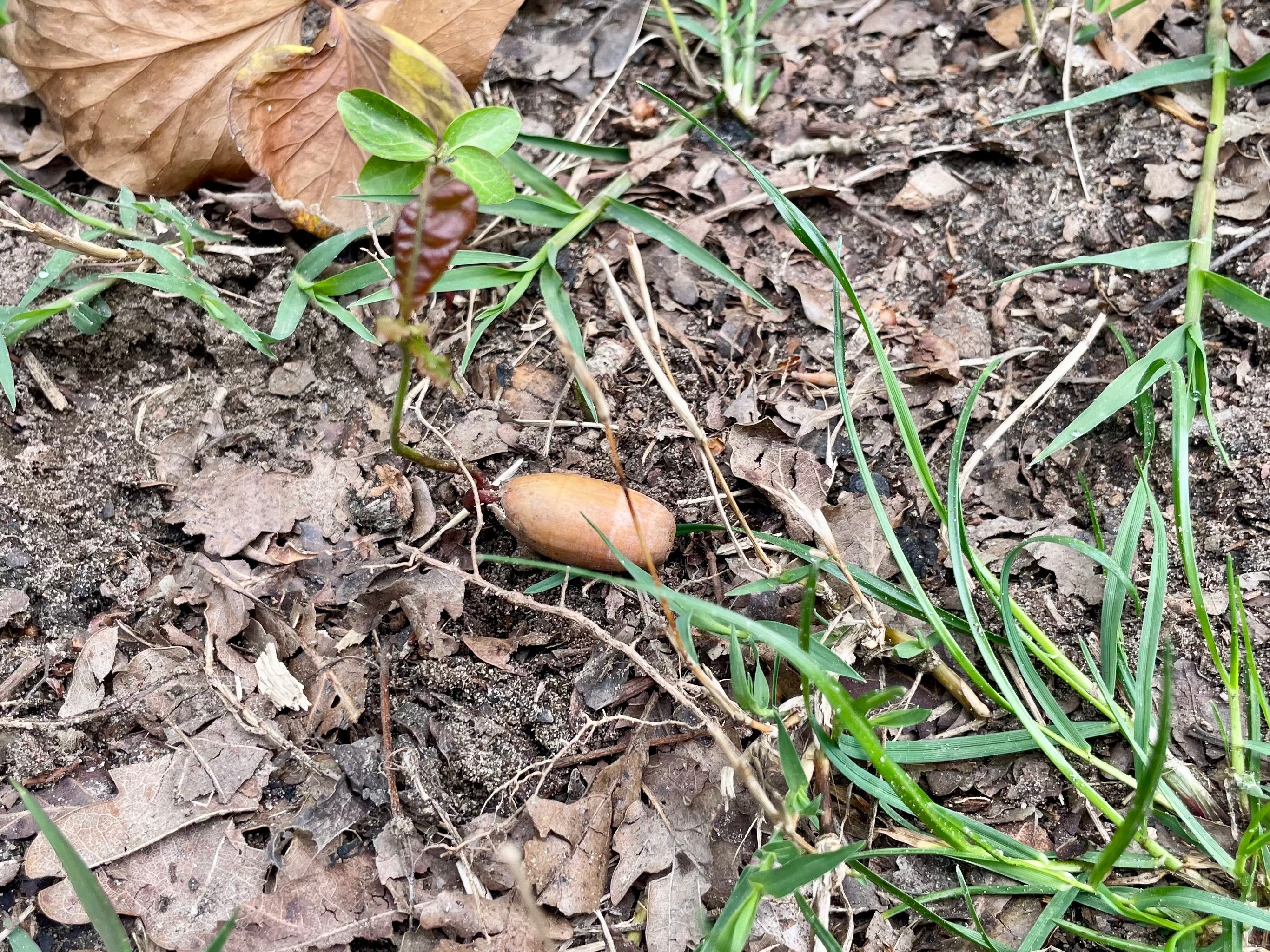
    Wild honeysuckle exuded a delicious tangy scent and from an acorn, an oak plant tentatively hazarded a thin thread of life.

    ‘If you don’t visit a place and touch it with your feet don’t get it,’ said Oliver.

    He spoke fondly of his wife, Donatella, who he said was very much at one with nature – somewhat of a tree hugger like me. When she harvested wild strawberries from the forest she asked for permission, he said.

    ‘Man needs to realize that nature does everything by itself.’

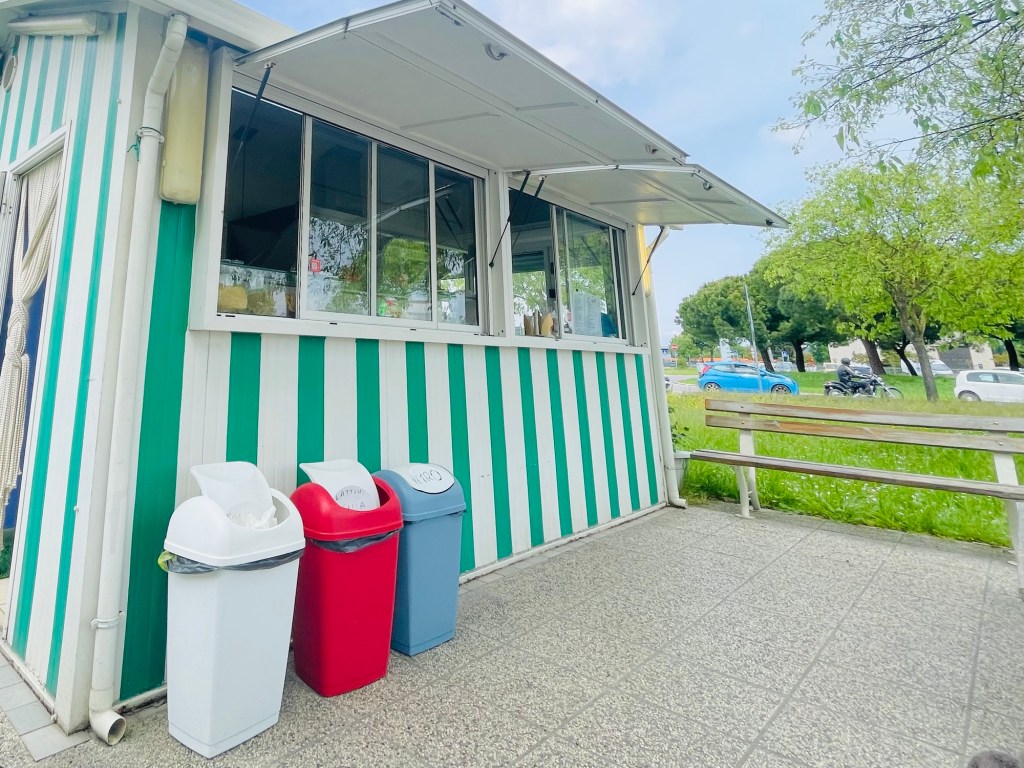
    Back on the road, we stopped at a piadina shack that was recognizable from its green and white stripes. I had one with rocket and a local runny cheese called squacquerone. Kelsey and Oliver had ham and hard cheese. I felt Italian, wearing my feather jacket in the midday sun.

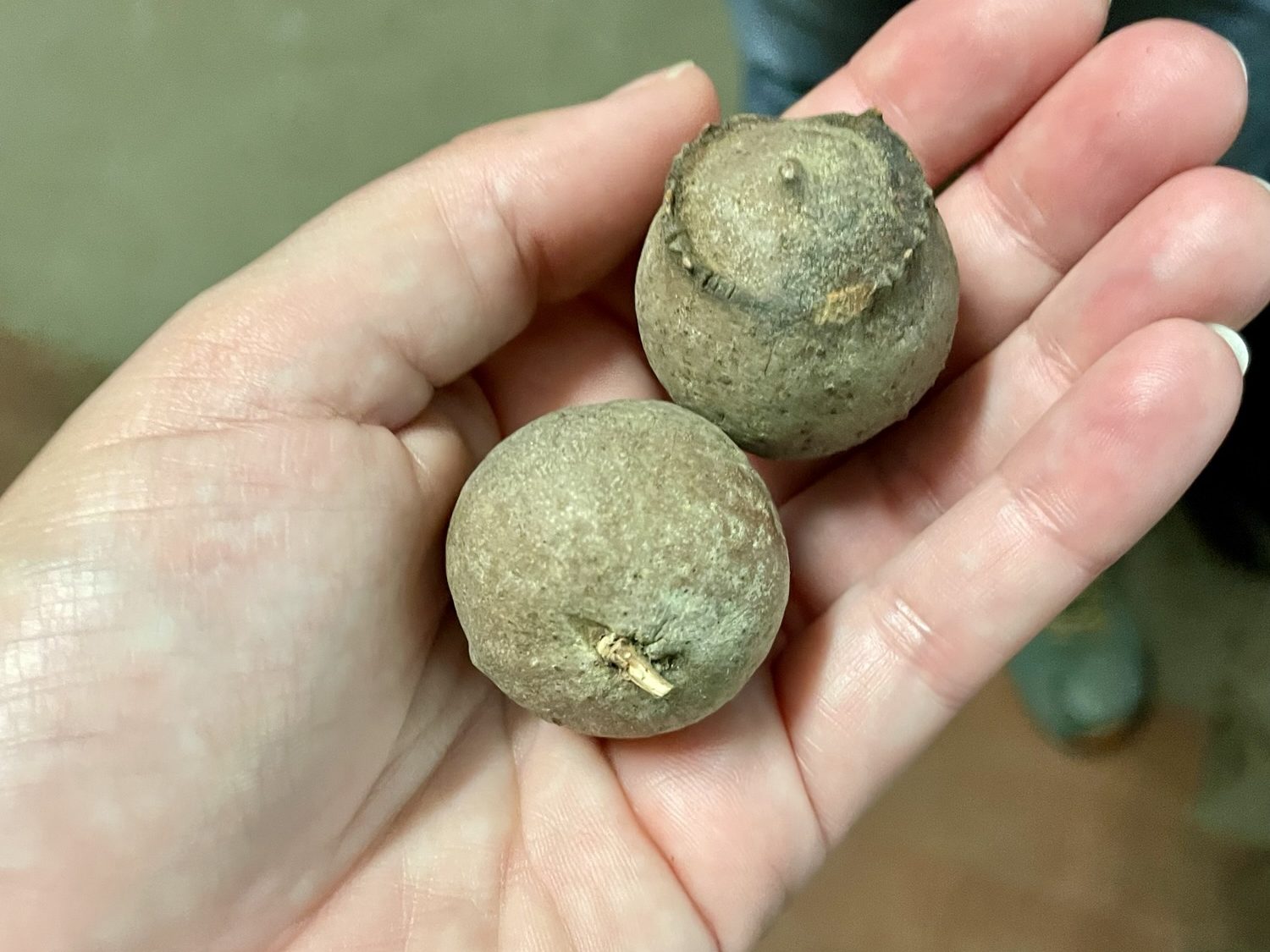
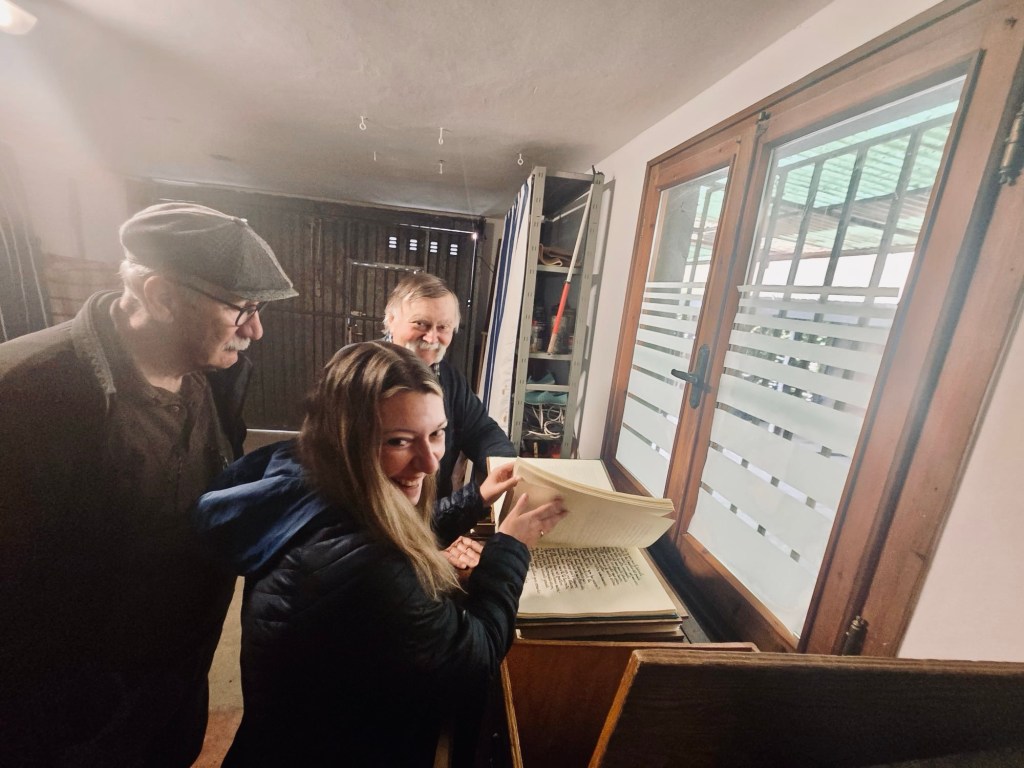
    Oliver then took us to meet Paulo, another extraordinary man who makes his own ink out of oak parasites, which are rich in tannins, and uses it to write out, by hand, stunning tracts of the Divine Comedy.

    This ancient way of making ink requires daily mixing, boiling and the addition of iron and copper to make black from red and green. Gum is added from apricots and peaches to create a substance that is tacky, doesn’t run and sticks to the page.

    His work was flawless.

    The ink smelt like balsamic vinager and he kept it in a sea shell which he used for his ink pot. He was, he explained, a man of the sea. Mountain scribes use stones with holes in as their ink pots. 

    He had started on his work with Paradiso since he had been sick at the time and wanted some lightness – Dante’s vivid depiction of Hell was too close to home, he explained. But now he was recovered and halfway through Inferno. It was the second time he had transcribed the Divine Comedy since he was unsatisfied with his first attempt which was rendered in a slightly different, gothic font. He had had to change the font he used because, with age, his hand was not as dexterous.

    It took him five to six months to complete a canticle. 

    On some of the pages you could see the light outline of the lead he had used to draw the lines to guide his careful script. And here and there, he had embellished letters in gold leaf.

    Alongside the Divine Comedy he had transcribed the two volumes of Dante’s political tract, Convivio, and the Bible.

    After removing the car from his garage so that we could all fit in, he showed us his equipment of an eyeglass, goose feather quill, and a hare’s leg that had been taxidermized and stuffed with cotton. The softness of the hare’s fur gave a particular shine to the embossed parts of the manuscript, he revealed. Each text was written on paper made in the traditional way from papyrus. 

    The name for someone who handwrites manuscripts is an amanuense.

    When we had arrived, Paulo and his wife, Lucia, had been hand making passatelli. Of course they were, they said, it was Easter. They would eat it with prawns and courgettes in a soup, or brodo. 

    On the walls were family pictures, some of which had come loose from the frame, and a white shaggy dog called Pipo bounded across the room in search of affection. An easter display contained eggs and plastic decorations of rabbits and chicks. From the study two budgerigars were tweeting. 

    Paulo appeared incredibly humble but also proud of his work. 

    ‘Many normal people do things that are seen by others are titanic,’ explained Oliver. 

    Then suddenly his wife appeared from the doorway of the garage.

    ‘The Pope is dead,’ she announced. 

    ‘He met J.D. Vance yesterday,’ said Kelsey, ‘shit I hope he didn’t contract the evil eye.’

    I was struck how quickly the conversation moved on back to the books. Paulo was a religious man and the Pope was important, but he was here to show us his own devotional work.

    I asked him what his favourite part of the Comedy was,

    ‘For me,’ he replied, ‘Beatrice is everything.’

    He explained that for him calligraphy was a form of meditation that empties his mind. 

    He read us the last lines of Paradiso and then offered to write it out for Kelsey and I. Yes please, we said. He would entrust it to Oliver to pass forward. 

    Paulo tucked up the pages he was currently working on in a leather cover as if he were putting to bed a baby. 

    He used to go into schools to explain his work to the next generation but he fears that the art is being lost. He was teaching a 16 year old called Giovanni and a student at the university had done a thesis on his work.

    I thought of my great aunt mary who had taught me how to handmake pillow lace. I’d have to pull out my cushion and bobbins when I got home and see what I could remember. 

    As we left, we asked if there was anything we could do for Paulo and he simply said ‘remember me.’ This touched me for its similarity to the pleas of the souls in Dante’s afterlife who ask him to remember them when he returns to the earthly realm. 

  • An Earthly Paradise: From Passo Vico to Ravenna

    The last stretch to Ravenna boasts two magical gardens where I would meet a friend and a soul mate who showed me that Dante’s divine love is at once self-reflective, shared and in harmony with the natural world.

    Kelsey and I had a leisurely breakfast at our lodging, Fattoria Chiocce Romagnole, with the two fellow male Italian pilgrims and our host, Rossella. She explained a bit more about the flooding that had occurred in the region on the 17th of May, 2023, a date that she had tattooed on the inside of her left arm. The water had come in through the windows where we were now eating fresh apple cake made by her mother. 

    ‘The most disturbing thing was the screams of the animals in the night,’ she said.

    She had lost one goat and saved another by giving it mouth-to-mouth resuscitation. A lot of the birds perished. In the morning, the fire service had come in a dinghy to rescue her dogs. 

    ‘At least here the water was clean,’ explained Rossella, ‘further down it became muddy and even more treacherous.’ 

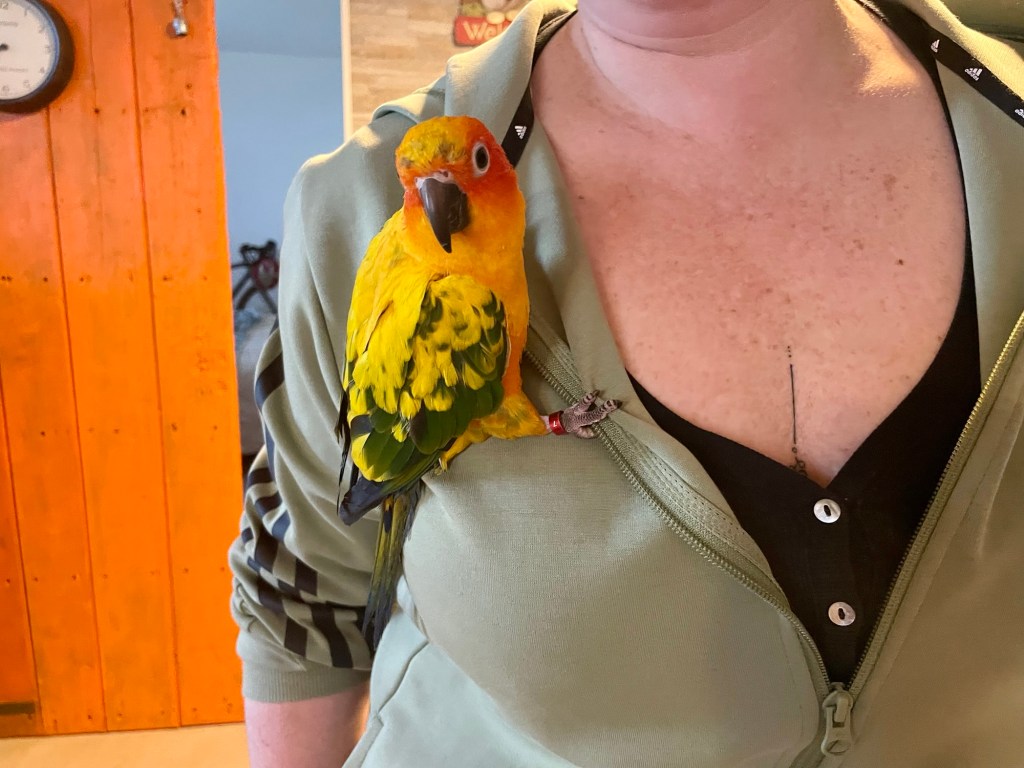
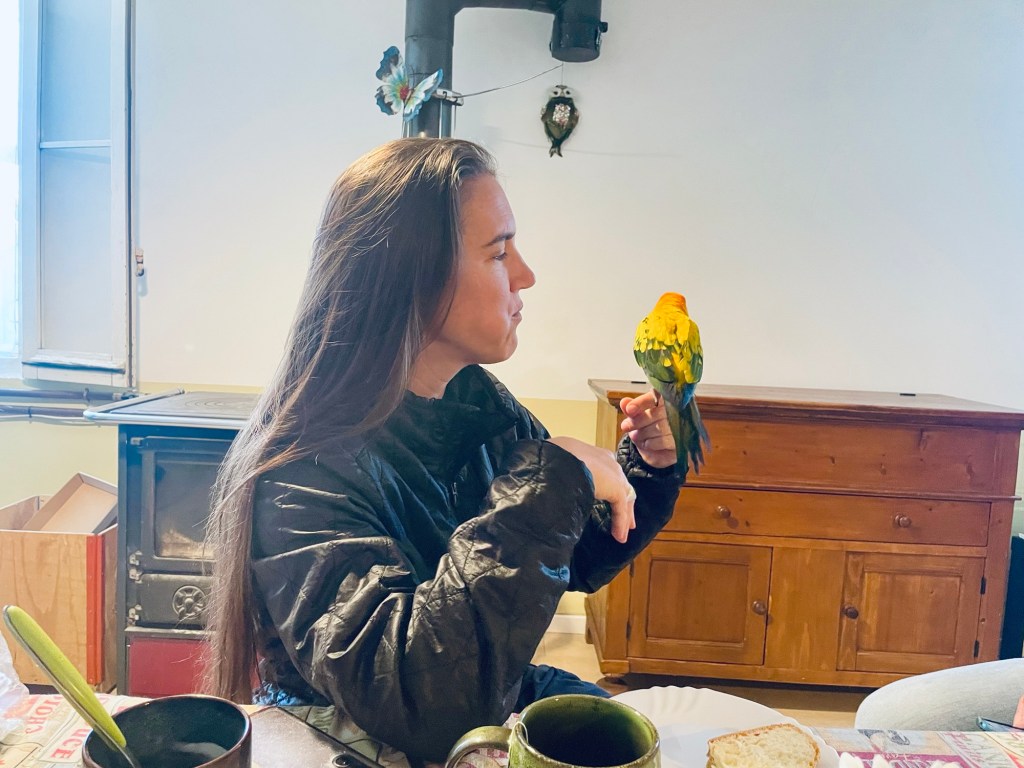
    A green and yellow parrot called Raul clung to her chest as she spoke, dipping its beak occasionally into some milk.

    Rossella recounts her love for her animals in episode 3 of the podcast, Respirano ancora (‘Still they breathe’) which is called The End of Eden.

    There is much of Eden in Rossella’s farm, a place that Dante visits in the last three canti of Purgatorio. 

    Here, atop Mount Purgatory, Dante returns to the prelapsarian perfection of the place from which Adam and Eve were expelled after eating the forbidden fruit.

    In canto 28 he tells us it is the ‘place chosen as the nest for human nature,’ the place given by God to Adam and Eve as a ‘mortgage on their eternal home, until they defaulted on the loan.’ 

    In canto 29, he continues,

    ‘While I moved on, completely rapt, among
    so many first fruits of eternal pleasure,
    and longing for still greater joys, the air

    before us altered underneath the green
    branches, becoming like an ardent fire,
    and now the sweet sound was distinctly song.

    Full of astonishment, I turned to my
    good Virgil; but he only answered me
    with eyes that were no less amazed than mine.

    I halted, and I set my eyes upon
    the farther bank, to look at the abundant
    variety of newly—flowered boughs;

    Here, mankind’s root was innocent; and here
    were every fruit and never—ending spring;
    these streams—the nectar of which poets sing.’

    Rossella’s farm is certainly a place for poets to sing about. The scent of organic lemon trees mingles with jasmine and turkeys and hens roam free across the perfectly mowed lawn. Dogs and cats co-habit with affection and swallows circle out of the barn which they have come to call home. 

    Though she is humble, Rossella is clearly also aware of the magic she has created here, something that is perhaps all the more special because it was almost lost.

    Two peacocks called Dante and Beatrice flirt beside olive trees. This is poignant for it is in the Earthly Paradise in canto 30 at the end of Purgatorio that Dante finally meets his beloved Beatrice. He realizes she has arrived when he ‘recognizes the signs of the ancient flame’.

    ‘a woman showed herself to me; above
    a white veil, she was crowned with olive boughs;
    her cape was green; her dress beneath, flame-red.

    Within her presence, I had once been used
    to feeling—trembling—wonder, dissolution;
    but that was long ago. Still, though my soul,

    now she was veiled, could not see her directly,
    by way of hidden force that she could move,
    I felt the mighty power of old love.’

    The parrot flew over the Kelsey and began nibbling on her long brown hair. 

    We spent the morning catching up with work in the garden surrounded by the four donkeys, Mais, Judith, Quedo and Nerina. They would come over and give us a friendly nudge or nibble here and there. Two rams circled us without menace and there descended a real sense of peace.

    A man called to check whether the five hives of bees had succeeded yet in producing honey. 

    After lunch we set off for the 19 kilmetre walk to Ravenna where we would meet the great man himself, Dante Alighieri. We stopped for a coffee at the restaurant Trattoria da Luciano where some of his cantos were hung up on the wall.

    The path followed the river Montone and the scenery was much like yesterday: agricultural and strikingly flat.

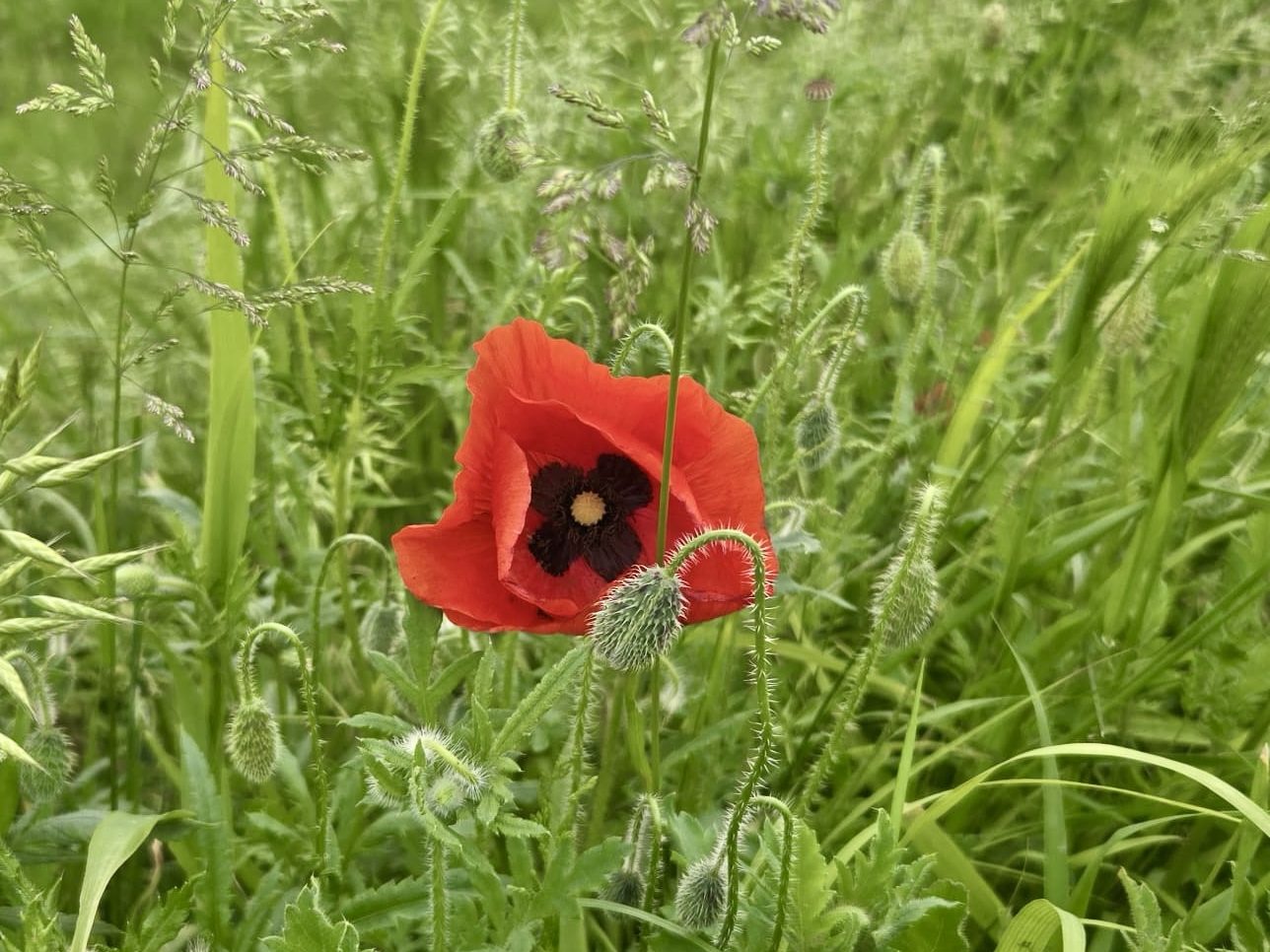
    A road sign warned of crossing children and Kelsey commented that it reminded her of signs back home in San Diego that warn of immigrants crossing the road from across the border. As two bikes came thundering past, she bent down to rescue a ladybird that had an iridescent beak. A poppy hesitantly rose its head.

    We were in the middle of discussing what the ‘social’ means in social policy research when a fit man with walking poles called Walter passed in the opposite direction and wished us a good day. 

    ‘Are you pilgrims?’ he asked.

    It turned out that Walter was a seasoned walker who had done the cammino di Dante some years before when he’d had to take several long diversions because of landslides. Now he was training for his next adventure. I tried to convince him to head to England to tackle the Pennine Way, while Kelsey advocated for the Pacific Crest and John Muir Trails. 

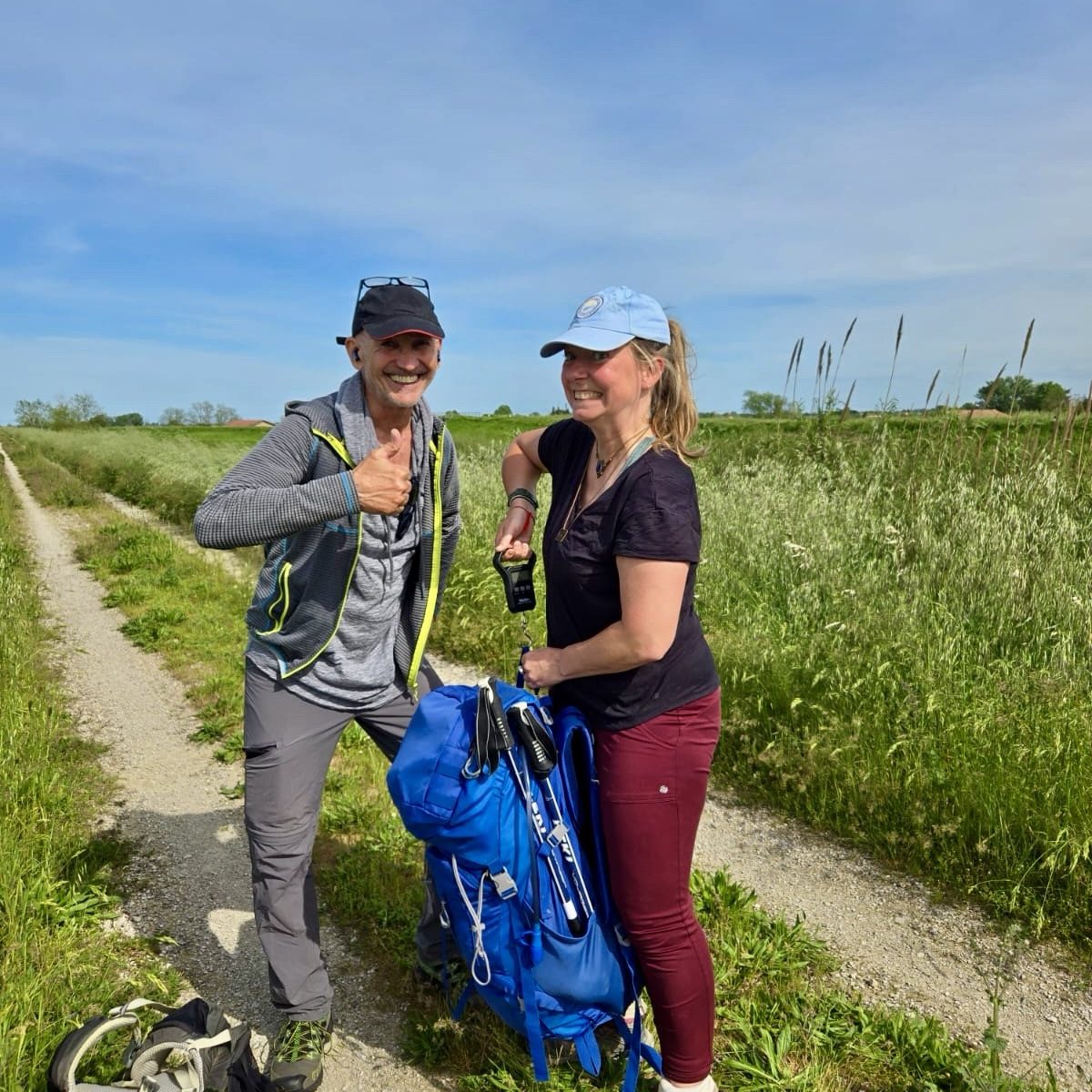
    Quite to our surprise, right there and then, he whipped out a weighing scale with a hook on the end and insisted on weighing my bag. 

    ‘15 kilos!’ he cried out. ‘What on earth are you thinking, you should have a maximum of 10, how have you made it all the way from Florence?’

    Suddenly the blisters made sense.

    He advised us to stop at the house of Giordano Bezzi, the founder of the cammino which we would pass in about 5 kilometres on our way into Ravenna. He was certain that we could just show up unattended, even though it was Easter weekend. Perhaps we would.

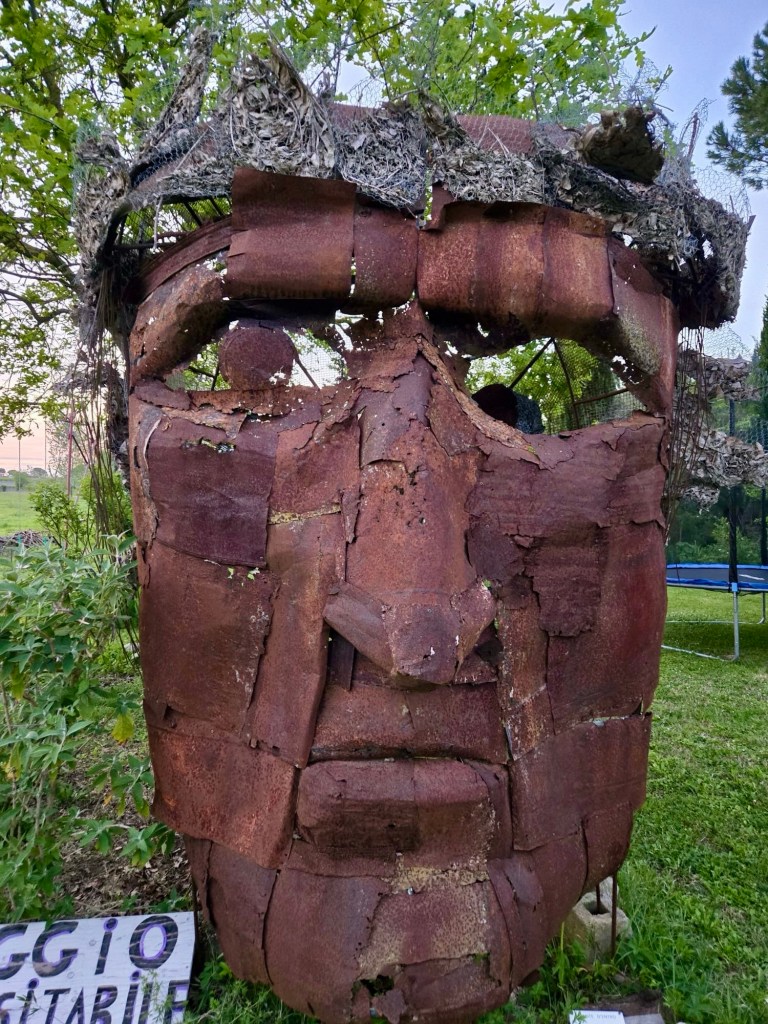
    ‘You’ll recognize the house from the huge Dante sculpture outside,’ he advised.

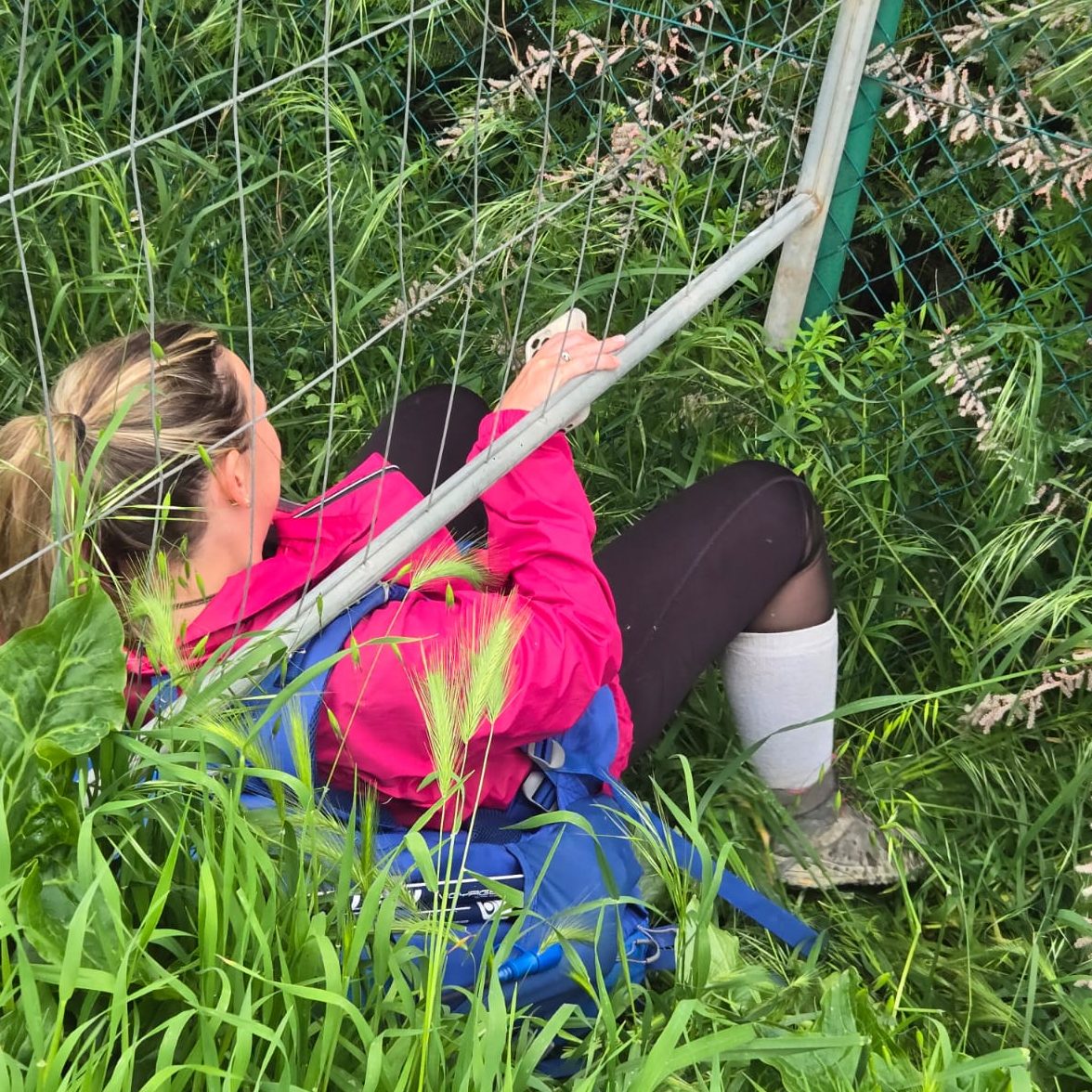
    We passed some road works and three places where the path had been cordoned off by metal fences and barbed wire. Now seasoned to the trials of Italian walking, I knew to head under, round or over them. I tossed my bag over first, careful not to damage my laptop, and then threaded my body around the wire. Kelsey dexterously followed. 

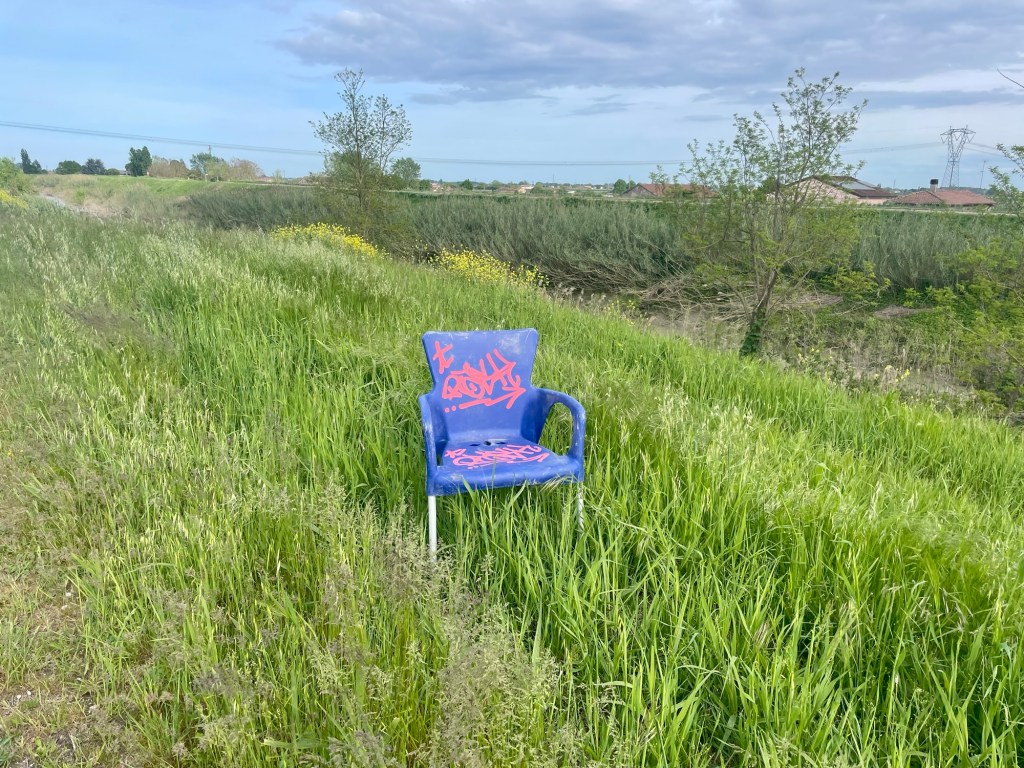
    We passed a man in a green shirt who was tending to his vegetable garden with a hoe and took a break to eat slices of apples with peanut butter. A random plastic chair that was covered in graffiti was situated in the verge beside the river. 

    Kelsey and I discussed Tuvalu’s climate refugees and the efforts the people are taking to preserve their culture. Our next topic of conversation was where in the afterlife we would locate certain politicians.

    As the path became more substantial, we navigated a traffic jam caused by a tractor which suggested that we were nearing the city. 

    Then, there it was, the face of Dante rendered in metal with one eye looking in and another looking out. 

    As we descended the path to the yellow house, a cockerel skitted past a yellow camper van. Would he be in, this Giordano Bezzi, of whom we’d heard such elevated praise?

    It turned out that he was.

    The next six hours flew by. In one of those encounters that happen rarely in one’s lifetime, time stood still.

    Giordano was everything I could ever have imagined of the founder of the Dante trail: an effervescent, extraordinary man who I can only describe as a creative genius.

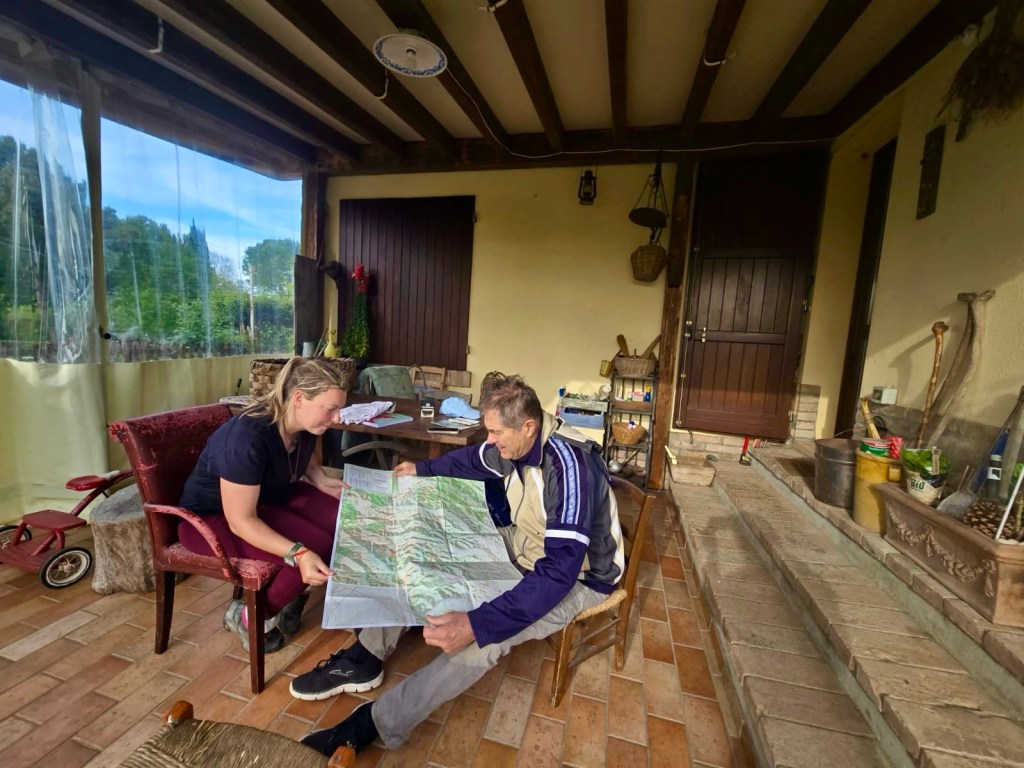
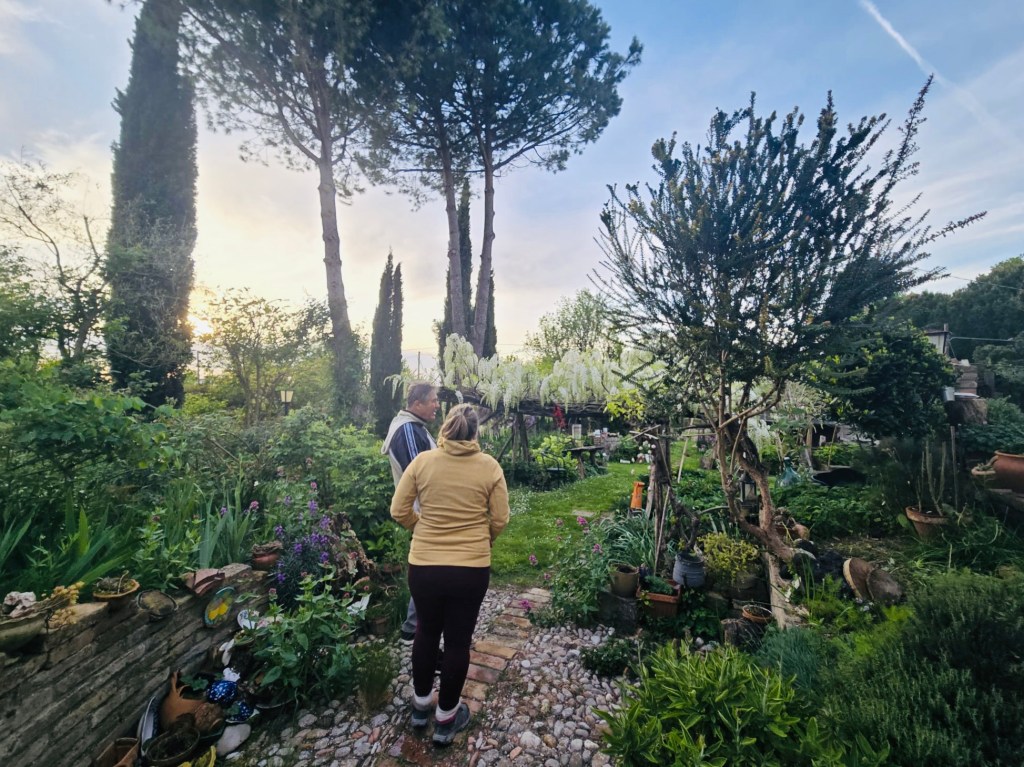
    In the time we spent together, he showed us around his spectacular garden and told us something of the origin of the trail. Though he’d worked as a pharmacist, now, in retirement, he was a musician and an installation artist. Much of his work is inspired by Dante’s invitation to look inside ourselves as well as out.

    ‘Life is all about reflections and uncertainties,’ he counselled. 

    As I followed him through his sprawling garden which was on the cusp of bloom, I thought of Purgatorio, canto 28 once more’\|| ,

    ‘Now keen to search within, to search around
    that forest—dense, alive with green, divine—
    which tempered the new day before my eyes,

    without delay, I left behind the rise
    and took the plain, advancing slowly, slowly
    across the ground where every part was fragrant.’

    The peonies had flowered early. They were struggling to keep their heavy heads up on delicate stems. They were verdant, vibrant, huge. 

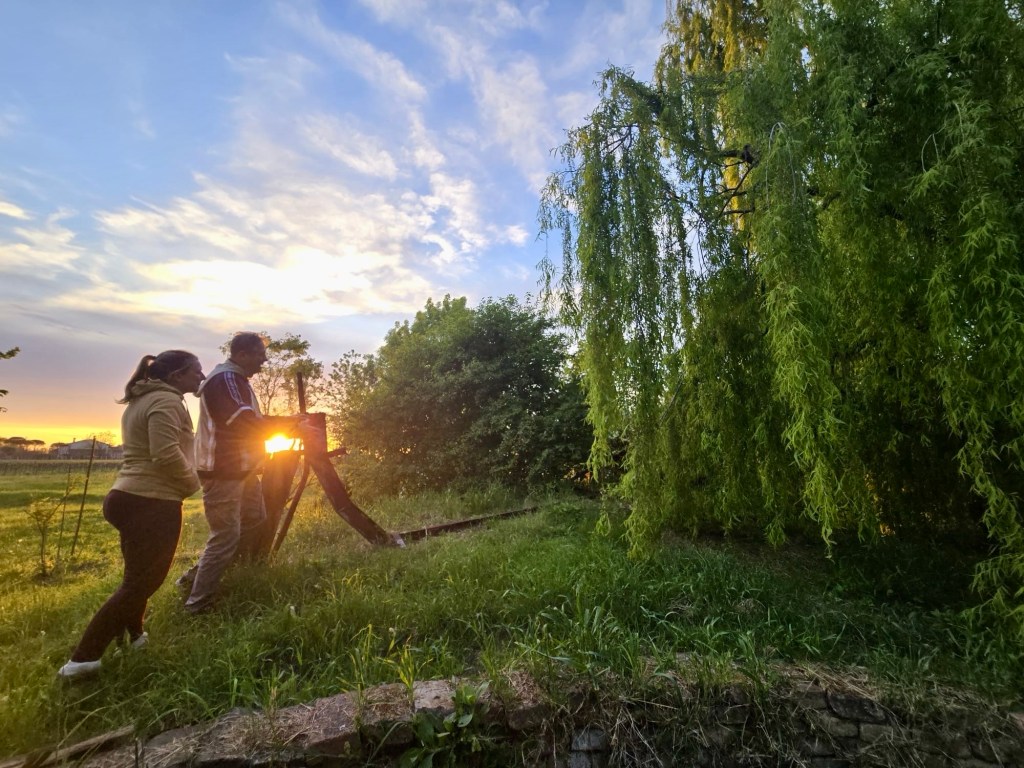
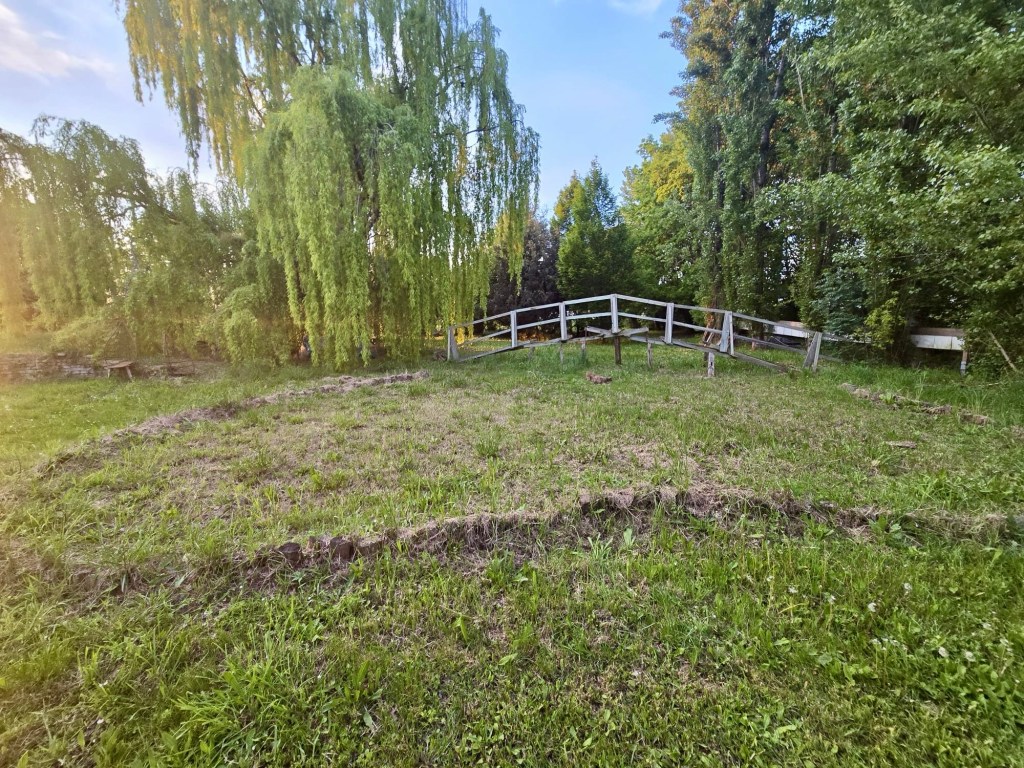
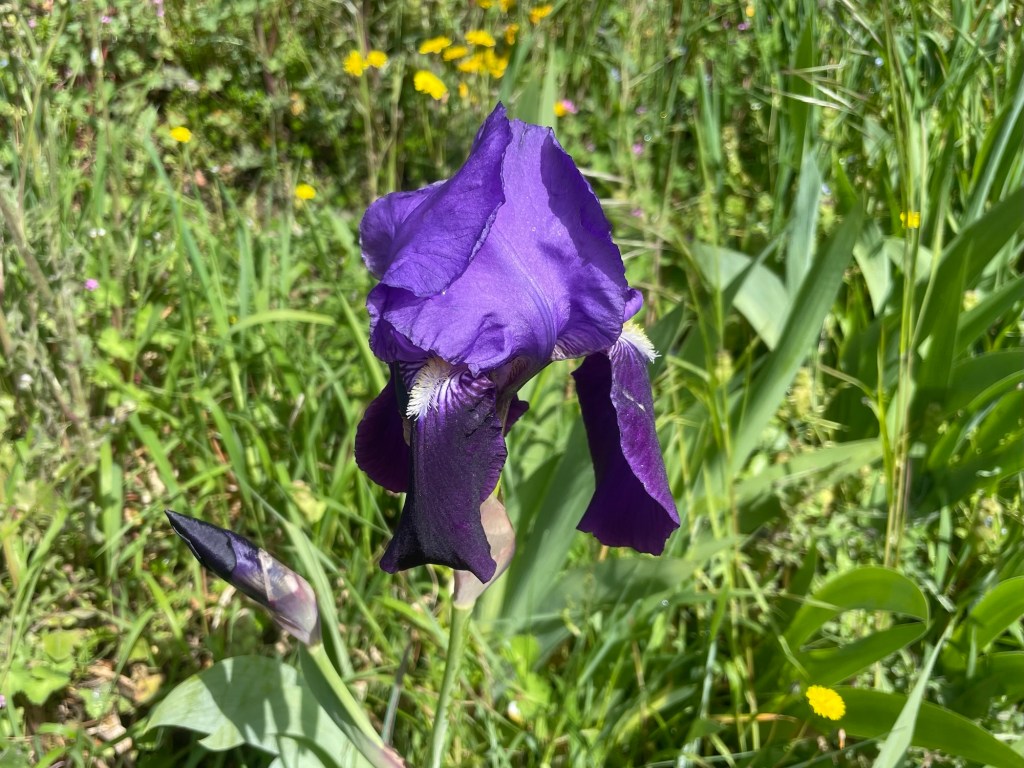
    Some fruit trees had exploded in a blossom of pink and white. Irises lined the path here, and there we entered into a surfeit of melancholy willows before which sat another piece of art.

    ‘Come back in two weeks and it will be a riot of colour,’ he insisted. 

    Every tree, every flower he had planned and planted with his own hands. I felt like Dante being shown by Mathilda the Earthly Paradise in canto 29 of Purgatorio.

    ‘following her short
    footsteps with my own steps, 

    I matched her pace.’ 

    And then there was the art. 

    Here was a sculpture of Don Quixote’s horse made out of tin cans, forks and kettles. When he had presented it, he had ridden it forwards towards a fan that sprayed out pieces of newspaper. This was the windmill, the ‘fake news’, he explained.

    And there, a rendering of Monet’s Giverny emerged from the grass complete with the bridge. 

    He had previously installed mirrors to reflect the water.

    The sunset lit up the sky and, as Dante puts it, ‘little birds upon the branches were in the practice of their arts’.

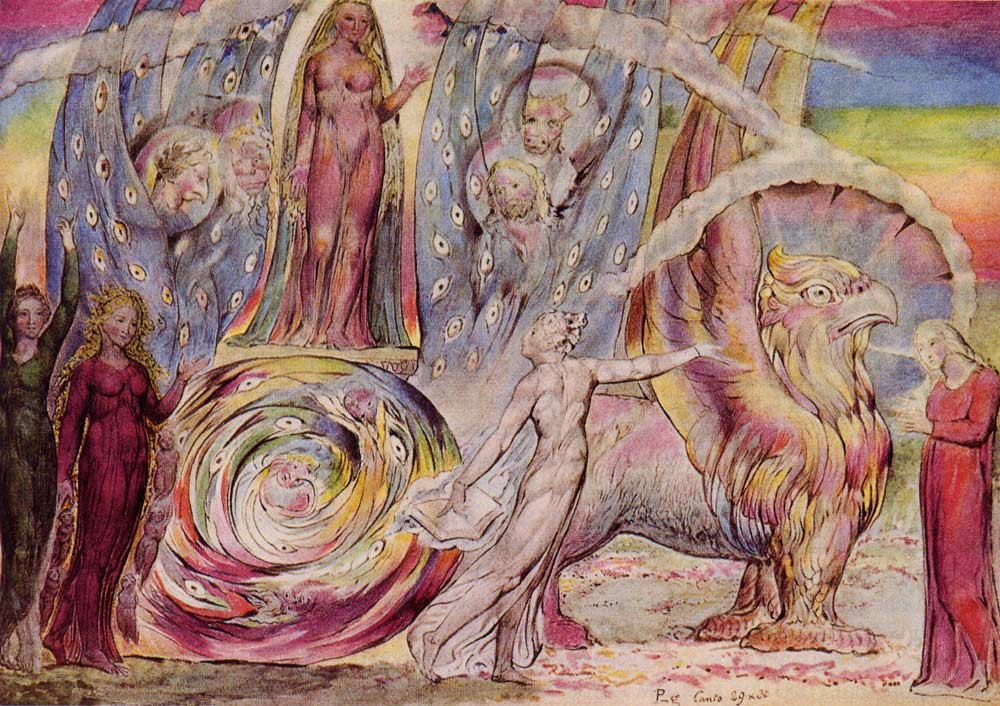
    I felt like I was witness to the spectacular procession Dante observes in the Earthly Paradise, a forest full of life. Introduced by heavenly songs and blazing lights, Dante sees a burning seven-armed candelabra approaching. Each of the seven candles gives the sky one of the colors of the rainbow. Then a procession follows: 24 elders, four beasts with each six wings covered with eyes, one of them a griffon drawing a two-wheeled chariot, at its left wheel there are three ladies, at its right four, then there follow two men, four humble men and finally an old sleeping man.

    But Giordano, at seventy one, was full of life.

    As Dante describes Eden,

    ‘a sudden radiance swept across
    the mighty forest on all sides—and I
    was wondering if lightning had not struck.

    But since, when lightning strikes, it stops at once,
    while that light, lingering, increased its force,
    within my mind I asked: “What thing is this?”

    And through the incandescent air there ran
    sweet melody.’

    Suddenly, it was 9pm and we hadn’t thought to eat. 

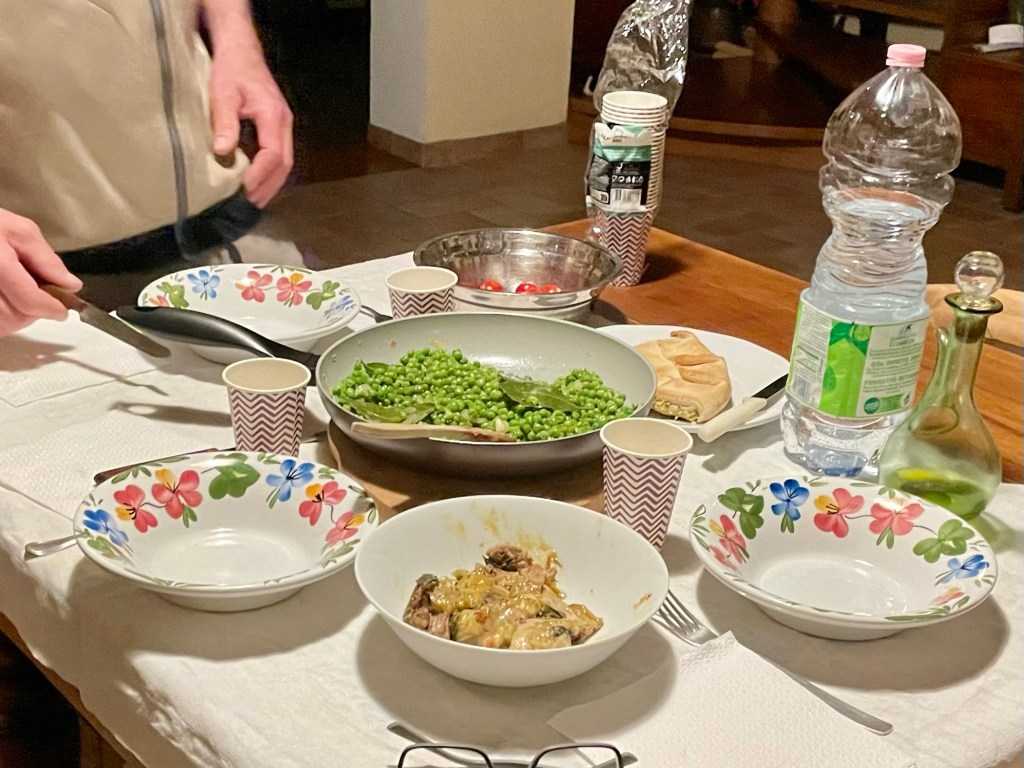
    ‘Fear not,’ said Giordano, I have peas. ‘And let’s put in some laurel to give it the taste of Dante.’

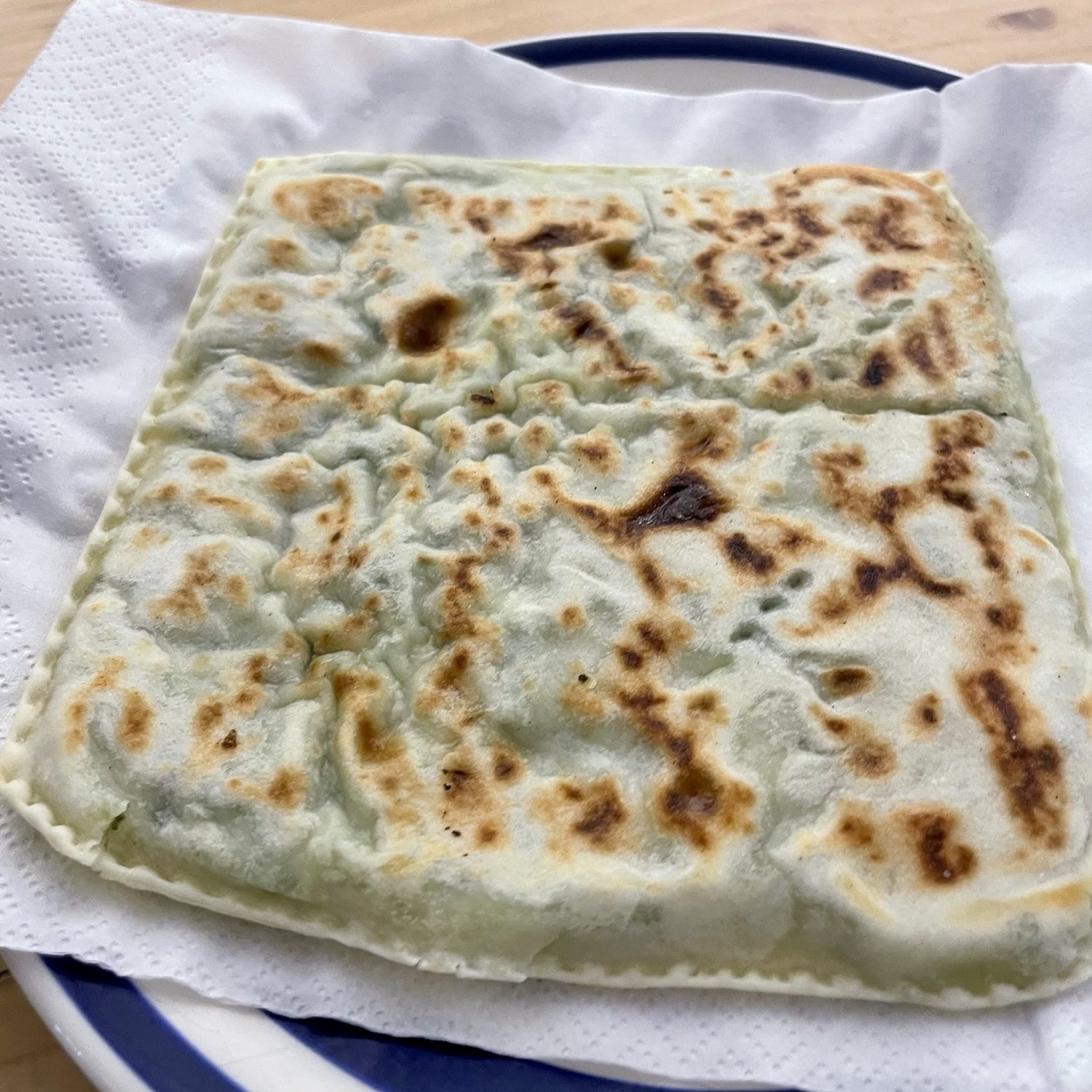
    Thus, we ate a delicious supper together of peas marinated in freshly harvested onions, stock and laurel leaves. Kelsey and I contributed a spinach and cheese crescione and a great deal of gratitude. Her and Giordano also ate some rabbit that was reheated from the night before. 

    The conversation flowed like water. 

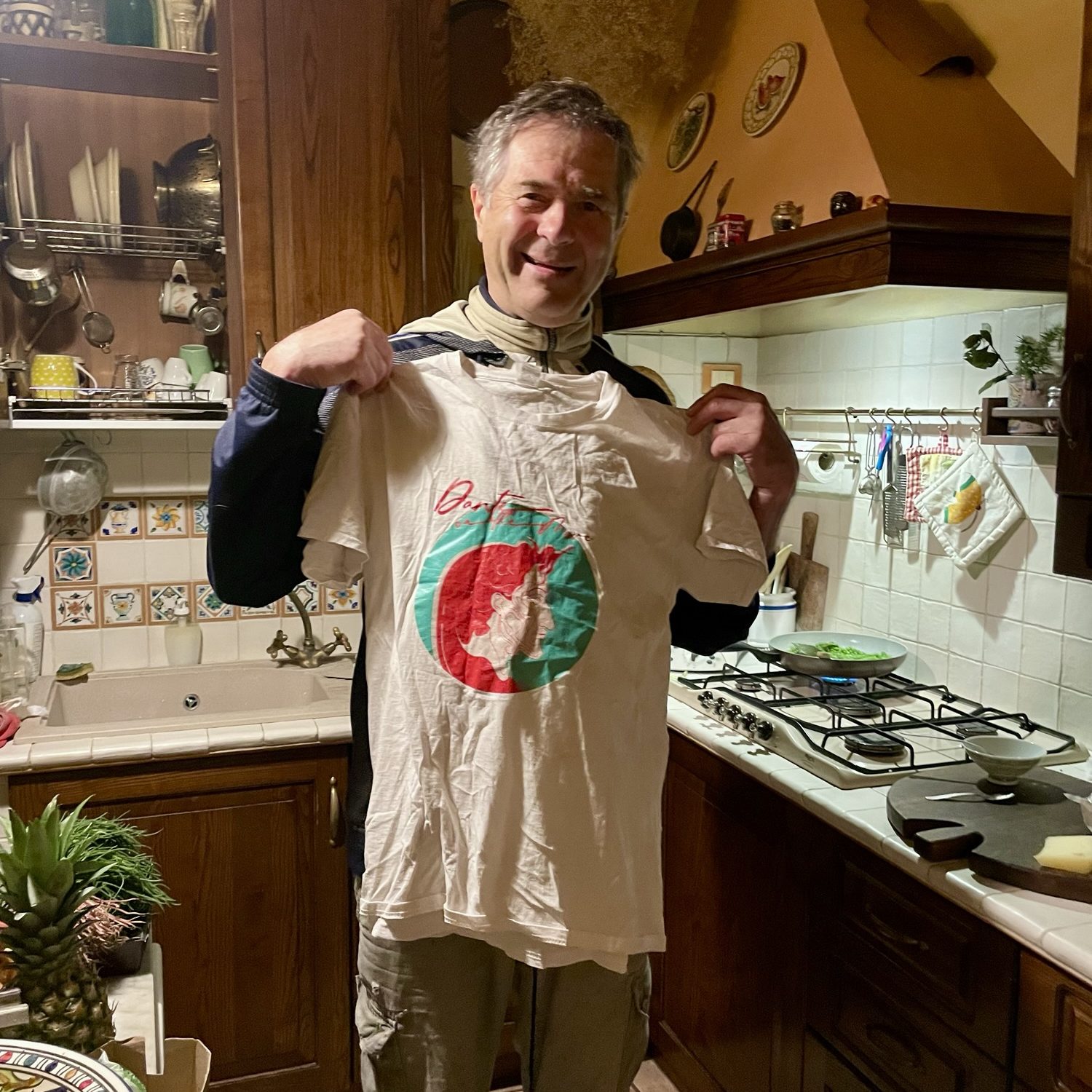
    Giordano was as enthusiastic to share his own passions, which comprised jazz – including Kelsey’s favourite, Charlie Parker’s album, Bird –, Pirandello and women’s liberation, as he was to hear about mine. I gifted him a copy of our Dante on the Move anthology and a T-shirt with the front page logo that had been designed by Alina. He was thrilled.

    At 10.30pm we called the hotel in Ravenna to say that we were running late and, after a few more episodes of precious conversation, Giordano gave us a lift into the city in his van. 

    In the van, we still couldn’t stop talking. In a frenzy of new friendship, we were finishing one another’s sentences. This was unreal. 

    He was intense but so was I. And, for once, that was ok! In fact, it was more than ok, it was appreciated, cherished even.

    When was the last time I had felt so seen?

    Giordano dropped us by our lodging, Hotel Centrale Byron, and we dumped our bags before making the short walk around the corner to Dante’s grave. It was nearly midnight, and we had the whole place to ourselves. We sat before the great poet on the cold cobbled floor.

    I read Kelsey the blog I had written ready to publish in the morning and, as I did so, tears filled my eyes. It felt so special to be reading my work out loud here to her, before the bones of Dante. I had made it to him and now all that was left was to return to Florence in his honour.

    We purchased some red roses from a Bangladeshi street seller called Mashalim which means ‘to be safe, secure, at peace.’ 

    Two of them we threaded through the bronze gates of his mausoleum; the other one I gifted Kelsey and the fourth I would carry with me to Florence to place outside his cherished San Giovanni where Dante had so desired to return to be ‘crowned a poet’.

    We returned to the hotel, slightly disappointed with the filthy carpet and 80’s bathroom décor after what had been such a jubilant day. 

    I was contemplating how on earth I could show my appreciation for Giordano when there appeared a message on my phone.

    It read:

    ‘Flowers are not only in gardens,

    but they also walk with a backpack,

    the scent of intelligence that you leave

    is inebriating and indelible.

    Your garden is the work with those

    young refugees, you manage to sow

    flowerbeds with smiles, you work like

    a bee, you build bridges of

    looks, you gamble with

    invisible things.

    Your pen becomes the sting

    for stupidities and blindness,

    I will certainly eat your honey.’

    ‘I fiori non sono solo nei giardini , 

    ma camminano anche con lo zaino, 

    il profumo di intelligenza che lasci 

    è inebriante e indelebile.


    Il tuo giardino è  il lavoro con quei 

    ragazzi, tu riesci a seminare delle 

    aiuole con i sorrisi, lavori come 

    un’ape, costruisci ponti degli 

    sguardi, giochi d’azzardo con le 

    cose invisibili.


    La tua penna diventa il pungiglione 

    per le stupidità e le cecità, 

    Certamente mangerò il tuo miele.’


    I stroked the necklace Alina had gifted me of the almond plant which flowers before it bears fruit.

    Perhaps my honey was also in the process of production on this cammino. 

  • Ditches, Dandylions and Donkeys: From Forlí to Passo Vico

    Today’s walk gave a detailed insight into rural life, while the animals at the farm where we stayed were a delight. 

    I had met my friend Kelsey in Forlí the evening before, still somewhat shaken after my strange encounter with the dog. To shake it off, we went partying until around 2am. 

    We must have been the oldest people in the underground club, but we had a blast, dancing and chatting to various Erasmus exchange students. We also met a couple of Moroccan men with whom I spoke Arabic and French. One was a hairdresser from Fez where I have a dear friend from a former home stay called Fatima Zohra. I thought of how unsuccessful I had been at navigating the souk when I stayed with her and felt proud, on the whole, of the navigational abilities I had demonstrated during this trip thus far.

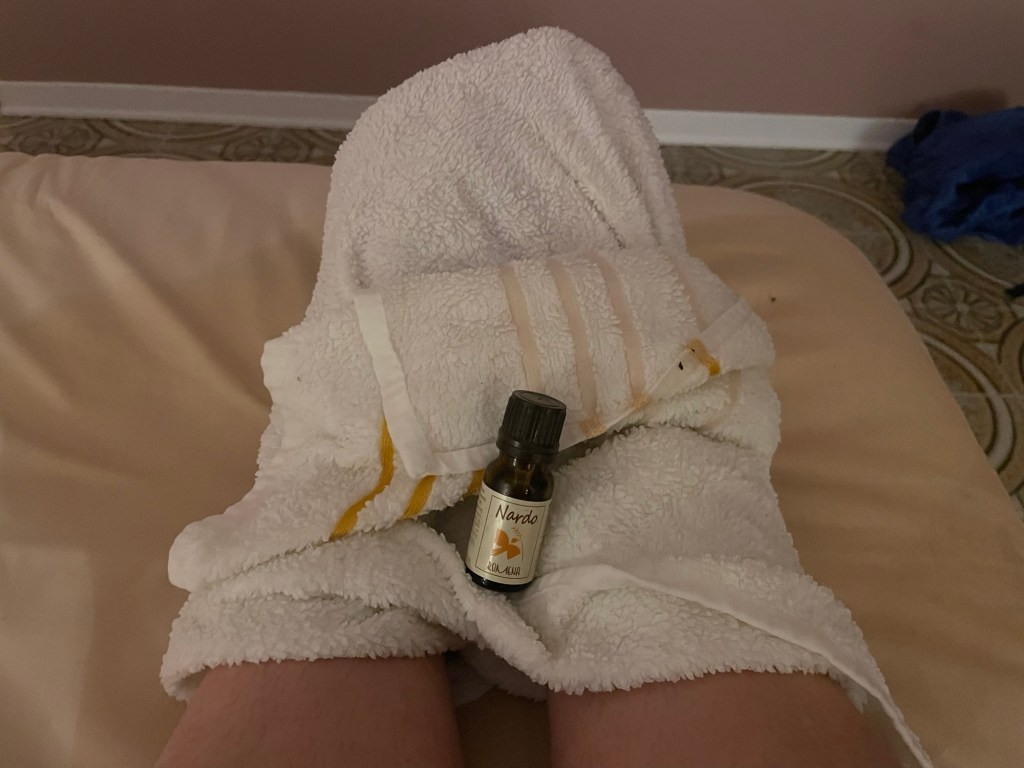
    The nardo oil I had purchased at San Pietro a Romena had opened and spilled all over my bag in the night. I was sad to lose it, but at least the canvas now smelt fantastic which was not insignificant given that I had spent over a week sweating into the back of it. 

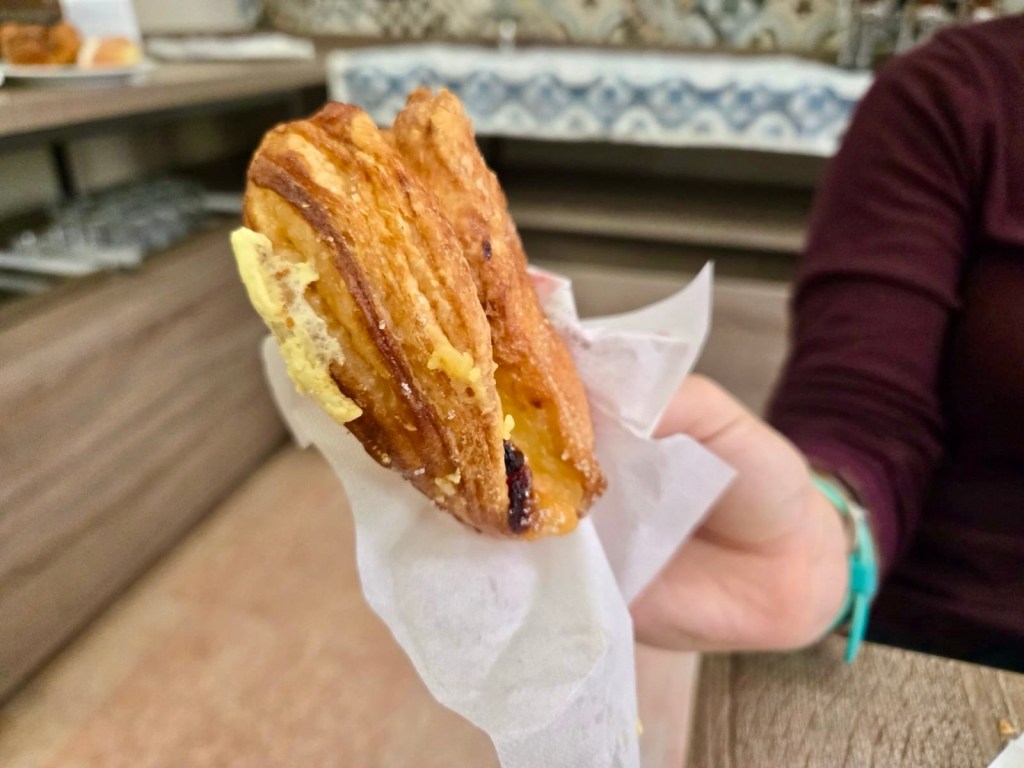
    After a slight panic about Kelsey misplacing her wallet, and then her earrings, we checked out of Hotel Lory at 11.30 after a breakfast of pastries, kiwis and bananas. Kelsey pointed out that the reason Italian café paper napkins are so thin and unpliable is because their primary purpose is to be used to hold  the food rather than to clean yourself up after it. She demonstrated this with a cream cornetto (no, not the type Pavarotti sung about, but a pastry). 

    I’d dried my boots on the towel rail and they appeared to have shrunk. After applying two blister plasters to my heels and two smaller elastic plasters to my second toes – which now had blisters at the very end – I had to lever my feet into them with a lot of wriggling and brute force. These were not happy feet. But today had been meant to be a shorter walk of only 15 kilometres. It turned out, of course, to be 22.

    ‘Do you mind?’ said Kelsey as she strode out into the tentative sunlight, putting on her all-American baseball cap which was a bright lemon colour. She tugged her long brown ponytail through the hole at the back as I laughed,

    ‘Go for it! Americans on tour.’

    Around her neck she wore a wooden necklace of a kingfisher which served as a whistle and, in her ears, she wore studs a friend had made for her out of wood depicting a little hiking backpack and a firepit. 

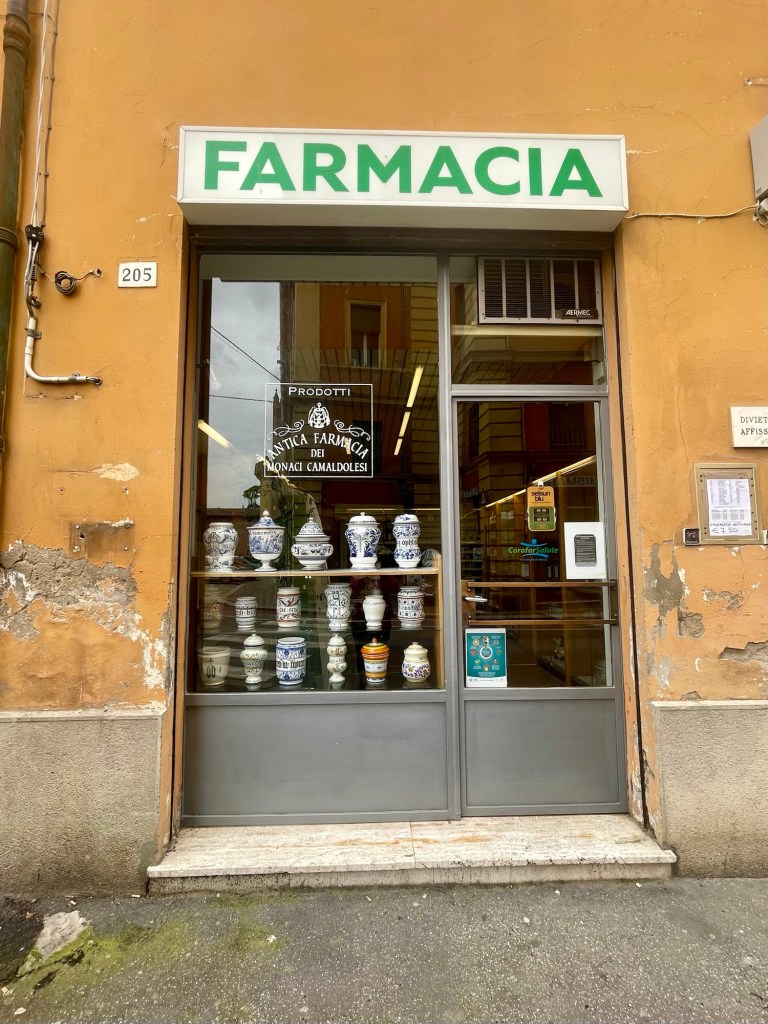
    A local pharmacy with an embellished façade had Chinese jars in the window and displays of honey, teas and perfumes. In fact, it was more like an apothecary, but luckily it sold Compeed blister plasters. They really are like a second skin.

    Kelsey introduced me to Propoli, an Italian herbal remedy for a scratchy throat made from a resinous mixture that honeybees produce by mixing saliva and beeswax with exudate gathered from tree buds and sap flows, in this case the Mediterranean poplar. 

    When we stopped for a coffee, we got chatting to a middle-aged man called Alessandro from Bologna who thought nothing of drinking a large glass of prosecco at midday. The café was still displaying Christmas gnomes inside.

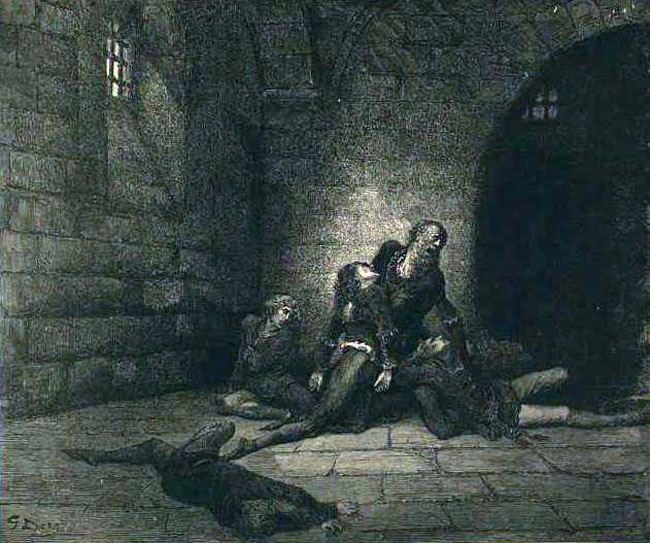
    When I explained about the cammino, Alessandro began reciting a verse from canto 33 of Inferno, Dante’s famous encounter with the last great charismatic sinner of Infernothe Sardinian vicar Ugolino who was locked in a tower in Pisa with his children. His sin was to have manipulated his family members in securing and consolidating power over Pisa. This form of exploitation, while taken to the extreme in Ugolino’s case, was systemic in Dante’s dynastic society. 

    Ugolino narrates to Dante the tortured days of imprisonment in the tower and his death by starvation, a death that takes him only after he has witnessed the deaths by starvation, one by one, of his children and grandchildren. Ugolino is depicted as an absent and terrible father.

    ‘I did not weep; within, I turned to stone.

    They wept; and my poor little Anselm said:

    “Father, you look so . . . What is wrong with you?”

    Therefore I shed no tears and did not answer.’

    Dante insists on the innocence of youth, saying of the children, ‘their youth made them innocent’, seeming to imply that Ugolino’s sins should not have been visited upon his descendants. 

    I reflected on the many young male Albanians with whom I’ve worked who have fled blood feuds of familial descent, a phenomenon that is largely ignored by the UK government in asylum decisions.

    Though the text is ambiguous, in a dramatic crescendo it seems to imply that Ugolino ate one of the bodies of his children who offered himself up to him so that he might survive a little longer:

    ‘As soon as a thin ray had made its way
    into that sorry prison, and I saw,
    reflected in four faces, my own gaze,

    out of my grief, I bit at both my hands;
    and they, who thought I’d done that out of hunger,
    immediately rose and told me: “Father,

    it would be far less painful for us if
    you ate of us; for you clothed us in this
    sad flesh—it is for you to strip it off.”

    Then I grew calm, to keep them from more sadness;
    through that day and the next, we all were silent;
    O hard earth, why did you not open up?

    But after we had reached the fourth day, Gaddo,
    throwing himself, outstretched, down at my feet,
    implored me: “Father, why do you not help me?”

    And there he died; and just as you see me,
    I saw the other three fall one by one
    between the fifth day and the sixth; at which,

    now blind, I started groping over each;
    and after they were dead, I called them for
    two days; then fasting had more force than grief.’

    This is a famous passage which Alessandro must have studied at school. 

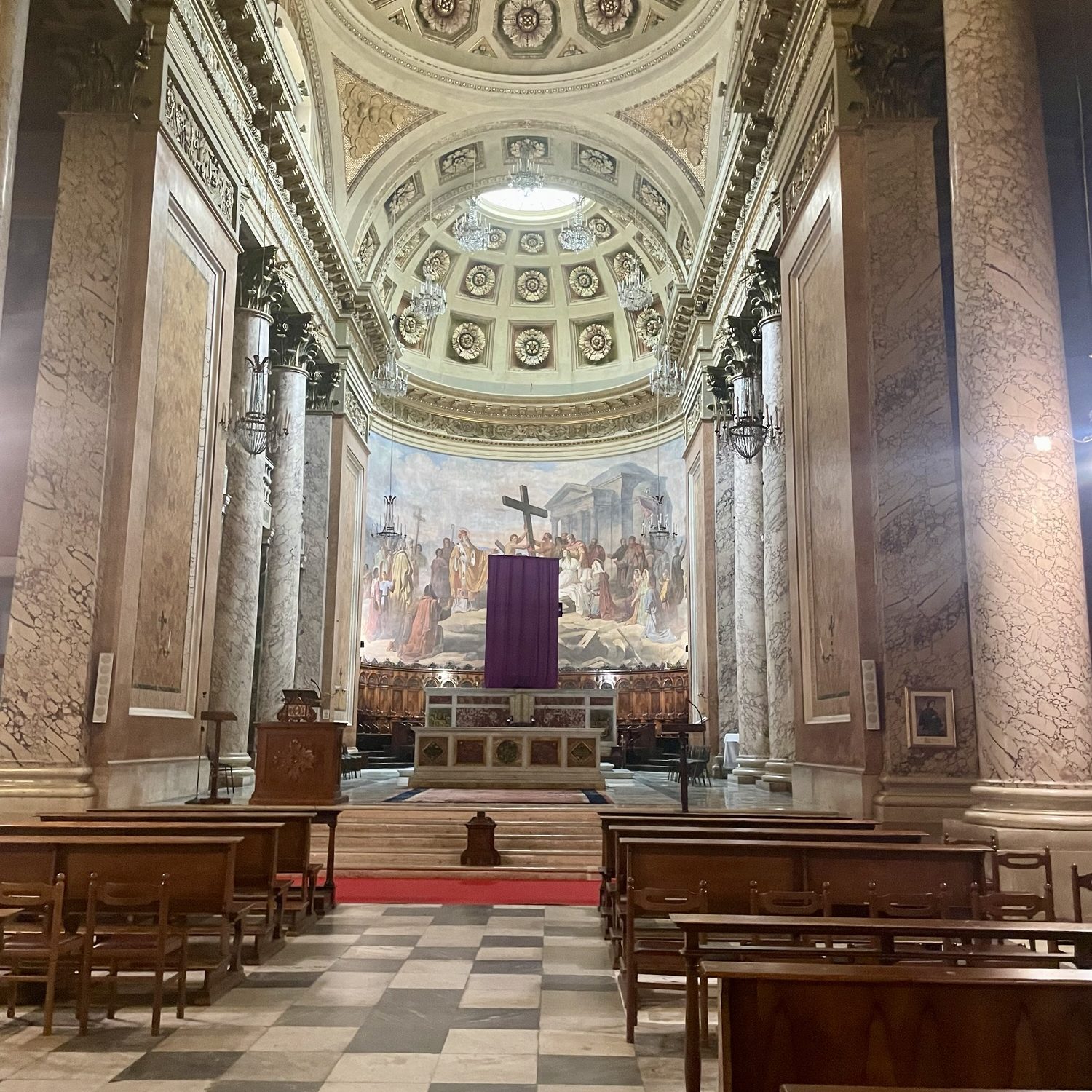
    He offered to buy us more coffee, but we made our way to the Duomo of Santa Croce where Kelsey had attended mass the evening before. She took her cap off as we entered and made a cross. 

    The cathedral contained a spectacular array of marble and, to the left, the Madonna del Fuoco, the Fire Madonna, a painting of the Virgin Mary with Jesus. An information plaque and mural informed us that the artwork had hung in a school until 1425 when it miraculously survived a fire. The Fire Madonna is now considered the protector of the city.

    Though the Piazza Dante Alighieri was a bit disappointing – an urban rectangle of stray cats and pigeons with a war memorial – a plaque on the wall of the surrounding street said something of the time the poet had spent in exile in Forlí: ‘here, the house of the Ordelaffi family welcomed Dante Alighieri’. 

    The cross at the alter had been covered by a large maroon cloth because it was Good Friday. They would unveil it again on Sunday to mark Easter, when Jesus came back to life.

    A man with brown skin and worn shoes showed us the screen of his iPhone where there was written a request for money in multiple languages. 

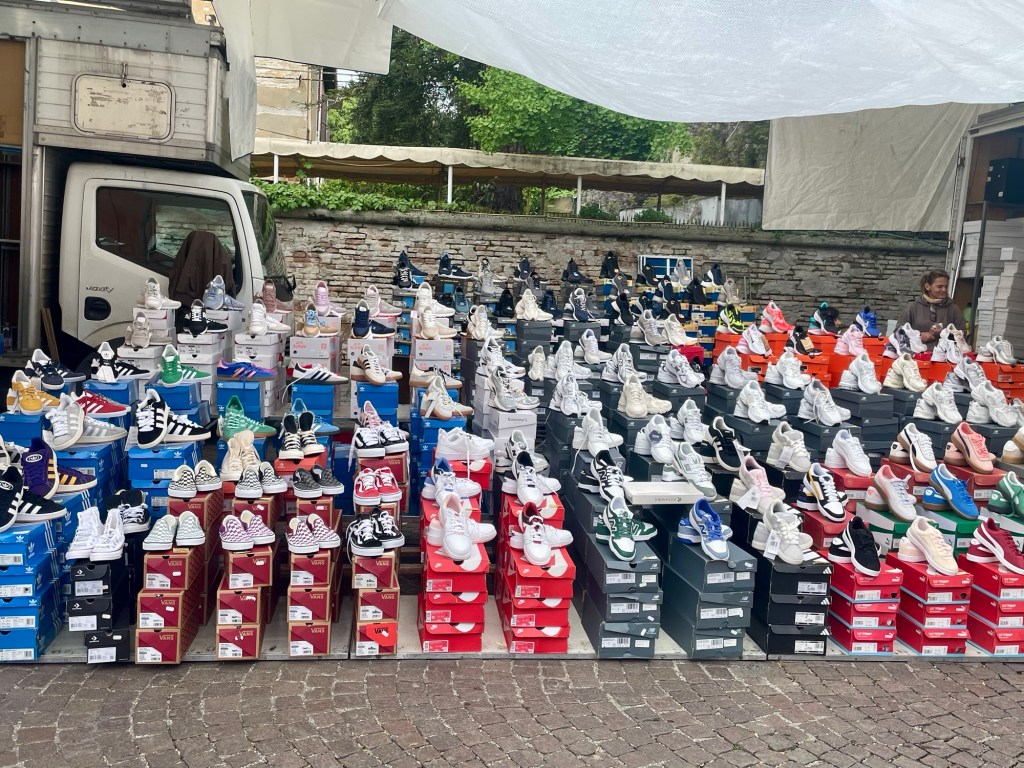
    The market was in full swing outside the church, including clothes, shoes and fresh vegetable stalls from local farmers. We passed by a tiny rusting Fiat red panda car. A lady in a leopard coat with matching trousers and purse cycled by. A sausage dog came waddling down the street. 

    We had a leisurely lunch at a restaurant called Zio Bio 100% natura in Piazza Dante Alighieri. It consisted of aubergine parmigiana, a delicious crecione (the typical specialty of Romagna cuisine I had first tried yesterday) and fennel salad.

    Delicious doesn’t come close to it. 

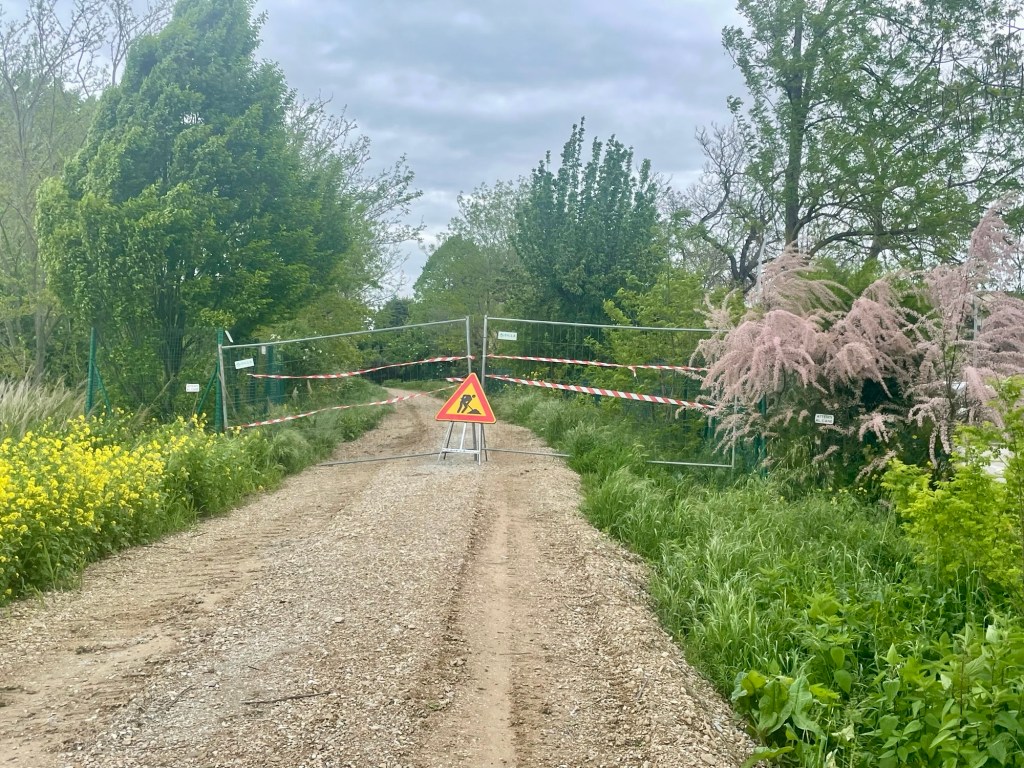
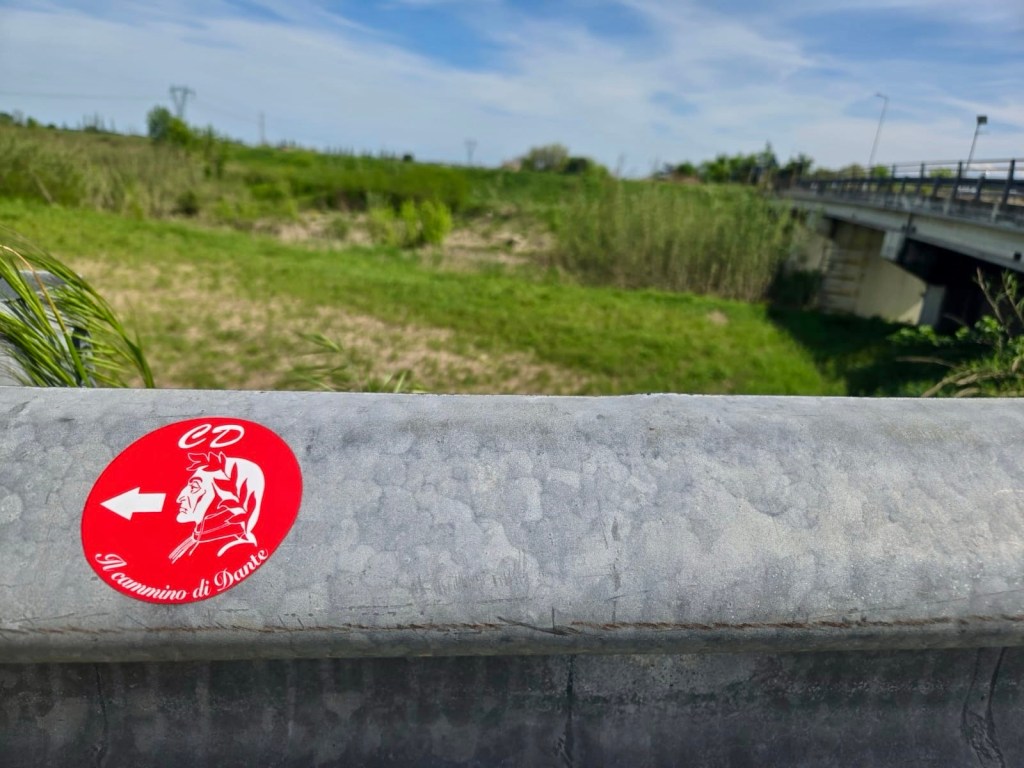
    Today’s stretch of the cammino began with passing through the city gates of Forlí. From there we proceeded to a river where we had to army roll under a metal fence that blocked the path with a no entry sign which, by now, I’d learnt to ignore. 

    Like the doors of Dante’s Hell, it seemed to say,

    THROUGH ME THE WAY INTO THE SUFFERING CITY,
    THROUGH ME THE WAY TO THE ETERNAL PAIN,
    THROUGH ME THE WAY THAT RUNS AMONG THE LOST.

    JUSTICE URGED ON MY HIGH ARTIFICER;
    MY MAKER WAS DIVINE AUTHORITY,
    THE HIGHEST WISDOM, AND THE PRIMAL LOVE.

    BEFORE ME NOTHING BUT ETERNAL THINGS
    WERE MADE, AND I ENDURE ETERNALLY.
    ABANDON EVERY HOPE, WHO ENTER HERE.

    These words—their aspect was obscure—I read
    inscribed above a gateway

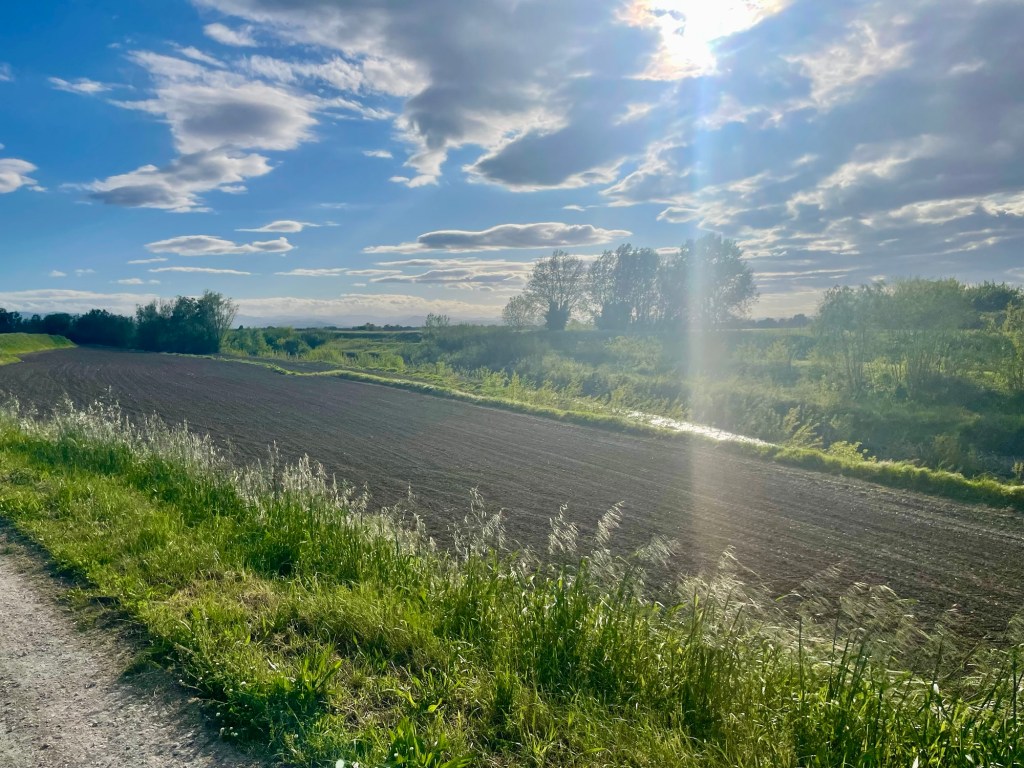
    Though we could see the mountains peeking in the distance, the route all day today was totally flat to the point that I almost missed the hills.

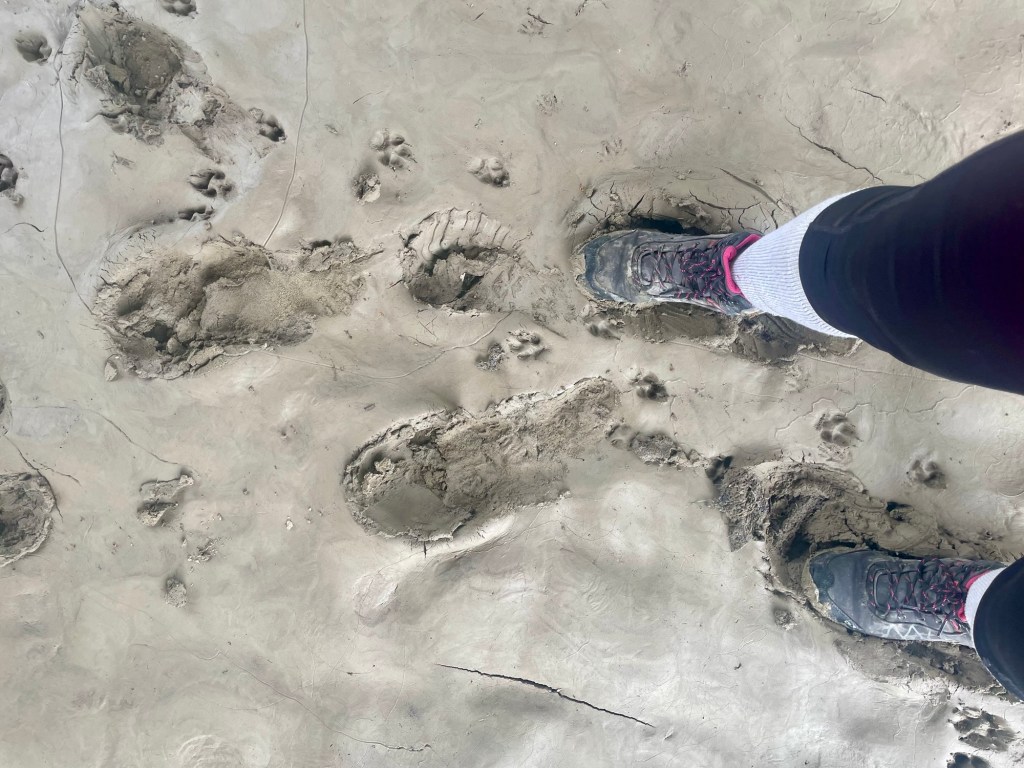
    What I didn’t miss was the continued surplus of tacky mud. 

    As we crossed under a bridge, our feet were submerged by the molten riverbank. Further up, the terrain was cracked from where the river had recently been higher due to excessive rainfall and washed away the bank. Two men on bicycles also sought to navigate it. 

    There was a light breeze and the clouds hung low in the sky. 

    We passed through another ‘do not pass’ sign and observed a crane doing work on the other bank of the river.

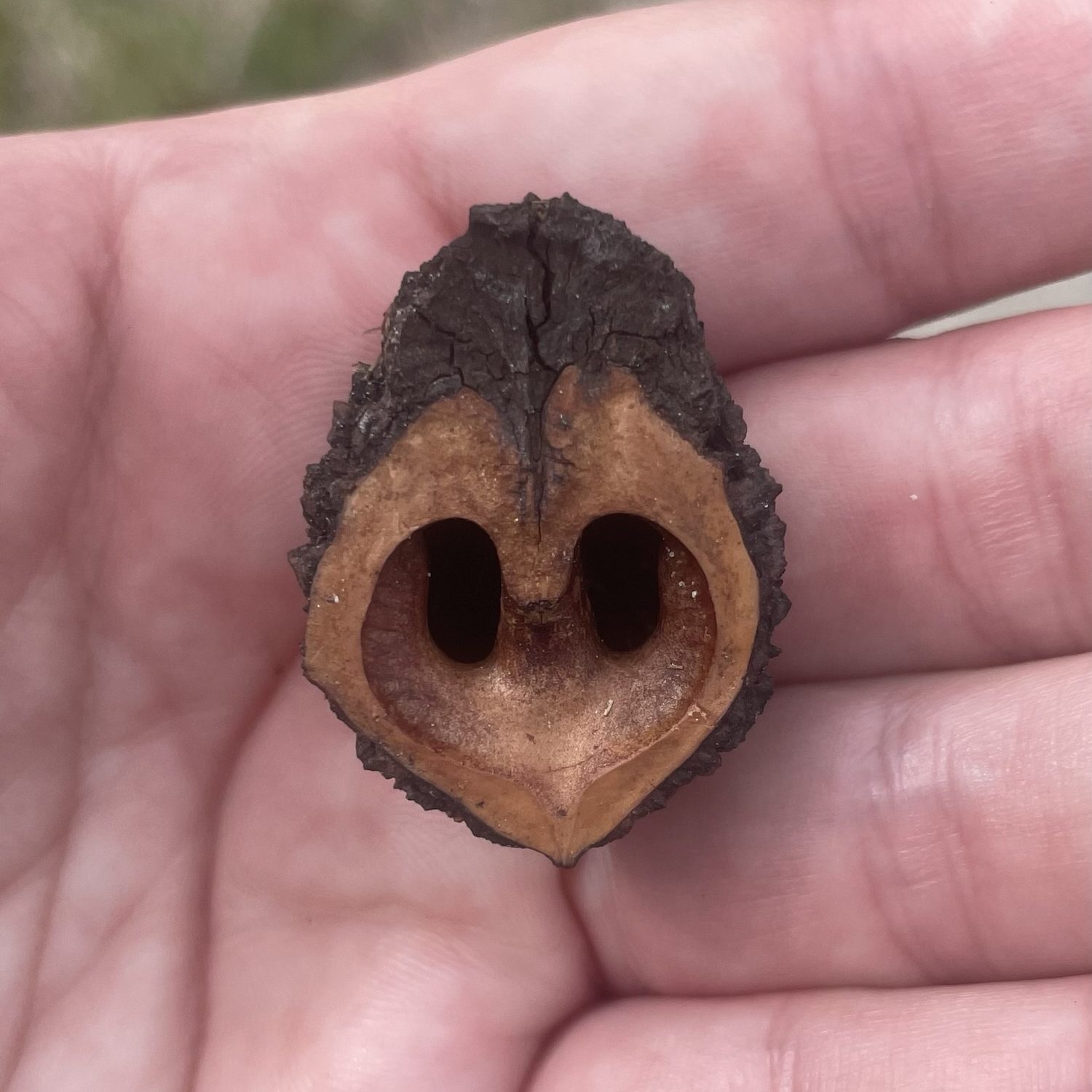
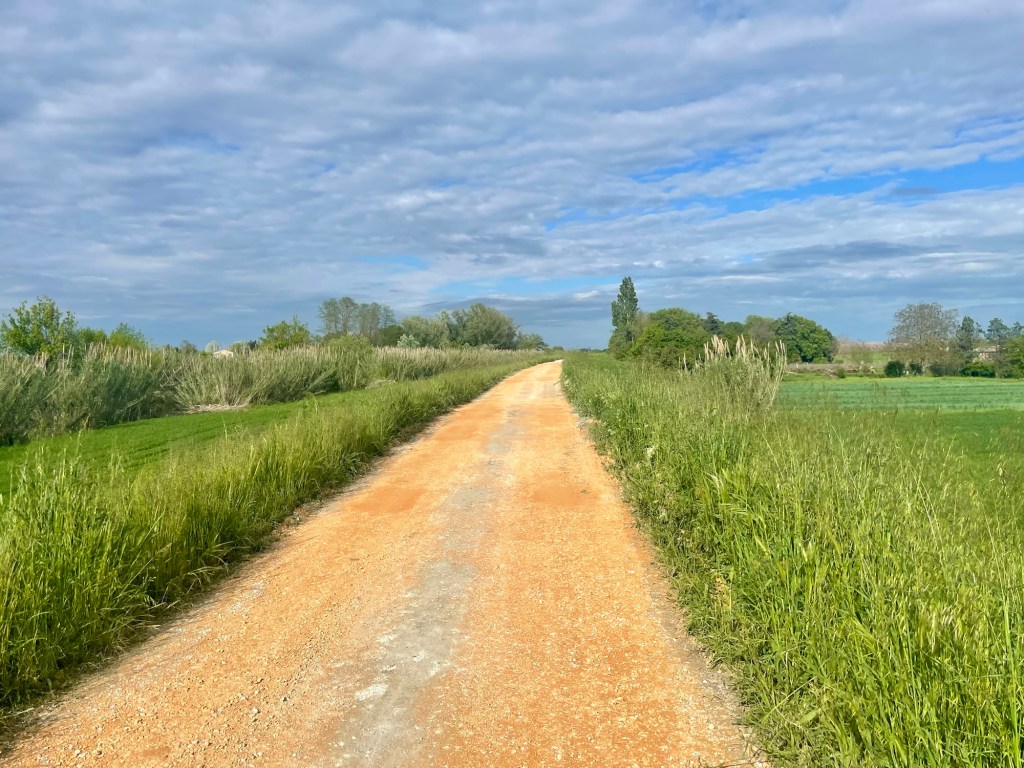
    After about an hour, the road became a raised mount between two ditches on which we continued nearly all the way to our final destination. The track was perfect for two people to walk side-by-side, which we did. It was riddled with ant mounds, beetles and seeds the shape of hearts (Kelsey’s interpretation) or pig snouts (mine).

    ‘That’s the biggest worm I’ve ever seen!’ Kelsey exclaimed.

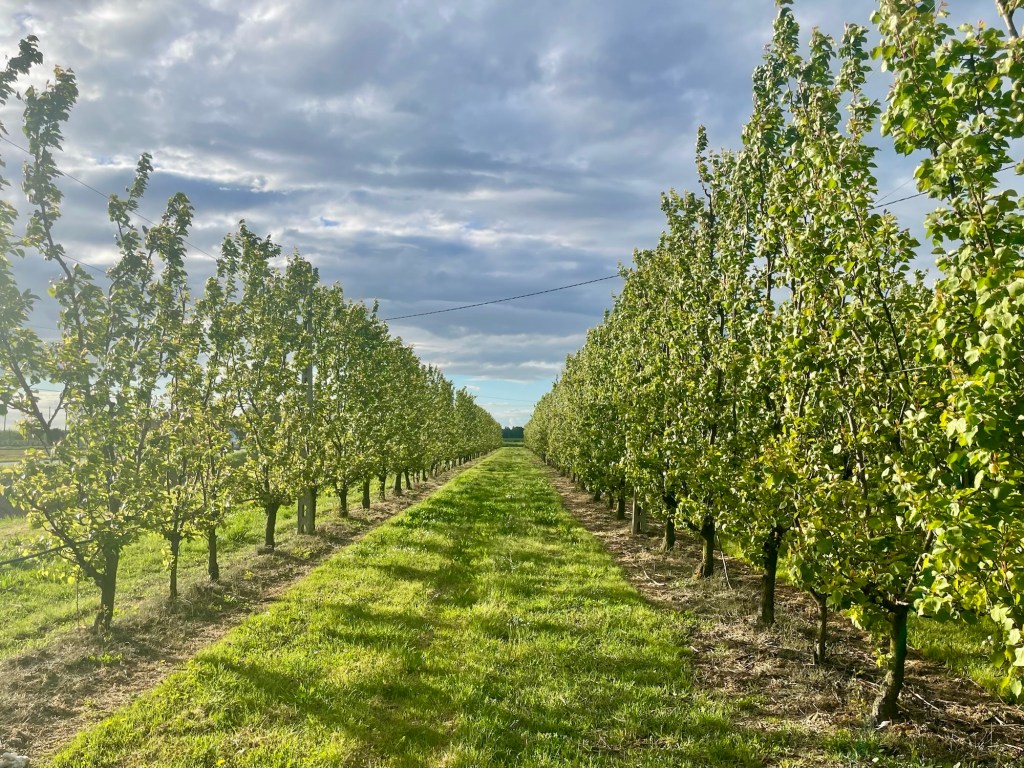
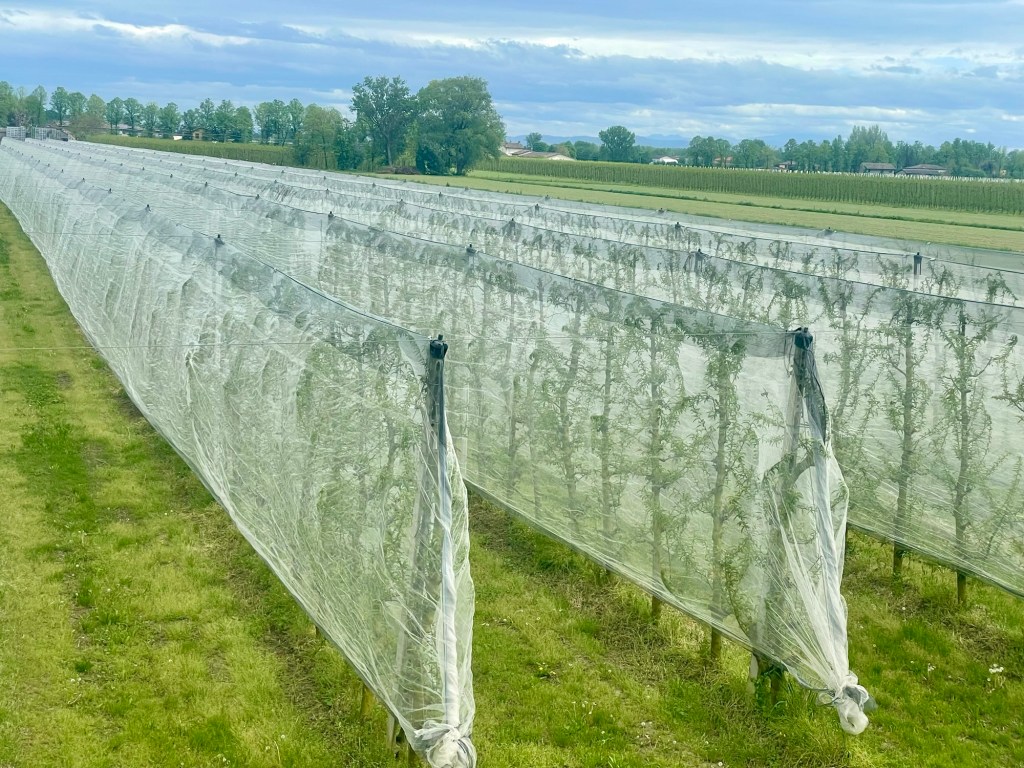
    Plastic nets had been placed over fruit trees to protect them from intruders – a white wedding veil here, a black funeral mantilla there. Kelsey whose work focusses on reducing plastic waste in fishing, pointed out the damage of such farming innovations.

    We passed several farmers who were maintaining their fields and pretty country houses with large gardens. One had a rectangular swimming pool like a humungous bathtub. Another had a trampoline.

    It felt somewhat voyeuristic to be staring down at this from on high. I thought of a backwater tour I had taken on a boat in Kerala and how awkward I had found the experience of staring into other people’s private yards and private lives. 

    The flat, single-track walk became a little tedious with the hours and I was grateful for Kelsey’s company. Though I was also sad that she had missed the more spectacular parts of the cammino.

    By midafternoon, the wind had dropped and it was quite humid. A bird had become caught in one of the farming nets. As it futilely flapped upwards, we contemplated descending to try to rescue it but the bank was too steep. I thought of Ugolino in his tower and wondered if it would slowly starve to death. This is the price of our fresh nectarines, I thought.

    As we walked, Kelsey was inspired by the agricultural landscape to tell me about her childhood. Growing up in Southern California in a rural town she could relate to the scenery which also reminded me of a Steinbeck novel.

    A Bobcat tractor made her recall her twin brother Carl doing wheelies on theirs, while the waft of manure reminded her of playing in horse dung piles as a girl. 

    Red bugs burrowed into seed shells and a slug slowly made its way across the path. 

    A man in a smart bright blue coat was collecting dandelions for his rabbits. He scratched his back with his sickle dexterously. 

    There were horses and cockerels in the pretty farmsteads and gaggles of happy geese.

    Kelsey picked up rocks to examine them as we walked. She also collected stray pieces of plastic that had been discarded on the road. 

    We passed an abandoned house which was framed by a caravan and a water tower.

    Around 5pm, we stopped to take off a layer in the evening sun, sitting on the verge and putting our feet together and pumping them in a grounding stretch. I used to do this with my brother as a child when we were bored. We called it the ‘thinking game’. In a play on words, Kelsey called it ‘sole heal-ing’. 

    Our shadows merged together as we carried on beneath the crepuscular rays. 

    We passed by sprigs of elephant garlic which has healing properties and grass that looked like leeks. A hare leaped across a field, pumping its hind legs in tall arches like a water sprinkler.

    I reassured Kelsey not to worry too much about ticks or rattle snakes which had killed many of her cats and dogs as a child. 

    Nearing the farm stay we had booked for the night, Fattoria Chiocce della Romagnole, we took a shortcut through an apricot farm. We passed by a muddy ditch, into which I promptly fell and soaked my left foot, and a stinky swamp. I was reminded of the eighth pit of the Malebolge (‘evil pockets’) that constitute, in a wheel shape connected by bridges, Dante’s eighth circle of Hell. These ditches, or ‘pockets’ are used to punish various sins of fraud. One example is the second bolgia, where flatterers are submerged in excrement. 

    We arrived at our accommodation around 6.30pm to a warm welcome from our host Rossella and from a sturdy-looking man who was mowing the lawn. 

    Everywhere there were animals.

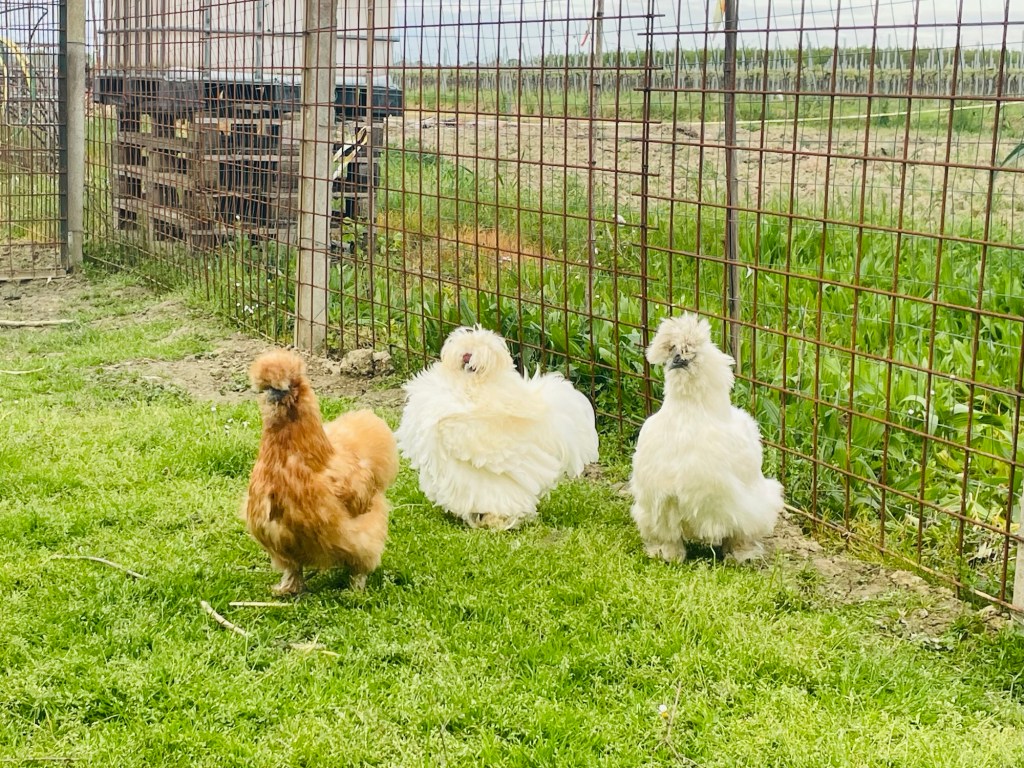
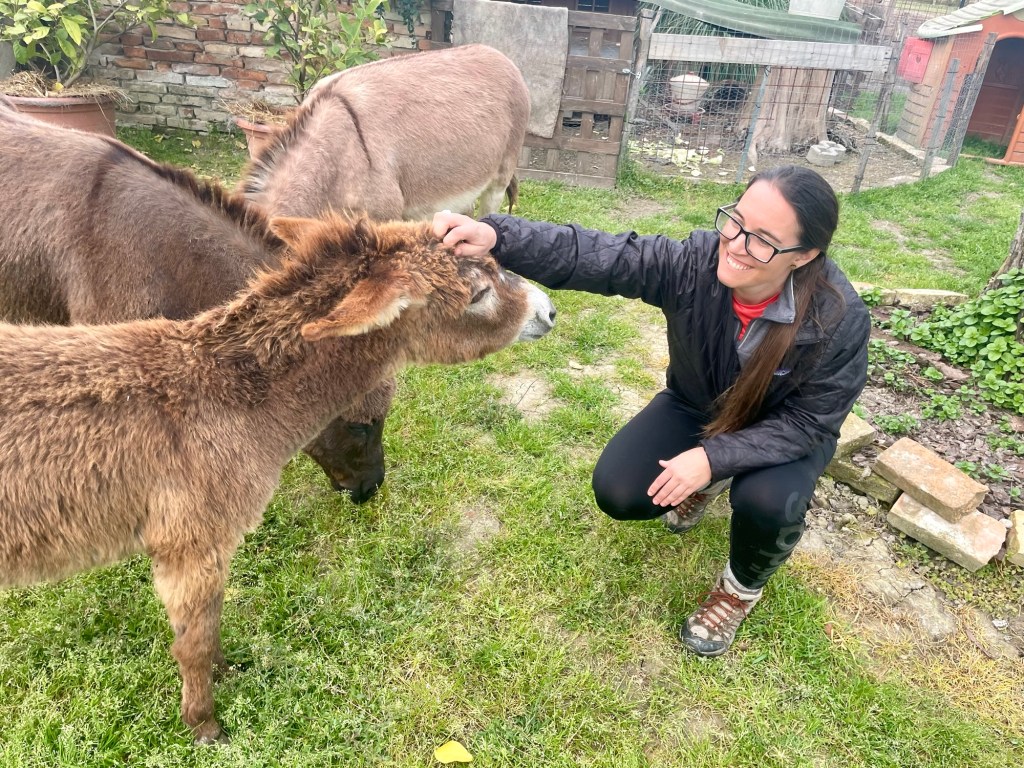
    Chickens with glossy coats of different varieties pecked at the ground; geese, both white and grey, waddled around on their neon orange feet; turkeys waved their wrinkled necks; guinea pigs nibbled on hay; sheep baad from a field behind the farmhouse; and two parrots, one red, one a grey African, spoke out to us. The guard dogs barked into the evening air. But best of all, four donkeys merrily wondered around the garden nibbling on the grass. 

    Kelsey is a huge animal lover.

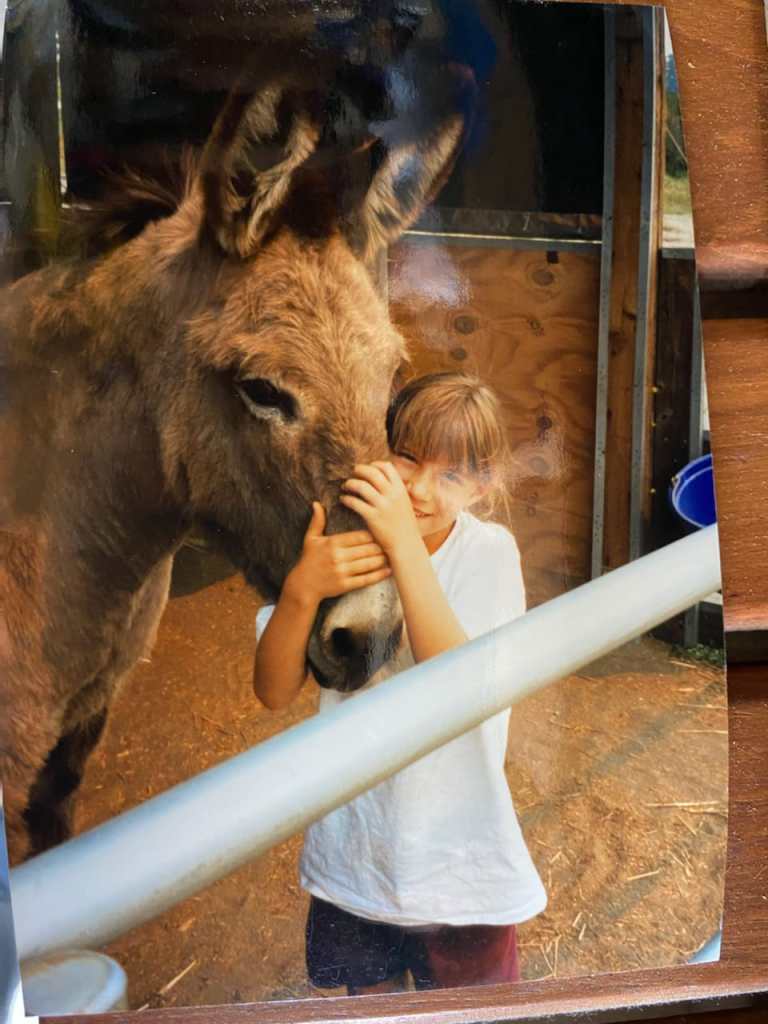
    As we walked, she had told me about a donkey she had owned as a child called Sweet Pea, on whom she would ride around selling girl scout cookies. Once, he had bitten off the button from her brother’s jacket. He was choking, so Kelsey had had to hold open his mouth while Carl put his hand down her throat to retrieve it.

    ‘She was such a good girl.’
    When Sweet Pea died, they had used a tractor to dig her grave, only for it to fall on top of her. All of the neighbours had pitched in to tie ropes to rescue the tractor from the pit. In this landscape, I could picture all too well her rural childhood and took great pleasure in seeing her nuzzle the donkeys and kiss them on the nose. 

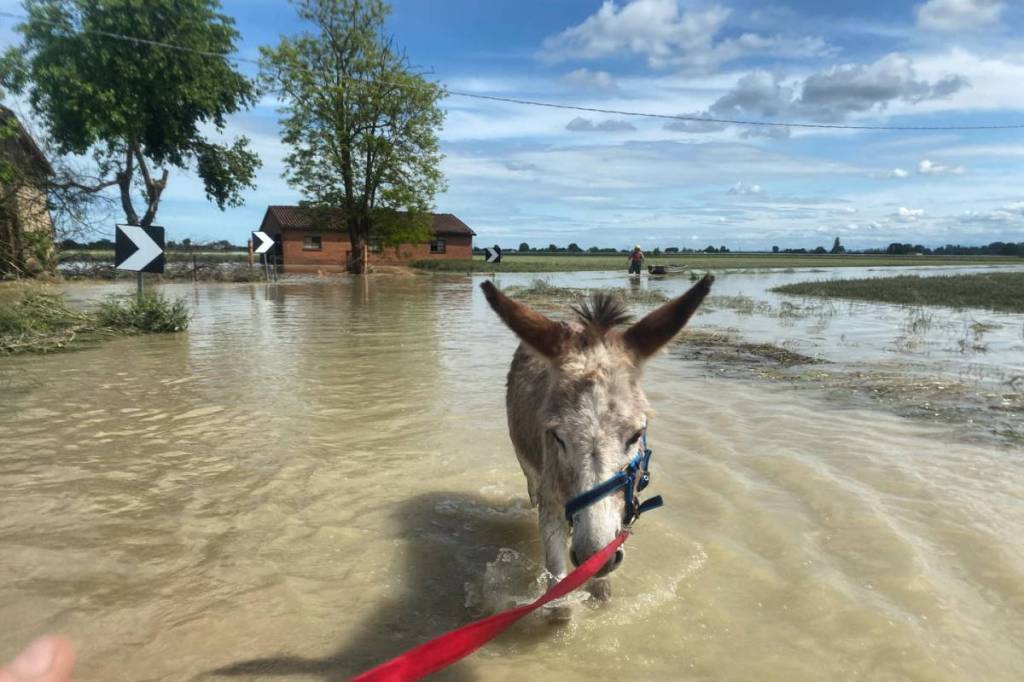
    The most lightly coloured one, Mais, Rossella explained to us, had become famous when, during a period of bad flooding that cut off the roads, he had walked three kilometers to safety with the help of the emergency services alongside his two girlfriends. In a play on words with his name, he became a symbol of the region’s resilience:

    la Romagna non molla Mai(s)‘ – Romagna never gives up!’

    Two men, Marco and Francesco, were also staying at the farm having left from Ravenna yesterday to do the Cammino in the Florence direction. Helpfully for other hikers, they are recording their walk on the app, Komoot.

    ‘Oh, so you’re Jenny from the blog!’ they exclaimed. 

    In our room, two kittens, one with a black patch on his eye and spot on his face, the other grey, brown and white, played on our bed, jumping to catch iPhone cables and sniffing every item as we unpacked. The grey one purred like a motorbike. 

    ‘It must be a lot of work running this place,’ I commented to Rossella as we warmed up our dinner of artichoke pie.

    ‘It’s not work, it’s pleasure’ came her reply. 

    She was cradling, in her arms, a black and white skunk called Margarita. 

  • ‘Beware of the dog’: From Dovadola to Forlì

    The town of Castrocaro Terme offered interesting street art and engaging conversation, but a strange encounter with a dog left me melancholy.

    In the night we’d been visited by a storm which had brought with it thunder, lightning and heavy rain and so, over a breakfast of delicious fresh yoghurt, apricot jam and honey, I talked with Benjamin and Michaela, his partner and co-host, about the perilous weather in the region. 

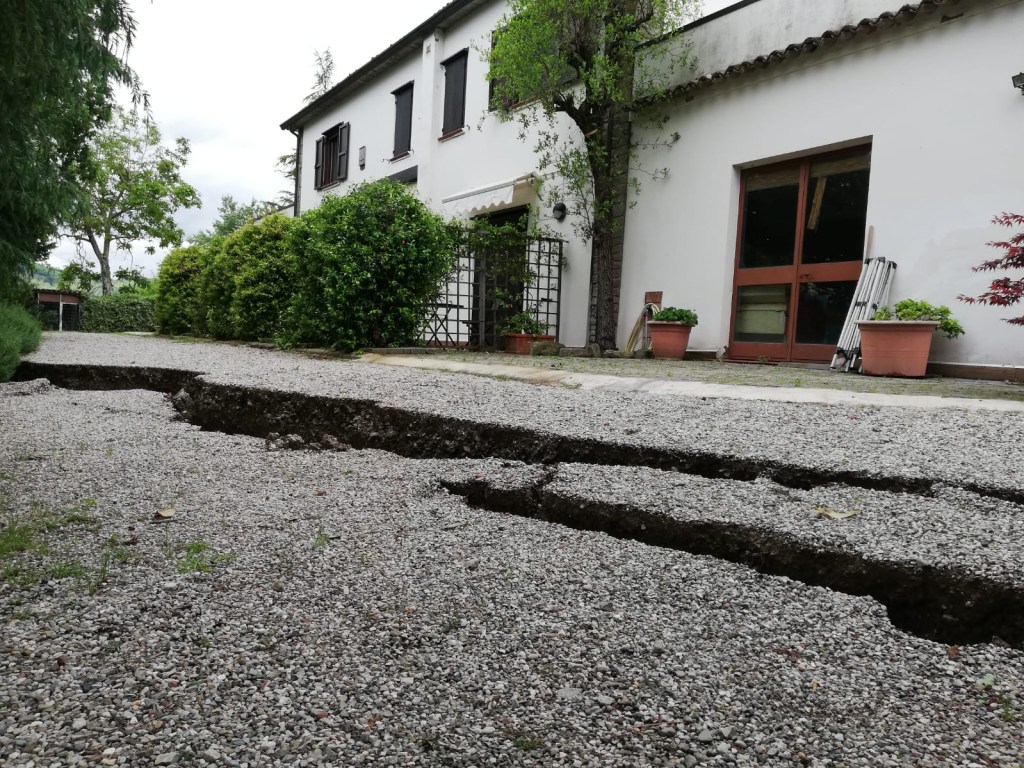
    Mud slides and flooding had occurred in May of 2023 and an earthquake had struck in September of the same year. Their driveway had been split in two. In Faenza the river had broken its banks and Montemignaio had been cut off completely for 10 days. Two people had lost their lives.

    Michaela showed me images on her phone – they were catastrophic. 

    Pepe, their small black dog, licked my hand, insinuating that he would be thrilled to share my breakfast thank you very much. 

    I’m not a big dog person and during this cammino I have been quite scared on occasion at the ferocious barking that greets you when you pass by houses in town and country alike. 

    They have, affixed to their gates, the sign, ‘beware of the dog.’
    Michaela who is an interpreter fluent in Italian, French and Spanish explained that her and Benjamin spoke to one another and their two female children in French but that the dog was Spanish.

    ‘Pepe, ven aquí!’
    I felt comfortable in this plurilinguistic environment and spoke to the dog in an accented Spanish that I had learnt in Cuba at the age of 19. 

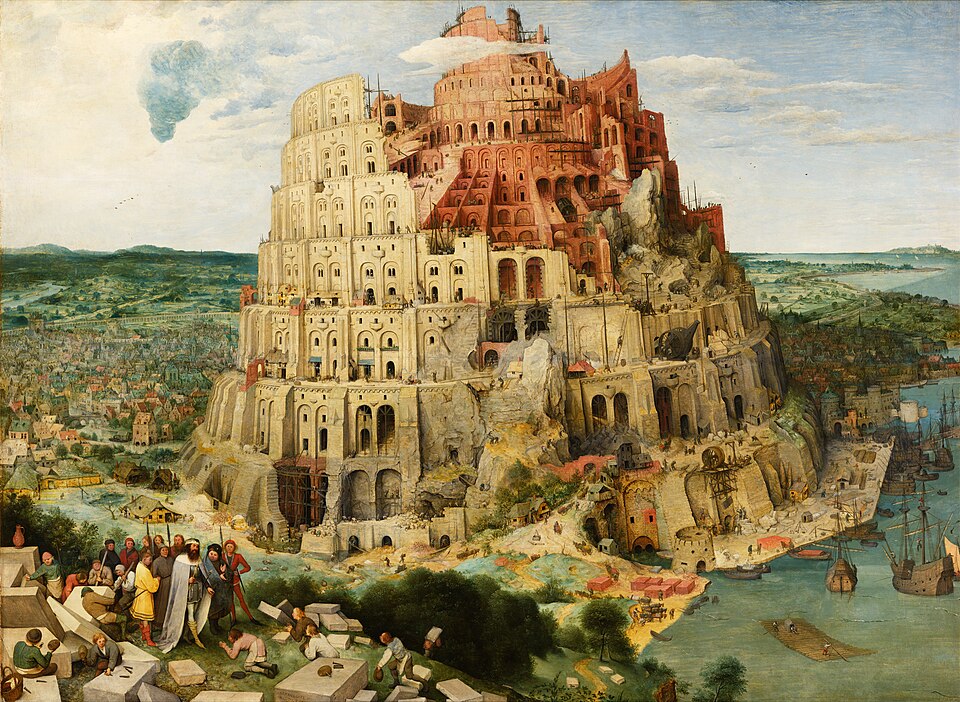
    In canto 31 of Inferno, Dante offers an explanation for the world having multiple languages, or a ‘confusion of tongues.’ As was church doctrine at the time, he sees it as a punishment for the construction, by Nimrod the giant, of the Tower of the Babel through which he sought to reach God and glory.

    ‘He is his own accuser;
    for this is Nimrod, through whose wicked thought
    one single language cannot serve the world.

    Leave him alone—let’s not waste time in talk;
    for every language is to him the same
    as his to others—no one knows his tongue.’

    It is said that this tower was destroyed by an earthquake,

    ‘No earthquake ever was so violent
    when called to shake a tower so robust’

    The Tower of Babel is the subject of three stunning paintings by the Dutch and Flemish Renaissance painter Pieter Bruegel the Elder.

    According to the principle of contrapasso whereby the punishment is an inversion of the sin, Dante punishes Nimrod not with linguistic diversity, as in all previous versions of the story, but by assigning him a non-language that communicates non-sense.

    As the Dante critic Teodolind Barolini explains, the social analogue to the linguistic fall is betrayal: the misuse and corrosion of the bonds that tie humans into social and familial consortia. 

    After the terrible weather events of 2023, Michaela and Benjamin had taken in two donkeys who had been displaced. Their names were Socrates and Augustine.

    I passed them and saluted them as I set off on my way. Ducks were quaking in the reservoir as I descended the hill at 11:30am. The rain was spitting. 

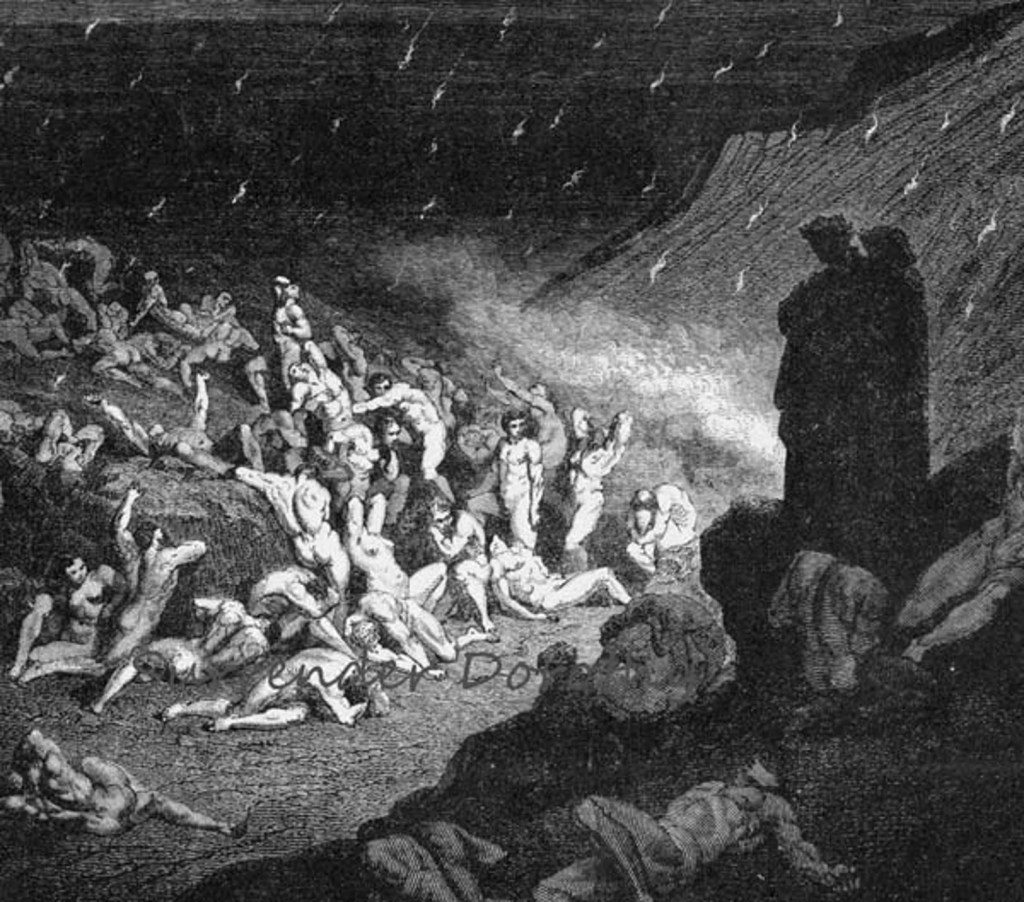
    Dante includes rain among the punishments for the violent against God, nature and art in canto 14 of Inferno, although his is a rain of fire. The arid desert of the third ring of the seventh circle is compared to the African deserts trod by Roman Cato, and Alexander the Great is evoked as having experienced in India a similar rain of fire:

    ‘Above that plain of sand, distended flakes
    of fire showered down; their fall was slow—
    as snow descends on alps when no wind blows.

    Just like the flames that Alexander saw
    in India’s hot zones, when fires fell,
    intact and to the ground, on his battalions,

    for which—wisely—he had his soldiers tramp
    the soil to see that every fire was spent
    before new flames were added to the old;

    so did the never-ending heat descend;
    with this, the sand was kindled just as tinder
    on meeting flint will flame—doubling the pain.’

    The rivers of Hell, meanwhile, Virgil informs Dante, are created by the tears of the Old Man of Crete. 

    It was cold and so I was wearing my yellow striped hoodie under my anorak, the only thing that I had left in my backpack that was dry. 

    I had washed my hair with the conditioner I’d purchased yesterday and tied it in two braids that hung down my neck. I’d put nardo oil on my feet before the plasters. I was getting short. I’d have to buy more in Forlì.

    I walked along a road for 15 minutes feeling anxious of the speeding cars. The clouds were bulbous and pregnant with rain.

    Soon the roar of the lorries was replaced by that of the river and I proceeded to a more tranquil trail. Wisteria pods hung off their stems like runner beans. They were soft to the touch like donkey ears.

    I wondered why on earth I’d packed two pairs of shorts.

    I passed by vines which were contorting their limbs on one side of the path and, to the other, olive trees were bunched together, a dusty green.

    Soon I entered the town of Castrocaro Terme which is known for its healing thermal waters. The fortress towered over me. The greenery on its top looked like a toupee.

    An acer tree thriving in the ground told me something of the composition of the soil. A DHL delivery driver in a yellow van was playing drum and bass.

    The first café I tried for lunch was closed – of course, it was a Thursday? But in a little square I found a bar outside of which an elderly man was coughing over a thick cigar. 

    As I ate a mozzarella and rocket sandwich which had been freshly prepared, we got chatting. His name was Silvano which means ‘man of the woods.’ When I explained about my cammino he began citing canto 3 of Inferno where Dante crosses the river Acheron, guided by Charon. 

    ‘here, advancing toward us, in a boat,
    an aged man—his hair was white with years —
    was shouting: “Woe to you, corrupted souls!

    … Charon, pilot of the livid marsh,
    whose eyes were ringed about with wheels of flame.’

    The demon Charon, with his eyes like embers,
    by signaling to them, has all embark;
    his oar strikes anyone who stretches out.’

    Although Dante’s verse doesn’t describe his crossing of the Acheron in Charon’s boat, since he faints with fear, his voyage has been imagined by several prominent painters including the Frenchman Delacroix.

    Silvano and I discussed the Euro, Brexit and who had killed Princess Diana. He was impressed, as was I, that King Charles had given a short speech in Italian on a recent visit to Ravenna. When he complemented me on my Italian I replied,

    ‘The Italian language is logical. Well, the language is logical, but not always what people say.’

    He chortled heartily. It felt good to be able to make a joke in a foreign language.

    A rum and tea was two euros fifty. 

    I took my jumper off since the rain had stopped and the humidity returned. Some of the other men in the bar chuckled, one explaining that when he’d gone to a wedding in England, he had been the only own dressed in a jacket while all the other guests were practically nude. Us Brits like to expose ourselves at the first sign of Spring, whereas the Italians cautiously hang on to their feather jackets, or piumini  until May at the very least.

    Silvano who had owned a gift shop by the seaside prior to his retirement was struck by my lapis lazuli necklace. It was gift from my East German friend Susanna who does ecological activism in Guatemala.

    ‘She’s doing the Grand Tour!’ one patron cried. ‘You’re here to cultivarti – to culture yourself, no? Just like the British elite did in the 19th century?’

    It turned out his name was Giovanni and he was a respiratory doctor who worked in the thermal baths.

    I left Silvano and Giovanni with a ‘buon appetito’ after an hour of rich conversation and carried on my way. Because of the weather, I decided not to take advantage of the many gelaterie.

    The town benches had been painted in different colours with messages that sought to bring hope to the local people. One read, ‘I keep asking myself, would there still be war if people used their brains?’ Another, ‘no to violence against women’ and another still, ‘one less piece of rubbish in the environment is a smile for the people’ – a phrase that rhymes in the original Italian. 

    There was a random photo booth in the street next to a Perspex bus stop. A school wall was painted with a mural depicting women from around the world and a garden contained a series of stone sculpture people.  

    The town had a surplus of banks, and there was the fizzy water fountain, next to a defibrillator. A small park with fairground rides sat next to an ugly breeze block hotel. Someone had graffitied a rather accurate penis on a bin.

    The town wouldn’t be a bad place to grow old, I contemplated. It reminded me of the spa town of Balneari Prats where I had spent time with my yoga guru Mary Paffard in Spain during multiple Springs.

    I exited through the medieval walls of the city, the cobbled stones serving as a welcome massage for my feet. Two children’s bicycles had been discarded on a corner without locks. There was an unexpected little forest of bamboo to the right.

    I stopped to explore the beautiful little church of Santa Reparata where there was a strong smell of bleach. Here too, women were cleaning in preparation for the Easter services. Outside, a lady was trying to entice two cats off the roof of her car. 

    As I proceeded to the off-road track that would take me all the way to Forlì beside the river, I met an Italian man with hiking poles.

    ‘Be careful,’ he said, ‘it’s super muddy.’

    I thanked him and carried on. Mud? I could handle mud by now. 

    Upon reaching the riverbank, I disturbed a heron who flew – dinosaur like – into the grey air.  

    The path was poorly trodden and tall grasses obscured it here and there. I’d attached my hiking sticks to my backpack since the terrain was flat and, without knowing what to do with my hands, I tugged on my braids and ran my fingers through the flora.

    Soon I arrived at an expansive mud flat which had the texture of quicksand on a beach.

    The Abominable Sands is a location in Dante’s Inferno. Indeed, it is the third and final region of the Seventh Circle of Hell.

    I thought of Dante’s description:

    ‘The ground was made of sand, dry and compact,
    a sand not different in kind from that
    on which the feet of Cato had once tramped.’

    In places, this sand was certainly far from dry and compact and the gentleman had certainly been right about the mud. I proceeded tentatively, one step at a time, managing to avoid submersion. 

    Red poppies clustered at the feet of vines to my left and an ugly piece of orange plastic netting blocked off a worksite.

    Then I took a sharp left into the woods. 

    The brambles reminded me of home, however I was relieved that there were relatively few nettles. A man mowed a lawn behind a hedge and I observed a plastic red chair stuck in a tree.

    Though the path was deserted, I took comfort in the dog prints that marked the path before me.

    The cloud still hanged low but the sun was starting to break through. I removed my anorak and enjoyed the feel of the breeze and occasional sun on my skin. My bare arms were covered in bramble scratches from earlier in the hike when I’d got lost in the woods with Alina.

    I noted the contrast between the wild grasses and the tidy vines. There was an abundance of a beautiful spiky, thistle-like plant that was streaked white and green.

    Inspired by the morning’s conversation, I sent a voice note in French to my friend and former student Sahra from Afghanistan who had moved from Italy to Belgium a couple of months prior where she was applying for university. Her response came quickly in a mix of Italian and French. 

    ‘You’re like a Sufi,’ she said. ‘Sufis walk and wonder.’

    I recalled placing a basket bin on my head and spinning in my mum’s white silk dressing gown as a child after we returned from a holiday in Turkey.

    ‘I’m a whirling dervish,’ I had exclaimed.

    And then there was the time I’d been to a global Sufi gathering on the Algerian border with my Moroccan friend Miriam. One woman had become so ecstatic she had collapsed in a fit of ecstasy. Some say Dante was influenced in writing the Divine Comedy by Sufi mysticism. 

    I passed a greenhouse with plants erupting through the roof and briefly conversed with two ladies who were hiking with a dog called Clifford. They agreed with me that Dante would have wanted me to do the walk this way, finishing in Florence and not Ravenna. Did I need anything?

    Further ahead, I saw a family complete with a dog, toddler, bike and pram. The middle child was racing ahead on his cycle and circling back in a burst of freedom.

    As I turned a corner, there appeared a black dog who was sporting a red bandana round his neck. Cautious at first, I pulled my hand into a fist to let it sniff me which it did tentatively. Then it looked at me as if to say, ‘are you coming?’ and trotted on.

    For well over an hour, I followed the dog as it made its way alone along the Dante path. At each fork in the road, I wondered whether it might turn the other way. But on it went in the direction of Forlì. When I stopped to pee, drink or rest, so it stopped too. And mad as it sounds, it appeared to be smiling at me, lolling out its neon pink tongue and wagging its tail erect.

    As I ducked under a surplus of ivy, I lost sight of it and felt a pang of sadness. But then there it was again. This part of the path was more well-trodden and I imagined it was a common recreational ground for the locals. Still, there was nobody around except me and my new guide. 

    All the while, he kept ahead at a distance of around three metres. Now the dog prints ahead of me made sense. 

    I felt my belly rumble and wanted to stop for a snack, but I was scared of losing this dog who I had by now nicknamed Virgil.

    It stopped to defecate, yawning with his mouth wide open.

    My leg had acquired a sprig of sticky weed. I blew a dandelion for no one else but myself. One obstinate seed stayed on the stem.

    The river to my right gurgled like my stomach.

    I wondered if the owner had dropped Virgil at Castrocaro Terme to let him take himself on a walk back to his home in Forlì. I tried to approach him to check his tag but he wouldn’t let me come close, only follow him.

    He was quicker than me up the hill but when I turned the corner, there he was panting, still waiting for me.

    My shoes were rubbing and I would have stopped to rest and take some ibuprofen, but for the dog, I had to continue.

    He kept peeking his head back to check I was still there. Where was he going?

    On the ground were fallen ivy leaves shaped like hearts and soon, as we passed through another prairie, Virgil’s back became covered in yellow petals from the flowers. A seed that looked like soft cotton on stems and another that resembled a caterpillar fell from the trees above me to my feet.

    I thought we must be getting close to Forlì. There was some kind of industry that looked like a quarry on the left and pretty soon we hit a main road. Would Virgil now abandon me?

    None of my friends had dogs and I was a cat person. I had a cat called Dante Alighi-‘hairy’ and, before that, I’d had Toffee, a rescue with anxiety issues. When I’d gone to the vet to put her down, my friend Danni accompanied me. I was so traumatized that I had vomited in the sink in the veterinary surgery. I still owe Danni 100 pounds for the procedure.

    I was playing music on my iPhone which was tucked into my bra, the words of Talos rang out,

    ‘Your love is an island, I’m scorched in the sands of it.’

    Virgil went under an underpass. I thought the way would be to the left, but I followed him. When I checked the map, he was right.

    I wished I had some kind of treat to offer him, but the relationship was not reciprocal. He was leading me. Now, when he stopped to sniff something, I waited for him.

    ‘I’m here. Don’t worry I’m here,’ I said.

    I could suddenly understand how people got so attached to their dogs. He was so loyal.

    I think this was the longest I’d walked without taking a break. It was coming up to ninty minutes.

    It was 5 o’clock and the sun now definitively occupied the sky having won the battle with the rain clouds. Virgil drank from a clear puddle in the path that hugged a ploughed field to the left.

    When we came back to the river where I was supposed to cross, he jumped in for a swim and waited for me on the opposite bank. The current was strong and, lo and behold, there was no bridge. I would later learn that it had been washed away in the recent heavy rainfall. For now, I was quite literally stuck in the mud.

    Five minutes passed as I tried to work out a solution. We locked eye contact. I couldn’t cross the river but to turn back to the road would mean to leave him.  

    I thought about taking my leggings off and trying to wade over but the water looked deep and the current spooked me. 

    I stood there on the shore feeling tears prick at my eyes and the muddy water soaked once more into my boots. My feet ached and I wanted to sit down and consider my options, but I couldn’t: the riverbank was a swamp of ash-coloured mud. My feet were slowly sinking down above the ankle.

    A jogger ran past Virgil on the other side of the bank. I contemplated calling out to her. 

    I turned to wade back onto solid ground and when I looked back, Virgil was gone.   

    I walked five minutes to a bench and was just quiet for a while, listening to the sound of bird song. I noticed a little mushroom underneath the bench which was like a nipple in shape and size. I bit into an apple I had bought yesterday. It was the size of a fist, red and yellow.

    I had a video of Virgil swimming across the river which I now watched obsessively on repeat.

    I picked some grass out of the zip of my anorak with my hands and put it back on. A large pigeon flew through the trees. Finally, I took some ibuprofen for my feet.

    I was riddled with a melancholy I found hard to understand. Virgil had crossed the river Acheron and I had not. 

    I headed back to the main road to take an alternative route into Forlì with a sigh. 

  • A Secular Pigrim: From Portico di Romagna to Dovadola 

    People keep addressing me as a pilgrim which feels strangely comfortable, but my path is pantheistic. 

    This image has an empty alt attribute; its file name is img_7011.jpg

    At the start of canto 2 of Inferno, Virgil tells Dante that it is Beatrice who has sent him to guide him on his journey. Dante is reassured. He responds by describing how,

    ‘As little flowers, which the chill of night
    has bent and huddled, when the white sun strikes
    grow straight and open fully on their stems,

    so did I, too, with my exhausted force’

    Like Dante, I set off this morning standing tall but with some weariness in my body. I had a 33-kilometre day ahead of me and my feet were still painful from being waterlogged for the last two days. My boots hadn’t dried out in the night as I’d hoped they might, and so to put them on was to submerge my feet into a damp abyss. 

    I squelched my way out into the sun to set off at 9am. The golden orb had returned, at least momentarily. 

    I couldn’t help but stop for a coffee in the café I had visited yesterday to salute Lisl. A man in an African shirt was sat on a tall stall reading the paper. It turned out he was from Burkino Faso and he appeared delighted when I spoke to him in French. Once again that thought crept into my mind, ‘I could live here.’ 

    Lisl put added a powder to my coffee,

    ‘It’s ginseng,’ she explained, ‘it will make you more powerful.’
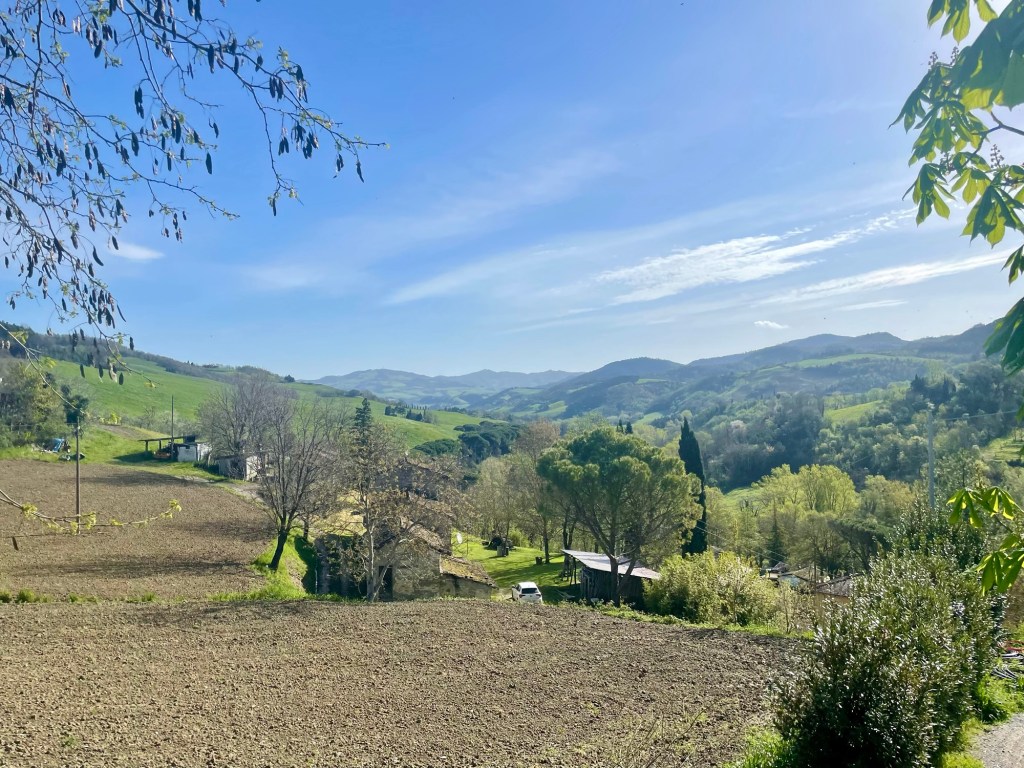
    This image has an empty alt attribute; its file name is img_6962.jpg

    After getting lost and losing phone signal the day before yesterday, I made sure to text my mum and let her know where I was heading and my estimated arrival time. Nadia had sent me another lovely message saying that my blog was helping her to see and appreciate Dante through a new sociological lens.

    ‘It’s so much more interesting that the way we’re taught at school,’ she said. ‘You’re now like my academic Virgil!’

    I wondered whether the fact sociology is less respected in Italy, as Alim had opined last night, was why there were so many Italian sociologists in the UK. The migration research centre where I work, IRiS, at the University of Birmingham, counts three.

    It was 9.30am by the time I left the bar. A band of us had had another long discussion about the prospect of rain. In these parts, people seem to enjoy talking about rain as much as in England.

    This image has an empty alt attribute; its file name is img_6964.jpg

    On this walk, I’m finding that it’s a constant challenge to manage my time between walking, writing and making memories with new people. But I’m determined to write every day. The writing feels as important as the walking.

    As the critic Osip Mandelstam has observed, the rhythm of Dante’s prose – in the form he invented of terza rime – third line rhymes – reminds us of the footsteps of a walk. He writes,

    ‘Inferno, and even more so Purgatory, celebrate the human journey, the measure and rhythm of our steps, the foot and its form…Dante’s is a prosaic modality. He pictures the coming and goings of life drawing on multiform and captivating expressions. In Dante, philosophy and poetry are always on the move, always on their feet.’
    I followed to Via dei caduti – the way of the fallen – up for about 5 kilometres before I stopped to see what is known as the world’s smallest volcano which has been active since before 1500. In reality, the perennial flame is due to the emanation of gaseous hydrocarbons which, in contact with oxygen, remain perpetually on. The flames that emerge from the subsoil, in the middle of an uncultivated field, create a particular sight that reminded me of Ulysses speaking to Dante from within the tongue of far – could this have inspired him?

    This image has an empty alt attribute; its file name is img_6997.jpg

    I stayed a while to look at the body of a dead mole. Its hands were leathery with large talons stemming from them. Then I set back off.

    Pink flowers had climbed through the centre of an abandoned traffic cone in the hedgerow and buttercups, cow parsley, and dandelions lined the verges of the road. I was glad to have a single path to follow so I couldn’t get lost. Here to my right were hexagonal, indigo flowers, and there, a mauve plant that looked a bit like lavender but without the smell.

    This image has an empty alt attribute; its file name is img_6994.jpg

    Tractors were loading hay bales into a lorry and I passed more piles of wood and a fence weaved with sticks the way I’ve seen in Shining Cliff Woods near my house back home.

    The sweat was dripping down my forehead, but I resisted the temptation to put my cap on for fear I would fate the sun to disappear. 

    I passed by rosehip, the fruit of which we’d used at my primary school as a form of itching powder, and modesty, the seeds of which my brother and I used to shake out and use as money in pretend games of a summer. 

    A black goat bleated from behind an electric fence and out of the margins there emerged a wild iris, a vivid purple in the sun. A happy bee buzzed past and a couple of butterflies tentatively made their way back out into the sunlight after the rain

    It was a show and steady ascent with panoramic views of the town. Electric cables were strung across the landscape like fairy lights on a Christmas tree.

    A single stone house with a terra-cotta roof was nuzzled into the bosom of the rolling hills. 

    This image has an empty alt attribute; its file name is img_6971.jpg

    The path was covered in more broken tiles that would have made for spectacular mosaic pieces had I only had the space in my bag: there was a flower, some sunglasses, a pineapple, pink, purple, yellow and green – perhaps we could adopt this method to fill the ubiquitous potholes in England. The Department for Transport had recently said that the local authorities’ road maintenance pot would be boosted by £500m from mid-April, but councils must publish annual reports detailing progress on potholes or lose a quarter of that extra funding.
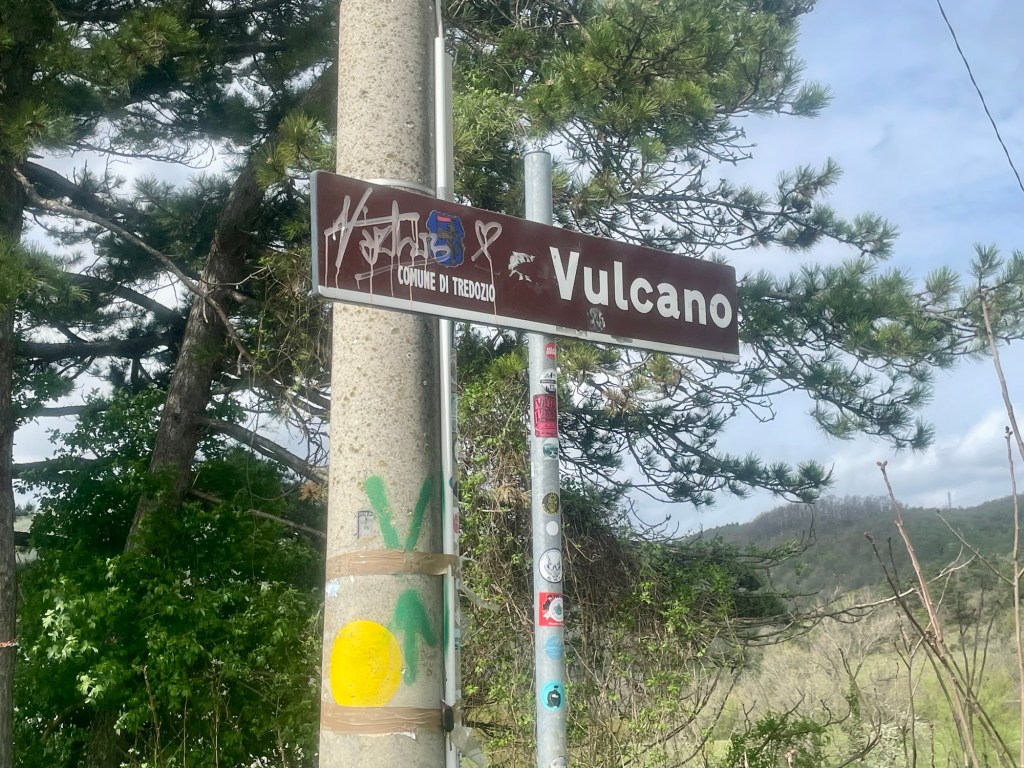
    This image has an empty alt attribute; its file name is img_6983-edited.jpg

    I heard the familiar rustle of lizards and a frog jumped into the stream to the right of the road. But would the weather hold?

    I was making slow progress at about 4 kilometres an hour, unlike the cyclists who sped past me up the hill in their fifty shades of lycra. At one point the road was interrupted by a landslide, the asphalt shredded into black puzzle pieces. 

    My bag was definitely heavier than the recommended weight of 10 pounds and I was reminded of the proud penitents who carry heavy rocks on their backs in Purgatorio. The weight forces them to walk slowly, their bodies bent low to the ground. Dante compares the suffering of the hunched souls to the human figures (with knees to their chest and pained expressions) used in architecture to support a ceiling or roof. 

    ‘Just as one sees at times—as corbel for
    support of ceiling or of roof—a figure
    with knees drawn up into its chest (and this

    oppressiveness, unreal, gives rise to real
    distress in him who watches it): such was
    the state of those I saw when I looked hard.

    They were indeed bent down—some less, some more—
    according to the weights their backs now bore;
    and even he whose aspect showed most patience,

    in tears, appeared to say: “I can no more.

    Hairpin turn after hairpin turn, I proceeded up with my stash of coffee and a cachet of teabags. I was carrying two litres of water, Alina’s socks, my blue eyeliner, a Pokémon card and one tile fragment – the one with the pineapple – that I just hadn’t been able to resist picking up.

    On a wall there was graffitied ‘Viva la resistenza Palestinese‘ (long live the Palestine resistance).

    This image has an empty alt attribute; its file name is img_6996.jpg

    Unlike previous days where I’d been totally alone, today I passed a few individuals. I oscillated between ‘ciao,’ ‘salve’ and ‘buongiorno’ and people returned a friendly reply. 

    The village of Monte Busca announced itself by the sight of wheat and a display of orange flowers that did not appear wild. Here, potholes in the road had been filled with tarmac. A man sat outside a wood workshop eating a yoghurt next to a stack of abandoned crates. There were sweeping views on either side of the path.

    This image has an empty alt attribute; its file name is 3087a671-affa-4517-917a-7b8dbc498b38-1.jpg

    Much thought has gone into this route so that, wherever possible, you are not walking on the road but it felt good to have my feet on solid ground. 

    The expansive green lawns that cascaded down the slopes reminded me of the quads of Oxford colleges, although these always came with a sign, ‘do not step on the grass.’ Here I could tread as I pleased. I thought back to the Wadham summer ball. At 6 in the morning a group of us had staggered out onto the quad in a rare opportunity to laze there for a while, hung over and cuddling one another for the fun of it all.

    The cloud started to hang heavy and I could smell the oncoming rain.

    By midday, I’d done 10 kilmetres. Since it was a long day, I was rationing my water intake. Thirsty, I bit into an apple and ate a cheese sandwich. As Dante writes also in canto 10 of Purgatorio, 

    ‘I was exhausted; with the two of us
    uncertain of our way, we halted on
    a plateau lonelier than desert paths.’

    Except now I was alone, walking with just the familiar sound of the cuckoo. It sounded like a child’s first notes on the recorder.

    My guidebook was still a little damp, though it had spent all night on the radiator.

    I snapped a nail heaving my bag back onto my shoulders. I hadn’t brought a nailfile and, though I’d gifted one to my twelve-year-old niece for her birthday, I didn’t have a Swiss army knife of my own.

    With my bag I was now also carrying a spider as a stowaway. 

    I disturbed a dandelion, sending the seeds into a little cloud.

    This image has an empty alt attribute; its file name is img_7047-edited.jpg

    The path went from asphalt to gravel to concrete to woodland. It was hard to walk past an agriturismo without stopping but I had to keep moving forwards. I stopped briefly to change my sodden socks for dry ones, a piece of advice my friend Craig from the local pub, Angel’s, had given me before I set off. My feet felt like they were on fire, bringing to mind the popes who are buried in holes by Dante with their feet in flames. 

    ‘Out from the mouth of each hole there emerged
    a sinner’s feet and so much of his legs
    up to the thigh; the rest remained within.

    Both soles of every sinner were on fire;
    their joints were writhing with such violence,
    they would have severed withes and ropes of grass.

    As flame on oily things will only stir
    along the outer surface, so there, too,
    that fire made its way from heels to toes.’

    This image has an empty alt attribute; its file name is the-inferno-canto-19.jpghalfhd.jpg

    Inferno 19 is the first full-fledged indictment of the Church in the Divine Comedy, picking up on some earlier indications that Dante associates the clerical establishment with the sin of avarice. He, like me, was not a fan of organized religion, or at least as it existed in its contemporary form.

    I sat for a while and observed some baby donkeys. They had soft hair on their heads, fluffy like little chicks. I thought about the similarity of their hooves and my nail that had just snapped off and of how all things in nature are connected.

    The two calves hung close to their mother nuzzling her neck. One of them had a large penis that hung down. The other didn’t. One bit its mother’s mane playfully, and the mother nibbled the back knee of the lighter of the two which was coloured like ash.

    Mud stuck to their fur which was wavy, and their ears looked soft to the touch. They were pointing forward. Did that mean that they were happy or scared?

    This image has an empty alt attribute; its file name is img_7028.jpg

    I was reminded of a quote from Alice Walker’s novel, The Colour Purple, 

    ‘Whenever you trying to pray, and man plop himself on the other end of it, tell him to git lost, say Shug. Conjure up the flowers, wind, water, a big rock…The more I wonder, the more I love.’

    Tiny flies buzzed around puddles on the muddy woodland path which I tried to avoid in order to keep my feet some semblance of dry.

    Suddenly it became humid and I felt a twinge in my right buttock. I was tired from the uneven path and would be happy to get back on the road. Prickled by pines on the descent, I put one foot in front of the other on the narrow path like a tightrope walker. I got my foot caught in a bramble and nearly went tumbling

    I ate some almond cake and chocolate and worried that I hadn’t factored enough rest days to the return.

    At 2 o’clock the first rain came. I was counting the kilometers religiously on my phone, grateful for my solar powered phone charger. A beetle climbed onto my shoe. It was iridescent, despite the lack of sun.

    Curious ants had burrowed minuscule holes in the ground and a yellow and black butterfly soared past me, the first I’ve seen of its kind. White and brown ones abound. 

    This image has an empty alt attribute; its file name is img_7317.jpg

    To the right, solar panels spilled over the landscape reflecting the light like strips of unraveled cassette tape. 

    I saw cows in a field which always reminded me of my dad and the game Spot It that we would play in the car as children. You had a series of cards with things to see on the road: a tractor, a yellow car, a phone box etc. Once my dad had taken a 2 kilometre detour via a fire station so that he could trump us with his fire engine card. 

    At 4 o’clock, the mist started to descend, and the top of the hills were obscured

    Haybales had been tucked up in tarpaulin and an abandoned piece of farming equipment was slowly rusting outside an old farmhouse.

    The cloud hung in heavy curtains, a blind folding down over the undulating hills.

    An bathtub containing water was propped up on the marsh by two pieces of wood. Daisies stretched out on their storks which were the length of a ruler.  

    This image has an empty alt attribute; its file name is img_7073.jpg

    I turned the corner and there it was, the village of Dovadola, with its winding path that would take me to shelter. The stark cliff faces were a mark of the ancient river that had forged the valley. Once again, the rocks were caged in to avoid landslides. As my earth sciences major mother had taught me, geology is the language of the land. 

    I heard the familiar sound of the church bell strike 5pm and felt a pang of hunger. I’d always liked the sound of church bells just like in Morocco and Syria I had so enjoyed the call to prayer. 

    Wisteria was hanging down from fences like bunches of grapes. The scent was something akin to the tiny round violet sweets that I would eat as a child. A three-wheel vehicle passed me. It was an emerald green. 

    This image has an empty alt attribute; its file name is img_7119.jpg

    I passed the FC Dovalda football ground and an older church in town with a medieval tower. Someone stopped to asked me if I was doing the cammino of Assisi but I explained that I was a secular pilgrim doing the Dante cammino. I was a pantheist and following nature as my guide.

    I went into the to bar the Antica Osteria and had a delicious spinach and ricotta crecione. This regional plate is a folded piadina in the shape of a half-moon. It looks like one big piece of ravioli, or rather, a raviolo

    This image has an empty alt attribute; its file name is img_7084-edited.jpg

    I was self-conscious that I smelt but the atmosphere in the joint was intoxicating. An older lady sat in the corner peeling plastic labels off a new set of plates. A little girl called Lucia was dressed as Snow White and sat terrorizing a black cat. 

    ‘It’s from the Befana!’ she shrieked, alluding to the old witch who brings sweets on the epiphany according to Italian folklore.

    Another group of kids hung about in a gaggle around the ice cream freezer. Outside the adults were smoking. One of them had a beautiful wolf-like dog called Deni. After spending the day walking alone it was nice to be in company and I stayed and talked awhile.

    I brought some cheese, tomatoes, dates, a big apple, pistachio nuts and some much-needed hair conditioner from a local store and continued with the next 50 minutes down the busy road to my agriturismo. 

    I passed the sign to Loch Ness fishing zone and a petrol station. In Italy they put in the petrol for you, so you don’t even have to exit your car for a fill up. 

    This image has an empty alt attribute; its file name is img_6974.jpg

    I already missed being up in the hills with the wildflowers. I thought back again of Oxford and how I’d religiously learnt all their names in translation. We had had to learn an insane amount of very specific vocabulary in French and Italian. I still have a cushion my friend Caroline sewed for me with the opening phrase from our French translation exam,

    ‘You are the most wonderful hippogriff.’ 

    Now I’ve been here a week, I’ve started thinking in Italian.

    The final leg involved another steep ascent along a winding road. I tried to channel the spirt of Virgil as my guide. As Dante writes when he finally reaches the slopes of Mount Purgatory, leaving Hell behind: 

    ‘The climb had sapped my last strength when I cried:
    “Sweet Father, turn to me: unless you pause
    I shall be left here on the mountainside!”

    He pointed to a ledge a little ahead
    that wound around the whole face of the slope.
    “Pull yourself that much higher, my son,” he said.

    His words so spurred me that I forced myself
    to push on after him on hands and knees
    until at last my feet were on that shelf.’

    This image has an empty alt attribute; its file name is img_7131.jpg

    Thus I arrived in the Airbnb, Naturaliterre BnB – Microfattoria, a sweaty mess.

    I was greeted by Benjamin, a kind French host who ordered me a pizza and put my boots by the fire. I checked my email to see that I had received a beautiful note from Anna in Montemignaio. There is so much love on this cammino. I feel held by the path itself. 

    Another email to my work account reminded me to finish a funding application this week and for once I felt inspired and up to it. I’d been holding myself back because of confidence, but if I could do this hike, I could do anything.

  • Dante’s Women: From Premilcuore to Portico di Romagna

    Today’s short hike promised a rainbow but real colour came in the narrow streets of the medieval town where Beatrice’s family lived.

    ‘Gloom of Hell or of a night deprived 

    of all the stars, beneath a barren sky

    Which everywhere was overcast with clouds’

    With these words Dante begins the canto of Purgatorio 16. I could relate. All night, it hadn’t stopped raining and, as I opened the curtains, the grey clouds still hung in webs.

    My top and bottoms had dried on the radiator, but my anorak was still slightly wet. My boots were soaked through.

    Nadia had given me some sweet treats for breakfast the night before since, though it was Tuesday, today was their day off. They coordinate in the village so that no one closes on the same day. 

    There was no big rush to get going today since the hike to Portico di Romagna is one of the shortest of the cammino at around 10 kilometres. But still, I was a little wary after yesterday’s experience of getting lost.

    I caught up with work emails, performed my usual ritual of folding my hiking socks over my laces so that they would not become untied, and by 11am I had set off into the spitting rain. I stopped briefly at a panettiere – bread shop – and bought a slice of vegetable pizza to complement my sweet breakfast, breaking the hard and fast Italian rule of not eating on the move. 

    By the time I exited the town over the bridge, the rain had eased off a bit and sunlight was pushing through the clouds. In Canto 17 of Purgatorio, Dante makes a similar observation on the particular microclimate of the region, writing,

    ‘Remember, reader, if you’ve ever been
    caught in the mountains by a mist through which
    you only saw as moles see through their skin,

    how, when the thick, damp vapors once begin
    to thin, the sun’s sphere passes feebly through them,
    then your imagination will be quick’

    It was. I scanned 360° for a rainbow but was left disappointed.

    As I made the ascent, I thought of the line from the film Forrest Gump, ‘I’d never seen so many shades of green until I went to Vietnam [insert Premilcuore].

    To my left were horses with bells tied around their neck nodding in the rain, their mains slick to their necks.

    There was something in the rolling hills of the Lake District in my native England as I looked back down towards the town.

    A brown spider the size of my little fingernail crossed the path.

    The concrete way had foot and paw prints cast into it, reminding me of the concrete in my garden back home. I’d have to do something with it upon my return. I thought of my Great Aunt Lena who in her older age would still bend forward with a butter knife to tease the weeds out from the cracks. 

    The path transitioned to tarmac which was coated in petals that had been cast into the air like confetti at a wedding. Some of the blossom had caught on the needles of the pines, embellishing them like Christmas trees.

    It felt strange to be walking along the path strewn with the petals. I was reminded of my wedding to my former husband which had taken place in Port Meadow, Oxford. I had been an excellent bride, but a terrible wife, though I still have fond memories of the day which was themed around love art, and revolution. I had shown Alina some pictures two days before. She had complemented my mother’s sewing work on the dress I wore in the engagement shoot in Wadham College gardens.

    Here the path turned to mud with a little strip of green running down the middle, riddled with an abundance of rust-coloured pinecones. Encroaching at the sides were imposing, prickly trees. I thought of the aide-memoire I’d learnt to identify plants in the White Mountains – ‘spiky, spruce; friendly fern.’

    I suddenly realized that with the rain had come the absence of lizards, bees, and butterflies and I missed them.

    I was feeling tired, achy and nostalgic. 

    Dante, like me, had not suited married life, though for him it had been more of a familial negotiation rather than anything to do with love. When he was exiled, it is said his wife Emma Donati would cry in the streets where she was left behind with her children. Dante, on his travels, continued to pen poetry to his one true love, Beatrice Portinari. 

    An ancient legend goes that Dante met Beatrice in Portico di Romagna where her family owned an estate, though Dante himself writes that he first saw her as a girl and then when she was 19 in Florence on the Santa Trinità bridge. This image was rendered immortal by Henry Holiday in 1884.  

    Dante’s treatment of women in the Divine Comedy is proto feminist. Although they rarely speak, he was one of the first writers to document the lives of women in Medieval Italy at all and he depicts them in various roles: as victims of domestic violence, harlots and saviors. The fact that he was guided in Paradise by a woman was revolutionary and, though she is put on a pedestal, she is also ‘real’. She chastises Dante for his sins and baulks at him for not listening attentively to her philosophizing. 

    Another woman, Mathilda, is given the task of baptizing him in the river before he can enter the Earthly Paradise at the top of Purgatorio. For the umpteenth time, Dante passes out, and when he comes to, Mathilda is reviving him in the river Lethe. Some people believe Dante may have had a condition like epilepsy or narcolepsy because of how many times he passes out, and how realistic his descriptions are of coming back to himself.

    Mathilda has been compared to a priestess, although the Roman Catholic Church forbids women from being ordained as priests. Dante confesses to having erotic feelings for her however she quickly assumes the role of teacher and sister-in-Christ to Dante when she scolds him and refers to him as frate, or ‘brother’. Mathilda, far from being a romantic interest for Dante, demonstrates the brotherly love found between the blessed souls of Paradise.

    This representation of the Beatrice and Mathilda is foreshadowed by Dante in Canto 27 where he has his character dream of Leah and Rachel, Mathilda and Beatrice’s biblical counterparts.

    The issue of women was in my mind today as the UK Supreme Court made a controversial and cruel ruling to deny rights to trans women by deciding that the legal definition of women in the Equalities Act only relates to biological sex. I messaged my trans friend Andie back home to see how she had received the news. 

    ‘I’m terrified,’ she replied. ‘I can’t change – I’ve come too far. But had I not come out in 2017, I wouldn’t come out in today’s climate. How fucking sad is that?’

    To the right the slope was precipitous. A blister at the top of my middle toe pushed painfully against the inside of my wet shoe as I kicked conkers along the trail that had fallen from the horse chestnut trees. As kids, my brother and I had tried all sorts of tactics to try to strengthen them so that we might compete with them honorably in the playground: baking them, freezing them, soaking them in vinager. How did we play? Well, you would thread a string through with a needle and then compete to crack open the opposing party’s conker. It was good, honest fun, but fun that had been banned in my Middle School on health and safety grounds. 

    Their cases lay split open like sea urchins on the ground. 

    The air was fresh and my spirit lifted.

    Now that the path was easy to follow and I knew the day was short, it was fantastic to be outside alone in the forest. With absolutely no one around, I listened to some music on my phone which was tucked into my pocket – the Italian composer Einaudi’s album, Seven Days of Walking.

    Needles from the pine trees reminded me of another childhood game, pick-a-sticks, where you’d let a tray of thin sticks go from your hands and then try to remove them from the pile without disturbing the others. There was a version at Anna’s house Air B&B in Castel San Niccolò , but Alina and I had been too tired to play.

    A tree which had fallen down was consumed by ivy which threaded tightly around it like the serpents who take over the souls’ bodies in Dante’s circle of the thieves. 

    A cuckoo sounded like a hollow wooden wind instrument 

    I walked downstream tentatively over the slippery lime, disturbing several boulders. I was still cautious after yesterday’s fall, though I was relieved to see that my arm had not come out in a bruise. 

    As Dante writes of him and Virgil in canto 12 of Inferno,

    ‘And so we made our way across that heap
    of stones, which often moved beneath my feet
    because my weight was somewhat strange for them.’

    Unlike the other souls in Hell who are bestowed with the quasi-Foucauldian invention of ‘aerial bodies’ that can experience pain while exerting no weight, Dante, the living pilgrim, also disturbs the land around him. 

    Now it was raining in earnest but not quite so hard as yesterday. The sun still couldn’t make up its mind. I kept my hood down, enjoying the pitter patter of raindrops on my forehead. 

    A small brown bird chirped alone on an electric wire and something like bulrushes lined the little stream to the left of the path.

    I was starting to enjoy my own company.

    And with that, the sun exploded out. 

    I was so happy to see the sun again that I stopped to nibble on a pistachio and chocolate biscuit. A bee puffed past like a yellow pom pom; a tiny beetle the size of a penny coin climbed onto my rucksack, iridescent.

    As I descended into Portico di Romagna, a range of stark orange tubes cut into the earth to channel the stream, the mark of humans interfering with the landscape to try to master the ubiquitous water of the region. 

    Before me lay a beautiful scene. A medieval arched bridge framed a permaculture plantation in which herbs sprouted in a bathtub and old pipe into which holes had been drilled. A tortured vine hanged from a scaffold. Something of the scene reminded me of Hebden Bridge.

    The river ran ferociously in rapids from all the recent rainfall. It was a sandy brown, coloured by silt. 

    As I followed the steep street as it winded upwards, I was rewarded with the sight of flower boxes bursting forth with tropical plants which were clearly happy in the wet, temperate climate: bromelias, calla lilies and ferns. There were painted pebbles and succulents planted into tree barks. Someone had posted poetry on their door, another had hung Nepali prayer flags from their window. 

    Around the corner, just before the central arch, there appeared the jewel of the town, the amazing ‘Libri Libreria’ or ‘free book bookshop’. Though I knew I couldn’t carry the weight of a book, I couldn’t help but go in. The walls were lined with all manner of tomes. Comfy antique sofas and strings of poetry made for a welcoming environment. 

    I rounded the corner and took a coffee in a bar in which a group of men, all wearing flat caps, were playing at cards. They were waving their arms around in the passion of the game. A younger man with a broken arm sat outside smoking. He was chatting to a man in an orange waterproof with a walking stick. 

    Lisl, the bar owner, told me there were two English couples who lived in the town who usually spent their evenings there. For her part, she told me she was from the Philippines. She offered to make me a sandwich for tomorrow’s hike. 

    ‘I could live here,’ I thought.

    I saw the longest worm I’ve ever seen as I walked down to the B&B, the Molino di Sopra. Next to the house, the river had burst its banks and was straying onto the lawn. I was reminded of the great Florentine flood of 1966 which killed 101 people and damaged or destroyed millions of masterpieces of art and rare books, including Ghiberti’s famous bronze baptistry doors which were rescued and given sanctuary in the Duomo museum. The doors you see in the city today are replicas.  

    There was a big pile of logs stacked outside. This is the nature of the region, wood everywhere: wood and water. 

    My hosts for the night, Orlando and Cinzia, were incredibly welcoming, inviting me to dry my wet clothes by the fireplace and showing me up to the modern two-story apartment with a bed at the top and a view of the river. They’d already heard of me and my journey from my blog. When I handed it over, even my passport was sodden. 

    At 7.30pm I headed out to the only local restaurant, Il Vecchio Convento – The Old Convent, where I dined surrounded by orchids on an exceptional and somewhat extravagant set menu which included, among other things, strawberry gazpacho and wild rocket and carrot pesto gnocchi which were perfectly pan fried, like scallops.

    Despite the fancy environs I was eager not to miss a bite so I ‘did the scarpetta’, the act of circling your plate with a piece of bread to absorb the remaining scraps and juices. The plates were flat with raised edges like the ones my friend Carly makes back home and my knife and fork came with a little raised plate to perch them upon. Lounge jazz played in the background. 

    I felt underdressed in my hiking gear. At least I had put on, with my sandals, Alina’s glittery mismatching socks. 

    ‘See,’ she later wrote to me, ‘they’re not that impractical after all!’ She also sent me a video she had made of our trip which nearly made me cry. 

    I was tempted to go back to the bar to meet the English locals but I was tired and had a long day of walking ahead and so I carried on back to the B&B beneath a night sky which was now strewn with stars. Finally, the cloud had lifted, and as Dante writes at the end of Inferno,

    ‘thus, we departed to see once more the stars’.

    I stopped a while to contemplate the Big Dipper and Orion’s Belt and listen to the roar of the river.

    Recommended Listening: Einaudi, Seven Days of Walking https://en.wikipedia.org/wiki/Seven_Days_Walking

    Recommended Viewing: Forrest Gump: https://www.imdb.com/title/tt0109830/

  • Snow on the Mountaintop: From Passo della Calla to Premilcuore

    The unrelenting rain made the path treacherous, and I got lost, only to re-find myself again with new friends eating pecorino.

    It wasn’t easy to leave the luxurious round bed this morning, but the weather forecast predicted rain from about midday. The earlier I left, the less chance I’d have of repeating yesterday’s wipe out. 

    To leave early and avoid the rain or stay in bed and walk for a while beneath the drizzle, that was the question. 

    I took the middle ground. 

    I took my breakfast of a rather disappointing raspberry tart at around 8.30am – my one disillusionment with an otherwise exceptional hotel – and was on the road by 9am. 

    I’m a savory breakfast kind of girl and one of my only gripes with Italy is the madness of calling a cornetto or croissant a morning meal. Oh no. I’m a vegetarian but I need sustenance – cheese, bread, eggs. 

    I thought back to the yearly hiking trips I would do in the Lake District with my folks and two other families: the Halsteads and the Milns. Well, the men would go hiking and the women would go to Lakeland Plastics to buy kitchenware. The exception was Barbara. She was, and remains, a badass. 

    At the Red Lion hotel in the morning before we set off, we’d all have a full English. When I’d ask for the ‘Walker’s Breakfast but without the sausage and black pudding the heavily mustached waiter would respond, 

    ‘But then it’s not a walker’s breakfast, is it?’ 

    Everyone around the table would guffaw. It was an annual joke, and I took pleasure in the familiarity of the routine.

    I was dreading the prospect of the 3.5 kilometre hike up the winding road back to the path and had been told the shuttle bus wasn’t running out of season. Still, when I exited the hotel I met Giovanni, the grandfather of six-year-old the Desire with whom I’d exchanged conversation and giggles the evening prior. 

    ‘I don’t suppose if I give you 10 Euros, you’d be willing to give me a lift back up to the trailhead?’ I cheekily proposed.

    ‘But of course!’ came his reply. ‘And don’t be daft about the money.’

    On the way up in his cream leather upholstered 4-by-4, Giovanni pointed out the landslide to one side of the road where men were working to resecure the road. Temporary traffic lights had been installed to aid their toil. 

    He also remarked on the high number of trees that had been damaged or toppled over.

    ‘It’s the weight of the snow,’ he explained, ‘the trees have been here for centuries, but they’re not used to these new extreme climate conditions.’ 

    Climate change is an issue that increasingly surfaces in my research with refugees. In my work in Guatemala and Mexico, I found that failing crops are a significant reason alongside poverty and natural disasters why some Indigenous families migrate upwards in search of better opportunities. It’s like the Grapes of Wrath but tipped sidewards on a diagonal axis. 

    Landslides were nevertheless also a feature of Dante’s time. In fact, he was pretty into Geology. In the Divine Comedy he mentions earthquakes, rivers, the shape of mountains and landslides, a desert of hot sand and some types of rocks (like the marble of Carrara).

    The circles that make up Dante’s Hell gradually become smaller with less circumference, as Inferno is depicted like an inverted cone in a sphere, protruding towards Earth’s core. This image is based on calculations of Greek philosophers.

    Virgil explains to Dante that the cone in the planet’s surface into which they descend formed when Lucifer, the fallen angel, fell to Earth. Indeed, the impact was so great that it shaped Earth’s surface, with continents formed on the northern hemisphere and the southern hemisphere covered by the sea (Dante didn’t know of the existence of the southern continents of Australia and Antarctica). 

    In the south, Dante depicted only the mountain of Purgatory. Purgatory, together with the holy city of Jerusalem, forms an axis passing Earth, where Lucifer’s belly sits at the centre. It’s an allegoric image, since Lucifer is damned as far as possible away from the sun and divine light.

    In Canto 12 of Inferno, the travelers face a difficult climb down a steep and mountainous rock face. The terrain is passable, albeit tortuous, as if the travelers were making their way in the wake of an alpine landslide. They must climb down a rockslide in order to access the first ring of the seventh circle.

    Virgil calls this rocky mass questa ruina (this ruin) and explains to Dante that the ruins of Hell were caused by Christ’s Harrowing of Hell: they are places where the infernal infrastructure was destroyed by the earthquake that preceded Christ’s arrival. Thus, the ruins are a continual witness to Hell’s defeat, its impotence in the face of an all-powerful divinity.

    ‘The place that we had reached for our descent
    along the bank was alpine; what reclined
    upon that bank would, too, repel all eyes.

    Just like the toppled mass of rock that struck—
    because of earthquake or eroded props—
    the Adige on its flank, this side of Trent,

    where from the mountain top from which it thrust
    down to the plain, the rock is shattered so
    that it permits a path for those above:

    such was the passage down to that ravine.
    And at the edge above the cracked abyss,
    there lay outstretched the infamy of Crete.’

    And with that, Dante and Virgil encounter the minotaur.

    It is hypothesized, David Bressan relates, that the landslide is based on the a 3,000 year old landslide near the Italian city of Trento. Dante maybe visited this site, as he lived for a time in the nearby city of Verona. 

    After thanking Giovanni, I made the steep climb upwards to Mount Falco, passing a Madonna of the Forest. 

    Angel fibre was draped over the distant trees that peeked out between trunks. And higher still were more rounded clouds like those in Renaissance paintings. For a moment I imagined that I was in the world of Sonic the Hedgehog, like you could just jump and land on one of them to reach a new level.

    The path expanded into a big field strewn with tiny blue wild flowers and animal droppings the size of olives. An army base sat to my left. I nearly took wrong path but I double checked after yesterday’s 3-kilometre detour.

    The moss, like socks, covered the trees’ stems in a vibrant green. 

    And then I suddenly found myself in a snowy landscape. 

    Using the compass on my phone I decided to head back down to where I’d come from and just walk off piste in the direct of Fiumicello. I would give it 30 minutes and if I hadn’t re-found the path, I would have to give up and face the unappealing four hour hike back up the path I’d made back to Passo della Callo and call today a write off. Tears pricked at my eyes. I hated the thought of defeat. 

    With a foot of snow beneath me, I dug my heels in to keep my balance as I descended. Crocuses pushed up through snow, determined to mark the Spring.

    The snow made it hard to make out the path, obscuring the tracks of pilgrims prior. Moreover, the rain in the night had formed a thin skin of ice over the terrain. Now I really was skiing – reliant on my sticks not to fall forward. 

    I followed the signs that looked like the polish flag, red and white, and proceeded tentatively to the sound of birdsong. 

    The snow soon soaked through my boots and there began seven hours of squelching forward with saturated socks and shoes. The water in my boots bubbled through the top of the canvas, reminding me of the jacuzzi I’d luxuriated in last night which now felt a world away.

    In these treacherous conditions, it took me nearly 2 hours to descend 5 kilometers.

    I wasn’t cold until the rain came at around 10.30am. My hood up, I reflected on the epicentre of Dante’s Hell where we meet Satan writhing in a lake of ice. Unlike many popular depictions of the time, Dante’s Hell was not all fire and brimstone. Rather, while we encounter fire in the higher spheres, the more serious crimes are punished by a frozen sense of total immobility.

    In the belly of Hell are Judas, Brutus and Cassius who each writhe in one of Satan’s three mouths. 

    For Dante, the very worst sin was to betray one’s hosts like they did – perhaps something informed by his refugee experience.

    I’m sorry to be the one to tell you, but the commonly cited proverb attributed to Dante that ‘the deepest parts of Hell are reserved for those who stay neutral in times of conflict’ is simply not true. 

    I stuck to the side of the path where the snow was thinner and, without phone signal, I blindly carried on. The fog was now so thick that anything more than five metres away was obscured. 

    I eyed a footprint which appeared to be fox, or a wolf perhaps, and another that looked like a deer. 

    When I came to a steel barrier in the path with barbed wire either side, I shimmied my body around the side of it, clinging to the metal frame. I was back in a videogame.

    Without peering down at the precipitous drop, I carried on. There is no public right of way in Italy as in England, but I’d learnt in my six days of the cammino that to make progress, ‘no entry’ signs on this trail are largly to be ignored.

    I soon came to doubt this fact and felt foolish as I followed signs into a huge prairie where the straight path was well and truly lost.

    Still with no phone signal and with my hard copy map of little use for its sparse detail, I spent about an hour circumventing the huge stretch of grass looking out for a red and white sign. There was nothing to be found. I heaved my body and rucksack up to the top of the hill to see if the advantage point would reveal the path but alas, there was nothing. I was well and truly fucked. 

    The anti-anxiety drugs I am currently taking helped me resist the temptation to panic, though my heartbeat was still racing at twice its normal speed. I could see tracks running here and there, but the mud and pools of water made the animal and human tracks indistinguishable.

    Worried about water getting into my phone again, I used my chest as a ledge to protect it, walking forwards like a hunchback one step at a time. I found myself crossing my fingers and suddenly, out of the mist, there is appeared! A red and white lick of paint on a tree.

    Hallelujah!

    A few metres after that I saw a Cammino di Dante sign and, by God, I have never been more relieved to see a little block of wood – thank you Oliviero for your toils!

    I took a deep breath but couldn’t stop to process recent events since the rain was now pouring and there was absolutely nothing in the way of shelter at any point today on the route. I had told my therapist Hugh that one of my fears for the walk was that an annoying fellow hiker might attach themselves to me, but in that moment, I would have given anything for a companion. I felt utterly and completely alone to face my fears. I had a first aid kit and a tinfoil blanket, but I hadn’t even thought to bring emergency flares with me. What was I thinking?

    The path for the next three hours was literally just like sliding down a waterfall. I slipped about five times and banged by arm on a rock but the damage was superficial. The bank was so steep that with one proper fall you would go hurtling down the mountain side.

    I had to balance pulling out my iPhone from my bra for directions with the risk of water damage and, since the charge had run out, I also had to plug it into my power bank which I tucked into my pocket. The cable caught up in the necklace Alina had gifted me and now I thought of her words of encouragement as I navigated the puddles and the precipitous edge. Forza, Jenny, forza! ‘You are destined to complete this trail.’

    I’d gone from digging my heels into the snow this morning to walking sideways in a snowplow to try and defeat the soggy leaves which collected at the bottom of my poles like I was a garbage collector. My fingers had become like prunes and my boots thudded on the rocks for the extra weight of the water they had accumulated. 

    As I descended into Fiumicello – literally meaning little river – the muddy banks of the stream on my right side had given in so that to walk through the path was to walk through water. 

    I finally found some shelter under the porch of a house in the tiny hamlet of Fiumicello and untangled my iPhone cable which had stopped charging from the power pack. I had noted that the plastic was coming loose yesterday and now, though I’d applied an ample amount of the cellotape Alina had left me from her Mary Poppins style bag this morning, it was doggedly refusing to function. 

    Hopefully I’d have enough battery to make it the further 5 kilometers to Premilcuore, then I didn’t know what I’d do about the charger. Perhaps tomorrow would be a write off. I’d have to spend it getting a bus to the nearest supermarket in a larger town? I felt defeated.

    As I walked along the road from Fiumicello to Premilcuore I passed the stations of the cross and towering cliffs in which the rocks had been confined to cages to avoid damage to the path. 

    Finally, I descended into the charming little town of Primilcuore – meaning squeeze heart – and was somewhat surprised that the first person I’d seen all day was wearing a hijab. 

    I easily found my B&B, la Rosa della Rabbia, where my hostess Nadia could not have been more welcoming. When I asked about the iPhone charger she calmy replied,

    ‘No worries! You can use mine or else they sell hem in that tiny Tobacco shop just down the street.’

    I could not believe my luck. I headed straight there and purchased a golden thread of cable that was labelled as ‘extra resilient.’ I breathed a huge sigh of relief. An older lady in the shop was playing lotto. 

    ‘Long day?’ she asked me.

    ‘Just a bit,’ came my reply.

    Back in my room I peeled off my shoes and socks to reveal heels turned white from eight hours of soggy walking. They were cratered with little marks like the surface of the moon. 

    Eyeing up the bin I was disappointed that it looked more akin to the size of a mug so there would be no foot bath for me today. Instead, I bundled myself into the shower and held the nozzle up close against my toes, spraying them, one-by-one, back to life. Then, at my mum’s advice I wrapped my feet in a warm towel with Nardo oil.  

    Emptying the contents of my rucksack, the coffee I had packed had exploded and the dried spaghetti was now moist in the bottom of my bag. I threw on my spare pair of clothes that had only got partially wet and went next-door for an onion and cheese Piadina, an Italian sandwich made with soft flat bread.

    As I ate, I got talking to a friendly local man, Alim, of Moroccan origin, who was sipping on a white Russian – ‘like coffee, but a cocktail’ – he informed me. He was wearing a fashionable adidas tracksuit and fixed eye contact as he spoke to me. 

    I told him I had been surprised to see the lady with the hijab on my entrance into the village.

    ‘Oh yes, we’re quite a few here,’ he replied. ‘The first Arabs came in 1989.’

    We exchanged some conversation in Arabic, at which he seemed at once delighted and surprised. Alim had five kids and was a social worker who supported the elderly and people suffering from poor mental health. 

    ‘You have to speak to old people and poor people if you want to understand life,’ he said.

    On his neck were three tattoos of stars which increased in size as they reached his earlobe. 

    I told him I had visited Morocco and had good friend, Fatima-Zohra, in Fez, where there exists one of the oldest universities in the world. 

    There followed a heated discussion between myself, Alim and Nadia about whether social sciences were worth studying at all – Nadia had an undergraduate and masters in Sociology and Criminology, the specialism of the department where I teach at the University of Birmingham. Alim also sought to convert me to religion.

    ‘You cannot read Dante or any philosophy for that matter and not be religious,’ he insisted, ‘we never have an original thought, we just receive it.’

    His speech was strewn with adages and beautiful words,

    ‘Poetry,’ he remarked, ‘is the skin of a language that you cannot graft or translate…sorry, when I drink, I become a philosopher.’

    We discussed all things abolishing the police – or not, and Nadia told me about her thesis on the mafia in the region we were now in, Emilia Romana, and dreams of pursuing further studies in psychology. Her boyfriend listened in but did not engage in the conversation. 

    As I munched on rosemary flavoured crisps, Alim chastised me and bought me a plate of local pecorino – ‘much healthier,’ he said. ‘Do you like tequila?’

    It was 10pm when I left the restaurant. I’m not sure I managed to convert Alim to the delights of social sciences, just as he made little headway in converting to me religion, but the next day I received a text from Nadia,

    ‘Thanks for everything, and especially for giving me hope in pursuing my passion,’ it read. 

    Recommended reading: KNOW Your Rights: A Critical Rights Literacy Framework Based on Indigenous Migrant Practices across Guatemala, Mexico, and the United States (available in English and Spanish): http://collections.unu.edu/view/UNU:9673#viewAttachments

    Recommended reading: The Grapes of Wrath: https://en.wikipedia.org/wiki/The_Grapes_of_Wrath

  • Into the misty morning: from Casalino to Passo della Calla

    Today’s hike zigzags the Tuscany and Emilia-Romaña borders across the Apennine ridge where ghosts from historic battles give it a spooky air.

    I woke up at 6am to see Alina off. Massino Kyo had kindly offered to take her down to Prato Vecchio to catch the bus back to Florence from where she’d take the train. Refugees in Italy are obliged to not leave their accommodation for a certain amount of time or they lose it. So, despite her newfound love for hiking, the prospect of Alina continuing with me wasn’t possible. 

    Unlike when Virgil leaves Dante in Purgatory, suddenly and without warning, Alina and I shared a meaningful hug goodbye. Also in contrast to Dante, I was now completely alone, without a fellow traveller or guide. 

    Alina had left me a little glass vial of Chinese ointment for my aching limbs. She also accidentally left her impractical mismatching socks which were glittery: a sea blue and an emerald green. Though every ounce counts in long distance walking, I carried them with me. I was too sentimental to throw them away. 

    At 7am I was cooking ravioli to take with me for lunch. The weather forecast predicted rain and I had ahead of me a steep climb of 23 kilometres and 255 floors up.

    I was on the road by 9am as I had to wait to go over the calculations of the heating costs in extensive detail with our host. This is something I’ve only ever encountered in Italy – that in B&B’s you pay only for what you use in electricity.

    It was a steep climb up out of the village and the rocky terrain reminded me of the White Mountains where I’d hiked in New Hampshire during the year and a half I lived in Massachusetts. I’d joined a meet-up group called Ridjit where we carpooled to go on walks most weekends. I joined the Appalachian Mountain Club and by the end of my time there, I’d succeeded in climbing 14 of the 48 4,000-footers. I’m determined to go back and cross off them all.

    The path was uneven and steep and composed of grit and stones. This stood in contrast to some of the other paths I’ve trodden on the cammino which are scattered with shards of terracotta and old tiles in shades of pink, white and blue. As a mosaicist, it has been difficult not to succumb to the temptation to pick up little pieces, but I know the extra weight is not worth it. 

    Mushrooms jutted out from tree trunks like fairy ledges making me think of the Enid Blyton book, The Magic Faraway Tree which my Granny would read to me in bed. We used to call her Granny Daisy though I’m not sure why. Perhaps because of her beautiful little garden and for the fact she once worked as a florist. It’s from her that I get my love of flowers. 

    At 11am the rain was immanent so I stopped by the bridge of Prato Al Fiume to eat some of my pasta which was still warm. I sat on a plastic bin liner which I’d unfolded to make an improvised tarpaulin. I’d brought with me Tupperware and a travel set of cutlery and now I stuffed rocket into my mouth with spinach and ricotta and bit, apple-like, directly into a chunk of pecorino cheese.

    The Via dei Legni, or ‘way of the woods’ has long been a place of cross-border encounter and trade but also of fighting. The North Apennine mountains ridge weaves across the border of three regions of Italy: Liguria, and also Tuscany and Emilia Romagna. I crossed between the latter two, straddling the nature reserves of Sasso Fratino and Pietra.

    Casentino, the Tuscan land between Arezzo and Florence, is the first valley of the river Arno – the same river that flows through Dante’s hometown of Florence. I could imagine that the enduring presence of this river was a great comfort to him, hence the ubiquity of rivers in the Divine Comedy.

    The abundant waterfalls and streams, which also feature in the Comedy, are a legacy of the glacial age. 

    If the water is one of the great riches of the high Emilian Apennine, we mustn’t forget that this is also due to the unusual microclimate. The area has record rainfall, exceeding, on occasions, 2000 mm of rain per year. The region is also known for its cumulonimbus, or thunderclouds, the only cloud type that can produce hail, thunder and lightning. The base of the cloud is often flat, with a very dark wall-like feature hanging underneath and it sometimes lies just a few hundred feet above the Earth’s surface.

    Today the clouds started as white slivers but, as I ascended the Faggiolo mountain, they soon became a panorama of white which engulfed the sky like curtains at an opera. 

    The gray-blue clouds, laden with water from the Tyrrhenian Sea which is part of the Mediterranean Sea off the western coast of Italy, rise up with the thermal winds and clash against the Apennines. They are an integral part of the landscape of the ridge, and one I was to come to know all too well.

    While yesterday we had contemplated the rolling green hills, now the crown of surrounding mountains was obscured from view by the mist which served as an uneasy companion to the Spring blossom. 

    Shortly after eating, I arrived at the Monastery in Camaldoli, a monastic complex located within the municipality of Poppi, in the heart of the Park of the Casentinesi Forest. The place used to be known by the name Fontebuona  – literally, ‘good fountain’ – because of the high quality of its waters. 

    And with that the rain began to fall. 

    I had planned to visit the nearby castle of Poppi yesterday. Here Dante had been hosted for one year by the Guidi Counts in 1310 and here he likely wrote parts of Inferno.

    But my visit to Poppi on this occasion was not to be. Instead, today I contemplated Dante’s time in exile as I listened back to audio recordings of my Reading Dante with Refugees project and made voice notes into my iPhone. 

    As the panorama became spookier, with clouds hanging in the trees like gigantic cobwebs, I also contemplated Dante’s time in the military. 

    Between the castles of Poppi and Romena, on the plains of Campaldino on June 11, 1289, a 24-year-old Dante took part in the Battle of Campaldino between the pro-imperial Ghibelline troops from Arezzo and the pro-papal Guelph troops from Florence. It was likely he was on horseback. 

    It was a fierce clash in which Dante’s side, the Florentines, won but there were many fallen soldiers on either side. It is estimated that some 1,700 Ghibellines died and around 2000 were taken prisoner. The battle marked the beginning of the hegemony of the Florentine Guelfs over Tuscany which subsequently split into two factions – the black Guelfs and the White Guelfs of which Dante was a part.

    Indeed, Dante was exiled for being a White Guelf in 1302 when the Black Guelphs took control of Florence. The Blacks continued to support the Papacy, while the Whites were opposed to Papal influence, specifically the influence of Pope Boniface VIII who Dante prophesizes as being condemned to the eighth circle of Hell, that of the simoniacs. 

    Simony is the act of selling church offices and roles or sacred things.

    Dante directly references the Battle of Campaldino in canto 5 of Purgatory where the reader might be surprised to find a slain Ghibelline soldier granted redemption. From the terrace of those who have repented last minute and died in situations of violence, Bonconte da Montefeltro, interrupts his singing of the Miserere to speak. In the canto, three souls tell of their violent deaths: two in battle, and one at the hands of her husband. Bonconte da Montefeltro is the second soul who speaks to Dante. 

    After he led the Ghibelline cavalry at Campaldino, Bonconte’s body was never found on the battlefield. Instead, he explains to Virgil and Dante, it was carried by the elements into the river Arno:

    ‘…across the Casentino
    there runs a stream called Archiano—born
    in the Apennines above the Hermitage.

    There, at the place where that stream’s name is lost,
    I came—my throat was pierced—fleeing on foot
    and bloodying the plain; and there it was

    that I lost sight and speech; and there, as I
    had finished uttering the name of Mary,
    I fell; and there my flesh alone remained.

    His evil will, which only seeks out evil,
    conjoined with intellect; and with the power
    his nature grants, he stirred up wind and vapor.

    And then, when day was done, he filled the valley
    from Pratomagno far as the great ridge
    with mist; the sky above was saturated.

    The dense air was converted into water;
    rain fell, and then the gullies had to carry
    whatever water earth could not receive;

    and when that rain was gathered into torrents,
    it rushed so swiftly toward the royal river
    that nothing could contain its turbulence.

    The angry Archiano—at its mouth—
    had found my frozen body; and it thrust
    it in the Arno and set loose the cross

    that, on my chest, my arms, in pain, had formed.
    It rolled me on the banks and river bed,
    then covered, girded me with its debris.’

    Through describing the fate of Bonconte’s body, Dante gives us a stark description of the weather conditions in the region.

    Dante does not glorify violence. Quite the contrary. Teodolinda Barolini, Editor-in-Chief of Digital Dante writes that ‘when I read the Commedia, I am always struck by how forcefully Dante communicates historical pain.’ 

    In Inferno 12, the violent are immersed in a river of boiling blood, the Phlegethon. Meanwhile, in canto 21 of Inferno, Dante demonstrates empathy for the opposing soldiers who were defeated in the siege on the Caprona Castle in August of 1289. It is possible Dante may have also fought in this battle. He recalls the fear of the opposing side as they walked among their enemies following surrender: 

     “so I saw the troops fearful as they left Caprona under treaty, 

    finding themselves in the midst of their many enemies”.

    I was grateful for my hiking poles which I have not used until now as I made my way across the hostile terrain of the thick woodland.

    After hours of climbing uphill, I was so relieved at the prospect of going down that I missed my turning and took a 3 kilometre detour, having to climb back up the path from which I’d come. The view was completely obscured by the clouds. 

    As the rain metamorphosed from mist to drizzle, I covered my backpack with its light waterproof cover, sending contact lenses spilling across the mud as I removed it from a pocket at the front of the bag. I tucked my phone into my sports bra so that I could continue listening back to my Dante class recordings. I had bought earbuds, but hiking alone I felt vulnerable and wanted to preserve my senses. 

    The combination of sweat and rain pooled in my eyes which stung from the sun cream I had pointlessly applied that morning. As I got my phone out to check directions – the amazing team at Cammino di Dante have made a GPS of the walk – the water also saturated my power bank, causing my phone to alert me that water had been detected in the charging cable.

    My biodegradable phone case eroded from the rub of my breasts.

    I jogged some of the downhill in the afternoon to make up lost time, using my sticks like a four-legged animal. The path was well trodden but abandoned. My heavy backpack thudded against my spine with every step.

    I took a selfie and reflected how the flaps of my pink cagoule hung at my ears like Dante’s wimple. I felt like I was skiing as I rushed down the path, trees surrendering to my sight on either side. 

    Just after the Monastery in Camaldoli, I met the first fellow hiker of the day who was coming in the opposite direction, an Austrian woman who had a bad knee. She informed me that she had stayed at the same hotel to which I was headed and that it was luxurious. This motivated me to plough on with the steep climb back up. 

    At one point, to my left there appeared a mound of snow. I thought back to yesterday when I was dressed in old shorts and a t-shirt – an 80’s set up of leopard bottoms and a neon top that I could dump if needed. I had packed clothes for warm and cold weather but the contrast between the two days could not be starker. 

    I took a short break at 2.30pm, huddling under a protruding rock that served as a grotto for shelter – the first cover I had encountered all day. I couldn’t get my layers right – I was sweating but my hands were also starting to go numb. I truly felt like I was climbing Mount Purgatory as I weaved my path, staggering up and across the two regions. 

    I arrived at Passo della Calla at around 3pm then made the 40-minute descent down a steep, zig-zagging road to the Hotel Granduca in Campigna. The sky was white, not grey like when it rains in England.

    Phalanxes of pine trees lined the road, some of which had been damaged by the winter snowfall. Here and there, waterfalls cascaded down from where they had been diverted by man to preserve the road. I tried not to think about the climb back up that awaited me tomorrow. 

    I arrived at the hotel reception soaking wet. My purple leggings, in their sodden state, had turned a darker plum hue. 

    Booking the Hotel Granduca was a treat for me at 100 Euros a night – much more expensive than most of my accommodation. But by God was it worth it.

    I made use of the spa, contorting my body in the water to project the jets onto the aching arches of my feet. And the bed in my room, which had its own personal sauna, was round! What novelty. 

    I had my first meal out of the trip: a sweet onion soup on which I burnt my tongue I was so eager to devour it, and a plate of tagliatelle marinated with local mushrooms. 

    A little girl sat playing games on an iPhone behind the bar. It turned out she was the daughter of one of the owners.

    ‘What’s your boyfriend’s name?’ she asked me, handing me a little note with her name on it, like a business card. 

    ‘I don’t have one.’ I said.

    ‘Come no!’ she exclaimed. She then proceeded to inform me that her own boyfriend Salvatore, was also 6 years old. 

    Finally, after a day walking in isolation, I’d made a friend.

    Recommended reading: The Magic Faraway Tree by Enid Blyton: https://en.wikipedia.org/wiki/The_Faraway_Tree